
Key Takeaways
- 71% of sales reps waste time on manual data entry in legacy CRMs, and the 7 Cs framework unifies customer relationship management.
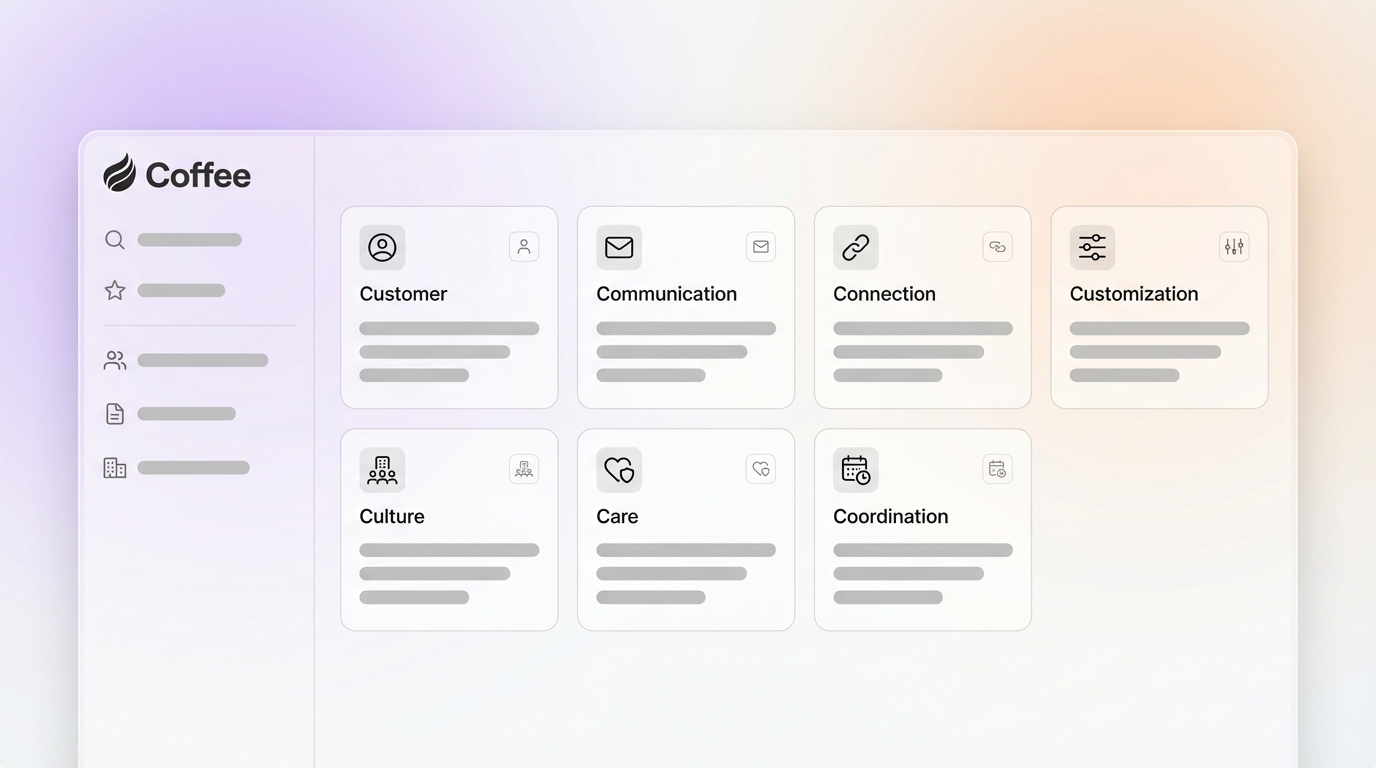
- Common variations of the 7 Cs create confusion, but the core framework includes Customer, Communication, Connection, Customization, Culture, Care, and Coordination.
- Coffee’s AI agent automates each of the 7 Cs, from data enrichment and communication logging to pipeline coordination, and removes manual tasks.
- Teams save 8-12 hours weekly with Coffee, turning CRMs from productivity drains into strategic assets with SOC 2 compliance.
- Implement the 7 Cs effectively in 2026 by getting started with Coffee so your team can focus on selling instead of data entry.
How 7 Cs Variations Confuse CRM Strategy
Search results for “7 Cs of CRM” show major inconsistency across authoritative sources. Some frameworks emphasize Culture and Context as foundations, while others prioritize Capability and Convenience for operational efficiency. This variation creates implementation challenges for sales teams that want a single, reliable approach to customer relationship management.
|
Variant Source |
Primary Focus |
Key Components |
Implementation Gap |
|
Traditional Marketing |
Customer-Centric |
Customer, Communication, Care |
Lacks automation strategy |
|
Operations-Focused |
Process Efficiency |
Coordination, Convenience, Cost |
Missing relationship depth |
|
Technology-Driven |
Data Integration |
Connection, Customization, Context |
Requires manual data entry |
|
Coffee Consensus |
AI-Automated |
All 7 Cs unified |
Eliminates manual gaps |
This fragmentation helps explain why 86% of companies using structured community programs see measurable improvement in customer retention and lifetime value. A unified, automated approach to the 7 Cs removes confusion and keeps execution consistent across every sales team.
The Core 7 Cs of CRM: A Unified Working Model
The consensus 7 Cs framework gives you a complete approach to customer relationship management that covers strategy and execution. Each component supports the others and creates a single system for customer success.
1. Customer
Customer-centricity sits at the core of effective CRM. Teams need clear insight into customer needs, preferences, and behaviors to deliver relevant experiences. Legacy CRMs fall short because manual data entry produces incomplete customer profiles. Coffee’s AI agent enriches customer records with job titles, funding data, and interaction history, so reps see a complete picture without extra work.

2. Communication
Consistent, timely communication deepens relationships. Strong communication depends on tracking every touchpoint and following up at the right moment. Traditional systems rely on reps to log calls and emails, which often results in missed opportunities. Coffee’s agent logs communications automatically, creates AI summaries, and drafts follow-up emails, so no interaction slips through the cracks.

3. Connection
Meaningful connections turn prospects into long-term customers. Teams need relationship context and interaction history across channels to build those connections. Manual systems scatter this data across tools and inboxes. Coffee’s agent unifies email, calendar, and call data into clear relationship timelines, giving reps full context for every conversation.
4. Customization
Tailored outreach improves conversion rates and customer satisfaction. Customization depends on understanding individual preferences and aligning with the right sales methodology. AI adoption has been linked to revenue growth rate increases of over 25% when teams implement it correctly. Coffee’s agent structures notes using BANT, MEDDIC, or SPICED, so qualification data enters the system consistently and supports personalized follow-up.
5. Culture
Team culture determines whether CRM processes actually stick. Culture includes shared customer-first values and consistent process execution. Poor CRM adoption pushes reps into “shadow CRMs” in spreadsheets and Notion. Coffee improves culture by turning the CRM into a helpful co-pilot instead of a reporting chore, which encourages adoption through automation instead of strict enforcement.
6. Care
Real care for customer outcomes sustains long-term relationships. Care shows up through proactive support, fast responses, and anticipation of customer needs. Manual systems make this difficult because data lives in silos. Coffee’s agent delivers “Today” briefings that prepare reps with customer context, so they can hold proactive, informed conversations that show genuine care.

7. Coordination
Cross-team coordination keeps customer experiences consistent. Coordination requires shared data, clear handoffs, and transparent pipeline visibility. Legacy CRMs often create chaos with manual updates and scattered reports. Coffee’s Pipeline Compare feature shows week-over-week changes automatically, so pipeline reviews shift from interrogation to focused strategic planning.
Putting the 7 Cs into Practice with Coffee in 2026
Coffee’s AI agent turns the 7 Cs framework into a working system by automating each component and removing the manual work that usually causes CRM projects to stall.
Step 1: Unify Customer Data – Coffee’s agent scans Google Workspace and Microsoft 365, auto-creates contacts and companies, and builds complete customer profiles without manual entry.

Step 2: Automate Communication Logging – The agent captures emails, calls, and meetings automatically, then builds detailed communication histories that guide future outreach.
Step 3: Establish Connection Context – AI briefings deliver relationship context before every interaction, so reps create stronger connections using full historical insight.
Step 4: Enable Dynamic Customization – The agent adapts to your sales methodology and customer preferences, and structures data with BANT, MEDDIC, or custom frameworks automatically.
Step 5: Build a Pro-CRM Culture – By removing manual data entry, Coffee shifts CRM culture from resistance to reliance and turns the platform into a trusted co-pilot.
Step 6: Show Proactive Customer Care – Automated summaries and follow-ups support timely, informed interactions that clearly reflect attention to customer needs.
Step 7: Coordinate Pipeline Intelligence – Pipeline Compare delivers automatic week-over-week analysis, so teams respond to pipeline changes together without manual reporting.
One company generating tens of millions in revenue previously managed sales in spreadsheets and struggled with visibility. After adopting Coffee’s agent, automated data entry and Pipeline Compare removed manual processes and gave leaders the depth they needed for strategic decisions. AI agents enable true omnichannel customer experience through unified orchestration with consistent CRM integration, which makes this type of transformation possible at scale.
Transform your 7 Cs implementation with Coffee to remove manual CRM maintenance and keep your team focused on strategic selling.
Why Coffee Outperforms Legacy CRMs on the 7 Cs
Coffee separates itself from legacy CRMs like Salesforce and HubSpot by acting as an active agent instead of a passive database. Traditional systems depend on manual data entry and constant upkeep, while Coffee’s AI agent handles the busywork so accurate data flows in and useful insights flow out.
Partial tools such as Clarify or Day.ai cover only narrow slices of CRM workflows. Coffee delivers broad automation across the full CRM lifecycle. The Standalone and Companion models support teams that want to replace legacy systems or enhance existing Salesforce and HubSpot setups.
Coffee’s SOC 2 Type 2 compliance and simple seat-based pricing reduce security concerns and complexity that often slow enterprise CRM rollouts. Teams typically save 8-12 hours per week on manual tasks, which directly addresses the productivity drain that turns many CRMs into administrative burdens instead of strategic systems.
Frequently Asked Questions
What are the 7 Cs of CRM?
The 7 Cs of CRM are Customer, Communication, Connection, Customization, Culture, Care, and Coordination. Together they create a complete approach to customer relationship management that supports retention and revenue growth. Coffee’s AI agent automates each component and removes the manual work that usually causes CRM initiatives to fail, while keeping implementation consistent across teams.
What is the 7 Cs framework?
The 7 Cs framework is a structured model for customer relationship management that covers both relationship-building and operational efficiency. Instead of focusing on a single element, the framework keeps all seven components working together in a coordinated way. Coffee brings this framework to life through AI automation so teams can use it daily instead of treating it as a theory.
What are the 7 Cs of communication in CRM?
Communication within the 7 Cs framework covers consistent, timely, and contextual interactions across every channel. Teams log all touchpoints, schedule follow-ups at the right time, and maintain a clear history for continuity. Coffee’s agent captures communications automatically, generates summaries, and drafts follow-ups so no interaction gets lost.
How do the 7 Cs of customer relationship management work together?
The 7 Cs form a connected system where each part supports the others. Customer insight shapes Communication, which builds Connections that enable Customization. A strong Culture supports this work and shows Care, while Coordination keeps teams aligned. Coffee’s AI agent keeps all seven elements in sync automatically and removes the silos that often appear in traditional CRM setups.
How does AI implement the 7 Cs framework?
AI implements the 7 Cs by automating data capture, analysis, and follow-up actions. Coffee’s agent enriches customer data, logs communications, provides connection context, tracks customization preferences, supports adoption culture, powers proactive care, and coordinates team activity without constant manual input. The framework becomes a live system that runs in the background instead of a static checklist.
Conclusion: Turn the 7 Cs into Daily Practice with Coffee
The 7 Cs of CRM framework delivers real value only when automation supports it instead of manual processes. Coffee’s AI agent converts this framework into a working system, which allows teams to spend far more time selling while still executing every component consistently.
Legacy CRMs struggle because they expect teams to maintain the very relationships those tools should manage. Coffee succeeds by acting as an autonomous agent that handles repetitive work, keeps data accurate, and surfaces actionable insights. Master the 7 Cs of CRM with AI automation and get started with Coffee to shift your team from data entry to strategic selling.