
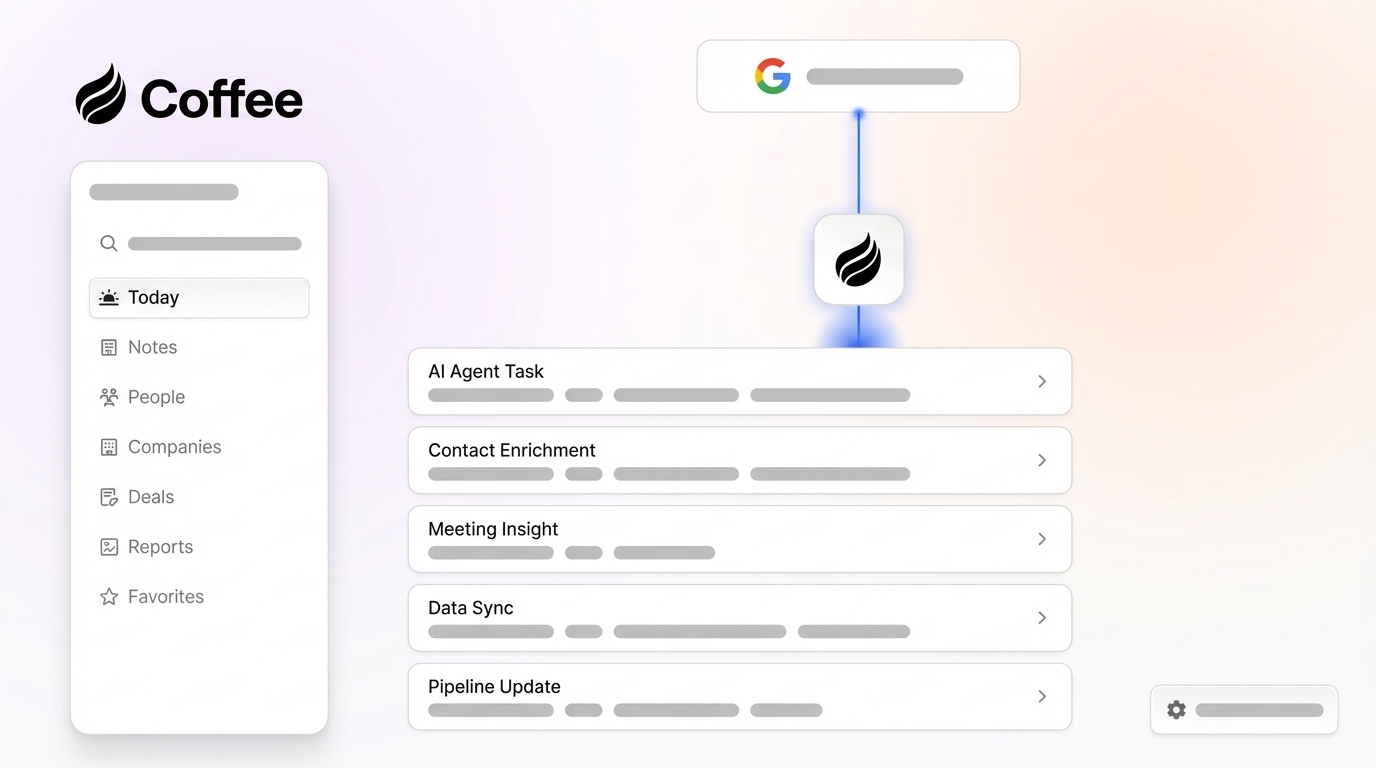
Executive summary:
- AI sales agents reduce manual data entry, fragmented workflows, and administrative overhead that slow down traditional CRM tools.
- Modern AI platforms unify data from email, calendars, calls, and external sources into a single, accurate view of the customer.
- AI agents automate routine tasks, coordinate workflows, and surface next-best actions so sales teams can focus on selling.
- Coffee connects with existing systems like Salesforce and HubSpot to provide real-time data sync, meeting intelligence, and pipeline insights.
- Organizations using AI agents see measurable gains in productivity, data quality, personalization, and pipeline predictability.
- Effective implementation depends on clear goals, clean data, thoughtful change management, and alignment with existing sales processes.
The AI-Powered Sales Revolution: Why AI Agents are Redefining Sales
Sales technology is shifting from static record-keeping to real-time, AI-supported workflows. Many legacy Customer Relationship Management systems were built on older architectures that no longer match current sales requirements.
The core limitations of traditional CRMs show up in daily work. Data is fragmented across multiple tools, and sales teams switch between platforms to complete basic tasks.
Common stacks include separate products for key activities, such as:
- HubSpot for CRM functionality
- ZoomInfo for prospect data
- SalesLoft for outreach sequences
- Fathom for call recording
This complex and expensive setup often adds friction instead of reducing it. Manual data entry continues to consume valuable time, with many sales reps spending a large share of their week on administrative work and only a minority of their hours on direct selling activities.
Architectural challenges in some legacy CRMs go beyond user experience. Older systems can struggle to integrate modern AI capabilities or to process certain types of data in a structured, intelligent way.
Coffee applies an AI-first architecture to address these challenges. Instead of layering AI on top of legacy foundations, Coffee uses artificial intelligence as a core operational component. This shifts CRM from reactive data storage to a proactive sales co-pilot that helps teams work from a unified view of customer data and streamlined workflows.
To see how AI agents work in a real sales environment, request access to Coffee.
Demystifying ‘How AI Agents for Sales Work’: Core Mechanics and Components
Understanding how AI agents for sales work starts with the technology that supports intelligent sales automation. These systems combine multiple components to create connected, adaptive workflows that improve how sales teams operate.
AI Foundations in Sales Automation
AI sales agents in platforms like Coffee rely on models that can process and interpret customer interactions. Coffee uses these capabilities to automate CRM workflows, support sales tasks, provide conversational intelligence for meetings, and surface insights for pipeline management and forecasting.
Data Ingestion & Unification: The Single Source of Truth
Effective AI sales agents depend on clean, comprehensive data. They gather and organize information from many sources to build a unified, real-time customer view.
Coffee begins by automatically ingesting data from key touchpoints, including:
- Email servers
- Calendar systems
- Call recordings
The platform then structures this information, removes duplicates, standardizes formats, and enriches records with additional context from licensed data providers. This unified dataset gives the AI agents the context they need for accurate automation and decision support.
Intelligent Task Automation & Workflow Orchestration
AI agents improve sales operations by handling routine tasks and coordinating processes across tools. Coffee automates activities such as:
- Creating and enriching contacts and companies
- Logging emails, meetings, and other activities
- Updating deal stages based on calendar and email interactions
These automations reduce manual effort for sales reps and create consistent workflows that support more reliable execution.
Predictive Insights & Decision Support: Becoming a Sales Co-Pilot
Coffee’s AI agents act as decision-support tools that guide sales representatives toward the most impactful actions. The platform analyzes activity patterns and pipeline movements, highlights meaningful changes, and recommends next steps to advance opportunities. Reps can then prioritize high-value accounts and focus attention where it is most likely to affect outcomes.
Seamless Integration: Connecting AI Sales Agents with Your CRM Workflow
Successful AI sales agent deployments integrate with current workflows while addressing the structural limitations of traditional CRM setups.
Overcoming Legacy CRM Limitations: AI as the Accelerator
AI agents address gaps in traditional CRMs by capturing more complete data and triggering timely actions. Where legacy systems often depend on manual entry, Coffee’s AI agents automatically capture and structure customer interactions from email, calendars, and meetings. This creates real-time visibility into customer activity and supports quicker, better-informed responses.
Real-Time Data Flow & Bi-Directional Synchronization
Coffee connects with existing Salesforce or HubSpot instances through simple authentication. This integration enables bi-directional data flow so that information stays accurate and current across systems. Teams can decide which enriched data and insights from Coffee are written back to their primary CRM, preserving a single source of truth across tools and processes.
Key Integration Points Transforming Sales Operations
Coffee focuses integration on high-impact areas that deliver immediate value.
Lead management and enrichment: As new prospects enter the system, Coffee automatically creates and enriches contact and company records, reducing manual data work for reps.
Meeting preparation and follow-up: Before calls, Coffee assembles briefings with attendee details and recent interactions. After meetings, the system generates summaries, action items, and draft follow-up emails that reps can review and send.
Pipeline management and reviews: Coffee offers visibility into sales performance with tools like the compare button for week-over-week pipeline reviews. Managers can quickly see which deals are new, progressing, stalled, or at risk without building manual reports.
Coffee: Your AI-First CRM & Sales AI Agent Co-Pilot
Coffee represents a shift from CRM as a reporting tool to CRM as an active assistant for sales teams. Built as an AI-first platform, Coffee illustrates how modern sales technology can support day-to-day execution in a practical way.
Elevating Sales with Coffee’s AI Agent Capabilities
Eliminate manual data entry: Coffee’s AI agents automatically create contacts, companies, and activities by analyzing email communications and calendar interactions. This can save representatives an estimated 8–12 hours per week, freeing more time for direct selling. Data enrichment features add details such as job titles and company information to improve record quality.
Automate pre- and post-meeting workflows: Coffee streamlines the sales meeting lifecycle. Before meetings, it provides briefings with attendee context and prior touchpoints. During meetings, an AI bot can join calls on Google Meet, Microsoft Teams, and Zoom to record and transcribe discussions. After meetings, Coffee generates summaries, highlights action items, and drafts follow-up emails for review and sending through Gmail, using formats such as BANT or MEDDIC when helpful.
Provide pipeline intelligence: Coffee’s compare feature, powered by a built-in data warehouse, delivers historical pipeline snapshots. Sales managers can review week-over-week changes, see which deals progressed or stalled, and identify new opportunities without building manual spreadsheets.
Consolidate your tech stack: By bringing CRM functionality, data enrichment, meeting intelligence, and pipeline analytics into one platform, Coffee reduces the number of separate tools teams depend on. This consolidation lowers complexity and can reduce overall software costs.
Create a CRM that reps adopt: Coffee prioritizes features that help sales representatives do their jobs more efficiently. By reducing administrative work and providing relevant insights, the platform functions as a practical co-pilot that supports day-to-day selling.
To explore Coffee’s AI agent capabilities in more depth, request access to the platform.
Measurable Impact: The Tangible Business Benefits of AI Sales Agents
Organizations that implement AI sales agents like Coffee report measurable improvements across key performance indicators, including efficiency, data quality, and sales effectiveness.
Boosted Sales Efficiency & Productivity
Coffee’s AI agents reduce administrative workloads by automating data capture and routine updates. Many teams see time savings of 8–12 hours per week per representative. That recovered time can be redirected to prospecting, relationship building, and advancing active deals.
Improved Data Quality & Actionable Insight
Coffee improves data quality by automatically capturing complete information from emails, calendars, and meetings. This consistent data foundation supports more accurate reporting, clearer pipeline visibility, and better-informed decision-making at both the rep and leadership levels.
Enhanced Personalization & Customer Experience
By analyzing interaction history, Coffee helps sales teams tailor outreach and conversations. Reps gain quick access to context and relevant talking points, which supports more personalized engagement and a more consistent customer experience across the sales cycle.
Accelerated Sales Cycles & Higher Conversion Rates
Automated follow-ups, timely reminders, and clearer pipeline insights help teams respond faster and keep deals moving. Organizations using Coffee often see shorter sales cycles and more predictable forecasting as the system collects more data and refines its insights.
Preparing for Implementation: Integrating AI Agents into Your Sales Team
Implementing AI agents with Coffee works best when supported by clear planning, defined metrics, and thoughtful change management.
Defining Integration Goals & Key Performance Indicators (KPIs)
Effective implementations begin with specific goals. Common metrics include time saved on administrative work, improvements in data completeness and accuracy, increases in sales activity volume, and changes in conversion rates. Establishing baselines before rollout makes it easier to quantify impact over time.
Strategic Selection: Choosing the Right AI Solution (Build vs. Buy)
For many small to mid-sized businesses, Coffee offers a practical alternative to building an in-house AI solution. The platform delivers proven functionality and integrations out of the box, reducing the need for dedicated internal AI expertise while still providing robust capabilities.
Change Management & Adoption Strategies for Success
Driving adoption requires positioning Coffee as a tool that supports, rather than replaces, existing sales roles. Training should highlight how Coffee reduces low-value tasks and provides useful insights that help reps close deals. Early success stories from within the team can encourage broader use and advocacy.
|
Feature/Attribute |
Legacy CRM Approach |
Coffee AI Agent Approach |
|
Data Entry |
Manual entry required for contacts, activities, and notes |
Automatic capture and enrichment from emails and meetings |
|
Data Unification |
Fragmented across multiple tools and systems |
Single source of truth with integrated data warehouse |
|
Task Automation |
Limited to basic workflow rules and notifications |
Intelligent automation based on context and interactions |
|
Insights & Forecasting |
Static reports requiring manual analysis |
Pipeline intelligence with historical comparison features |
|
User Experience |
Administrative burden reducing selling time |
AI co-pilot enhancing productivity and insights |
|
Tech Stack Consolidation |
Multiple specialized tools requiring integration |
Comprehensive platform reducing tool sprawl |
Navigating the Landscape: Avoiding Common AI Agent Integration Mistakes
Organizations implementing AI sales agents like Coffee can avoid common challenges with upfront planning and realistic expectations.
Misaligned expectations can create friction. Coffee enhances well-defined sales processes rather than replacing them, so teams benefit most when core workflows are already documented and consistent.
Underestimating data quality needs limits AI effectiveness. A data audit before deploying Coffee helps ensure that records are accurate, current, and standardized, reinforcing the principle that strong AI outcomes depend on strong underlying data.
Neglecting user adoption often leads to low utilization. Coffee delivers direct value to sales reps by reducing administrative work and supporting selling activities, so rollout plans should highlight these benefits and gather feedback early.
Siloed AI initiatives restrict impact. Coffee fits into the broader sales technology ecosystem, supporting smooth data flow and more unified customer experiences across marketing, sales, and customer success.
Frequently Asked Questions (FAQ) About AI Agents for Sales
How do AI sales agents compare to traditional CRM automation features?
AI sales agents in platforms like Coffee extend beyond rule-based automation. They can analyze unstructured data such as email content and call transcripts, identify patterns related to deal momentum, and suggest actions that simple workflow rules are not designed to provide.
Can AI agents for sales really eliminate manual data entry?
Coffee’s AI agents significantly reduce manual data entry by automatically creating and enriching contact and company records and logging activities from emails and calendars. Many teams see time savings of 8–12 hours per week per representative.
How do AI sales agents ensure data security and privacy?
Coffee maintains a strong security posture through programs that include SOC 2 Type 2 compliance and alignment with GDPR requirements. The platform uses encryption and access controls to protect customer data, and Coffee’s security policy specifies that customer data is not used to train AI models.
What kind of ROI can I expect from integrating AI sales agents?
Return on investment typically comes from productivity gains, higher data quality, and tool consolidation. Time savings of 8–12 hours per week per representative increase selling capacity, while consolidating multiple tools into Coffee can lower software and integration costs.
How quickly can we implement AI sales agents and see results?
Coffee is designed for relatively fast deployment. Core features become available within days of connecting email and calendar systems, delivering immediate benefits through automated data capture and meeting summaries. As the platform processes more data over 30–60 days, its insights and recommendations become more refined.
Conclusion: The Future of Sales is Intelligent and AI-Powered
Traditional CRM systems often act as productivity barriers by relying on manual processes and fragmented data. Architectures developed decades ago can struggle to meet the speed and integration requirements of modern sales teams.
AI agents for sales, as implemented in Coffee, offer a different approach. By automating routine tasks, unifying data sources, and providing contextual insights, Coffee helps sales organizations work more efficiently and manage their pipelines with greater clarity.
Coffee operates as an AI-first CRM that emphasizes sales representative productivity and practical automation. This focus supports adoption and helps teams build more consistent, data-driven sales motions.
The competitive landscape is moving toward AI-enabled sales operations. Adopting platforms like Coffee early can help organizations build durable advantages in how they manage customer relationships and revenue processes.
To evaluate how Coffee could support your sales pipeline with intelligent automation, request access to Coffee today.