

Last updated: February 1, 2026
Key Takeaways
- Coffee’s AI agent automates data entry, enrichment, and activity logging, saving sales reps 8–12 hours weekly compared to Pipedrive’s manual processes.
- Coffee excels in meeting orchestration with AI briefings, auto-join bots, and structured summaries using BANT/MEDDIC, surpassing Pipedrive’s basic tracking.
- Coffee’s pipeline intelligence tracks historical changes and analyzes unstructured data, providing deeper insights than Pipedrive’s visual kanban boards.
- Coffee consolidates tools for stack simplification and scales without limits, while Pipedrive requires integrations and faces plan constraints.
- Teams that want future-proof sales automation and more selling time choose Coffee; get started with Coffee to eliminate manual CRM tasks today.
How We Evaluated Coffee and Pipedrive for Modern SMB Sales Teams
Modern sales teams need CRMs that excel in six areas: labor automation for data entry and meeting management, data quality from unstructured data, user adoption, SMB scalability without extra complexity, integration depth, and pipeline intelligence for accurate forecasting.
These criteria reflect that 81% of sales leaders expect AI automation to cut administrative work, so automation now separates legacy systems from modern platforms. Pipedrive stands out for visual pipeline management, while Coffee’s AI agent architecture delivers stronger automation across these evaluation dimensions.
Data Entry & Enrichment: Coffee’s Auto-Capture vs Pipedrive’s Manual Work
Growing teams that move from spreadsheets to a CRM feel the data entry burden immediately. Traditional platforms demand manual contact creation, company details, and activity logging for every interaction.
|
Feature |
Coffee |
Pipedrive |
Winner |
|
Data Input |
AI auto-scans email/calendar, enriches via partners |
Manual entry/forms, basic automations (50 limit in Growth) |
Coffee |
|
Time Savings |
8–12 hrs/week/rep |
Relies on manual entry workflows |
Coffee |
|
Data Quality |
Agent unifies structured/unstructured data |
Relational database, limited history |
Coffee |
Coffee’s agent connects to Google Workspace or Microsoft 365, then automatically creates contacts and companies by scanning existing communications. The agent enriches records with job titles, funding data, and LinkedIn profiles through licensed data partners, which removes the need for separate enrichment tools like ZoomInfo.

Pipedrive relies on manual data entry through forms and templates. While workflow automation supports triggers and follow-up rules, humans still carry the main responsibility for data completeness and accuracy. The Growth plan caps automations at 50 workflows, which creates scalability issues for expanding teams.
Meeting Orchestration & Activity Logging: AI Assistant vs Basic Tracking
Meeting workflows offer one of the fastest payoffs from automation. Coffee’s agent acts as a full meeting assistant, while Pipedrive centers on activity tracking and basic logging.

|
Feature |
Coffee |
Pipedrive |
Winner |
|
Pre/Post-Meeting |
AI briefings, summaries, follow-ups (BANT/MEDDIC) |
Manual activity logging, Pulse AI summaries (Pro tier) |
Coffee |
|
Bot Integration |
Joins Zoom/Teams automatically |
Automatic call logging via mobile/email sync |
Coffee |
|
Sales Methodology |
Structured qualification (BANT, MEDDIC, SPICED) |
Custom fields for methodology tracking |
Coffee |
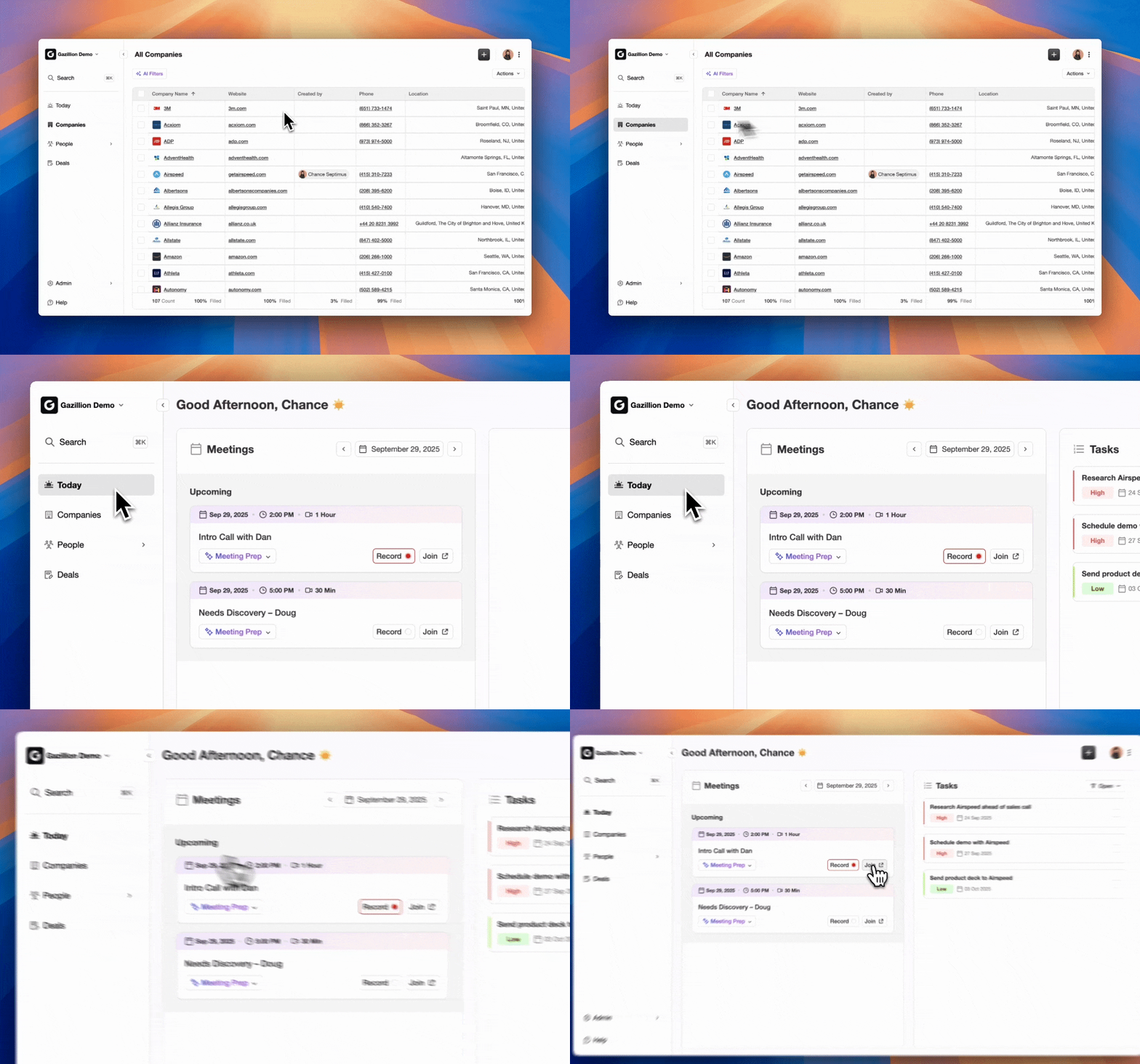
Coffee’s agent prepares meeting briefings with attendee context and past interactions, then joins video calls automatically for recording and transcription. After the call, the agent generates structured summaries, next steps, and follow-up emails, applying BANT or MEDDIC consistently across every conversation.

Pipedrive’s AI focuses on sales productivity through Pulse AI, including deal summaries and email assistance, with automatic call logging via the mobile app and email sync. The platform tracks daily activities such as meetings and calls effectively and helps managers spot activity gaps, but it does not provide autonomous meeting orchestration.
Pipeline Management & Intelligence: Agent Insights vs Static Visual Boards
Pipeline visualization and intelligence now separate modern CRMs from basic activity trackers. Pipedrive emphasizes clear visual pipelines, while Coffee emphasizes historical intelligence and pattern recognition.
|
Feature |
Coffee |
Pipedrive |
Winner |
|
Pipeline Tracking |
“Compare” visualizes historical changes and stalls |
Drag-and-drop kanban with stage metrics |
Coffee |
|
Historical Data |
Data warehouse preserves all changes |
Relational database, limited history |
Coffee |
|
Intelligence |
Unstructured data analysis, List Builder |
Pulse prioritization, basic analytics |
Coffee |

Pipedrive delivers strong sales pipeline visualization with intuitive drag-and-drop kanban boards that many reps enjoy for daily deal management. The platform surfaces instant pipeline metrics and conversion tracking that help teams spot bottlenecks.
Coffee’s “Compare” feature changes pipeline reviews by tracking week-over-week changes automatically. Leaders see which deals progressed, which stalled, and which appeared recently. Because the agent stores every interaction in a data warehouse, teams keep full historical context instead of losing it when relational database fields overwrite older values.
Teams can shift pipeline reviews from interrogation sessions to strategic discussions. Get started with Coffee to bring automated intelligence into every pipeline review.
Tool Stack, Scalability & Ownership: Unified Agent vs Add-On Ecosystem
Technology stack complexity affects adoption and total cost of ownership directly. Coffee consolidates several tools into one agent, while Pipedrive often needs extra integrations for full coverage.
Coffee replaces separate products for data enrichment, call recording, meeting intelligence, and forecasting through its unified agent architecture. Teams can deploy Coffee with zero setup as a primary CRM for SMBs or run it as a Companion App that feeds Salesforce or HubSpot, so the platform adapts to existing workflows.
Pipedrive’s add-on strategy typically requires external tools for enrichment, advanced analytics, and conversation intelligence. The 2025 plan changes introduced limits such as 500 custom fields and 25 teams per company in the Ultimate tier, which raises scalability concerns for fast-growing organizations.
Adoption patterns highlight the labor gap clearly. Coffee’s agent needs no training or manual setup, while Pipedrive’s manual workflows often push teams toward shadow CRMs, where real work happens in spreadsheets and Notion instead of the official system.
Decision Matrix: When Coffee Wins vs When Pipedrive Fits
Teams should choose their CRM based on primary needs and growth expectations.
|
If You Need… |
Choose Coffee |
Choose Pipedrive |
|
AI automation, minimal manual entry |
✅ Agent handles data tasks end to end |
❌ Manual-first approach |
|
Visual activity pipeline management |
✅ Agent-enhanced pipeline intelligence |
✅ Strong visual interface |
|
SMB scalability with historical data |
✅ Data warehouse architecture |
❌ Relational database limitations |
|
Stack consolidation |
✅ Replaces multiple tools |
❌ Requires integrations |
Coffee fits teams that prioritize automation and reliable data quality. Pipedrive fits teams that accept manual processes and place visual pipeline management above operational efficiency.
Frequently Asked Questions
What is the easiest CRM to use?
Coffee’s AI agent makes CRM management feel effortless through automatic setup and data handling, which removes most training overhead. The agent creates contacts, logs activities, and updates the pipeline autonomously, so sales reps spend time selling instead of administering a system. Pipedrive offers a friendly visual interface, yet it still depends on manual data entry and workflow configuration that can slow busy teams.
Is Pipedrive having issues or closing?
Pipedrive remains active but introduced major plan changes in 2025, including new usage limits and pricing updates that concern some customers. The company continues to invest in AI features and integrations, which signals a long-term roadmap. Limits such as 500 custom fields in premium tiers mark a shift away from earlier unlimited options. Coffee’s AI-native design gives teams a more agile alternative if they want modern automation without legacy constraints.
How do Coffee and Pipedrive compare for sales automation?
Coffee delivers end-to-end sales automation through its AI agent, which manages data entry, meeting orchestration, and pipeline intelligence automatically. The agent saves 8–12 hours per rep each week by removing manual CRM work. Pipedrive supports workflow automation for tasks like stage updates and email templates, along with email and call sync and AI tools, but still relies on humans for complete and accurate data. Coffee extends automation into unstructured data processing and historical analysis, which goes beyond Pipedrive’s current capabilities.
Does Coffee integrate with existing tools and meet security standards?
Coffee connects to existing systems through Zapier, with deeper native integrations on the roadmap, and maintains SOC 2 Type 2 compliance and GDPR alignment. The platform delivers enrichment quality comparable to leading data tools while ensuring customer data never trains public AI models. Coffee’s Companion App mode plugs into Salesforce or HubSpot, so teams gain AI automation without replacing their current system of record.
Which platform scales better for growing sales teams?
Coffee’s agent architecture scales smoothly as teams grow, handling higher data volume and complexity without extra configuration. The data warehouse preserves full historical context, which supports advanced analytics and forecasting as organizations mature. Pipedrive’s recent plan limits and manual workflows create friction for scaling, especially for teams that need heavy customization or deep historical analysis. Coffee’s unified approach reduces the tool sprawl that usually appears as sales teams expand.
Conclusion: Why Coffee Delivers Future-Proof Sales Operations
The Coffee vs Pipedrive choice reflects how your team wants to run sales operations. Pipedrive suits teams that accept manual work and focus on visual pipeline management with basic activity tracking. Coffee removes the administrative burden that consumes 66% of rep time, so teams can focus on strategic selling and relationship building.
A company generating tens of millions in revenue from custom AI solutions illustrates Coffee’s impact clearly. The team rejected Salesforce and HubSpot because of manual overhead, then adopted Coffee’s agent for automated data capture, actionable pipeline insights, and smooth team onboarding. The agent now operates as an extension of their sales process instead of another administrative system.
Teams that want to maximize selling time, protect data quality, and scale efficiently gain the most from Coffee’s AI agent. Pipedrive still plays a role for visual pipeline management, but Coffee tackles the core labor problem that limits sales productivity.
Teams ready to shift reps from data entry to strategic selling can get started with Coffee and experience autonomous CRM management in practice.