
This guide compares leading CRM automation vendors in 2026 and explains how AI-first platforms such as Coffee address common CRM challenges.
- More than 65% of businesses are adopting CRM platforms with generative AI in 2026, shifting expectations from simple workflows to intelligent automation that reduces manual work.
- Legacy CRMs often create productivity drains through manual data entry, fragmented tools, and low user adoption, which limits the impact of sales teams.
- Effective vendor evaluation now centers on AI-native automation, data quality, integration, user experience, real-time pipeline intelligence, scalability, and overall value.
- Coffee, Salesforce, HubSpot, and Pipedrive each serve different segments, but AI-first designs provide clearer gains in automation, usability, and data completeness.
- Coffee offers automatic data capture, meeting intelligence, and pipeline analysis that help small and mid-sized teams save time and improve forecasting accuracy.
The Flaws of Legacy CRM Automation in 2026: Why Businesses Are Still Struggling
Many organizations still face core CRM challenges that limit productivity and revenue growth. Understanding these issues helps clarify what to look for in a CRM automation vendor in 2026.
The Manual Data Entry Burden
The most persistent challenge with legacy CRM systems is continued reliance on manual data input. Sales representatives are expected to log notes, update opportunity fields, and copy emails after every customer interaction.
This burden is substantial. Seventy-one percent of sales reps report spending too much time on data entry, with only about 35% of their work hours devoted to actual selling activities.
This requirement creates a series of problems. Excessive manual data entry and work-intensive interfaces are leading causes of CRM failure, as representatives resist using systems that feel more like administrative burdens than sales tools. The result is incomplete, outdated information that undermines the value of the CRM.
Request access to see how AI-first automation can eliminate this productivity drain and free your team to focus on what matters most: selling.
Fragmented Data & Disjointed Workflows
Many sales teams manage a complex mix of disconnected tools. A typical setup might use HubSpot for basic CRM, ZoomInfo or Clearbit for data enrichment, SalesLoft for outreach sequences, and Fathom for call recording.
Each tool maintains its own data repository, which creates silos and prevents a unified view of customer relationships. Integration problems often result in data silos and inefficient workflows, forcing sales representatives to manually combine information from multiple sources.
This fragmentation wastes time and increases the risk of errors and inconsistencies that can hurt customer relationships and sales outcomes. The financial impact grows as organizations pay for overlapping point solutions that duplicate functionality yet still do not provide a cohesive workflow.
The complexity of managing integrations, maintaining data sync, and training team members across multiple platforms becomes a significant operational burden.
Outdated System Architectures
Many leading CRM platforms were built on architectures that predate the AI era. Salesforce, for example, was founded more than 25 years ago. Despite ongoing updates and modern interface improvements, some users find its underlying data model challenging for real-time, AI-driven requirements.
These systems typically rely on relational databases that overwrite historical data when fields are updated. This makes accurate pipeline intelligence and historical analysis difficult without extra configuration and tooling.
Many CRMs are now over-engineered, too complex, expensive, and hard to deploy, which creates implementation bottlenecks that slow business agility. Legacy architectures can struggle to incorporate generative AI or handle unstructured data such as email text and call transcripts in a meaningful way, limiting their ability to deliver proactive insights for sales teams.
Low User Adoption & Poor User Experience
The combination of manual data entry, fragmented workflows, and dated interfaces often results in low user adoption. User resistance and lack of adequate training decrease productivity and reduce the return on CRM investments. Many sales representatives view their CRM as a reporting system for management rather than a tool that helps them sell.
This resistance creates a cycle. Poor adoption leads to incomplete data, which makes the system less useful and further discourages usage. In many organizations, sales teams keep “shadow CRMs” in tools like Notion, Evernote, or spreadsheets where the real work happens, which undermines the investment in the official CRM platform.
Essential Evaluation Criteria for CRM Automation Vendors in 2026
Clear evaluation criteria help ensure that a CRM automation vendor solves real business problems instead of simply checking feature boxes. The factors below reflect key priorities for modern sales organizations.
True Automation & AI-Native Capabilities
The difference between traditional rule-based automation and AI-native capabilities is significant. Legacy systems often rely on “if-then” workflows, while modern platforms use generative AI to perform more complex tasks.
Generative AI is a leading CRM trend in 2026, extending beyond simple automation into predictive analytics, intelligent content generation, and dynamic decision-making.
Look for platforms that can automatically capture and enrich data from natural business activities such as emails and calendar events. Useful capabilities include intelligent meeting summaries, personalized follow-up content, and proactive insights about pipeline health and customer engagement patterns.
Comprehensive Data Unification & Quality
Data quality remains a major challenge across the CRM landscape. Thirty-seven percent of CRM users report losing revenue due to poor data quality, which makes this a critical evaluation criterion.
In many deployments, 76% of users say that less than half of their CRM data is accurate and complete. This level of inaccuracy weakens forecasting, reporting, and customer outreach.
The best solutions automatically ingest, cleanse, and structure data from all customer touchpoints to create a single source of truth without heavy manual work. Evaluate how effectively each platform captures unstructured data from emails, calls, and meetings, then turns it into actionable insights.
The ability to maintain historical data while still providing real-time updates is essential for accurate forecasting and pipeline analysis.
Integration Quality & Tech Stack Consolidation
Modern CRM platforms should reduce, not expand, tool sprawl. The strongest vendors provide broad functionality that can replace multiple point solutions for data enrichment, call recording, email automation, and pipeline forecasting.
Integration with other business tools is particularly challenging for SMBs and often leads to workflow misalignment. When integration is necessary, look for solutions that offer reliable, bi-directional sync without complex technical work or heavy ongoing maintenance.
User-Centric Design & High Adoption Potential
A feature-rich CRM has limited value if the team will not use it. Focus on platforms designed around the needs of sales representatives, with interfaces and workflows that support their daily work.
The system should be intuitive, provide clear benefits without extensive training, and help individuals and teams collaborate effectively. Using the CRM should feel like working with an intelligent co-pilot, not completing administrative tasks solely for reporting.
Real-time Pipeline Intelligence & Forecasting
Traditional CRM reporting often relies on manual data exports and spreadsheet analysis to understand pipeline changes and trends. Modern platforms should deliver real-time insights into pipeline health, deal progression, and forecast accuracy.
Look for features that automatically track and highlight changes in deal status, identify stalled opportunities, and generate predictive insights about future revenue based on historical patterns and current activity.
Scalability & Flexibility for Evolving Needs
Business agility in 2026 depends on removing implementation bottlenecks and making CRM customization accessible without heavy IT involvement. The right platform should grow with your business and support change without major disruption.
Consider current needs and likely future scenarios. The solution should adapt to larger teams, more complex sales processes, and new integration requirements without requiring a complete system replacement.
Total Value of Ownership (Beyond Initial Costs)
The real cost of a CRM includes more than license fees. Implementation complexity, training, ongoing maintenance, and the efficiency gains or losses all contribute to total value.
Insufficient budget for implementation, integrations, and support often undermines CRM success. When comparing vendors, consider how quickly the platform delivers value, whether it reduces the need for additional tools, and how it affects sales team productivity.
Strong solutions provide rapid time to value with limited ongoing overhead.
Head-to-Head: Top-Rated CRM Automation Vendors of 2026
Based on these evaluation criteria, the following comparison outlines how leading CRM automation vendors perform in 2026. Each platform has distinct strengths and target customers, but clear differences emerge when focusing on automation depth and user experience.
Coffee: AI-First Co-Pilot for Sales Teams
Coffee represents a newer generation of AI-first CRM automation platforms, built to address core limitations of legacy systems. Instead of adding AI to an existing architecture, Coffee uses artificial intelligence as a central design element.
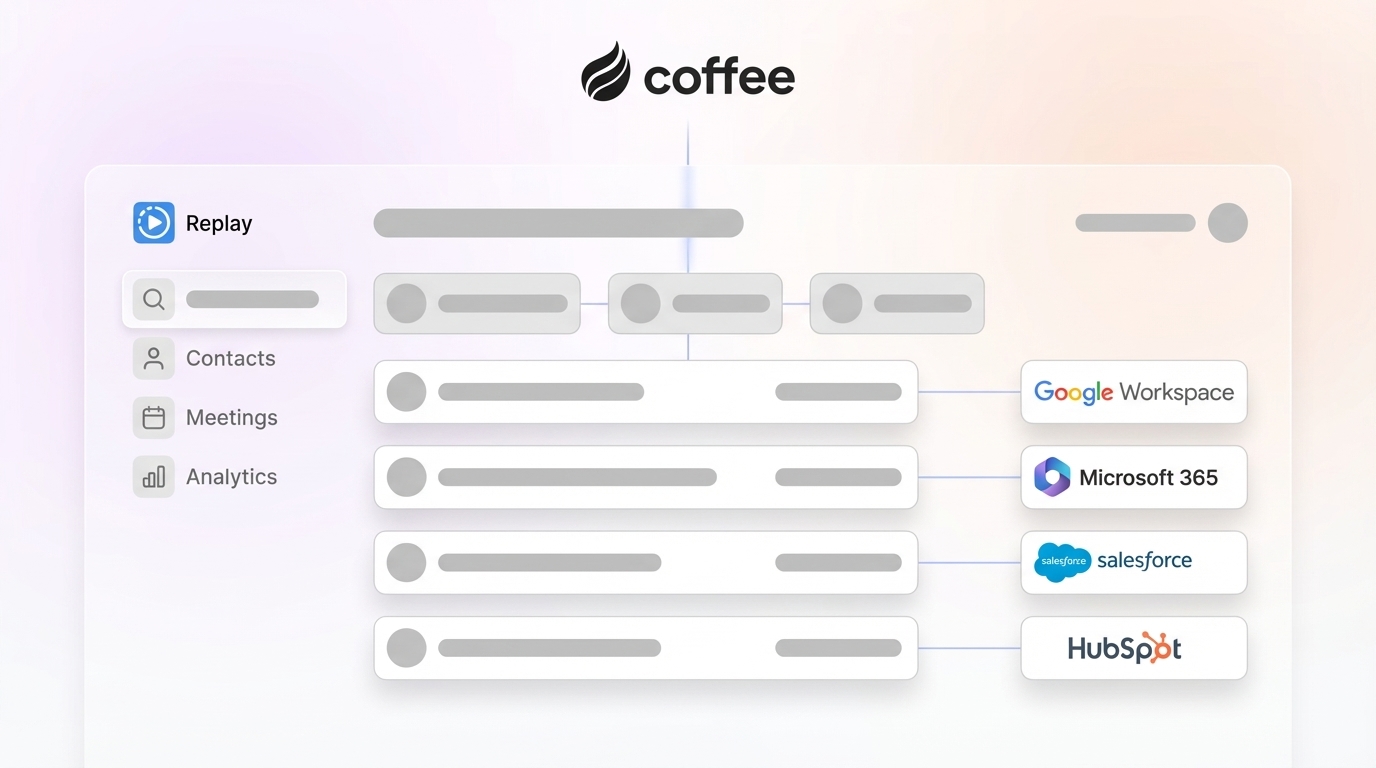
Key strengths: Coffee’s automatic data entry and enrichment capabilities reduce the manual input burden common in traditional systems. After connecting Google Workspace or Microsoft 365, the platform auto-creates contacts and companies from emails and calendar interactions, and enriches records with information from licensed data partners. This can reduce or remove the need for separate enrichment tools such as ZoomInfo or Apollo.
The AI-powered meeting management features act like a sales assistant. The system provides pre-meeting briefings with attendee information and interaction history, then generates summaries, action items, and draft follow-up emails after meetings. The Pipeline Compare feature uses a built-in data warehouse to provide week-over-week pipeline analysis with one view, highlighting deal progressions, new opportunities, and stalled prospects without manual spreadsheet work.
Ideal for: Small to mid-sized companies that want a modern alternative to traditional CRMs, and organizations with existing Salesforce or HubSpot installations that struggle with data quality and user adoption. Coffee is well suited to founders, heads of sales, and RevOps professionals who prioritize efficiency and want a CRM that sales reps are willing to use consistently.
Request access to see how Coffee changes CRM from a data entry task into an intelligent sales co-pilot.
Salesforce: The Enterprise Powerhouse
Salesforce remains a major platform in enterprise CRM, with extensive customization options and a broad integration ecosystem through its AppExchange marketplace. For large organizations with complex requirements and dedicated IT resources, Salesforce can support highly tailored sales processes.
Key strengths: Market presence, a comprehensive feature set, a wide integration ecosystem, and a customizable architecture for complex enterprise needs. The platform can be configured to support many sales processes and business models, with detailed reporting and analytics.
Challenges and considerations: Some advanced AI-driven features require additional configurations or add-ons. Implementation can be complex, often needing substantial technical expertise and longer deployment timelines. Overloaded systems with too many irrelevant fields reduce usability and worsen data quality, and manual data entry remains a frequent issue even with automation options.
Ideal for: Large enterprises with specific, complex requirements and dedicated CRM administration teams that can manage the platform’s depth and customization.
HubSpot: The Marketing-Centric Growth Platform
HubSpot began as an inbound marketing platform and later expanded into CRM functionality. This background shapes its strong marketing automation features and user-friendly interface for basic CRM work. It is popular among businesses that want tight alignment between marketing and sales.
Key strengths: Robust marketing automation, an intuitive interface for core CRM tasks, strong connections between marketing and sales activities, and a freemium model that allows companies to start small and expand over time.
Challenges and considerations: The CRM capabilities can feel added on rather than fully unified, because the platform originated as a marketing tool rather than a complete CRM. Modern solutions emphasize automated data cleaning, reliable integrations, and AI-powered features to stay competitive. HubSpot’s AI for sales automation may lag behind AI-first platforms focused primarily on sales workflows.
Ideal for: Small to medium businesses with a strong inbound marketing focus that want an integrated solution connecting marketing campaigns directly to sales outcomes.
Pipedrive: The Sales Pipeline Visualizer
Pipedrive built its reputation on visual pipeline management and deal tracking. The platform helps sales teams see their deal flow clearly and track opportunities through customizable sales stages.
Key strengths: Highly visual and intuitive pipeline management, straightforward setup, a strong focus on deal tracking and process visualization, and relatively accessible pricing for growing teams.
Challenges and considerations: While strong in pipeline visualization, its automation and AI capabilities are less extensive than those of AI-first platforms. Growing demand for CRMs that minimize manual data input through seamless data capture and AI-powered workflows may lead Pipedrive users to add extra tools for enrichment and advanced automation.
Ideal for: Smaller sales teams that prioritize visual pipeline management and straightforward deal tracking, especially those moving away from spreadsheet-based sales management.
Comparison Table: Top CRM Automation Vendors for 2026
|
Feature / Criterion |
Coffee |
Salesforce |
HubSpot |
Pipedrive |
|
AI-native automation |
Built-in AI for automatic data entry, meeting insights, summaries, and pipeline intelligence |
Some advanced AI features require add-ons or complex configurations |
Basic AI, stronger in marketing automation than sales automation |
Limited native AI automation, primarily rule-based workflows |
|
Data unification and quality |
Automatic data capture and enrichment from email and calendar, built-in data warehouse for historical data |
Often relies on manual entry, data silos are common without extensive customization |
Effective for structured inbound data, can fragment without careful management |
Primarily manual data entry, enrichment usually needs third-party integration |
|
User experience and adoption |
Intuitive and designed for rep productivity, functions as a co-pilot |
Steep learning curve, often perceived as a management reporting tool |
User-friendly for basic use, can become complex as usage scales |
Visual pipeline focus, generally accessible for basic rep usage |
|
Tech stack consolidation |
Replaces several tools natively, including enrichment, call recording, and forecasting |
May require integrations and add-ons for some advanced functions |
Needs integrations for a full sales stack, with a marketing-centric core |
Often requires integrations for broader sales functionality beyond core CRM |
How Coffee’s AI-First Approach Supports Sales Teams in 2026
Many legacy CRM vendors continue to struggle with manual data entry, fragmented workflows, and limited usability. Coffee offers an alternative approach built for how modern sales teams operate.
The platform’s AI-first design delivers value quickly. Sales representatives can save an estimated 8 to 12 hours per week on manual data entry through automatic contact creation and enrichment. The built-in data warehouse supports the Pipeline Compare feature, which gives instant visibility into week-over-week pipeline changes with a single view.
Coffee’s dual-model strategy addresses different organizational needs. The Standalone CRM serves small to mid-sized companies seeking a full alternative to legacy systems. The Companion App allows organizations to enhance existing Salesforce or HubSpot instances without a full replacement, giving access to AI-driven automation while keeping the current system of record.
A company with tens of millions in revenue that builds custom AI solutions for Fortune 500 clients chose Coffee after evaluating Salesforce, HubSpot, and other competitors. Key reasons included intuitive usability, automatic contact creation from Google Workspace without spam contacts, simple weekly pipeline reviews through Pipeline Compare, and API access for custom automation.
Ninety-four percent of companies report higher sales productivity with CRM adoption, especially when routine tasks are automated. The decision for most teams is no longer whether to automate sales processes, but which platform provides the most effective automation with the least operational overhead.
Coffee’s focus on being a CRM that sales reps choose to use, rather than a system they update only for reporting, supports a positive cycle of adoption, data quality, and sales effectiveness that many traditional platforms find difficult to match.
Request access to see how Coffee can improve your sales operations and reduce the productivity losses associated with legacy CRM systems.
Frequently Asked Questions About CRM Automation Vendors in 2026
Why is poor data quality still a major issue for CRM automation in 2026?
Data quality remains difficult because most CRM systems still depend on manual entry. When sales representatives must type in contact details, meeting notes, and opportunity updates, human error and incomplete records are likely.
Many legacy systems also use relational databases that overwrite historical values when records change, which makes it hard to track how deals evolve over time. AI-first platforms like Coffee address this by automatically capturing data from emails, calendars, and call transcripts, then storing it in a way that preserves history and reduces manual input.
How do AI-first CRM automation vendors differ from traditional CRM automation?
Traditional CRM automation usually means rule-based workflows that follow basic “if-then” logic, such as sending an email when a deal reaches a certain stage. AI-first automation goes further by using machine learning and generative AI to interpret data and perform more complex tasks.
AI-first systems can extract insights from unstructured data such as email threads or call notes, generate summaries and follow-up content, and surface pipeline intelligence. Instead of only speeding up manual tasks, these platforms reduce the amount of manual work required in the first place.
Can Coffee integrate with my existing Salesforce or HubSpot CRM setup?
Coffee offers a Companion App that connects to existing Salesforce or HubSpot instances. The integration uses a straightforward authentication process that syncs current CRM data into Coffee’s AI-powered environment.
Once connected, teams can use Coffee’s features such as automatic data entry and enrichment, AI-powered meeting management, pipeline intelligence, and consolidated analytics. Organizations can choose which enriched data and insights to write back to Salesforce or HubSpot, creating a workflow that enhances existing investments without replacing them immediately.
What specific benefits do small to mid-sized businesses gain from AI-first CRM automation like Coffee?
Small to mid-sized businesses often have limited IT resources, careful budgets, and lean teams where every hour matters. Traditional CRMs can be complex to implement and maintain under these constraints.
AI-first platforms like Coffee reduce manual work, consolidate multiple tools, and provide insights without dedicated IT support. Automatic data capture and enrichment help growing teams maintain accurate records without adding administrative headcount. Built-in pipeline intelligence supports better planning, and an intuitive interface encourages high adoption with minimal training.
Is Coffee suitable for a company that has outgrown spreadsheets but finds traditional CRMs too cumbersome?
Coffee’s Standalone AI-first CRM is designed for companies in this situation. Many growing businesses find that spreadsheets and basic contact tools no longer scale, yet enterprise CRMs feel too complex and expensive.
Coffee bridges this gap by offering automation and AI-driven insights in a focused, accessible package. The platform emphasizes quick setup, features that help sales representatives directly, and natural scaling as teams expand. Organizations can move from manual processes to AI-supported sales management without the typical implementation challenges of large legacy systems.
Conclusion: Making the Smart Choice for CRM Automation in 2026
The 2026 CRM automation landscape presents strong opportunities alongside clear trade-offs. Legacy platforms continue to face recurring issues such as manual data entry, fragmented workflows, low user adoption, and aging architectures. AI-first platforms are redefining how customer relationship data is captured, managed, and used.
The CRM choice you make now will influence how much time your sales team spends selling instead of updating systems, whether your customer data becomes an asset or a liability, and how effectively your CRM investment supports growth. Organizations that adopt AI-first automation often see gains in efficiency and sales effectiveness.
Coffee stands out as a rethinking of CRM for modern teams. By reducing manual data entry, providing pipeline intelligence, consolidating scattered tools, and offering a system that sales representatives are more willing to use, Coffee addresses several long-standing barriers to CRM success.
The future of sales favors teams that use artificial intelligence to focus on relationships, customer understanding, and closing deals. Legacy systems may continue to place more emphasis on administrative updates, while AI-first platforms aim to shift effort toward higher-value activities.
Outdated CRM practices can hold sales teams back in 2026, but AI-first options offer practical alternatives. Request access to Coffee today to explore AI-powered CRM automation and evaluate whether it fits your sales operations.