
Executive summary
- Legacy CRMs demand heavy manual data entry, which reduces selling time and contributes to poor data quality. Poor data quality and management remain top CRM data-related pain points in 2025, especially for teams juggling multiple tools.
- AI-powered CRM agents automate contact creation, data enrichment, meeting prep, and follow-up so sales reps can focus on conversations and closing deals.
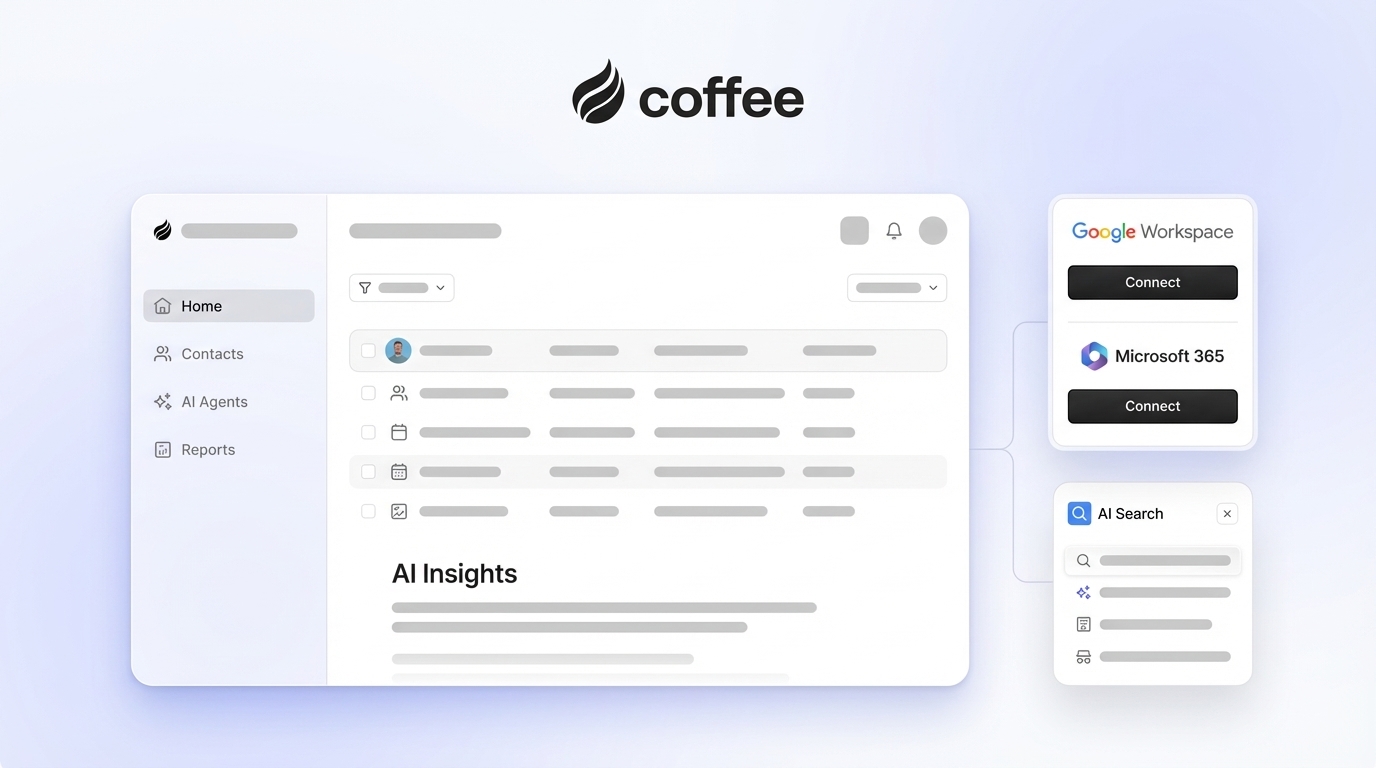
- Coffee is an autonomous AI CRM agent that connects to Google Workspace or Microsoft 365, unifies activity data, and keeps pipelines accurate with minimal manual work.
- Sales teams can reclaim 8–12 hours per rep per week, improve forecast reliability, reduce tech stack costs, and increase CRM adoption when they deploy an AI CRM agent.
- Clear metrics, leadership support, training, and a staged rollout help organizations implement AI CRM agents successfully and address common concerns about change and security.
The Problem: Why Legacy CRMs Are Hurting Sales Performance
The Cost of Manual Data Entry
Modern sales teams lose significant time to administrative work. Reps often spend the majority of their week updating contacts, logging activities, and maintaining pipeline accuracy across fragmented systems instead of speaking with prospects.
This manual data burden does more than waste time. When sales teams struggle to keep CRM details current, several problems show up quickly:
- Data silos: Information spreads across email, calendars, separate tools, and CRM records, which makes it difficult to see a complete picture of each prospect or customer.
- Poor user adoption: Reps view CRM systems as extra work rather than helpful tools, so they update records inconsistently and skip non-essential fields.
- Inaccurate forecasting: Incomplete or outdated data leads to unreliable forecasts, which complicates planning and affects revenue projections.
- Lost revenue opportunities: Follow-ups get missed, meeting notes stay in personal docs, and key interactions never make it into the system of record.
The Need for AI-Powered CRM Solutions
Traditional CRM systems assume that busy sales professionals will enter detailed, accurate data after every interaction. That assumption rarely holds up in real-world conditions. The result is a cycle where poor data quality leads to weak insights and low trust in the system, which further reduces usage.
AI-powered CRM agents change this model by shifting from passive data storage to active data management. Instead of requiring humans to serve the software, these agents capture and organize data in the background. The CRM becomes a reliable source of insight that supports revenue growth instead of a tool that simply tracks activity.
Introducing Coffee: Your Autonomous AI CRM Agent
Coffee is an AI-powered CRM agent built to handle the data entry and workflow tasks that slow sales teams down. Traditional software tends to act as a passive container for information. Coffee acts as an active agent that automates the work of putting good data in, capturing tasks, integrating data streams, and logging interactions so teams get better insights and forecasts out.
Coffee removes the need for reps to act as data entry clerks. The agent manages data unification, task automation, and note-taking. This agent-led model extends across workflow automation, sales assistance, conversational intelligence, revenue orchestration, and pipeline management.

Key Features of Coffee’s AI CRM Agent
Automatic data entry and enrichment: Once connected to Google Workspace or Microsoft 365, the Coffee agent begins auto-creating contacts and companies by scanning emails and calendars. It enriches records with job titles, funding information, and LinkedIn profiles through licensed data partners, which removes the need for separate enrichment tools.

AI-powered meeting management: Coffee acts as a pre- and post-meeting assistant. Reps see a “Today” page with attendee backgrounds, previous interaction history, and relevant context. After each meeting, the agent generates summaries, action items, and draft follow-up emails for review and sending. It can organize notes using sales methodologies such as BANT, MEDDIC, or SPICED.



Pipeline intelligence and Compare feature: The agent stores interaction history in a built-in data warehouse. It can then surface week-over-week pipeline changes, highlighting progressed deals, stalled opportunities, and new additions. Pipeline reviews shift from manual status checks to focused conversations about what will move deals forward.
Sales teams that want to see these capabilities in practice can explore Coffee in their own environment. Request access to see how an AI CRM agent can support your sales process.
7 Quantifiable Benefits of AI-Powered CRM Agents for Sales Teams
1. Maximize Selling Time: Reclaim 8–12 Hours Per Rep Per Week with Automated Data Entry
AI-powered CRM agents reduce time spent on manual data entry. Agents automatically capture contacts, meetings, and activities from email and calendar data. Reps do not need to retype information or remember every interaction they should log.
Coffee advantage: Coffee automatically creates and enriches contacts, companies, and activities once it connects to Google Workspace or Microsoft 365. Many teams see 8–12 hours per rep per week returned to selling activities. The agent unifies structured and unstructured data into a complete view of each account without extra effort from the sales team.
2. Enhance Data Reliability: High-Quality Data for Actionable Insights
Manual data entry often introduces errors and gaps. Missing titles, outdated company information, and incomplete activity logs make reporting and forecasting less useful.
Coffee advantage: The Coffee agent ingests and structures ground-truth data from emails, calendars, and call transcripts. Instead of relying on memory, the system captures what actually happened. The agent enriches those records with verified data from licensed providers so teams can trust that insights and forecasts rest on accurate inputs. This approach breaks the usual “garbage in, garbage out” pattern.
3. Accelerate Sales Cycles: Streamline Meetings with AI-Powered Intelligence and Follow-Up
Deals slow down when meetings are poorly prepared, notes are incomplete, or follow-ups take too long. AI agents help by giving reps context before calls and handling the first draft of post-meeting work.
Coffee advantage: Coffee prepares reps with a “Today” view that includes attendee details, prior conversations, and open tasks. After a meeting, the agent drafts a summary, identifies action items, and creates follow-up emails for the rep to review and send. Each interaction has a clear next step, which helps keep opportunities moving.
4. Ensure Real-Time Data: Minimize Data Sync Lags
Legacy CRMs often fall out of sync with the rest of the sales stack. Activities sit in inboxes or calendar events instead of reaching the system of record, which leads to stale reports and an incomplete view of deal health.
Coffee advantage: The Coffee agent logs activities and interactions automatically. It syncs deal states and activity history from connected tools such as Google Workspace or Microsoft 365. Sales teams see a current, unified view of customer engagement without waiting for manual updates.
5. Reduce Operational Costs: Simplify Your Tech Stack
Many organizations use separate tools for CRM, data enrichment, call recording, conversation intelligence, and forecasting. Each system adds licensing costs and integration work, which can slow teams down.
Coffee advantage: Coffee combines several of these functions in one platform. Teams get built-in data enrichment, call recording and analysis, and advanced pipeline tracking. This consolidation can reduce subscription spend and simplify vendor and integration management.
6. Optimize Pipeline Management: Improve Reviews with Automated Tracking
Pipeline management often depends on manual updates and time-consuming spreadsheet work. Leaders spend much of pipeline review meetings confirming whether data is current before they can discuss strategy.
Coffee advantage: The Coffee agent uses the Pipeline Compare feature to highlight progressed deals, stalled opportunities, and new additions. Teams can see how the pipeline changed since the last review and focus the conversation on risk, impact, and next steps instead of debating data accuracy.
7. Drive User Adoption: Give Sales Reps a CRM They Rely On
Sales teams are more likely to adopt tools that reduce their workload. When an AI agent handles repetitive administrative tasks, the CRM feels more like a partner and less like a reporting requirement.
Coffee advantage: Coffee takes over tasks such as activity logging, enrichment, and follow-up drafting. Reps can spend more time engaging prospects and less time updating records. Many teams choose Coffee because it turns the CRM into a system that supports their daily work rather than a database they maintain.
Sales leaders who want to change how their teams interact with CRM can start with Coffee. Request access and see how an AI agent can handle routine CRM work for your reps.
AI-Powered CRM Agent vs. Traditional CRM: A Comparison
|
Feature or benefit |
Traditional CRM |
AI-powered CRM agent |
|
Data entry |
Manual, time-consuming, prone to errors |
Automated by agent |
|
Data quality |
Often poor due to human oversight |
High due to agent-driven input |
|
Rep time for selling |
Limited due to admin tasks |
Maximized by agent automation |
|
Meeting management |
Manual note-taking, follow-up, and prep |
Automated briefings and summaries |
|
Pipeline visibility |
Manual updates, prone to lags |
Agent-driven insights |
|
Tech stack complexity |
Fragmented, requires multiple tools |
Consolidated by agent |
|
User adoption |
Low due to perceived burden |
Higher due to agent support |
The ROI Case for AI-Powered CRM Agents
AI-powered CRM agents can deliver measurable productivity gains and cost savings across a sales organization.
Productivity gains: Many teams reclaim 8–12 hours per week per sales rep through automation of data entry and meeting workflows. That time can shift to prospecting, discovery, and deal progression without increasing headcount.
Technology consolidation savings: Organizations can replace multiple point solutions with a unified AI agent. Consolidation reduces licensing fees and internal effort spent on maintaining integrations and user access.
Implementation Best Practices for AI CRM Agents
Teams that see strong, sustained results from AI CRM agents plan their rollout and change management carefully. A structured approach helps align expectations and encourages adoption.
Start with clear success metrics: Define specific, measurable goals for time savings, data quality improvements, and user adoption rates before implementation begins.
Involve sales leadership: Ask sales managers to champion the AI agent. Leaders can model usage, answer questions, and share examples of how the agent improves pipeline visibility and coaching.
Provide comprehensive training: Give teams guided training that shows everyday use cases, from meeting prep to follow-ups. Demonstrating how the agent supports existing workflows helps reps build habits quickly.
Plan for gradual rollout: Use a pilot group to test the AI agent, gather feedback, and refine processes. Insights from the pilot can shape training, documentation, and configuration for a broader rollout.
Monitor and optimize: Track metrics such as adoption rates, time saved, and data completeness. Use those insights to adjust settings, update playbooks, and identify new workflows that the agent can support.
Overcoming Common Implementation Challenges
Implementing an AI-powered CRM agent can raise questions about change, security, and integrations. Addressing those topics early builds confidence.
Change resistance: Communicate clearly how the AI agent reduces low-value administrative work and gives reps more time for strategic activities. Highlight early wins and share examples from pilot users.
Data security concerns: Select AI CRM agents that meet strict security standards. Coffee is SOC 2 Type 2 compliant and adheres to GDPR requirements. Customer data is not used to train public models, which helps maintain confidentiality and data ownership.
Integration complexity: Choose AI agents that work cleanly with existing platforms such as Salesforce and HubSpot. Coffee offers integrations that allow teams to use it as a standalone AI-first CRM or as a companion layer on top of current systems.
Organizations ready to explore this approach can move from theory to practice quickly. Request access to Coffee and see how fast your team can begin saving time.
Frequently Asked Questions about AI CRM Agents
Data privacy and security with AI-powered CRM agents
Data security is a priority for AI CRM agents. Coffee maintains SOC 2 Type 2 compliance and follows GDPR requirements to protect customer data. The platform also enforces policies that prevent customer data from being used to train public AI models, which supports confidentiality and data ownership for clients.
Integration with existing tools like Salesforce or HubSpot
Modern AI CRM agents are built to integrate with existing CRM systems. Coffee offers two deployment models. Teams can use it as a standalone AI-first CRM if they want to modernize their sales stack, or as a Companion App that adds an intelligent layer on top of existing Salesforce or HubSpot instances. In both cases, integration typically requires only straightforward authentication.
Sales team reactions to implementing an AI CRM agent
Some teams may initially be cautious about a new tool. Over time, many reps come to appreciate that AI CRM agents reduce the manual tasks they find most frustrating in traditional systems. When reps see the agent handling data entry, enrichment, and follow-up drafts, they tend to view it as a helpful assistant. Clear communication and practical training support this shift.
How an AI agent supports the “good data in, good data out” principle
AI agents improve data quality by reducing reliance on manual entry. Coffee ingests data directly from systems such as Google Workspace or Microsoft 365. It then creates and enriches records with verified information from licensed data providers. That process helps ensure that reports and forecasts rest on complete, accurate data.
Expected ROI from implementing an AI CRM agent
AI CRM agents can deliver time savings of 8–12 hours per week per rep on administrative tasks, which converts into more time for selling and pipeline development. Consolidating several tools into one platform can also reduce software and integration costs. The exact ROI depends on factors such as team size, deal volume, and current tech stack complexity.
The Future of Sales: AI Agents as Strategic Assets
The move from traditional CRMs to AI-powered agents marks a significant shift in how sales organizations operate. As AI capabilities advance, agents will provide deeper insights, better coaching signals, and tighter alignment with the full customer journey.
Organizations that adopt AI CRM agents early can reduce manual work, strengthen data quality, and give sales teams tools that match how they actually work. These changes help leaders focus more on strategy and less on basic data hygiene.
Conclusion: Turn Your CRM into a Strategic Sales Asset with Coffee’s AI CRM Agent
Traditional CRMs have often burdened sales teams with manual updates and inconsistent data. An AI-powered CRM agent changes that dynamic by taking on the work of capturing, enriching, and organizing information.
The benefits outlined in this guide, from reclaiming 8–12 hours per rep per week to improving data reliability, show how AI CRM agents can create tangible value. By automating data entry and consolidating parts of the tech stack, these agents address core challenges that many sales organizations face.
Coffee’s AI CRM agent provides both standalone and companion options. Whether your team runs on Salesforce, HubSpot, or is building an AI-first sales stack, Coffee can support more accurate data, better pipeline visibility, and a smoother daily workflow for reps.
Teams that want to see these outcomes can start with a focused rollout. Request access to Coffee and explore how an AI CRM agent can strengthen your sales operations.