
Sales leaders are at a crossroads in today’s fast-paced business environment. The demand for efficiency, actionable insights, and streamlined workflows has never been higher, yet many traditional CRM systems fall short. Built on outdated frameworks, these legacy tools often burden teams with manual data entry and fragmented processes, pulling focus away from revenue-generating activities.
The market landscape has shifted dramatically over the past decade, with sales teams spending significant time—up to 71% of their week—on administrative tasks rather than direct selling. This inefficiency, compounded by disjointed tech stacks and slow adaptation to modern needs, has created a pressing need for innovation.
Enter AI-first CRM platforms like Coffee and Clarify CRM. These tools aim to redefine sales operations by automating routine tasks, unifying data, and delivering real-time insights.
This comparison provides a clear look at how each platform addresses common pain points, helping sales teams choose a solution that fits their unique challenges and goals.
How AI-First CRMs Are Changing the Sales Game
Traditional CRMs often fail to meet the demands of modern sales teams. Many legacy systems require extensive manual input and struggle with integrating data across tools, costing sales reps valuable time. AI-first CRMs tackle these issues head-on by automating repetitive tasks, consolidating data into a single accessible view, and offering insights that guide decision-making. This shift allows reps to focus on building relationships and closing deals rather than managing data.
These platforms use artificial intelligence to process information in real time, turning raw data into actionable steps. They can pull details from emails, calendars, and calls, reducing the need for manual updates. For sales teams, this means less time wrestling with systems and more time engaging with prospects. The broader trend shows a move from reactive tools to proactive systems that anticipate needs and streamline workflows.
Meet the Players: Coffee and Clarify CRM
Coffee CRM: A Smart Partner for Sales Teams
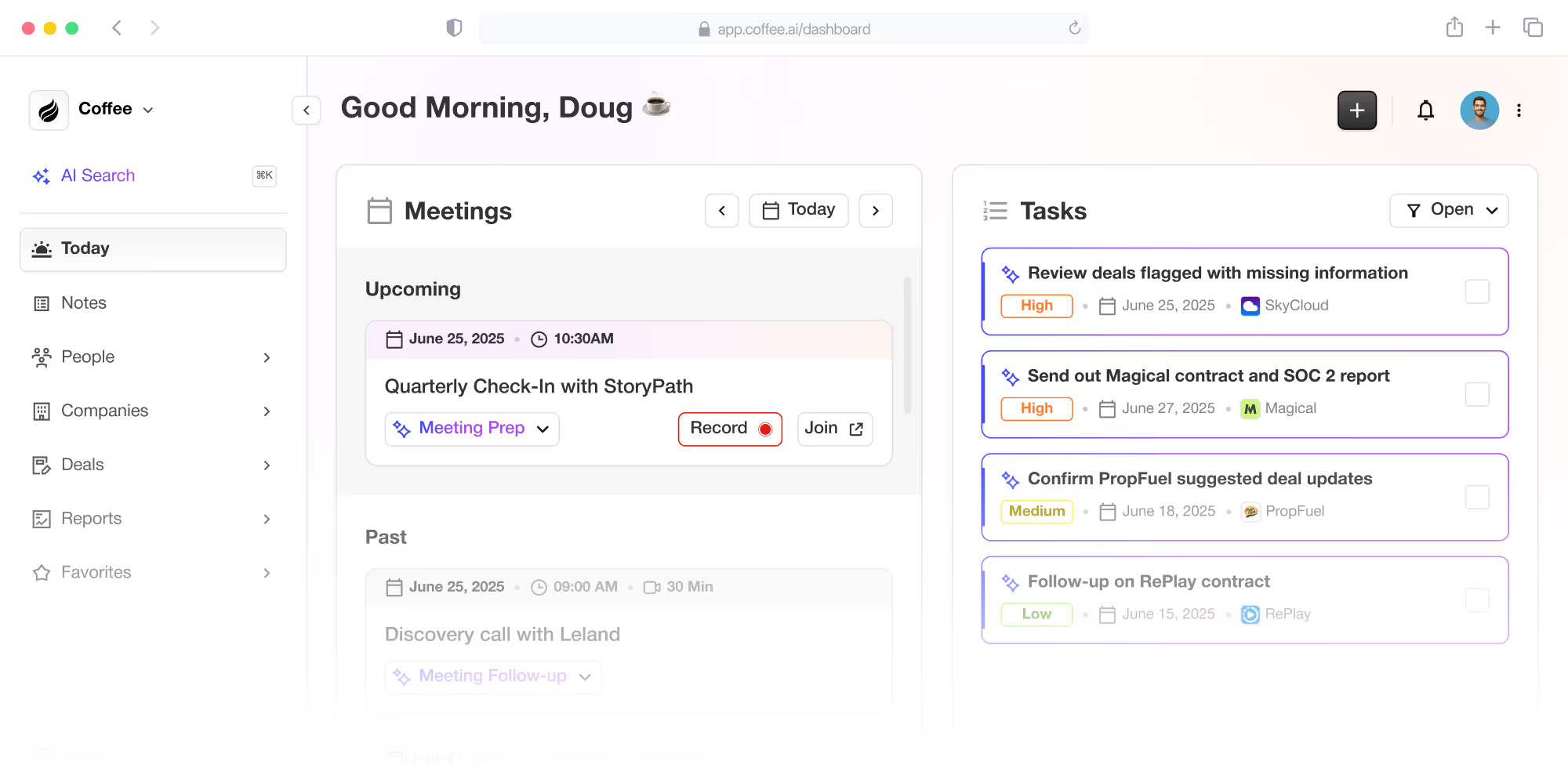
Coffee CRM stands out as an AI-driven platform designed to simplify sales processes. It offers two options: a standalone CRM for small to mid-sized businesses looking for a full system, and a companion app that works alongside existing tools like Salesforce or HubSpot. This dual approach makes it adaptable for teams at different stages of growth or with varying tech setups.
Coffee focuses on usability. It automatically pulls data from emails, calendars, and call recordings, removing the hassle of manual entry. By combining structured data, like contact details, with unstructured data, such as meeting notes, it offers a complete view of the sales pipeline. This setup helps sales reps stay informed without extra effort.
The standalone version suits companies with 1-20 employees moving beyond basic tools like spreadsheets. The companion app, on the other hand, enhances larger organizations’ existing CRMs, adding AI features without the need to overhaul current systems. Coffee represents a growing wave of AI tools built to prioritize user experience and efficiency in sales.
Clarify CRM: Automation with Minimal Effort
Clarify CRM scans emails, calendars, and calls to act on opportunities without manual prompts. Clarify also offers semantic search and query features, allowing users to dig into data for insights across departments. Unlike tools focused solely on sales, it supports broader business needs, sharing knowledge organization-wide.
Breaking Down Capabilities: Coffee vs. Clarify CRM
AI Automation and Insights for Sales Efficiency
Coffee uses AI to cut down on time-heavy tasks. It automatically builds and updates contact lists from emails and calendars, adding details like job titles and company info. For meetings, it prepares briefings with attendee backgrounds and post-meeting summaries, even drafting follow-up emails that sync with Gmail.
Its pipeline analysis stands out, using a built-in data warehouse to track changes over time. Sales leaders can see weekly progress, spot new deals, or identify stalled ones with a single click, avoiding manual spreadsheet work common in older CRMs.
Clarify focuses on self-running automation. It handles follow-ups and reminders without setup, using ambient intelligence to scan communications. Its search and query tools let users ask for insights directly, supporting strategic planning across teams.
Coffee’s strength lies in preparing reps with actionable tools, while Clarify prioritizes automation that runs independently, often benefiting wider business functions.
Unifying Data for a Clearer Picture
Coffee tackles scattered data by merging structured and unstructured information into one system. Its data warehouse tracks historical pipeline changes, offering features like weekly comparisons to monitor deal health. This cuts out manual exports and third-party tools for enrichment, keeping everything in one place.
Clarify also consolidates data, creating a unified view of client interactions. Its approach supports knowledge sharing across an organization, making data accessible for multiple teams, not just sales.
Coffee offers more focused tools for sales pipeline tracking, while Clarify’s broader data access benefits companies needing cross-departmental insights.
Streamlining Sales Workflows and User Experience
Coffee aims to make CRM use effortless for reps, cutting an estimated 8-12 hours of weekly admin tasks through automation. From contact creation to meeting follow-ups, it handles the grunt work. Its pipeline insights go beyond basic reports, helping teams spot risks and prioritize deals.
Flexibility is key. The standalone CRM replaces outdated systems for smaller teams, while the companion app boosts Salesforce or HubSpot for larger ones, preserving existing data and workflows.
Clarify automates admin tasks too, freeing reps for client focus. But unlike Coffee, it doesn’t provide the companion app feature.
Coffee directly targets sales rep workload and pipeline clarity, while Clarify’s low-setup automation works across broader functions with less user input.
Integration and Setup Options
Coffee’s two-pronged model fits different needs. Its standalone CRM is ideal for small teams upgrading from basic tools, while the companion app syncs with Salesforce or HubSpot, letting larger teams add AI without starting over. Data flows both ways, so users control what updates their main system.
Clarify does not offer a specific companion app feature, meaning organizations have to get rid of CRMs such as Salesforce and HubSpot to use it.
Quick Comparison: Coffee CRM vs. Clarify CRM
|
Feature / Aspect |
Coffee CRM |
Clarify CRM |
|
Core AI Approach |
Proactive automation, unified data, sales-focused tools |
Independent automation, ambient intelligence, minimal setup |
|
Sales Automation |
Auto data entry, meeting support, pipeline tracking |
Auto follow-ups, reminders, data search tools |
|
Data Handling |
Merges all data types, historical tracking, pipeline snapshots |
Unified client data, org-wide access |
|
User Experience |
Rep-friendly design, task reduction, sales co-pilot |
Low-config setup, mobile access, tailored interactions |
|
Flexibility |
Standalone or companion for Salesforce/HubSpot |
Standalone only |
Who Should Choose Coffee or Clarify? Matching Needs to Solutions
Coffee CRM: Best for Sales-Focused Productivity
Coffee fits small to mid-sized teams outgrowing basic tools like spreadsheets or light CRMs. It’s also ideal for companies using Salesforce or HubSpot that want AI enhancements without replacing their system. The companion app boosts data quality and adoption for established setups.
Sales teams wanting to cut manual tasks, automate meeting prep, and gain deep pipeline insights will find Coffee valuable. It’s a strong choice for consolidating tools, reducing the need for separate apps for data enrichment or call analysis.
Leaders who prioritize efficiency and modern design over complex enterprise features often prefer Coffee’s straightforward, user-friendly approach.
Discover how Coffee’s AI CRM can meet your sales team’s needs. Request access today to experience focused sales automation.
Clarify CRM: Suited for Hands-Off Automation
Clarify works well for organizations wanting automation with little manual input. Its system handles tasks independently, using ambient intelligence to act on data. This fits companies that value cross-departmental data access through a unified platform, and don’t mind not having a companion app solution for Salesforce or HubSpot.
Looking at Total Value: What You Get Beyond Features
Onboarding ease matters in CRM adoption. Coffee’s setup is simple, connecting to Google Workspace or Microsoft 365 to start pulling data right away. This quick start reduces delays in seeing benefits. Clarify’s setup might take longer if custom integrations are needed, as it’s not a companion app to Salesforce or HubSpot.
User adoption varies. Coffee’s design focuses on reducing tasks, leading to fast uptake with little training. Reps often see productivity gains from day one. Clarify’s advanced automation may need initial learning.
Scalability differs too. Coffee’s dual model grows with companies, supporting standalone or companion use as needs change. This avoids the pain of outgrowing a system.
For ROI, Coffee offers immediate time savings of 8-12 hours weekly per rep, plus lower costs by consolidating tools. Clarify’s returns come from reduced setup effort and wider workflow gains over time.
Common Questions About AI CRMs for Sales Teams
How AI CRMs Boost Sales Rep Productivity
AI CRMs like Coffee improve productivity by handling repetitive tasks that slow down reps in traditional systems. Instead of manual data entry or follow-up tracking, these platforms pull information from emails and calendars automatically.
Coffee saves reps an estimated 8-12 hours each week by creating contacts, enriching data, preparing meeting summaries, and drafting emails. This frees up time for client engagement and deal-closing activities, directly impacting performance.
Beyond time, AI tools offer insights into pipeline health, helping reps focus on high-priority deals with data-driven guidance, a step up from static reports in older CRMs.
Integration with Existing Tools Like Salesforce or HubSpot
AI CRMs are built to complement existing systems, not replace them outright. Coffee’s companion app connects with Salesforce or HubSpot, adding AI features without disrupting current setups. Data syncs both ways, letting users decide what to update in their main CRM.
The process is straightforward, often just needing a quick authentication to start enhancing data and insights. This addresses fears of complex migrations, allowing teams to keep workflows intact while gaining AI benefits.
Understanding Pipeline Intelligence in AI CRMs
Pipeline intelligence goes beyond basic CRM reports, offering a dynamic view of sales health over time. It tracks trends, highlights opportunities, and flags risks before they become issues.
Coffee uses a data warehouse to store historical pipeline data, enabling a feature that shows weekly changes at a glance. Leaders see progressing deals, new opportunities, and stalled prospects without manual analysis, saving hours of prep work for pipeline reviews.
Data Security in AI-Driven CRMs
Security is a top priority for AI CRMs. Coffee adheres to strict standards like SOC 2, Type 2, and GDPR, protecting customer data with clear policies on storage and processing. This transparency helps address concerns about data use in AI models or third-party sharing.
Modern platforms often include encryption, access controls, and audit logs, offering more oversight than many older systems. Companies should review compliance details to match their industry needs and risk policies.
Measuring ROI from AI CRM Adoption
AI CRM ROI combines hard numbers and less tangible gains. Time saved on tasks is a clear metric. Coffee’s 8-12 hours weekly savings per rep can be valued against salary costs, set alongside platform fees for a direct comparison.
Other measurable gains include fewer tool subscriptions by consolidating functions. Less quantifiable benefits, like better forecasting from pipeline visibility or faster deal cycles, also add value. Tracking baseline metrics before adoption helps measure progress.
Ready to see the impact of AI-driven sales tools? Request access to Coffee and explore how it can lift your team’s results.
Final Thoughts: Pick the AI CRM That Fits Your Sales Goals
Choosing an AI-first CRM is a pivotal step for sales performance and growth. Coffee and Clarify each address shortcomings of traditional systems, but their approaches suit different needs.
Coffee stands out for sales leaders wanting quick productivity boosts through targeted automation and data insights. Its dual setup—standalone or companion—offers flexibility for small teams or those with established CRMs. Saving 8-12 hours weekly per rep, it delivers clear value for sales-focused organizations looking to streamline tools and enhance user experience.
Clarify appeals to companies seeking automation with minimal oversight, extending beyond sales to other functions. Teams valuing independent operation and cross-departmental data tools may prefer its model.
Your choice hinges on current systems, team priorities, and growth plans. Sticking with outdated CRMs risks falling behind as competitors adopt AI efficiencies. As part of a larger trend toward intelligent sales tools, Coffee exemplifies how focused solutions can drive results.
Want to see how an AI-first CRM can change your sales approach? Request access to Coffee now and test its impact on your team.