
In the rapidly evolving world of sales technology, choosing the right CRM platform is more critical than ever.
The market landscape for customer relationship management tools has shifted dramatically over the past decade, driven by the integration of artificial intelligence. Businesses now face a growing array of options, from legacy systems adapting to new trends to innovative, AI-first solutions built from scratch for modern needs.
This shift reflects broader industry pressures: sales teams must close deals faster, manage complex pipelines, and build stronger customer relationships, all while minimizing administrative burdens. With AI promising to automate routine tasks and deliver actionable insights, companies are reevaluating their CRM strategies to stay competitive.
This article dives into a detailed comparison of two notable contenders, Coffee and Microsoft Dynamics 365, focusing on how their AI capabilities address these challenges.
We’ll explore specific features, practical benefits, and key differences to help you make an informed decision for your sales team, with Coffee positioned as a compelling example of the AI-first trend reshaping the industry.
Why an AI CRM Matters for Your Sales Team
Your CRM choice directly affects sales efficiency and business growth. Modern AI-driven platforms go beyond storing data, helping teams focus on selling by automating repetitive tasks and providing real-time insights.
Sales professionals face increasing demands to manage larger pipelines and deepen customer connections while spending less time on manual work. A well-chosen AI CRM can streamline these processes, reduce errors, and improve outcomes.
Key factors to evaluate include automation of workflows, integration of scattered data sources, ease of use for your team, and overall cost versus benefits. These elements determine whether your CRM boosts productivity or becomes a source of frustration. Let’s break down how Coffee and Microsoft Dynamics 365 address these needs.
Exploring Coffee: An AI-First CRM for Today’s Sales Needs
Coffee stands out as a platform designed with AI at its core, aiming to solve the pain points of traditional CRM systems. Built specifically for automation and ease of use, it focuses on empowering sales reps with tools that reduce workload and enhance effectiveness.
Automation of Data Entry
Coffee scans emails and calendar events to create and update contacts, companies, and activities automatically. Each interaction, whether an email or a meeting, links to the correct records without manual effort. The system also pulls in detailed data like job titles, company information, and LinkedIn profiles through partnerships with data providers.
Smart Meeting Support
Before meetings, Coffee offers briefings with attendee details, company backgrounds, and past interactions. During calls on platforms like Google Meet, Microsoft Teams, or Zoom, its AI bot records and transcribes conversations. Afterward, it summarizes key points, highlights action items, and prepares follow-up emails for review and sending via Gmail.
Pipeline Insights
With a built-in data warehouse, Coffee stores historical pipeline data for easy comparison. A single click shows changes over time, identifying progressed deals, new opportunities, closed wins, or stalled prospects. This replaces the need for manual exports and spreadsheet tracking.
Unified Toolset
Coffee combines multiple functions—CRM, data enrichment, call recording, and forecasting—into one system. This integration cuts costs and simplifies workflows by maintaining consistent data across sales processes.
Focus on Sales Reps
Designed with sales reps in mind, Coffee acts as a supportive partner in daily tasks. Its features prioritize selling over reporting, aiming for high user adoption and accurate data capture.
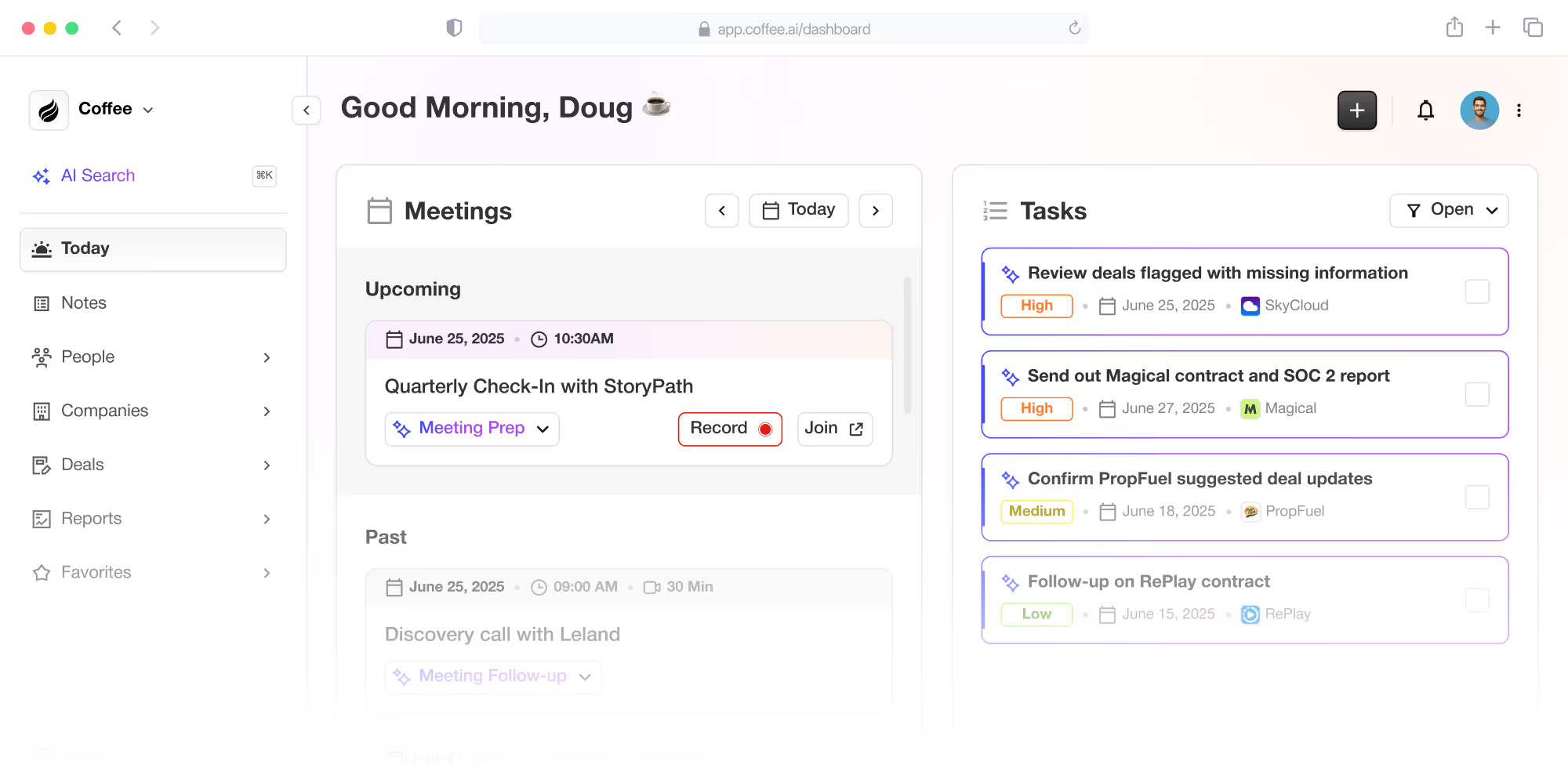
See how Coffee can simplify your sales process. Request access now.
Microsoft Dynamics 365 Sales: Key Features and Challenges
Microsoft Dynamics 365 holds a strong position in the CRM market, especially for companies already using Microsoft 365 tools. It offers tight integration with Outlook and Teams through Copilot for Sales, which captures sales data automatically into the CRM.
The platform creates custom workflows based on customer actions, enabling automated sales assignments and process triggers. AI features include predictive lead scoring and relationship analytics, though many advanced options are limited to Enterprise and Premium plans.
On the downside, implementation can be complex, potentially slowing adoption and raising costs. Users on basic plans might lack access to deeper customization or AI insights. While data integration within Microsoft tools is strong, handling unstructured data like email content or meeting notes may not match the depth of newer AI-focused platforms.
Comparing Coffee and Microsoft Dynamics 365: AI Features for Sales
|
Feature Area |
Coffee (AI-First CRM) |
Microsoft Dynamics 365 Sales |
|
Core Design |
Built with AI to automate sales tasks and minimize manual work |
Traditional CRM with added AI, tied closely to Microsoft 365 tools |
|
Data Entry |
Fully automates contact and activity tracking from emails and calendars, enriched with external data |
Captures data from Outlook and Teams via Copilot, but may need manual input for full records |
|
AI Tools |
Offers meeting summaries, follow-up drafts, pipeline analysis, and deal qualification frameworks like BANT |
Provides lead scoring, relationship mapping, and action suggestions, mainly in higher-tier plans |
|
Data Integration |
Combines structured and unstructured data for complete customer views via a data warehouse |
Integrates structured data across Microsoft 365 apps for cohesive workflows |
|
User Interface |
Simplified design focused on rep needs, reducing administrative tasks |
Updated interface, but complex features may challenge new users |
How AI Drives Sales Automation
Coffee uses AI to handle routine tasks proactively. Its bot joins virtual meetings, transcribes discussions, creates summaries, and suggests follow-ups without user input. It also applies sales frameworks to qualify deals and tracks pipeline changes instantly.
Microsoft Dynamics 365 focuses AI on predictive analytics within its ecosystem. Lead scoring and action recommendations guide sales efforts, primarily for higher-tier users. Copilot aids data capture from Microsoft tools, but its AI reacts to inputs rather than driving workflows independently.
Data Handling for Better Insights
Coffee’s system stores both structured data, like deal stages, and unstructured data, such as call transcripts, in one place. This setup provides a full picture of customer interactions and supports historical pipeline analysis without manual effort.
Dynamics 365 integrates structured data effectively across Microsoft apps like Outlook and Teams. While it creates smooth workflows, its ability to analyze unstructured data might lag behind platforms designed with AI as the foundation.
Ease of Use for Sales Teams
Coffee emphasizes a user-friendly experience, automating data entry and meeting prep to let reps focus on selling. This approach often leads to better engagement and data accuracy among teams.
Dynamics 365 has improved its design for mobile and analytics access, yet its wide range of features can overwhelm beginners. Full use often requires significant training, especially for tailored setups.
Cost and Value Over Time
Coffee keeps costs predictable with seat-based pricing and built-in features, avoiding the need for extra tools. Its quick setup and straightforward design lower training time and speed up value delivery.
Dynamics 365 costs vary widely by plan. Basic tiers are affordable but limited, while advanced AI and customization need pricier Enterprise or Premium plans. Setup complexity and potential third-party integration fees can raise overall expenses, though Microsoft ecosystem users might offset this with existing investments.
Cut down on manual CRM work. Explore Coffee’s AI tools today.
Finding the Right Fit: Which AI CRM Suits Your Business?
For smaller teams or growing businesses needing automation and simplicity, Coffee fits well. Its AI-first design tackles manual data issues and supports sales reps directly, making it ideal for companies with 1-20 employees or those enhancing Salesforce or HubSpot setups. It appeals to teams favoring modern tools over traditional enterprise software.
For organizations tied to Microsoft 365 with larger teams and complex needs, Dynamics 365 could be the choice. It offers deep customization and ecosystem integration, best for companies with IT support to manage setup and compliance requirements, despite its steeper learning curve.
Common Questions About AI CRMs
How Do Coffee’s AI Features Stack Up Against Dynamics 365’s Copilot?
Coffee’s AI builds the CRM from interactions, proactively automating workflows like meeting summaries and pipeline tracking. It engages directly in sales tasks, from pre-meeting prep to drafting communications.
Dynamics 365’s Copilot captures data from Microsoft tools into a traditional CRM structure. While it eases some data entry, it enhances existing processes rather than redefining them.
Does Coffee Work with Microsoft 365 Tools Like Outlook and Teams?
Yes, Coffee integrates with Microsoft 365 and Google Workspace, pulling data from emails and calendars to update records automatically. It focuses on essential syncs like contact creation and event logging without requiring full ecosystem commitment, unlike Dynamics 365’s deeper Microsoft ties.
How Do Pricing Structures Differ?
Coffee uses a clear seat-based pricing model, ensuring cost predictability without hidden fees for features or usage. Dynamics 365 operates on tiered plans, with basic options at lower costs but advanced AI and customization locked behind higher plans, potentially increasing expenses with add-ons or setup support.
Which Is Better for Small Businesses or Enterprises?
Coffee suits small to mid-sized teams, especially those with 1-20 employees, seeking quick setup and ease of use. Dynamics 365 fits a wider range, but smaller firms might find basic plans restrictive, while larger ones benefit from premium features with the right resources.
Final Thoughts: Equipping Your Sales Team with the Right AI CRM
Sales success today hinges on smart automation, not just data collection. Microsoft Dynamics 365 brings AI to a robust enterprise platform, while Coffee offers a streamlined, AI-first experience that prioritizes sales reps’ daily needs.
For many growing businesses, Coffee represents the shift toward intuitive, automated CRM solutions. It cuts out manual tasks, streamlines meeting workflows, and delivers pipeline insights, allowing teams to focus on relationships and closing deals. Meanwhile, Dynamics 365 serves firms needing extensive Microsoft integration and customization, though with added complexity.
Your decision should align with whether you value straightforward AI efficiency or comprehensive enterprise capabilities. Coffee exemplifies how AI can redefine CRM as a proactive sales ally, fitting the needs of modern, agile teams.
Spend less time on CRM tasks. Request a Coffee demo to boost your sales efficiency.