
Key Takeaways
- Integrated CRM tools reduce administrative work so sales teams can spend more time selling and less time on manual data entry.
- Automated data capture, enrichment, and meeting workflows improve data quality and create more reliable pipeline visibility.
- Centralizing customer data and integrating core sales and marketing tools limits silos and tool sprawl.
- Agent-led CRM systems support user adoption by handling routine tasks in the background and fitting into existing workflows.
- Coffee’s AI CRM Agent automates data, meetings, and pipeline management for modern sales teams in 2026. Get started with Coffee here.
The Problem: Why CRM Integration Matters for Sales Teams
Most sales teams still spend too much time updating fields, logging activities, and cleaning up data. That time comes directly out of prospecting, follow-up, and closing work.
Manual data entry leads to incomplete or inconsistent records. Different reps track information in different ways, so reports feel unreliable, and personalization becomes difficult. CRMs then feel like demanding systems that require constant service instead of tools that support revenue.
Introducing Coffee: An Agent-Led Approach to Integrated CRM
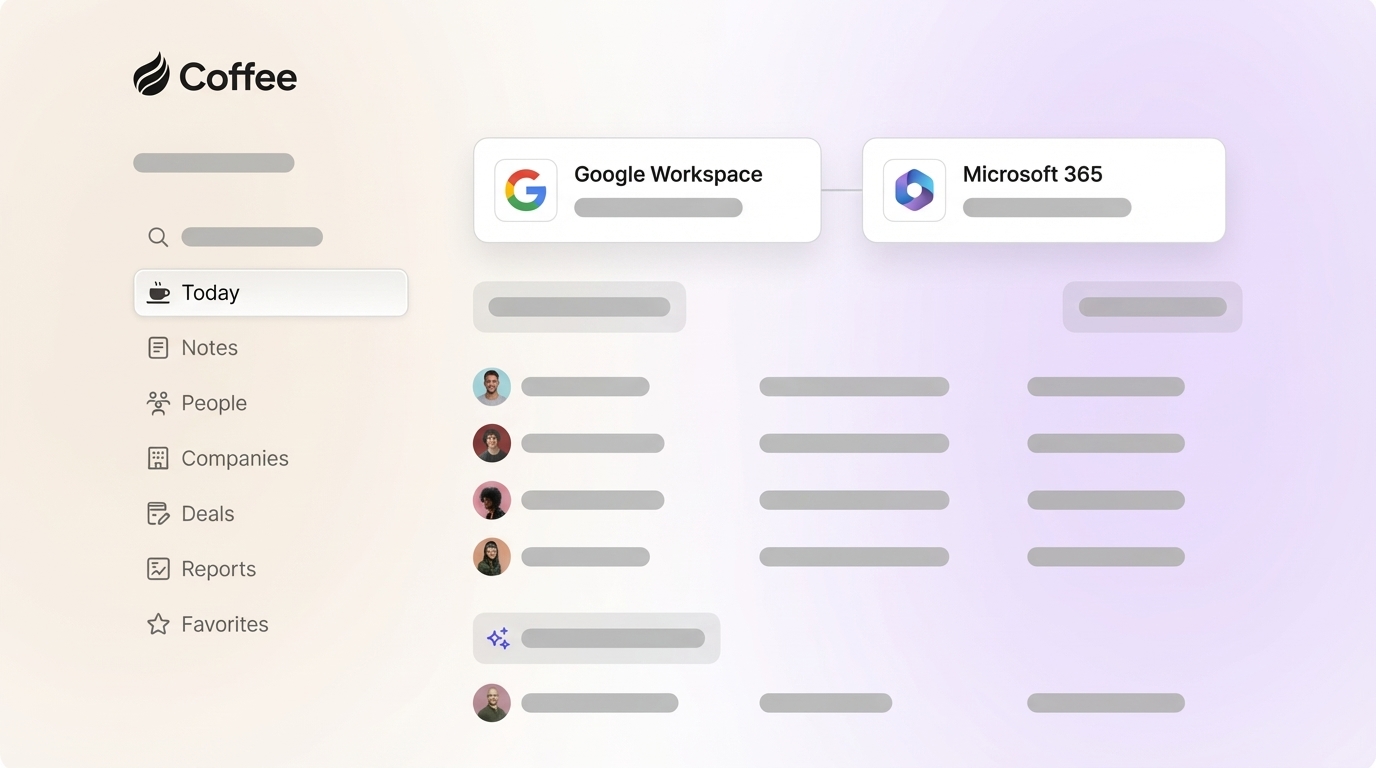
Coffee takes an agent-led approach to CRM. The system acts as an autonomous assistant that captures data, structures it, and keeps records current in the background.
Key capabilities include:
- Automatic data entry and enrichment that creates contacts, companies, and activities from emails and calendars, then enriches them with role, funding, and profile details.
- AI meeting management that prepares briefings, records and transcribes calls, structures notes to your sales methodology, and drafts follow-up messages.
- Pipeline intelligence that tracks changes over time and surfaces meaningful shifts without spreadsheet work.
- Stack consolidation that combines CRM, enrichment, recording, and forecasting into a single, integrated platform.

Get started with Coffee to see how an AI CRM Agent can support your sales team.
8 Strategies for Integrated Sales Team CRM Tools
1. Automate Data Entry for Reliable Data Quality
Consistent, accurate data gives leaders confidence in forecasts and helps reps personalize outreach. Manual entry rarely meets that standard.
Teams can configure automation and AI to capture contacts, companies, and activities directly from email and calendar data. That approach cuts errors and protects selling time.
Coffee automatically creates and enriches records from everyday sales activity, so ground-truth data enters the CRM without extra work from the team.
2. Connect Core Sales and Marketing Tools
Disconnected tools create silos. Prospects receive disjointed outreach, and teams lose context across channels.
Sales teams benefit from mapping critical data flows and setting up two-way sync where possible. A single, current view of each account supports smoother handoffs between marketing, sales, and customer success.
Coffee acts as a companion app for Salesforce and HubSpot, handling data-in workflows and syncing insights back to the primary CRM to reduce scattered point solutions.
3. Use AI for Structured Meeting Management
Sales meetings generate valuable information, but manual note-taking and follow-up often lack consistency.
AI can join calls, capture transcripts, create structured notes, and draft follow-up emails based on your qualification framework. That consistency improves coaching, forecasting, and deal reviews.
Coffee prepares meeting briefings, records and summarizes calls, structures notes to methods like BANT or MEDDIC, and drafts follow-ups automatically.

4. Centralize Data for a Complete Customer View
Scattered email threads, call notes, and documents force reps to hunt for context and slow down every interaction.
Centralizing structured and unstructured data into one view of each account gives every stakeholder the same story, from first touch to renewal.
Coffee automatically ties emails, call transcripts, and meeting notes to the right contacts and accounts, creating a single source of truth without manual logging.
5. Move to Agent-Led Pipeline Management
Static spreadsheets and infrequent updates make pipeline reviews reactive and time-consuming.
Automated tracking of stage changes, new deals, and risk signals turns the pipeline into a living dataset that leaders can trust for planning.
Coffee provides pipeline intelligence with week-over-week change views, so managers focus on strategy and coaching instead of data clean-up.

6. Consolidate Your Sales Tech Stack
Multiple overlapping tools increase cost, create extra logins and workflows, and introduce integration risk.
Sales leaders can audit their current stack, identify duplicate functions, and favor platforms that cover several needs in one place.
Coffee combines CRM, enrichment, recording, and forecasting within a unified, agent-led platform that helps reduce both cost and operational complexity.
7. Support User Adoption with Intuitive Design
Even strong CRM strategies fail if reps avoid the system and move back to spreadsheets or personal tools.
Involving end users in selection and rollout, and choosing tools that automate rather than add tasks, leads to higher adoption.
Coffee handles data capture and admin work in the background, so the primary interface feels simple and aligned with how reps already work.
8. Strengthen Data Governance and Validation
Automation works best on clean, standardized data. Unclear rules and unchecked duplicates create confusion at every level.
Clear data standards, regular cleaning, and validation rules help maintain quality as teams grow.
Coffee improves data quality at the source by ingesting and structuring accurate, ground-truth data automatically, which supports dependable reporting and planning.
Integrated Sales Team CRM Tools Comparison: Coffee vs. Other Options
|
Feature |
Coffee (Agent-Led CRM) |
Salesforce |
HubSpot |
Manual Processes |
|
Data Entry |
Automated via an AI Agent from emails and calendar |
Partially automated; manual input often required |
Partially automated; manual input often required |
Manual entry into spreadsheets and notes |
|
Data Quality |
High automation focuses on good data in |
Variable; depends on user behavior and setup |
Variable; depends on user behavior and setup |
Low, inconsistent, and error-prone |
|
Integration |
Designed to reduce tool sprawl and handle core data flows |
Extensive options; complexity varies by use case |
Strong native integrations for many common tools |
No automatic integration; silos are common |
|
Sales Rep Time Saved |
High; about 8–12 hours per week on admin tasks |
Variable; depends on automation usage |
Variable; depends on automation usage |
None; all work is manual |
Get started to compare Coffee’s agent-led workflow with your current CRM setup.
Conclusion: Make Integrated CRM a Driver of Revenue in 2026
Integrated sales team CRM tools now sit at the center of efficient revenue operations. Automated data capture, connected systems, and agent-led workflows help shift time and attention back to selling.
Coffee uses an AI CRM Agent to keep records clean, structure meeting data, and surface pipeline changes with minimal manual effort. That approach turns the CRM into a reliable partner for both reps and revenue leaders.
Get started with Coffee and explore how an agent-led CRM can support your 2026 sales goals.
Frequently Asked Questions (FAQ)
What are the common challenges with traditional integrated sales team CRM tools?
Traditional CRMs often depend on manual data entry, which leads to gaps and errors. Limited integrations keep key information in separate systems, user adoption can lag when workflows feel heavy, and older architectures may not handle email and call data well.
How do AI-powered CRM tools improve data quality and integration?
AI-powered CRM tools capture and enrich data automatically from daily sales activity. They connect structured fields with unstructured content such as emails and transcripts, then surface insights that support forecasting, coaching, and prioritization without extra admin work.
What should sales leaders look for in integrated CRM solutions in 2026?
Sales leaders can focus on four areas: depth of automation for data entry, strength of integrations with core tools, usability for front-line reps, and built-in intelligence for pipeline and account management.
How does an agent-led CRM differ from a traditional CRM?
An agent-led CRM acts as an always-on assistant. It monitors communication channels, updates records, structures notes, and highlights changes without waiting for a user to enter data. Traditional CRMs rely more heavily on manual updates to stay accurate.
What ROI can sales teams expect from integrated CRM tools?
Teams typically see time savings from reduced admin work, better visibility into pipeline health, fewer redundant tools, and more consistent follow-up with prospects and customers. Those gains support higher productivity per rep.