
Last updated: February 8, 2026
Key Takeaways
- 76% of organizations have inaccurate CRM data, and sales reps spend 64% of their time on non-selling work like manual entry.
- Leading CRM enrichment tools such as Coffee, ZoomInfo, Apollo.io, Clearbit/Breeze, and Clay differ in automation, data coverage, and integrations.
- Coffee uses agent-driven automation to process unstructured data from emails and calendars, saving sales teams 8-12 hours every week.
- Core evaluation criteria include data accuracy (94-97% for top tools), compliance (SOC 2 and GDPR), and smooth Salesforce or HubSpot integration.
- Transform your CRM with Coffee’s agent-led platform, and get started today for automated enrichment and revenue growth.
The Real CRM Data Enrichment Problem for Enterprises
Modern sales teams work inside a fragmented data environment where customer details live across emails, calendars, recordings, and dozens of tools. This fragmentation forces sales reps to manually piece together customer profiles, which creates the familiar “garbage in, garbage out” CRM problem.
Current data shows how serious this issue has become. Only 65% of organizations describe their CRM data as somewhat accurate instead of fully accurate. Traditional automation-only tools cannot close this gap. At the same time, reps spend only 35% of their time selling, while the rest goes to admin work like data entry and CRM upkeep.
Legacy CRMs such as Salesforce and HubSpot make this harder with architectures that struggle with unstructured data from emails and call transcripts. These systems rely on basic relational databases, so historical context disappears when fields change, which creates blind spots in relationship tracking.
Traditional enrichment tools focus on appending data instead of automating workflows. They add fields but do not manage the ongoing stream of customer interactions. Without intelligent agents that handle this flow, sales teams stay stuck in manual processes that do not scale and that reps resist using.
How to Evaluate Enterprise CRM Data Enrichment Platforms
Effective enterprise CRM enrichment goes beyond simple contact appending. The strongest platforms combine multiple data sources, automate daily workflows, and connect cleanly to the existing sales tech stack.
Diverse data sources create richer enrichment. Leading tools pull from structured databases and unstructured inputs such as email signatures, calendar invites, and meeting transcripts. Top providers reach 94-97% data accuracy compared with 68-75% for lower-tier tools, which shows the value of multi-source validation.
Automation depth separates agent-driven platforms from passive databases. Advanced tools automatically create contacts, log activities, and generate meeting summaries with no manual work. This agent-led model directly addresses the integration friction and manual stitching complaints that appear in user threads on Reddit and Quora.

Compliance and security now sit at the center of enterprise buying decisions. By 2028, 33% of enterprise software applications will include agentic AI. SOC 2 Type 2 and GDPR compliance, therefore, become essential for any enrichment platform that needs to stay relevant.
Top 5 Enterprise CRM Data Enrichment Platforms Compared
1. Coffee: Agent-Driven Enrichment and Workflow Automation
Coffee leads with an agent-driven approach to CRM enrichment that removes manual data entry for small and mid-sized businesses. Teams can use Coffee as a standalone CRM or as a companion that upgrades existing Salesforce and HubSpot setups.
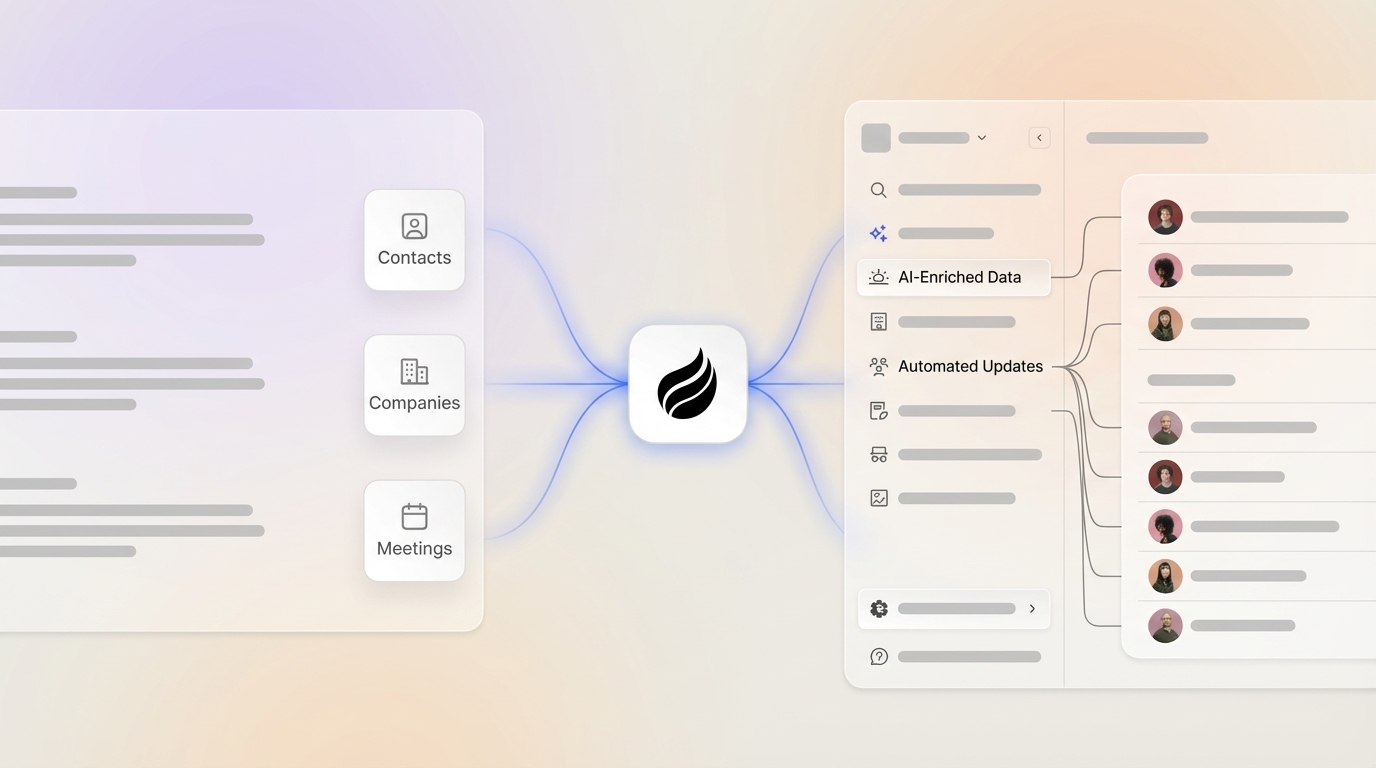
Coffee’s main strength is its ability to process unstructured data from Google Workspace and Microsoft 365. The agent automatically creates contacts and enriches records with job titles, funding details, and LinkedIn profiles. It also manages meetings by generating briefings, joining calls, and producing summaries with clear action items.

The platform saves sales teams 8-12 hours each week by removing manual entry and surfacing pipeline intelligence through its built-in data warehouse. Coffee holds SOC 2 Type 2 and GDPR compliance, which delivers enterprise-grade security with simple seat-based pricing that grows with the team.

2. ZoomInfo: Enterprise-Grade B2B Database
ZoomInfo remains a standard choice for B2B database enrichment and delivers 95%+ data accuracy with verified contacts. The platform focuses on broad company and contact coverage and strong intent signals for enterprise sales teams.
ZoomInfo stands out for its massive database, advanced search filters, and robust Salesforce integration. However, teams still need significant manual effort to activate the data. Pricing also skews toward high-cost enterprise contracts that fit larger organizations better than lean teams.
3. Clearbit (Breeze): Real-Time HubSpot Enrichment
Clearbit, now Breeze, focuses on real-time enrichment with native HubSpot integration. The platform automatically appends firmographic data to partial records, which supports stronger lead qualification and targeting.
Breeze performs well for company and technographic data that marketing and sales teams use for segmentation. Its focus on structured data, however, limits support for unstructured inputs such as email content and meeting transcripts. Teams often need extra tools to cover full workflow automation.
4. Apollo.io: All-in-One Prospecting and Engagement
Apollo.io combines prospecting, enrichment, and sales engagement in one platform, which appeals to growing teams that want a cost-effective stack. Users get integrated email sequences, calling tools, and contact enrichment in a single interface.
Apollo’s value comes from this all-in-one model and competitive pricing. Many users still report manual stitching and verification work, which reduces its impact for teams that want fully automated workflows.
5. Clay: Flexible Data Workflows for Outbound Teams
Clay stands out by pulling from more than 75 data sources for accurate contact and firmographic details and by using AI agents for trend analysis. The platform supports advanced personalization and complex data workflows.
Clay’s flexibility and broad data coverage make it a strong fit for sophisticated outbound campaigns. Its complexity can overwhelm smaller teams, and its outbound focus limits its role as a full CRM management solution.
Side-by-Side CRM Enrichment Comparison
|
Tool |
Automation Level |
Data Handling |
CRM Integration |
Accuracy/Compliance |
Cost Structure |
|
Coffee |
Agent-driven |
Structured + Unstructured |
Salesforce/HubSpot native |
SOC2/GDPR |
Simple seat-based |
|
ZoomInfo |
Manual activation |
Structured database |
Salesforce integration |
95%+/GDPR |
High-cost enterprise |
|
Clearbit/Breeze |
Real-time append |
Structured firmographics |
HubSpot native |
90%+/GDPR |
Usage-based |
|
Apollo.io |
Semi-automated |
Structured + sequences |
CRM sync available |
85%+/Basic compliance |
Freemium model |
|
Clay |
Workflow automation |
75+ sources |
API connections |
90%+/SOC2 |
Credit-based |
This comparison highlights a clear gap between legacy database tools and modern agent-driven platforms. Traditional tools such as ZoomInfo deliver strong accuracy but still demand manual activation and integration work. Coffee’s agent-led model removes this friction by automating the full data lifecycle from capture through activation.
Why Coffee Outperforms Other CRM Enrichment Tools
Coffee stands out through an agent-driven architecture that tackles the core CRM adoption problem, which is manual data entry. Passive databases simply push information into fields, while Coffee’s agent manages the entire customer data lifecycle.
The platform’s ability to process unstructured data from emails and calendars clearly separates it from tools that only enrich structured databases. Coffee automatically captures meeting context, generates summaries, and stores historical records in its built-in data warehouse, so no interaction is lost.

Coffee’s dual deployment model, as a standalone CRM or as a Salesforce or HubSpot companion, gives organizations flexibility at every stage of their sales tech journey. Teams avoid risky “rip and replace” projects and still gain immediate value from automated workflows.
Small and mid-sized companies that want to move beyond spreadsheet-based selling without the overhead of a heavy enterprise CRM find a practical fit with Coffee. Get started with Coffee to see agent-driven CRM management in action.
Rolling Out Coffee and Avoiding Common CRM Pitfalls
Successful CRM enrichment projects start with a clear rollout plan and realistic expectations about automation. Strong implementations connect primary data sources such as Google Workspace or Microsoft 365 first, then complete CRM authentication and agent setup.
Coffee’s rollout usually takes days instead of weeks. Once email and calendar systems connect, the agent begins populating contacts and companies and starts learning organizational patterns and preferences. This quick start contrasts with traditional enrichment tools that often need heavy manual configuration.

Common mistakes include chasing raw data volume instead of automation quality and ignoring unstructured data that holds crucial customer insight. Coffee’s flexible model addresses these issues by focusing on workflow automation first and data quantity second.
FAQs: CRM Data Enrichment and Coffee
What is CRM data enrichment?
CRM data enrichment means automatically adding accurate contact and company information to existing customer records. Typical enrichment includes job titles, company details, contact information, and firmographic data so teams can build complete profiles and make better sales and marketing decisions.
What are the best CRM data enrichment tools for Salesforce and HubSpot?
Coffee leads the market for agent-driven enrichment that supports both Salesforce and HubSpot. The platform automates data entry, meeting management, and pipeline intelligence while keeping enterprise-grade security and compliance.
What are the best alternatives to ZoomInfo for CRM data enrichment?
Coffee offers a comprehensive alternative to ZoomInfo by pairing database enrichment with agent-driven workflow automation. ZoomInfo often requires manual activation, while Coffee automatically processes unstructured data and preserves a complete history of customer interactions.
How can I automate CRM data entry?
Agent-led platforms such as Coffee remove manual data entry by capturing information directly from emails, calendars, and meetings. The agent creates contacts, logs activities, and generates summaries without human input, which saves typical sales teams 8-12 hours each week.
Which CRM data enrichment tools are GDPR compliant?
Coffee maintains SOC 2 Type 2 and GDPR compliance while delivering full enrichment and automation capabilities. The platform protects data security and privacy while still supporting powerful workflows.
Conclusion: Move from Passive Data to Active CRM Agents
The shift from passive databases to active agents now defines the future of CRM data management. Organizations that adopt agent-driven enrichment gain better data quality, less manual work, and higher sales productivity.
Coffee’s end-to-end approach to automated enrichment positions it as a leader for teams that want to turn their CRM from a data entry chore into a revenue engine. Get started with Coffee to experience the next generation of CRM data enrichment.