
Last updated: February 8, 2026
Key Takeaways
- Sales reps lose 64-70% of their time on admin tasks like CRM updates. AI-powered CRMs automate data entry from emails, calendars, and calls so teams reclaim selling time.
- Coffee leads as the top AI agent CRM with fully autonomous workflows, meeting agents, and flexible deployment as a standalone platform or Salesforce/HubSpot companion.
- Key evaluation criteria include agent autonomy, unstructured data processing, pipeline intelligence, stack consolidation, and proven 8-12 hours of weekly time savings per rep.
- Competitors such as Salesforce Einstein, HubSpot Breeze, Pipedrive AI, and Monday Sales offer useful AI features but do not match Coffee’s complete data lifecycle automation.
- Sales teams transform productivity with Coffee’s autonomous agents. Get started today to see immediate ROI from eliminating manual data entry.
How to Evaluate AI-Powered Sales Team CRMs
Choosing an AI-powered sales team CRM starts with confirming that it delivers true automation, not just surface-level AI features. The most important capability is autonomous data capture and enrichment, where the system processes unstructured data from emails, calendars, and meeting transcripts without human help.
Agent-led workflows represent the next stage of CRM evolution and give AI the power to create briefings, summaries, and follow-ups on its own. This shift turns CRMs from passive databases into active agents that manage the full data lifecycle and handle routine admin work.
Pipeline intelligence and historical tracking ensure teams receive accurate insights from their automated data. Legacy CRMs often struggle with unstructured data because of relational database limits, so strong processing of messy data becomes a major advantage for modern tools.
Stack consolidation shows whether a platform can replace point tools such as ZoomInfo for enrichment or Gong for conversation intelligence. Flexible deployment as a standalone CRM or as a companion to Salesforce or HubSpot gives organizations options that match their current stack.

Measurable time savings of 8-12 hours per week per rep, backed by clear ROI metrics, separate real automation from marketing claims. These criteria highlight which CRMs truly reduce manual data entry for sales teams and which simply add more features to existing workflows.
Top 5 AI-Powered Sales Team CRMs in 2026
1. Coffee: AI Agent CRM Built to Remove Admin Work
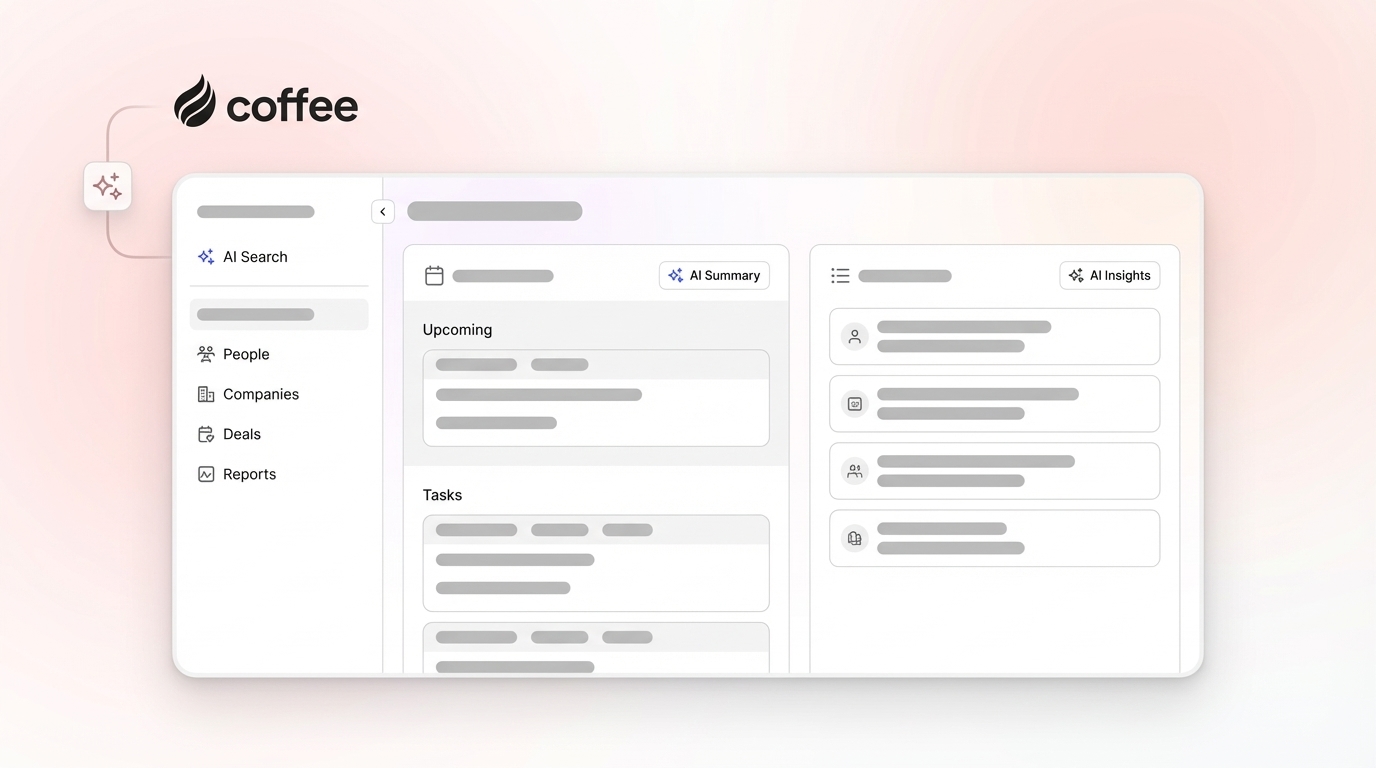
Coffee operates as a true AI agent in the CRM space and focuses on eliminating manual data entry through autonomous workflows. Instead of acting as a static database, Coffee behaves like an intelligent teammate that manages both structured and unstructured data.

Key Strengths:
- Fully autonomous data entry through Google Workspace and Microsoft 365 integrations
- AI meeting agent that joins calls, creates summaries, and drafts follow-up emails
- Pipeline Compare feature runs automated week-over-week pipeline analysis
- Flexible deployment as a standalone CRM or as a Salesforce/HubSpot companion
- Built-in data warehouse that preserves complete historical context
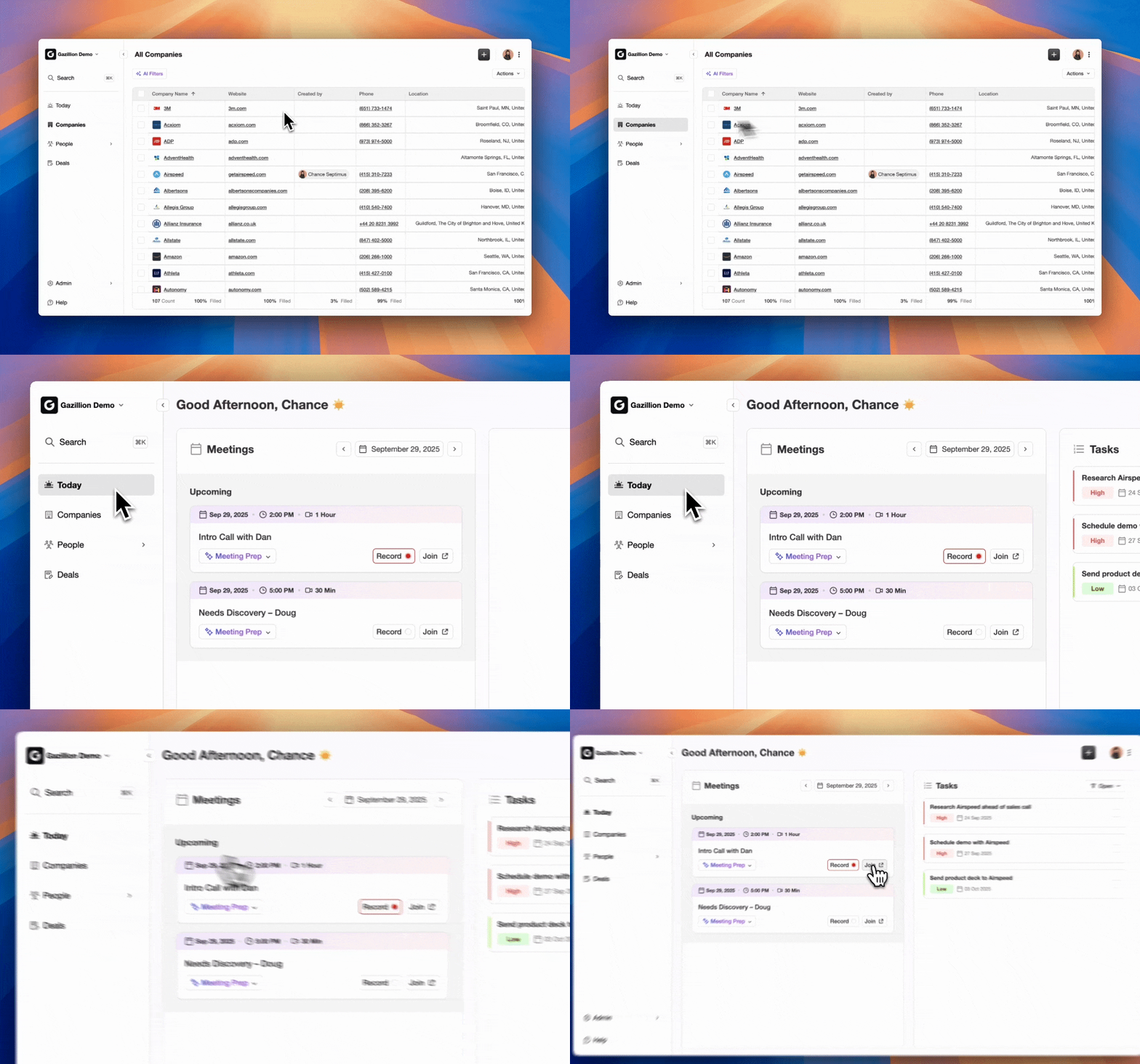
Best Fit: Small to mid-market companies that want to remove sales admin work entirely, whether they replace legacy CRMs or enhance existing Salesforce or HubSpot setups.
Pricing: Simple seat-based pricing that includes unlimited agent labor.
2. Salesforce Einstein: Enterprise AI Inside Salesforce
Salesforce Einstein adds AI capabilities to the Salesforce platform and focuses on predictive analytics and workflow automation through the newer Agentforce initiative. Teams that already rely on Salesforce gain AI features inside their existing environment.
Key Strengths:
- Native integration with Salesforce data, objects, and workflows
- Agentforce beta that supports multi-step autonomous workflows
- Advanced forecasting and opportunity scoring features
- Enterprise-grade security, governance, and compliance controls
Limitations: Limited automated data entry, heavy configuration requirements, and high costs for smaller teams.
Best Fit: Large enterprises fully invested in Salesforce with dedicated admins and operations resources.
3. HubSpot Breeze: AI Across Marketing, Sales, and Service
HubSpot Breeze Intelligence brings AI across HubSpot’s marketing, sales, and service hubs and improves data quality through automated enrichment and processing. One study reported a 92% improvement in data quality with these capabilities.
Key Strengths:
- Native AI woven into all HubSpot hubs
- Automated call summaries and conversation insights
- Data enrichment that includes buyer intent signals
- User-friendly interface with a short learning curve
Limitations: Restricted to the HubSpot ecosystem and lighter automation compared with dedicated AI agents.
Best Fit: Growing companies that already use HubSpot’s full platform and want steady AI improvements without changing systems.
4. Pipedrive AI: Pipeline-Centric Sales Assistant
Pipedrive AI Assistant delivers core automation features for pipeline management and deal insights and is available on Pro+ plans. The focus stays on helping reps manage deals more efficiently.
Key Strengths:
- Pipeline tracking with anomaly detection
- AI-assisted email drafting
- Predictive lead scoring tools
- Strong mobile experience for field reps
Limitations: Limited automation of data entry and lighter AI capabilities than agent-first platforms.
Best Fit: Small sales teams that value pipeline visibility more than full admin automation.
5. Monday Sales CRM: AI Inside a Work Management Platform
Monday Sales CRM layers AI features into the broader Monday.com work management platform and focuses on task automation and predictive insights. Teams that already run projects on Monday.com can extend that setup into sales.
Key Strengths:
- Deep integration with Monday.com workflow management
- AI-powered lead scoring and account prioritization
- Sales Copilot that generates account summaries
- Visual pipeline boards that are easy to customize
Limitations: Full CRM value requires broader adoption of the Monday.com ecosystem.
Best Fit: Teams that already manage projects in Monday.com and now want built-in CRM capabilities.
Feature Comparison: Coffee vs Other AI CRMs
|
Feature |
Coffee |
Salesforce Einstein |
HubSpot Breeze |
Pipedrive AI |
|
Auto Data Entry |
Full agent automation |
Partial email logging |
Call/email summaries |
Basic assistance |
|
Unstructured Data |
Complete processing |
Predictions only |
Limited summaries |
Minimal handling |
|
Agent Autonomy |
High (workflows and briefings) |
Agentforce beta |
Native AI features |
Suggestions only |
|
Companion Mode |
Yes (Salesforce and HubSpot) |
Native only |
Native only |
No |
Why Coffee Leads the AI CRM Market
Coffee’s agent-first design sets it apart from competitors that simply add AI features to older architectures. Other platforms focus on predictions or light automation, while Coffee delivers a fully autonomous agent that manages the entire sales data lifecycle.
The platform directly tackles the core admin burden that traditional sales processes create, including 20 minutes of note-taking, 10 minutes of CRM updates, and 15 minutes of email drafting after each call. Coffee’s agent cuts this work to minutes through automated transcription, CRM updates, and follow-up email creation.

Coffee’s dual deployment model gives teams rare flexibility. Smaller teams can use Coffee as a complete CRM, while established Salesforce or HubSpot users can run Coffee as an intelligent companion that removes manual data entry without forcing a full migration.
Real customer deployments show 8-12 hours of weekly time savings per rep. Those reclaimed hours translate into more selling time, cleaner data, and clear ROI. Get started with Coffee to see autonomous sales automation in action.
Rolling Out Coffee and Estimating ROI
Rolling out Coffee takes far less effort than a traditional CRM migration. Teams start by authenticating Google Workspace or Microsoft 365 so the agent can immediately capture and enrich contact data from existing email and calendar activity.

Teams that migrate from legacy systems benefit from Coffee’s automatic data unification, which removes most data mapping headaches. The main requirement is that every rep connects their email and calendar accounts so the agent can capture a complete picture of customer interactions.
ROI estimates usually start with Coffee’s reported time savings. Teams often see 8-12 hours saved per rep each week through automated data entry and workflow handling. A five-person sales team can reclaim a full workweek of productive time every week.
Common rollout mistakes include overlooking the value of unstructured data and underusing the meeting agent. Teams see the strongest ROI when they rely on Coffee’s autonomous workflows for calls, notes, and follow-ups instead of treating it like a simple logging tool. Get started with Coffee to begin that shift.
Frequently Asked Questions
What is the best AI CRM for sales data automation?
Coffee currently leads the market as the only AI agent built specifically for sales data automation. While many CRMs add AI features to existing products, Coffee acts as an autonomous agent that manages data entry, enrichment, and workflows from end to end. The platform removes manual data entry by processing emails, calendars, and meeting transcripts automatically and typically saves each rep 8-12 hours per week.
How does Coffee work with existing Salesforce or HubSpot setups?
Coffee connects as a companion app that enhances Salesforce or HubSpot without forcing a migration. The agent authenticates with your CRM, then syncs enriched data, meeting summaries, and pipeline updates in the background. Teams keep their familiar workflows while Coffee removes the manual data entry that slows reps down.
Can AI CRMs replace manual data entry clerks?
Modern AI agents, such as Coffee, can remove nearly all repetitive data entry tasks that occupy sales reps and data entry staff. The technology captures contact details, logs activities, processes meeting transcripts, and drafts follow-up messages automatically. Some strategic data checks can still help, but AI agents now handle the bulk of routine data work that once required human effort.
How do AI agents differ from traditional AI features in CRMs?
AI agents run entire workflows on their own, while traditional AI features only provide suggestions or predictions. Agents on platforms like Coffee capture data, create summaries, draft emails, and update records with no manual steps. Traditional AI in legacy CRMs usually focuses on scoring or recommendations and still depends on humans to enter data and complete tasks.
Which AI-powered sales CRMs lead the market in 2026?
Coffee dominates the AI agent category with fully autonomous capabilities. Salesforce Einstein and HubSpot Breeze provide strong AI features inside established ecosystems. Coffee’s agent-first architecture removes manual work, while competitors mainly enhance existing processes. Teams that want complete automation choose Coffee, and teams that prefer gradual improvements often select Einstein or Breeze.
Conclusion: Why Sales Teams Choose Coffee
Coffee stands out among AI-powered sales CRMs by delivering a true autonomous agent that removes manual data entry and unlocks major productivity gains. Competing platforms add AI to legacy frameworks, but Coffee’s agent-first design produces measurable ROI through full workflow automation.
The combination of flexible deployment, deep data processing, and proven time savings makes Coffee a strong choice for teams ready to modernize their CRM stack. Get started with Coffee today and experience autonomous sales intelligence in your daily workflows.