
Last updated: February 8, 2026
Key Takeaways
- B2B sales teams lose 6 hours each week to manual CRM data entry, and only 35% trust data accuracy, which weakens forecasting.
- CRM data enrichment adds firmographics, technographics, and intent signals, which can increase sales by up to 29% and forecast accuracy by 42%.
- High-impact strategies include real-time AI enrichment, trigger-based automation, multi-source unification, and continuous data hygiene to remove manual work.
- Traditional tools like ZoomInfo and Apollo provide data but still rely on manual CRM updates, while AI agents like Coffee automate enrichment and logging.
- Coffee operates as an autonomous AI agent for HubSpot and Salesforce, saving 8-12 hours weekly—get started with Coffee today for a fully automated CRM.
Four Proven CRM Data Enrichment Strategies for B2B Teams
Effective CRM data enrichment in B2B sales depends on four practical strategies that reduce manual work and keep data current.
1. Real-time AI enrichment: Automated field population uses artificial intelligence to scan emails, calendars, and public data sources. This approach removes manual research and keeps records fresh. Enriched data enables account-based targeting and cuts manual research time by 75%. Traditional tools still need human oversight and manual CRM pushing, which slows the enrichment process.
2. Trigger-based automation: Event-driven enrichment activates when specific conditions occur, such as job changes, funding announcements, or intent signals. This strategy updates records automatically when prospects enter buying cycles or change roles. It keeps outbound campaigns relevant and timely.
3. Multi-source data unification: Integration combines structured CRM fields with unstructured data from emails, call transcripts, and meeting notes. This approach builds a complete customer view that many CRMs struggle to support because of relational database limits. Unified data gives sales teams a clearer context for every account.
4. Continuous data hygiene: Automated deduplication, validation, and standardization maintain data quality over time. B2B data decays at roughly 30% each year. Continuous hygiene blocks outdated information from piling up, which protects AI accuracy and sales performance.
Modern AI agents solve the core problem in legacy enrichment workflows, which is constant human intervention. Traditional tools provide raw data but still rely on sales reps to push information into CRMs, recreating the same productivity drain they were meant to remove.
Comparing Top CRM Data Enrichment Tools for B2B Companies
The CRM data enrichment market splits into traditional data providers and emerging AI agents. Legacy tools focus on data volume but keep manual workflows in place, which encourages shadow CRMs and low adoption.
|
Tool |
Key Strength |
Limitations |
Best For (B2B Fit) |
|
Coffee |
Autonomous AI unification |
Data is roughly on par with ZoomInfo for most use cases |
Full automation, HubSpot/SF |
|
ZoomInfo |
Firmographic depth |
Manual CRM push, high cost |
Data volume, ABM |
|
Apollo |
Real-time contact enrichment |
Accuracy issues, no calls |
Outbound prospecting |
|
Clearbit |
API real-time |
Outdated data, phone accuracy concerns |
Marketing automation |
The main difference between these tools lies in their approach to automation. Traditional providers deliver data but still depend on human effort to maintain CRM hygiene. That dependency recreates the same 6-hour weekly administrative burden that enrichment tools should remove. AI agents like Coffee handle both data acquisition and CRM maintenance autonomously, which closes that gap.
#1: Coffee as an Autonomous AI Agent for CRM Data Enrichment
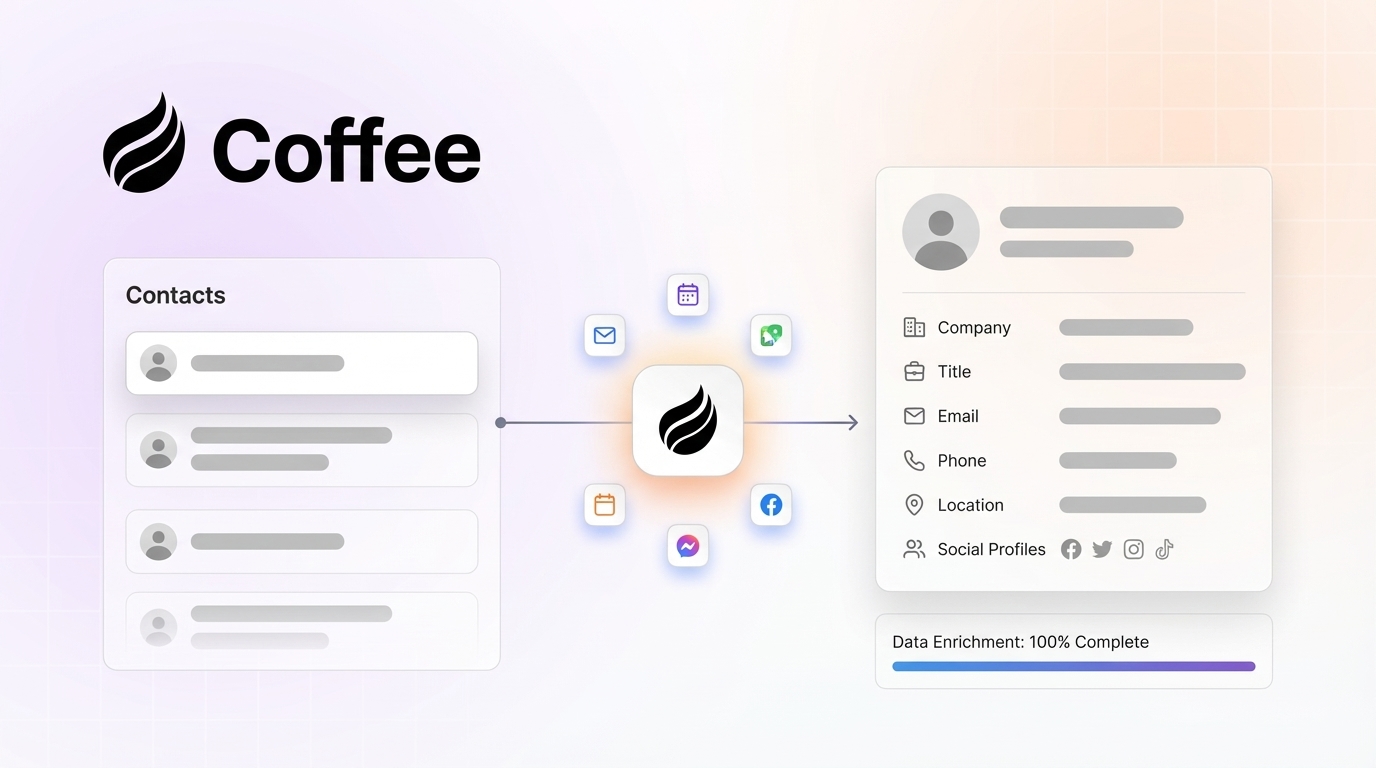
Coffee shifts CRM enrichment from passive data delivery to active AI execution that removes manual CRM maintenance. After connecting to Google Workspace or Microsoft 365, the Coffee Agent starts autonomous data enrichment and activity logging without human setup work.
Autonomous contact creation: The agent scans email communications and calendar invitations, then automatically creates and enriches contact records with job titles, company information, and LinkedIn profiles. This process replaces manual research and data entry that usually drains sales rep productivity.

Trigger-based activity logging: Every email, meeting, and interaction is logged with context and next steps. The agent keeps deal stages and pipeline velocity current, so reps no longer need to update CRM fields by hand.

Unstructured data processing: Coffee processes call transcripts, email content, and meeting notes to extract actionable insights. Legacy CRMs focus on structured fields, which limit visibility. Coffee turns unstructured data into a complete customer intelligence layer.

Flexible deployment options: Coffee can run as a standalone CRM for SMBs or as a companion agent for existing Salesforce and HubSpot setups. This flexibility lets teams adopt the agent without replacing their current stack.
One company generating tens of millions in revenue managed sales in spreadsheets because manual entry did not scale. The team rejected Salesforce and HubSpot due to heavy manual requirements. Coffee’s autonomous data management and Pipeline Compare feature automated weekly reviews and exposed pipeline changes, while API access supported custom briefings. The company gained enterprise-level visibility without extra administrative work.

Coffee holds SOC 2 Type 2 and GDPR compliance, which supports enterprise security standards. At the same time, the agent saves teams 8-12 hours per week on data management tasks. Get started with Coffee for automated CRM data enrichment and remove manual data entry from your sales process.
Implementing CRM Enrichment and Tracking Results
Effective CRM data enrichment implementation centers on automation and clear measurement. Connect email and calendar systems first to enable automatic data capture, then configure trigger rules for events such as new contact creation or deal stage changes.
Key success metrics include CRM adoption rates, data completeness, and pipeline velocity improvements. Many traditional rollouts fail because they still rely on humans for data maintenance. Coffee avoids this problem through autonomous agent operation that removes manual bottlenecks.
Teams should monitor enrichment accuracy and coverage while tracking time saved from automated workflows. The target outcome is full removal of manual data entry, not a small reduction. Revenue leaders can then measure how much time shifts from administrative work to direct revenue activities as the primary ROI signal.
Conclusion: Why Autonomous Agents Win for B2B CRM Enrichment
B2B CRM data enrichment works best when autonomous AI agents remove manual workflows from the process. Traditional tools like ZoomInfo and Apollo provide strong data sets but keep the administrative burden that slows sales teams. Coffee’s agent-first model delivers automation for data enrichment, activity logging, and pipeline intelligence in one system.
Get started with Coffee for comprehensive CRM data enrichment and upgrade your B2B sales process with autonomous AI.
FAQs
How does CRM data enrichment work?
CRM data enrichment supplements contact and company records with extra information from external data sources. The process connects to email systems, calendars, and public databases to gather firmographic, technographic, and behavioral data. Modern AI agents like Coffee automate this workflow and scan communications to create enriched records without manual effort. Traditional tools still need human oversight to push data into CRMs, while autonomous agents manage both data acquisition and CRM updates in one flow.
What is the best B2B data provider for sales teams?
The right B2B data provider depends on how much automation your team needs. Traditional providers like ZoomInfo offer large firmographic databases but still require manual CRM maintenance. Apollo supports real-time contact enrichment but can face accuracy gaps. Coffee stands out as an autonomous AI agent that combines enrichment with automatic CRM management, which removes the 6 hours per week sales reps usually spend on admin tasks. Teams should choose a solution that covers both data acquisition and CRM hygiene automatically.
How do ZoomInfo and AI agents compare for CRM enrichment?
ZoomInfo delivers extensive firmographic data but relies on manual processes to maintain CRM hygiene and push information into sales systems. AI agents like Coffee automate the enrichment workflow from end to end, including data acquisition, CRM updates, and activity logging. ZoomInfo excels at data volume, but it keeps the manual administrative burden that slows sales productivity. AI agents remove human dependency in enrichment and combine data quality with workflow automation in a single solution.
Can you enrich HubSpot automatically without manual work?
Autonomous AI agents can enrich HubSpot automatically without manual effort from sales reps. Coffee’s companion app integrates with HubSpot to manage contact creation, data enrichment, and activity logging on its own. The agent scans connected email and calendar systems and fills HubSpot records with job titles, company information, and interaction history. This setup removes manual data entry and keeps CRM hygiene consistent.
What are the benefits of real-time CRM data enrichment?
Real-time CRM data enrichment keeps sales teams working with current, actionable information. Teams gain immediate visibility into job changes, funding events, and buying intent signals, which support timely outreach. Real-time enrichment powers trigger-based automation for lead scoring and routing and preserves data freshness that improves AI accuracy. The main benefit is the removal of lag between data updates and sales action, so teams can act on opportunities as they appear.