

Key Takeaways
- AI agent automation removes manual data entry, fixes the 76% CRM data inaccuracy problem, and supports 91% adoption rates for small businesses.
- WIIFM-focused training and clean data foundations encourage natural user adoption and help achieve $8.71 ROI per $1 spent on CRM.
- Proven frameworks like the 7 C’s, 5 Principles, and 4 Pillars work best when paired with AI agents for complete customer relationship management.
- Automating meeting summaries, follow-ups, and pipeline tracking saves sales teams 8-12 hours weekly and increases productivity by 25-47%.
- Apply these 12 golden rules today with Coffee’s AI agent to scale CRM success without traditional headaches.
Golden Rule #1: Use Agent Automation to Keep Data Clean
Clean data forms the base of effective CRM. Yet 80% of companies report their CRM data is inaccurate, and 40% of CRM data becomes obsolete annually. Traditional CRMs struggle because they depend on humans to input and maintain data quality.
Deploy an AI agent that captures interactions from email and calendar systems, enriches contact records with firmographic data, and maintains data hygiene automatically. Coffee’s agent scans Google Workspace or Microsoft 365 to auto-create contacts and companies, ensuring complete capture compared with manual HubSpot or Salesforce entry. This approach prevents data decay and creates a clean foundation for reliable insights.

Golden Rule #2: Train Around WIIFM to Boost Adoption
CRM adoption improves when sales reps see the system as a productivity multiplier, not extra work. Many CRM rollouts fail due to lack of internal training, and sales teams resist CRMs that require too much manual input.
Center training on “What’s In It For Me” (WIIFM) benefits instead of feature tours. Show reps how the CRM saves 8-12 hours per week through automation, prepares them with meeting briefings, and drafts follow-up emails they can quickly approve. When Coffee’s agent handles data entry automatically, reps feel immediate value instead of extra burden, which encourages natural adoption.
Golden Rule #3: Apply the 7 C’s with Agent Support
The 7 C’s framework gives a complete approach to CRM: Customer identification, Customer acquisition, Customer retention, Customer extension, Customer selection, Customer interaction, and Customer information management. The CRM value chain model helps businesses prioritize customer needs and build stronger relationships.
Apply each C step by step with help from an AI agent. Coffee’s agent manages Customer information management by auto-logging interactions, supports Customer identification through enriched profiles, and improves Customer interaction through automated meeting summaries and follow-ups. This structure keeps coverage complete while the agent handles operational complexity.
Golden Rule #4: Set Specific CRM Targets You Can Measure
Successful CRM programs start with clear, quantifiable objectives instead of vague productivity hopes. Teams should define measurable goals like reducing admin time by 40% or boosting conversions by 25% before CRM selection.
Choose concrete targets such as increasing forecast accuracy by 42%, improving lead conversion by 300%, or reaching 27% higher customer retention. Coffee’s Pipeline Compare feature gives week-over-week visibility into deal progression, so goal tracking happens automatically instead of through manual spreadsheet exports.
Golden Rule #5: Automate Repetitive Work to Protect Selling Time
Sales productivity rises when reps spend less time on administrative tasks. Sales teams using AI agents see 25-47% productivity gains from time saved on repetitive work like lead enrichment, intent scoring, and data entry.
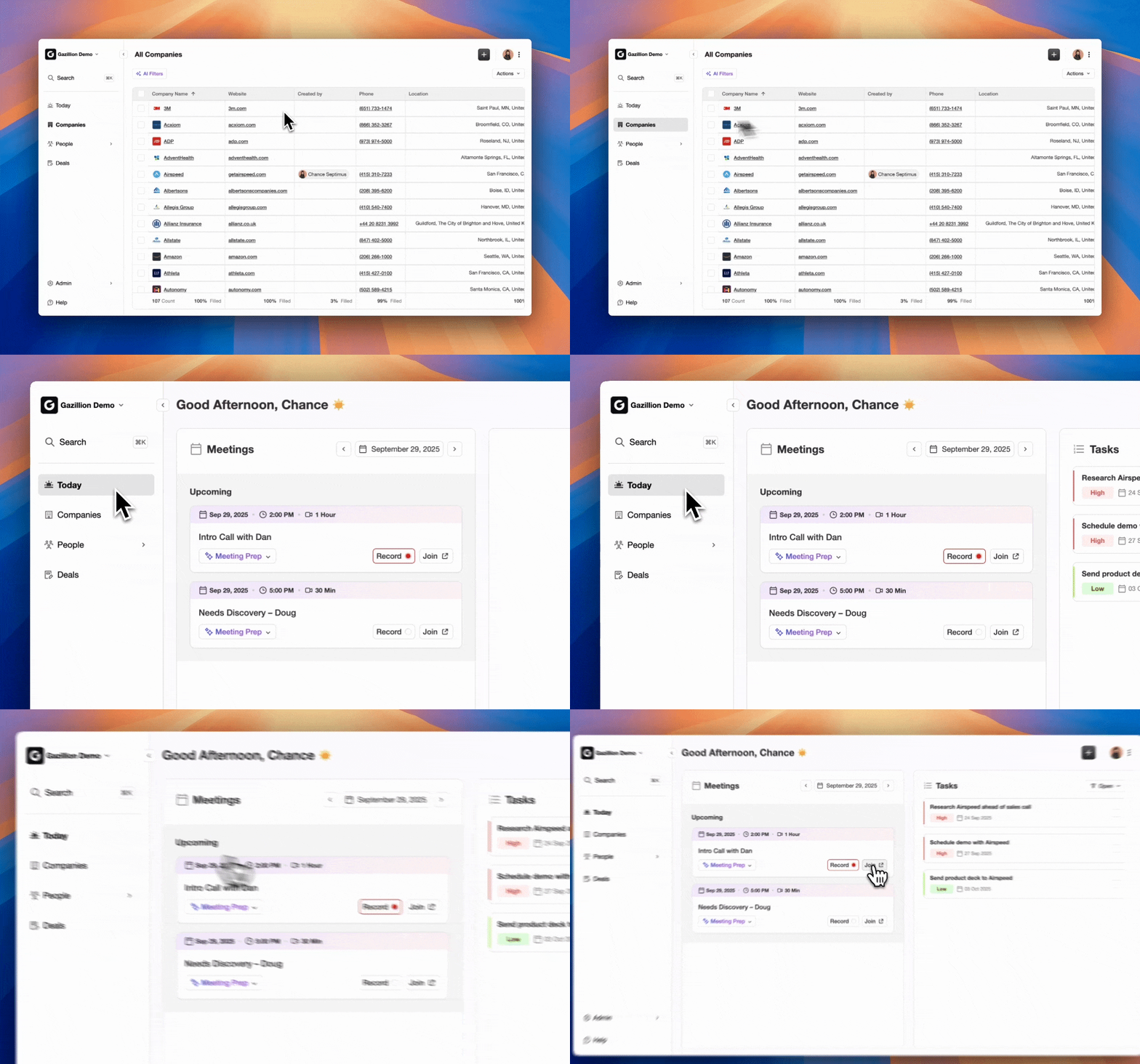
Automate contact creation, activity logging, meeting preparation, and follow-up generation. Coffee’s agent joins Zoom calls to record and transcribe, creates meeting summaries with next steps, and drafts follow-up emails in Gmail for review. This shift turns reps from data entry clerks into strategic sellers who focus on relationships and deals.
Golden Rule #6: Connect Your Tools for a Full Customer View
Fragmented data across tools creates inefficiency and incomplete customer views. Only 62% of organizations report having integrated systems, and only 32% have a single customer view across platforms.
Connect email, calendar, communication tools, and enrichment sources into one system. Coffee integrates with Google Workspace and Microsoft 365 to unify structured and unstructured data, so teams avoid switching between HubSpot, ZoomInfo, outreach tools, and recording apps. This integration delivers complete customer context without manual data stitching.
Golden Rule #7: Use the 5 CRM Principles with AI Help
Effective CRM rests on five principles: customer-centricity, process optimization, technology enablement, data-driven decisions, and continuous improvement. Payne and Frow’s Five Processes CRM model offers a simple structure for better CRM performance across functions.
Support each principle with an AI agent. Coffee improves customer-centricity with complete interaction history, streamlines processes through automated workflows, strengthens technology through seamless integrations, supports data-driven decisions with accurate pipeline intelligence, and encourages continuous improvement with detailed activity tracking and outcome analysis.
Golden Rule #8: Personalize Every Touchpoint with AI
Modern customers expect tailored experiences, yet manual personalization breaks down for small teams. In 2026, small businesses should use CRM to deliver personalized offers across email, WhatsApp, social media, and websites.
Use AI to analyze behavior, purchase history, and interaction patterns, then send tailored recommendations and messages. Coffee’s agent prepares personalized meeting briefings with attendee context, role details, and past interactions, so reps deliver relevant experiences without hours of manual research.

Golden Rule #9: Support Mobile CRM for On-the-Go Selling
Mobile CRM access improves quota attainment and productivity. 65% of salespeople using mobile CRM hit their quotas, compared with 22% who do not. Mobile-first CRM tools are a major trend for small businesses in 2026.
Choose a CRM that offers full functionality on mobile with a simple, responsive interface. Coffee’s web-based experience lets reps access meeting briefings, review pipeline changes, and approve AI-generated follow-ups from anywhere, while the agent continues working in the background.
Golden Rule #10: Strengthen the 4 CRM Pillars Together
The four pillars of CRM, people, process, technology, and data, must align for success. The Gartner CRM model outlines eight critical components of effective CRM implementation.
Reinforce each pillar in a coordinated way. Coffee supports the people pillar by cutting manual work, improves the process pillar with automated workflows, delivers advanced technology through AI agents, and protects the data pillar through automatic capture and enrichment. This balance creates a stable base for CRM success.
Golden Rule #11: Start with Essentials and Scale Features
SMEs will grow CRM use at 16.2% a year from 2025 to 2030, faster than large enterprises. The strongest CRM strategies for small businesses begin with lead tracking, contact management, and basic automation.
Launch with core features and expand as your team and processes mature. Coffee lets you begin with contact management and activity logging, then layer in pipeline intelligence and list building as needs evolve. This approach avoids overwhelm while keeping a clear path to scale.

Golden Rule #12: Use Agents to Power Pipeline Intelligence
Accurate pipeline management depends on consistent data capture and analysis that manual processes rarely sustain. 70% of revenue leaders lack confidence in their CRM data accuracy, which makes forecasting unreliable.
Deploy an AI agent that tracks pipeline changes, deal progression, and activity completion automatically to support reliable forecasts. Coffee’s Pipeline Compare feature shows week-over-week changes, flags progressed deals and stalled opportunities, and turns pipeline reviews into strategic discussions instead of manual spreadsheet sessions.
CRM Frameworks Explained for Small Teams
Clear CRM frameworks help small businesses build strategies that cover every critical success factor.
The 7 C’s of CRM in Practice
The 7 C’s cover Customer identification, Customer acquisition, Customer retention, Customer extension, Customer selection, Customer interaction, and Customer information management. Coffee’s agent automates information management and supports the other C’s with enriched data and automated workflows.
How the 5 Principles and 4 Pillars Work Together
|
Framework |
Key Elements |
Coffee Agent Benefit |
|
5 Principles |
Customer-centricity, Process optimization, Technology enablement, Data-driven decisions, Continuous improvement |
Provides complete customer context, automates workflows, enables seamless integrations, ensures data accuracy |
|
4 Pillars |
People, Process, Technology, Data |
Reduces manual burden, improves workflows, delivers AI capabilities, protects data quality |
Case Study: Coffee Saves a Small AI Firm 8-12 Hours Weekly
A custom AI solutions company with tens of millions in revenue managed sales through spreadsheets and knew that manual entry would not scale. They rejected Salesforce and HubSpot because of heavy manual work and chose Coffee’s agent instead.
Coffee’s agent created contacts from Google Workspace, kept data clean without human effort, and powered Pipeline Compare for automated weekly reviews. API access let them script custom prompts for tailored briefings while the agent handled routine CRM maintenance. The team saved 8-12 hours per week and gained better data quality and insights than with traditional CRMs. Get started with Coffee to pursue similar results.
FAQ
Why do small business CRMs fail?
Small business CRMs often fail because manual data entry overwhelms busy sales teams. With 71% of reps spending too much time on data entry and only 35% on selling, traditional CRMs feel like a drag. Low adoption creates poor data quality, which produces weak insights and abandoned systems. The manual maintenance burden hits small teams hardest because they lack dedicated admin support.
How does Coffee automate CRM data entry?
Coffee’s AI agent connects to Gmail, Outlook, and calendar systems to capture customer interactions, create contact records, and log activities automatically. The agent joins video calls to record and transcribe conversations, creates meeting summaries with next steps, and drafts follow-up emails for review. This automation removes the manual data entry that hurts CRM adoption and keeps customer records complete and accurate.

What are the 7 C’s of CRM for small businesses?
The 7 C’s of CRM are Customer identification, Customer acquisition, Customer retention, Customer extension, Customer selection, Customer interaction, and Customer information management. For small businesses, this means knowing prospects through enriched data, converting leads with personalized outreach, maintaining relationships through consistent follow-up, expanding accounts with upsell opportunities, prioritizing high-value prospects, managing all touchpoints, and keeping data clean and actionable. An AI agent can automate information management and support every other area.
What ROI can small businesses expect from CRM?
Small businesses often see strong returns from effective CRM, with industry data showing $8.71 ROI for every $1 spent. Benefits include a 27% increase in customer retention, 42% better sales forecasting accuracy, and 300% improvement in lead conversion. Companies using AI-powered CRM automation report 25-47% productivity gains from time saved on repetitive tasks, which lets sales teams focus on revenue-generating work.
How should small businesses choose between standalone CRM and companions?
Small businesses should choose a standalone CRM when starting fresh or replacing spreadsheets, since it offers a complete, integrated setup without legacy complexity. A CRM companion fits better when a team already uses Salesforce or HubSpot but struggles with data quality and manual entry. The key question is whether you want an AI agent to power your full system of record or enhance an existing platform. Both paths can deliver automation benefits, though standalone tools usually offer simpler rollout and lower total cost for small teams.
Brew CRM Success with Coffee
These 12 golden rules turn CRM from a manual chore into an automated advantage. By pairing proven relationship principles with AI agents, small businesses gain enterprise-level insights without enterprise-level complexity. The priority is hiring an AI agent that handles busywork while you focus on relationships and revenue.
Coffee’s agent removes the manual data entry that blocks CRM adoption, delivers clean data for accurate insights, and automates workflows for consistent follow-up and pipeline management. Get started with Coffee today and apply these golden rules with an AI agent that works nonstop for your CRM success.