
Sales reps often wrap up a productive client call only to spend the next half-hour updating CRM fields, organizing notes, and tracking deal progress. This repetitive admin work eats into time that could be spent on closing deals or building relationships. Across the globe, countless sales teams face this challenge every day, turning potential revenue moments into tedious tasks.
Traditional CRMs, once seen as solutions, now often slow teams down. Tools like Salesforce and HubSpot, while established, can drain productivity with fragmented data and outdated systems. Sales teams need a better approach, one that prioritizes efficiency over paperwork. AI-powered CRMs offer this shift, acting as intelligent assistants that automate routine tasks and provide actionable insights, allowing reps to focus on selling.
Understanding the Market: The Evolving Landscape of Sales Tools
The sales technology market has undergone significant changes over the past decade. Initially, CRMs like Salesforce, launched in 1999, brought structure to customer relationships by centralizing data. As digital tools grew, so did complexity, with sales teams now juggling multiple platforms for lead generation, outreach, and analytics. This fragmentation often results in inefficient workflows and missed opportunities.
Recent data highlights the scale of this issue. Sales reps spend just 28% of their time on direct selling, with the rest consumed by administrative tasks. Meanwhile, the CRM market, valued at over $50 billion in 2023, continues to grow as companies search for better solutions. The rise of AI offers a turning point, enabling tools to not just store data but analyze and act on it in real time, addressing long-standing pain points in sales processes. Salesforce’s State of Sales Report offers deeper insights into these trends.
Yet, adopting new technology isn’t without trade-offs. While AI-driven CRMs promise automation, they require clean data inputs to function effectively. Legacy systems, though familiar, often lack the flexibility to integrate with modern AI capabilities without costly customization. On balance, the shift toward intelligent tools provides clear value by reducing manual workload and improving decision-making, positioning forward-thinking companies to gain a competitive edge.
Why Traditional CRMs Fall Short in Today’s Sales Environment
Data Fragmentation Hinders a Unified Customer View
Sales teams today rely on a patchwork of tools. A rep might check leads in HubSpot, pull contact details from ZoomInfo, sequence emails via SalesLoft, record calls with Fathom, and manage pipelines in personal spreadsheets or Notion. This scattered approach creates data silos, making it hard to see the full picture of prospects and clients.
As a result, deals slip through gaps, follow-ups lag, and reps waste time navigating between apps instead of engaging with customers. Without a centralized view, conversations with prospects often lack the context needed to build trust or address specific needs.
Manual Updates Drain Valuable Selling Hours
Legacy CRMs demand significant manual input. After every call or meeting, reps must log notes, update opportunity statuses, copy emails, and ensure records are accurate. Studies indicate that 71% of sales professionals feel overwhelmed by data entry, cutting their active selling time to just 35% of their week. HubSpot’s data sheds light on this productivity loss.
This manual process not only consumes time but also leads to errors. Rushed updates between calls often miss key details, leave contacts outdated, and render pipeline data unreliable, undermining the CRM’s core purpose of organizing customer relationships.
Outdated Systems Struggle with Modern Demands
Many traditional CRMs were designed in a different era. Salesforce, for instance, operates on architecture that predates today’s real-time, AI-focused business needs. Even with updated interfaces, handling unstructured data like email content or call transcripts remains a challenge without extra tools or customization.
HubSpot, originally a marketing platform, expanded into CRM later. This history can create gaps in providing a fully cohesive design for customer data management compared to systems built with sales as the primary focus. These structural limitations often hinder seamless AI integration.
Low Adoption Leads to Hidden Workarounds
Frustration with traditional CRMs results in poor user adoption. Sales reps often see these systems as tools for management reporting rather than aids for closing deals. When a platform feels cumbersome, reps turn to alternatives like personal spreadsheets, Notion, or even paper notes to track their real pipelines.
This creates a cycle of incomplete data, making the CRM less useful and further discouraging use. Management ends up with inaccurate forecasts while the actual sales work happens outside the official system, eroding visibility and control.
Coffee: A Leader in the AI CRM Movement for Sales Efficiency
As part of the broader trend toward AI-driven sales tools, Coffee stands out by rethinking CRM design from the ground up. Focused on automation and user-friendly features, Coffee tackles the core issues of legacy systems. It serves as a practical example of how AI is reshaping sales technology, prioritizing high-quality data and intelligent workflows over manual input.
Coffee’s foundation lies in capturing accurate, real-time data from emails, calendars, and calls. This ensures AI functions effectively, creating a cycle where better data leads to smarter insights, which in turn improves data capture. Unlike traditional systems, Coffee aims to support sales reps directly, reducing admin tasks and enhancing their day-to-day experience.
Key Advantages of Coffee’s AI-Driven Approach
- Ends manual data entry by auto-creating and updating contacts and activities, saving reps an estimated 8-12 hours weekly.
- Handles pre- and post-meeting tasks with AI-generated briefings, summaries, and follow-up email drafts.
- Offers pipeline insights with one-click historical comparisons and real-time tracking of changes.
- Combines CRM, data enrichment, call recording, and forecasting into a single platform, reducing tech stack complexity.
- Delivers an intuitive interface that reps find helpful, acting like a supportive co-pilot for sales tasks.
How Coffee Enhances Sales Team Performance
Automated Data Capture Saves Time and Effort
Once connected to Google Workspace or Microsoft 365, Coffee instantly starts pulling data from emails and calendars. It creates contact and company records automatically, linking every interaction without manual effort. Beyond basic capture, it enriches data with details like job titles, company history, funding status, and LinkedIn profiles using trusted data partners, eliminating the need for separate tools like ZoomInfo.
This automation keeps activity logs current, ensuring fields like “last contact” or “next step” always reflect the latest information directly from integrated systems, cutting out update-related errors.
Streamlined Meeting Prep and Follow-Up with AI
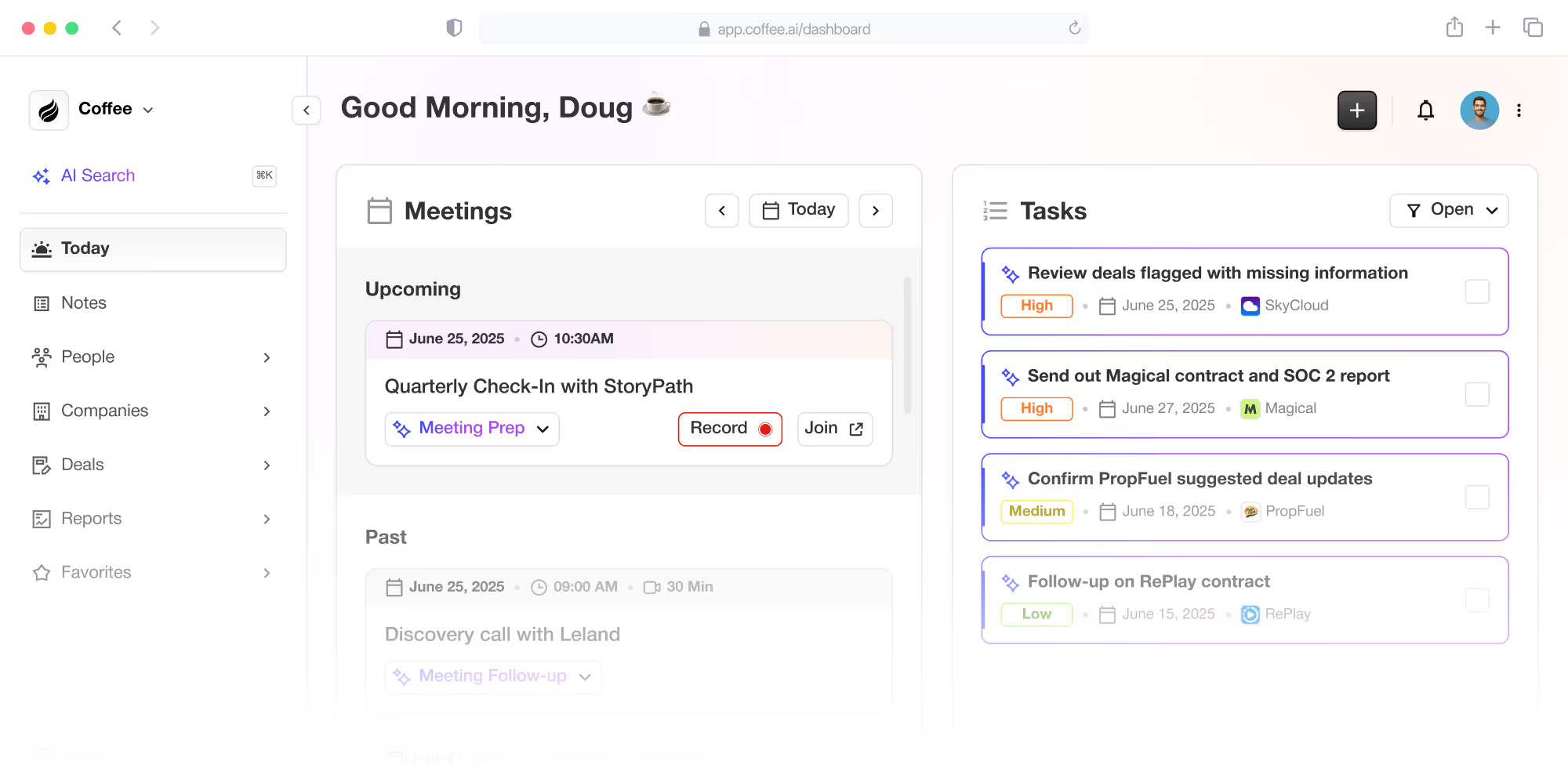
Coffee simplifies the entire meeting process. Before a call, reps get a tailored “Today” page with attendee details, company background, and past interaction summaries, ensuring they’re always prepared. During meetings, an AI bot joins platforms like Google Meet or Zoom to record and transcribe discussions.
Afterward, Coffee produces concise summaries, flags action items, and drafts follow-up emails ready to send from Gmail with minor edits. These summaries can align with sales frameworks like BANT or MEDDIC, maintaining consistency across the team’s deal qualification process.
Pipeline Clarity with Historical Tracking
Unlike static CRM reports, Coffee uses a built-in data warehouse to store historical pipeline snapshots. Its “Compare” feature lets reps see changes over any time frame with one click, showing deals that advanced, new opportunities, closed wins, or stalled progress.
This instant insight replaces manual data exports and spreadsheet work, turning pipeline reviews into focused strategy sessions. Teams can spot issues early and prioritize actions to keep deals moving forward.
Unified Platform Reduces Tool Overload
Coffee integrates multiple functions into one system, covering CRM, data enrichment, call recording, and forecasting. This cuts the need for separate subscriptions and reduces workflow disruptions caused by switching tools. Its List Builder feature, for example, lets reps create targeted prospect lists using natural language queries like, “Find VPs of sales in North American companies with 50-500 employees.”
Consolidation lowers costs, simplifies vendor management, reduces training needs, and keeps customer data consistent across all sales activities, improving overall efficiency.
Comparing Coffee to Traditional CRMs and Manual Methods
|
Feature/Benefit |
Coffee (AI CRM) |
Traditional CRM |
Manual Processes |
|
Data Entry |
Fully Automated, AI-Driven |
Manual, Time-Intensive |
Completely Manual, Error-Prone |
|
Data Enrichment |
Built-In, Always Updating |
Needs External Paid Tools |
Manual Research, Inconsistent |
|
Meeting Management |
AI Briefings, Auto Summaries |
Manual Notes, Basic Reminders |
No Support, High Effort |
|
Pipeline Visibility |
Historical Comparisons, Real-Time |
Static Reports, Manual Analysis |
Basic Tracking, No Insights |
See how automation can change your sales process. Request access to Coffee’s AI CRM and explore a new way to drive productivity.
Real Results: How Coffee Transformed a Growing Business
A custom AI solutions company generating tens of millions in revenue faced challenges scaling their sales process using spreadsheets. Despite their expertise with Fortune 500 clients, their internal system couldn’t keep up. After reviewing options like Salesforce, HubSpot, and Attio, they selected Coffee for its straightforward setup and minimal training needs.
Coffee’s automatic contact creation from Google Workspace removed manual data entry, while the Pipeline Compare feature streamlined weekly reviews, making them more actionable. Their tech-savvy team also used Coffee’s API to customize data access for tailored sales prompts, enhancing their process further.
Flexible Options: Coffee Fits Any Sales Setup
Coffee offers two models to meet diverse needs. For smaller teams of 1-20 employees moving beyond spreadsheets, the Standalone AI-First CRM delivers a complete, modern solution. For companies already using Salesforce or HubSpot, the Companion App adds an intelligent layer, enhancing existing setups without replacement.
Both options address common issues like low CRM usage, inconsistent data, missed information from interactions, and the cost of managing multiple tools, ensuring sales reps get the support they need.
Answering Your Questions About AI CRM
How Does AI CRM Increase Sales Productivity?
AI CRMs like Coffee shift reps’ focus from admin tasks to selling. By automating data entry, contact updates, and prospect research, reps spend more time on conversations and deals. Coffee captures interactions from emails and calendars, enriches records automatically, and preps meeting insights, freeing up hours for relationship-building while keeping data accurate.
Does Coffee Work with Salesforce or HubSpot?
Yes, Coffee’s Companion App integrates smoothly with Salesforce and HubSpot. After a simple setup, it syncs data and adds AI-driven features without disrupting current workflows. Teams decide which insights or enriched data to sync back to their primary system, maintaining full control.
What Makes Coffee’s Data Enrichment Reliable?
Coffee pulls data from real business interactions like emails and call transcripts, building a solid base ofAccurate information. It then enhances this with premium licensed data on job roles, company details, and funding status. Continuous updates keep records current without manual effort.
Is Coffee Suitable for All Team Sizes?
Coffee targets small to mid-sized companies, from startups with solo founders to firms with dedicated sales staff. The Standalone CRM suits teams of 1-20 moving from basic tools, while the Companion App helps larger teams with existing CRMs improve data quality and adoption.
How Does Coffee Protect Data Security?
Coffee adheres to SOC 2 Type 2 and GDPR standards, maintaining strict security and privacy protocols. Robust policies govern data storage and processing, ensuring customer information remains protected across all operations.
Looking Ahead: AI CRM Defines the Future of Sales
The move from fragmented, manual sales tools to automated, intelligent systems is underway. Teams adopting AI CRMs like Coffee gain measurable boosts in efficiency and data reliability, while others lag behind with outdated platforms.
Coffee represents a shift toward tools that support sales professionals directly. From capturing and enriching data to preparing meetings and tracking pipeline trends, it enables teams to work smarter. The choice is straightforward: stick with systems that hinder progress or embrace automation that prioritizes selling over admin work.
Don’t let outdated CRMs limit your team’s potential. Step into the future of sales with AI-driven tools. Request access to Coffee’s AI CRM and see how smarter technology can elevate your sales efforts.