
Key Takeaways for B2B SaaS Pipelines in 2026
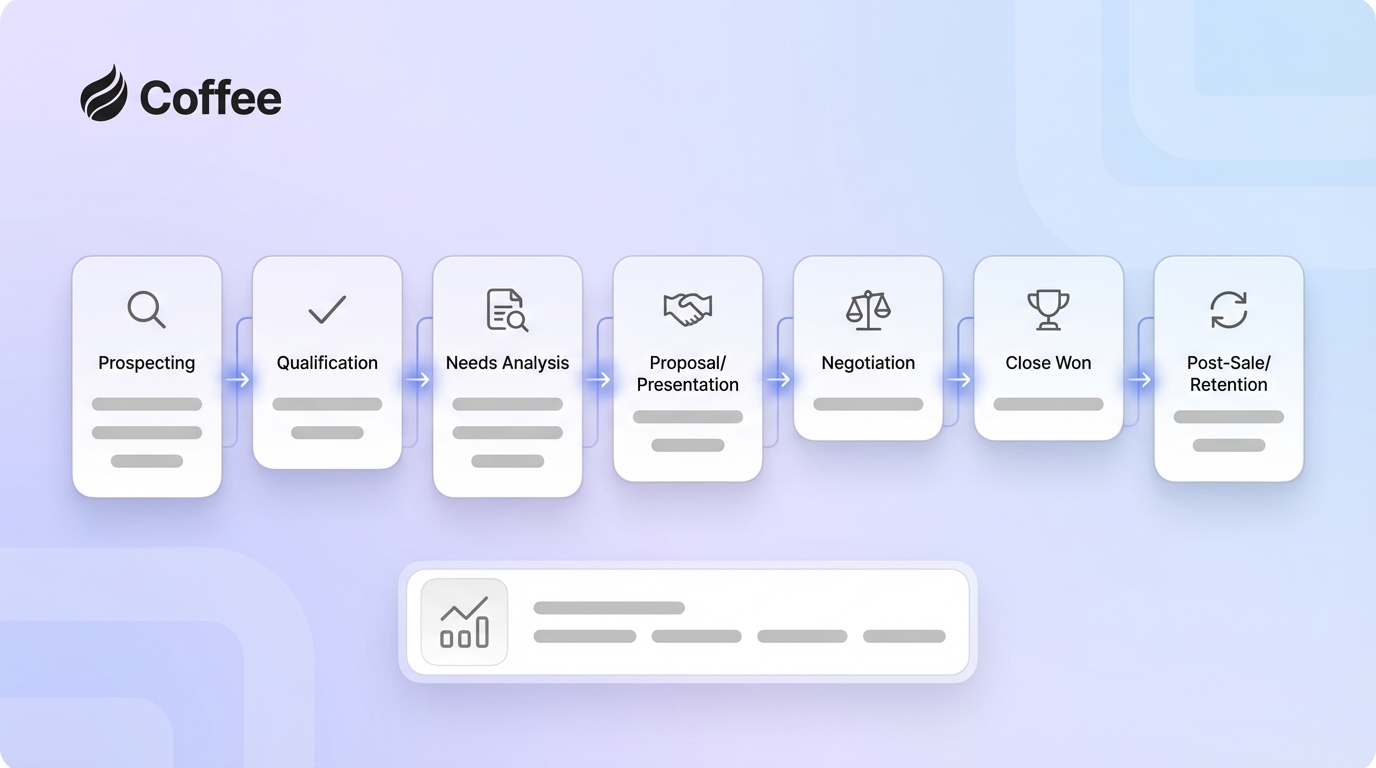
- B2B SaaS sales pipelines in 2026 typically run on 90-day cycles and follow 7 clear stages from prospecting to post-sale retention for predictable revenue.
- Manual data entry consumes 71% of sales rep time and causes a 65% efficiency loss, while AI automation across stages removes this bottleneck.
- Critical benchmarks include 20% outbound email response rates, 13-21% MQL to SQL conversion, and 120% or higher net revenue retention for top performers.
- Common bottlenecks such as fragmented data, weak qualifications, and stalled negotiations improve when AI agents handle enrichment, summaries, and insights.
- Streamline your pipeline with Coffee’s autonomous CRM to automate data entry and increase efficiency across all 7 stages.
1. Prospecting: Filling the Top of Your SaaS Pipeline
Goal
Identify and engage ideal customer profile (ICP) prospects through targeted outreach and focused lead generation activities.
Key Actions:
- Capture inbound leads from marketing campaigns
- Run cold outreach via email and LinkedIn
- Build pipeline through networking and referrals
- Execute account-based prospecting for enterprise targets
KPIs and Benchmarks: Outbound email response rates average 20% with meeting booking rates at 2.3% for 2026. Website visitor-to-lead conversion typically sits around 2.3% for B2B SaaS companies.
Common Bottlenecks: Fragmented data across multiple tools slows prospect research and follow-up, which reduces outreach volume and quality.
Coffee Automation: The Coffee Agent automatically creates and enriches prospect records from emails and calendars, logs all activities, and saves sales reps 8-12 hours per week on manual data entry.

2. Qualification: Focusing on Real Opportunities
Goal
Assess prospect fit using BANT (Budget, Authority, Need, Timeline) or MEDDIC frameworks so only viable opportunities move forward.
Key Actions:
- Run discovery calls to understand pain points
- Verify budget, timing, and urgency
- Identify decision-makers and influencers
- Score and prioritize leads based on fit and intent
KPIs and Benchmarks: Qualified leads should advance at roughly 30%, with MQL to SQL conversion averaging 13-21% across the industry. This stage often becomes the largest bottleneck in B2B SaaS funnels.
Common Bottlenecks: Poor follow-up timing and inconsistent qualification criteria create stalled prospects and wasted sales effort.
Coffee Automation: The Agent structures meeting notes using BANT or MEDDIC, so consistent qualification data enters the system without extra work from reps.

3. Needs Analysis and Discovery: Understanding the Customer Problem
Goal
Reveal specific business challenges, technical requirements, and success metrics so you can position the solution with precision.
Key Actions:
- Host deep-dive discovery calls with all key stakeholders
- Analyze current workflows and processes
- Prioritize and quantify pain points and business impact
- Gather detailed technical and integration requirements
KPIs and Benchmarks: SQL to opportunity conversion typically ranges from 30-59%. Strong discovery calls move qualified prospects toward tailored solution presentations.
Common Bottlenecks: Heavy manual research and preparation limit rep capacity for thorough discovery conversations.
Coffee Automation: Coffee delivers comprehensive meeting briefings with attendee context and company background, which supports more strategic discovery sessions.

4. Proposal and Presentation: Showing the Value Clearly
Goal
Deliver tailored solution demos and proposals that connect directly to the prospect’s stated needs and business outcomes.
Key Actions:
- Run customized product demonstrations for each account
- Build ROI calculations and a clear business case
- Set up proofs of concept or time-bound trials
- Align stakeholders through review and feedback meetings
KPIs and Benchmarks: Opportunity to customer conversion averages 22-30% across B2B SaaS companies. Presentation quality and relevance strongly influence advancement rates.
Common Bottlenecks: Generic decks and weak objection handling reduce conversion during this critical evaluation stage.
Coffee Automation: The Agent generates AI-powered meeting summaries and action items, which supports consistent follow-up and stakeholder alignment throughout evaluation.

5. Negotiation: Moving Deals Across the Finish Line
Goal
Resolve final concerns, negotiate contract terms, and secure stakeholder buy-in so the deal can close.
Key Actions:
- Negotiate pricing, terms, and contract structure
- Complete security and compliance reviews
- Coordinate with legal and procurement teams
- Plan implementation timelines and milestones
KPIs and Benchmarks: Average B2B SaaS win rates range from 21-28%, while top-performing teams reach 30-40% win rates with strong negotiation strategies.
Common Bottlenecks: Deals often stagnate when prospects enter long evaluation periods without clear next steps or urgency drivers.
Coffee Automation: Coffee’s Pipeline Compare feature flags at-risk deals and shows week-over-week progression, which enables proactive intervention before deals stall.
6. Close Won: Handing Off Cleanly to Customer Success
Goal
Complete contract execution and create a smooth handoff to customer success teams for implementation.
Key Actions:
- Finalize contracts and legal approvals
- Set up payment processing and billing
- Transfer ownership to the customer success team
- Schedule implementation kickoff and onboarding milestones
KPIs and Benchmarks: Average B2B SaaS deal sizes reach about $50,000 for mid-market segments. Clean handoffs play a major role in retention and future expansion.
Common Bottlenecks: Paperwork delays and weak internal coordination extend time-to-value for new customers.
Coffee Automation: Automated activity logging sends complete deal history to customer success teams, which supports a seamless onboarding experience.
7. Post-Sale and Retention: Growing Lifetime Value
Goal
Drive onboarding, adoption, expansion, and renewal so each customer reaches strong lifetime value and net revenue retention targets.
Key Actions:
- Deliver structured onboarding and product training
- Monitor health scores and product usage trends
- Identify expansion, cross-sell, and upsell opportunities
- Prepare early for renewals and run a clear renewal process
KPIs and Benchmarks: Leading B2B SaaS companies achieve 120% or higher net revenue retention with effective post-sale strategies. Customer health scoring often predicts renewal likelihood.
Common Bottlenecks: Limited visibility into customer health and usage patterns causes surprise churn and missed expansion chances.
Coffee Automation: The Coffee Agent maintains accurate data logging and pipeline insights, which supports focused and proactive customer success work.
Sales Pipeline vs. Sales Funnel in B2B SaaS
Sales pipelines track individual deal progression through defined stages with specific activities and probabilities. Sales funnels measure overall volume and conversion rates across the full prospect base, which highlights where leads drop off and where the process needs improvement.
2026 B2B SaaS Pipeline Benchmarks at a Glance
|
Stage |
Key Performance Indicator |
2026 Benchmark |
|
Prospecting |
Email Response Rate |
20% |
|
Qualification |
MQL to SQL Conversion |
13-21% |
|
Discovery |
SQL to Opportunity |
30-59% |
|
Proposal |
Opportunity to Customer |
22-30% |
|
Negotiation |
Overall Win Rate |
25% |
|
Close |
Average Deal Size |
$50,000 |
|
Retention |
Net Revenue Retention |
120%+ |
Average sales cycles extend to 90 days, while enterprise deals often require 9-12 months because of complex buying committees.
One Coffee customer generating tens of millions in revenue automated their pipeline reviews through the Agent and moved away from Salesforce and HubSpot’s manual processes. Coffee’s Pipeline Compare feature turned weekly reviews from interrogation sessions into strategic discussions and removed the need for spreadsheet-based tracking.
Get started with Coffee to turn manual pipeline management into an automated revenue engine.
Frequently Asked Questions
What are the 7 stages of a B2B sales pipeline?
The seven stages are: 1. Prospecting, which identifies potential customers, 2. Qualification, which assesses fit using BANT or MEDDIC, 3. Needs Analysis and Discovery, which uncovers specific challenges, 4. Proposal and Presentation, which delivers tailored solutions, 5. Negotiation, which addresses concerns and terms, 6. Close Won, which finalizes contracts, and 7. Post-Sale and Retention, which covers onboarding, expansion, and renewal.
What are the stages of the B2B pipeline?
B2B pipelines move from Prospecting through Qualification, Discovery, Proposal, Negotiation, Close, and Post-Sale Retention. Each stage has clear goals, activities, and success metrics that guide prospects toward becoming customers and then expanding their relationship over time.
How does AI automate SaaS pipelines?
AI agents such as Coffee automate data entry, enrichment, and activity logging across all pipeline stages. The Agent captures information from emails and calendars, structures meeting notes according to sales methodologies, provides briefings and summaries, and delivers pipeline insights without manual work. This automation saves reps 8-12 hours each week while improving data quality.
What is an example of B2B SaaS sales pipeline stages?
A typical B2B SaaS pipeline example shows prospects moving from initial outreach with a 20% response rate through qualification with a 30% advance rate, then into discovery calls, customized demos, contract negotiations, and finally to closed deals with a 25% win rate and ongoing expansion opportunities. Each stage carries specific conversion benchmarks and expected timeframes.
What is the difference between pipeline and funnel in B2B sales?
Sales pipelines track individual deal progression through specific stages with associated probabilities and activities. Sales funnels measure total volume and conversion rates across the entire prospect population, which reveals where leads drop off and highlights bottlenecks in the overall process.
Conclusion: Turning Your Pipeline into a Revenue Engine
The seven stages of B2B SaaS sales pipelines require consistent execution and accurate data to support predictable revenue growth. Coffee’s Standalone CRM or Companion App automates data entry, enrichment, and insights across sales stages and removes the manual processes that consume 71% of rep time. Get started with Coffee to turn your pipeline from a manual tracking exercise into an automated revenue engine that delivers reliable data in and reliable data out.