
Key Takeaways
- Legacy CRMs like Salesforce and HubSpot waste sales reps’ time on manual data entry, and 79% of opportunity data never gets entered.
- AI-native CRMs use autonomous agents for data entry, enrichment, and analysis, which can improve customer acquisition efficiency by 360%.
- Coffee leads the pack as an agent-led CRM with dual standalone and companion models plus full automation tailored for SMBs.
- Key evaluation criteria include agent automation, data architecture, pipeline intelligence, SMB-friendly pricing, and integrations.
- Teams ready to eliminate CRM busywork can get started with Coffee for agent-powered pipeline intelligence.
How To Evaluate AI-Native CRMs
True AI-native CRMs differ fundamentally from AI-enhanced legacy tools. AI-native CRM rewires the system around intelligence rather than data entry, with AI at the foundation in the data model, workflow engine, and interaction layer.
Our evaluation focuses on the following areas.
- Agent Automation: Autonomous data entry, call logging, and pipeline updates that do not require human intervention.
- Data Architecture: Built-in data warehouses that preserve historical context and handle unstructured data reliably.
- Pipeline Intelligence: AI-generated insights that rely on consistent, high-quality data input.
- SMB Pricing: Transparent, seat-based models that work for teams with fewer than 50 people.
- Integration Depth: Native connections to Google Workspace, Microsoft 365, and modern tech stacks.
- Security & Adoption: SOC 2 compliance and user-friendly interfaces that encourage everyday use.
#1 Coffee: Agent-Led CRM Built For SMBs
Coffee acts as an autonomous agent instead of passive software, which represents the core of AI-native CRM design. It targets small to mid-sized businesses and removes the manual work of entering data so teams can trust the information they see.

Key Strengths:
- Dual Model Flexibility: Works as both a standalone CRM and a companion app for existing Salesforce or HubSpot setups.
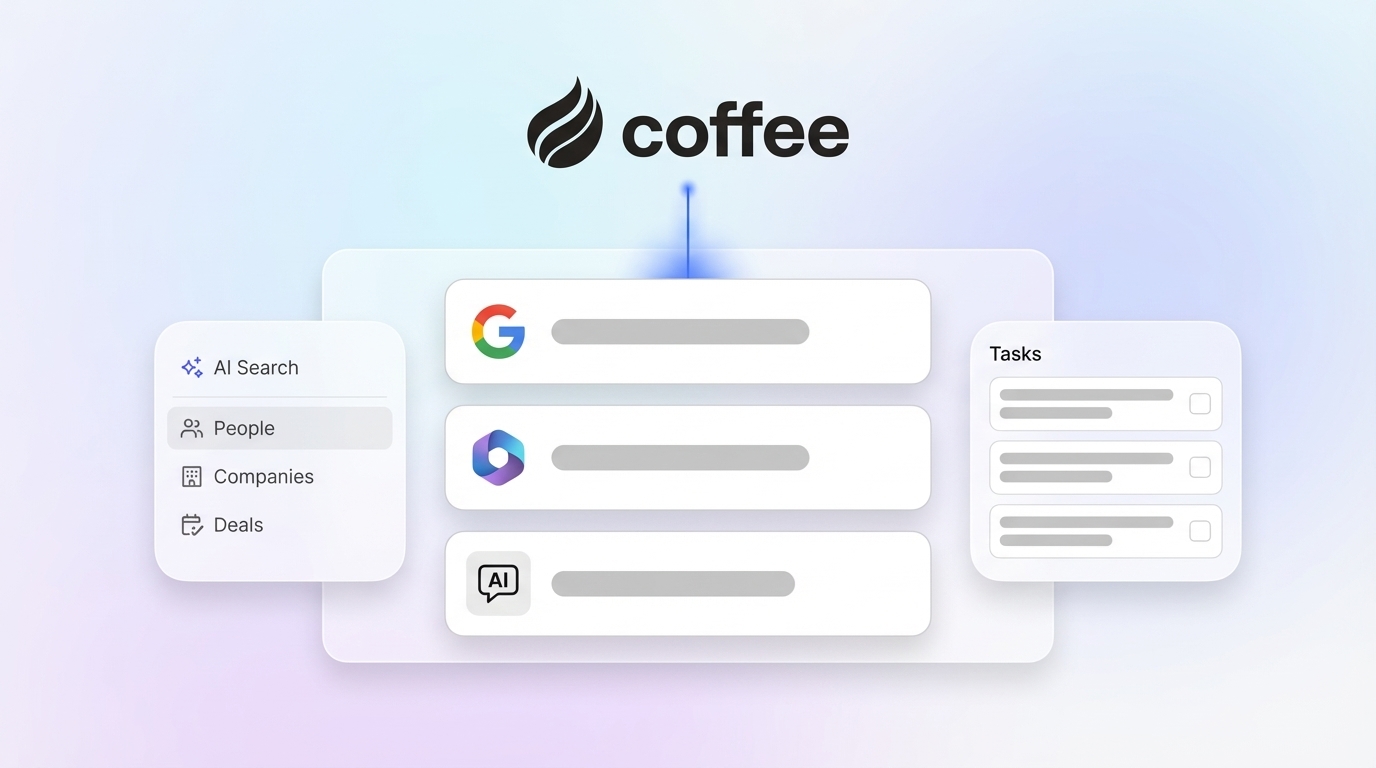
- Autonomous Data Management: Creates contacts and companies automatically from Google Workspace or Microsoft 365 with zero manual entry.
- Meeting Intelligence: An AI bot joins calls for recording and produces briefings, summaries, and follow-up actions.
- Pipeline Compare: A built-in data warehouse tracks every pipeline change automatically and removes the need for spreadsheet exports.
- List Builder: Natural language prospecting that taps into integrated enrichment data.

Real-World Impact: One company generating tens of millions in revenue automated its sales reviews completely and left spreadsheet chaos behind. The Coffee Agent created contacts from Google Workspace automatically, while Pipeline Compare handled weekly reviews without human effort.

Limitations: Coffee does not target large enterprises that need complex custom workflows or organizations in heavily regulated industries that require multi-year security reviews.
Ideal For: Startups, scale-ups, and RevOps leaders who want to remove manual CRM maintenance while protecting data quality.

Pricing: Simple seat-based pricing keeps Coffee accessible for growing teams.
Get started with Coffee and let the agent handle your CRM busywork.

#2 Attio: Flexible Data Automation For Startups
Attio has become a data automation benchmark for startups and supports flexible data models with real-time ingestion. Attio features total data model flexibility, real-time data ingestion syncing with tech stacks for live customer health views, and natural language search, update, and create via “Ask Attio”.
Strengths: Flexible object modeling, real-time data sync, and a natural language interface.
Limitations: Agent automation is less comprehensive than Coffee’s autonomous approach.
Ideal For: Early-stage teams that need flexible data structures.
Pricing: Tiered plans range from $29 to $99 per user each month.
#3 Clay: AI Prospecting And Outbound Engine
Clay focuses on AI-powered prospecting and outbound orchestration, which makes it popular with sales development teams. The platform shines at data enrichment and automated outreach workflows.
Strengths: Advanced enrichment, outbound automation, and strong data sourcing.
Limitations: Product scope centers on prospecting instead of full CRM functionality.
Ideal For: Teams that prioritize outbound sales and lead generation.
#4 Salesflare: Automated Email And Call Tracking
Salesflare automatically logs emails and calls while providing B2B intelligence, which cuts manual data entry for communication tracking.
Strengths: Automatic email and call logging plus B2B data intelligence.
Limitations: Focus remains on communication tracking rather than full-spectrum agent automation.
Ideal For: Small teams that rely on email-driven sales processes.
#5 Freshsales: Freddy AI For Scoring And Insights
Freshsales integrates Freddy AI for lead scoring and predictive insights within a cloud-native architecture.
Strengths: Built-in AI scoring and a mature, established platform.
Limitations: Product design emphasizes AI features more than autonomous agent behavior.
Ideal For: Teams that want a familiar CRM with added AI capabilities.
#6 Pipedrive: Visual Pipeline With AI Forecasting
Pipedrive delivers AI-powered sales forecasting and pipeline management while keeping a traditional CRM architecture with AI enhancements.
Strengths: Visual pipeline management and AI forecasting tools.
Limitations: Functions as an enhanced legacy system instead of a fully AI-native platform.
#7 Zoho: Zia AI And Broad Suite Coverage
Zoho CRM includes Zia AI for predictive analytics and automation across its suite. Bigin (Zoho CRM) has 89% adoption among surveyed users, which signals strong satisfaction.
Strengths: High adoption rates and a comprehensive product suite.
Limitations: Pricing can feel complex because it spans many products.
#8 Oliv: Modular Revenue Intelligence
Oliv centers on AI-powered revenue intelligence and sales forecasting with modular pricing. Oliv AI offers modular pricing with no platform fees, implementation, or training costs, with Meeting Assistant at $19 per user each month and CRM Manager at $29 per user each month.
Strengths: Cost-effective modular plans and a clear revenue focus.
Limitations: An emerging platform with a smaller market footprint.
#9 AskElephant And Lark: Content Automation Plus CRM
AskElephant and Lark focus on automated content generation and meeting summaries while also offering strong CRM automation and management features. Many plans include free tiers for basic usage.
Strengths: Free tier options and powerful content automation.
Limitations: Both remain emerging platforms with growing market presence.
Side-by-Side AI CRM Comparison For SMBs
|
Platform |
Agent Automation |
2026 SMB Pricing |
Key Differentiator |
|
Coffee |
Full autonomous agent |
Seat-based |
Standalone plus Companion model |
|
Attio |
Data automation |
$29-99/user/month |
Flexible data modeling |
|
Clay |
Prospecting focus |
Usage-based |
Enrichment powerhouse |
|
Salesflare |
Email/call logging |
$29-79/user/month |
Communication intelligence |
AI-native companies demonstrate 1.6x better sales efficiency, so the depth of agent automation becomes a critical success factor for SMBs.
Choosing And Migrating To An AI-Native CRM
SMBs with 1 to 50 employees should focus on total cost of ownership and implementation speed. Marq completed a Salesforce to HubSpot CRM migration in 90 days and cut costs by $77K annually, which shows how strategic migrations can deliver fast ROI.
Coffee’s zero-setup Companion model simplifies transitions by running alongside existing Salesforce or HubSpot instances. Migration processes typically take 1-5 days for SMBs when teams plan carefully.
Common pitfalls include data mapping errors and weak user training. Successful projects include thorough data cleanup, phased implementation, and clear change management to drive adoption.
Get started with Coffee to explore migration paths that match your timeline and budget.
Frequently Asked Questions About AI-Native CRMs
What are the best free AI-native CRM alternatives?
Lark and AskElephant offer limited free functionality that focuses on content automation. Most advanced AI-native features still sit behind paid plans because autonomous agents and large-scale data processing require significant compute resources.
Which AI-native CRM works best for small businesses under 20 employees?
Coffee and Attio stand out for small businesses, with Coffee providing stronger agent automation and Attio offering flexible data modeling. Coffee’s dual-model approach lets teams start with the Companion App next to existing tools and later move to the full standalone CRM. The agent manages data entry automatically, which matters for small teams without dedicated sales operations staff.
How does Coffee compare to Day.ai and Clarify CRM?
Coffee’s built-in data warehouse and Companion model create clear advantages. Day.ai focuses mainly on unstructured data processing, and Clarify lacks the integration depth that established teams expect. Coffee serves both as a system of record and as an intelligent layer on top of existing CRMs, which makes it more versatile for different organizations.
Are AI-native CRM pricing models changing in 2026?
Pricing is shifting toward value-based and outcome-based models that link costs to results such as deals closed or calls analyzed. These models lower financial risk at adoption and open advanced AI capabilities to smaller organizations. Seat-based pricing still appeals for predictability, and Coffee continues to use a simple seat-based structure.
How long does it take to migrate from HubSpot to an AI-native CRM?
Migration timelines depend on complexity, but Coffee’s Companion App often goes live in 1 to 5 days without disrupting current HubSpot workflows. Teams can experience AI-native benefits immediately while they plan a full migration. The agent starts automating data entry and delivering insights before any complete system replacement.
Conclusion: Why Agent-Led CRMs Are Winning
The agent revolution is turning CRMs from demanding databases into intelligent co-pilots for sales teams. The global AI in CRM market is expected to grow from USD 4.1 billion in 2023 to approximately USD 48.4 billion by 2033, driven by SMBs that want to escape manual data entry.
Coffee leads this shift as a comprehensive AI-native CRM for SMBs and supports both standalone and Companion models to meet teams where they work today. Its autonomous agent removes the 14-hour weekly data entry burden and maintains accurate pipeline intelligence through a built-in data warehouse.
Get started with Coffee today and see how agent-led CRM automation feels in practice.