
In today’s fast-moving business landscape, startups are navigating a pivotal shift as artificial intelligence reshapes sales and customer interactions. The market for customer relationship management (CRM) tools is evolving rapidly, driven by the need for data-driven strategies and real-time insights. Traditional systems, even widely adopted ones like HubSpot for startups, often fall short of meeting these modern demands. Many startups find themselves at a crossroads, balancing the familiarity of established tools with the promise of AI-powered solutions that aim to streamline operations and enhance decision-making.
This shift reflects a broader trend in the tech ecosystem, where efficiency and adaptability are becoming non-negotiable for growth. According to industry analysis, the global CRM market is projected to grow significantly, with AI integration playing a central role in this expansion as businesses increasingly prioritize automation and predictive analytics. However, adopting new technology isn’t without challenges. Startups must weigh the costs, integration hurdles, and learning curves against the tangible benefits of time savings and improved sales outcomes. This guide dives into these dynamics, offering a clear roadmap for leveraging AI CRM tools. It highlights how platforms like Coffee, as part of this innovative wave, help address common pain points while providing actionable value for scaling sales operations.
Why Traditional CRMs Like HubSpot Struggle to Meet Startup Needs
Traditional CRM systems often fail to deliver on their core promise of simplifying sales processes for startups. Despite their widespread use, platforms like HubSpot can introduce inefficiencies that slow down growth instead of supporting it. Let’s break down the specific issues that hinder performance.
Fragmented Tools Create Data Chaos
Startups frequently rely on a patchwork of tools alongside their main CRM, resulting in scattered customer data. A typical setup might include HubSpot for core tracking, plus separate apps for outreach, call recording, and analytics. This creates data silos, where key information is trapped in disconnected systems. Sales reps waste time manually updating records across platforms, increasing the risk of errors. Additionally, the cost of maintaining multiple subscriptions often exceeds initial budgets, adding financial strain.
Manual Data Entry Steals Selling Time
One major drawback of traditional CRMs is the heavy reliance on manual input. Sales reps must log call notes, update deal statuses, and track follow-ups by hand. Studies indicate that up to 71% of reps spend excessive time on such tasks, leaving only about a third of their week for actual selling resulting in a significant loss of productivity. This not only hampers efficiency but also leads to inconsistent data, as rushed or incomplete entries undermine the system’s reliability.
Outdated Systems Limit Modern Capabilities
Many popular CRMs, including HubSpot, were built on frameworks not designed for today’s AI-driven needs. Originally focused on marketing automation, HubSpot expanded into CRM later, which can limit its ability to manage complex data or integrate advanced features. For example, older database structures often overwrite historical data instead of preserving it, making it hard to analyze trends or optimize sales cycles.
Low User Adoption Undermines Value
Poor user experience in traditional CRMs often discourages sales teams from fully engaging with the system. Clunky interfaces and time-intensive tasks lead reps to view the CRM as a reporting burden rather than a helpful tool. This resistance creates a cycle of incomplete data and reduced utility. Many reps even maintain separate tracking in spreadsheets or apps like Notion, further fragmenting critical information.
Ready to move beyond these limitations? Explore Coffee’s AI-driven CRM for sales and see how it cuts manual work while boosting team efficiency.
What AI CRM Offers and Why Startups Should Care
AI CRM redefines sales management by using machine learning and automation to turn raw data into actionable insights. Unlike traditional systems that rely on manual effort, AI platforms proactively handle routine tasks and provide real-time guidance, freeing up sales teams to focus on closing deals.
Key Features That Set AI CRM Apart
AI CRM goes beyond basic automation, offering tools that transform sales workflows. Here’s what makes it different:
- Automated Data Updates: Pulls in and refreshes customer details like job titles and company info from multiple sources, eliminating manual research.
- Conversation Analysis: Processes call recordings and meeting notes to track deal progress and suggest next steps.
- Pipeline Insights: Uses data to highlight trends and prioritize opportunities, reducing guesswork in sales planning.
- Meeting Support: Automates preparation with pre-meeting summaries and post-meeting follow-up drafts, ensuring consistency.
Clear Financial Benefits for Startups
AI CRM delivers measurable value by saving time and improving outcomes. Sales reps can reclaim 8 to 12 hours per week through automated data handling, allowing more focus on building relationships and advancing deals. Over time, these efficiencies add up, often outweighing initial costs by reducing the need for multiple standalone tools and driving higher revenue potential.
How to Choose and Implement AI CRM for Your Startup
Adopting AI CRM isn’t just about picking a tool; it’s about aligning technology with your startup’s goals. A thoughtful approach ensures lasting benefits, while rushed decisions can waste resources. Let’s explore key considerations.
Should You Build or Buy Your AI CRM?
Building a custom AI CRM offers full control over features but demands significant time, expertise, and ongoing investment. Most startups find buying a ready-made solution more practical. Established platforms like Coffee come with proven integrations and continuous updates, delivering value faster without the burden of in-house development. When choosing a vendor, focus on ease of use, compatibility with your tools, and how well the AI addresses your specific challenges.
Getting Your Team Ready for AI Tools
Transitioning to AI CRM requires preparing your team for change. Some reps may worry about automation reducing their role. Counter this by showing how AI saves time on repetitive tasks and enhances their ability to close deals. Ensure your tech setup, like email and calendar systems, can integrate smoothly. Training should focus on real-world scenarios, helping reps see immediate benefits through hands-on practice.
Common Mistakes to Avoid During Adoption
Several missteps can derail AI CRM implementation. Prioritizing a long list of features over core needs often leads to complex, underused systems. Data quality is another critical factor; without clean, reliable inputs, AI outputs lose accuracy. Leadership support is also essential to drive adoption, as lack of buy-in can leave the tool seen as optional. Finally, expect that some advanced features, like predictive insights, need time to mature as data accumulates.
Coffee: A Standout AI CRM for Startup Sales Growth
As AI reshapes the CRM landscape, Coffee stands out as a platform built from the ground up to tackle the shortcomings of traditional systems. Designed with startups in mind, it offers both a standalone solution for small teams and a companion app to enhance existing setups like HubSpot or Salesforce. Coffee exemplifies the broader move toward intelligent, user-focused sales tools that prioritize automation and actionable data.
Standalone Solution for Early-Stage Startups
Coffee’s standalone CRM targets startups with 1 to 20 employees looking to scale sales without the baggage of legacy systems. It automatically builds customer profiles by scanning emails and calendars linked to Google Workspace or Microsoft 365, removing the need for manual data entry. Its built-in data enrichment adds details like job roles and company funding status, supporting informed outreach without extra tools.
Companion App to Enhance HubSpot or Salesforce
For startups already using HubSpot or Salesforce, Coffee’s companion app adds a layer of AI functionality without requiring a full system switch. After a straightforward setup, it syncs with your current CRM, captures data from emails and calls, and offers insights that boost usability. This flexibility lets you keep existing investments while addressing gaps like low adoption and incomplete records.
Core Features That Drive Results
Coffee’s design focuses on saving time and improving sales focus. Key capabilities include:
- Automatic Data Handling: Saves reps 8 to 12 hours weekly by auto-populating and updating customer info.
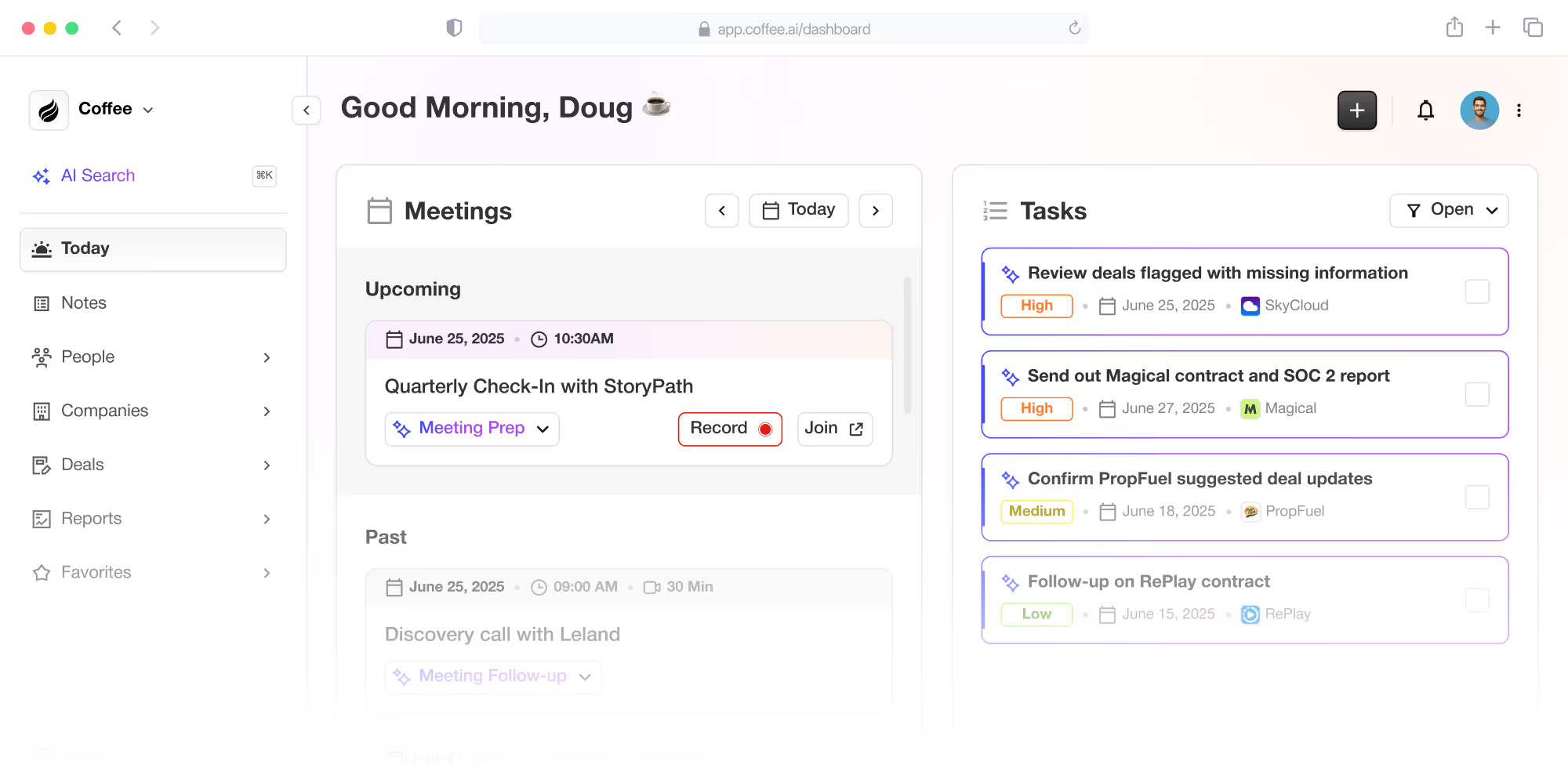
- Pipeline Visibility: Offers a “Pipeline Compare” feature for instant week-over-week analysis of deal progress.
- Meeting Automation: Provides pre-meeting briefings, call transcriptions, and follow-up drafts across platforms like Zoom and Teams.
- Smart Prospecting: Allows natural language queries to build targeted lead lists based on specific criteria.
Comparing Coffee to Traditional CRMs
|
Feature |
Coffee (AI-First CRM) |
Traditional CRM (e.g., HubSpot) |
Benefit for Startups |
|
Data Automation |
Auto-builds records from email/calendar; enriches with partner data |
Manual input; needs external tools |
Saves 8-12 hours/week per rep |
|
Pipeline Insights |
One-click historical analysis via “Pipeline Compare” |
Manual exports or costly add-ons |
Simplifies reviews; spots trends |
|
Meeting Tools |
Auto briefings, summaries, and follow-ups |
Manual notes and follow-ups |
Ensures prep and consistency |
|
Tool Consolidation |
Combines CRM, enrichment, and forecasting |
Needs multiple tools, raising costs |
Cuts spend and simplifies workflows |
See the difference for yourself. Request access to Coffee now and learn how startups are revolutionizing their sales approach.
Real-World Impact: A Startup’s Journey with Coffee
A tech firm earning millions annually from AI solutions for large clients faced scaling issues with sales tracked solely in spreadsheets. After assessing both traditional and modern CRMs, they chose Coffee for its simplicity and fit with their needs. The platform’s auto-contact creation from Google Workspace avoided data clutter, while the Pipeline Compare tool streamlined weekly reviews. Custom API access also enabled tailored reporting, showing how AI CRM adapts to unique workflows.
Key Challenges to Watch for When Adopting AI CRM
Even with strong planning, AI CRM adoption can hit roadblocks. Focusing too much on feature lists instead of specific business needs often results in overly complicated tools with little daily impact. Data quality is another hurdle; flawed inputs lead to unreliable AI suggestions. Without proactive training, teams may resist change, fearing automation threatens their roles. Lastly, recognize that some AI benefits take time to fully develop as systems learn from accumulating data.
Answers to Common Startup Questions About AI CRM
How Does AI CRM Improve Returns Compared to HubSpot?
AI CRM offers better financial returns by saving time and enhancing focus. Automation of data tasks frees up 8 to 12 hours weekly per rep for direct sales work. It also reduces reliance on multiple tools, cutting costs while sharpening focus on high-value prospects through data-driven insights.
Can Coffee Work with My Current HubSpot Setup?
Yes, Coffee’s companion app integrates directly with HubSpot or other CRMs through a simple connection process. It syncs data and adds AI features like automated insights, letting you control what updates flow back to your main system. This captures overlooked data from emails and calls without extra effort.
Which Coffee AI Features Matter Most for Startups?
Coffee’s standout features tackle startup pain points directly. Automated data entry cuts down on admin work. Meeting tools handle prep, transcription, and follow-ups. Pipeline analysis offers quick trend insights, and natural language prospecting builds targeted lists efficiently.
Is Data Security a Risk with AI CRMs?
Data protection is a valid concern, but trusted AI CRM providers prioritize it. Coffee adheres to SOC 2, Type 2, and GDPR standards with encryption and access controls. Startups should review vendor security practices and ensure alignment with their compliance needs.
How Does Coffee’s Data Enrichment Stack Up?
Coffee’s enrichment pulls in detailed customer info from licensed sources, integrated within the platform. This cuts the need for separate tools, reducing cost and complexity compared to traditional CRMs paired with standalone enrichment apps, while meeting most startup requirements.
Conclusion: Build a Strong Sales Future with AI CRM
AI is changing the game for startup sales, moving beyond outdated CRM models to address real challenges like fragmented data and manual workloads. Platforms like Coffee, part of this innovative shift, show how automation and smart design can save time, with reps gaining 8 to 12 hours weekly for core sales tasks. Early adopters gain a clear edge, positioning themselves to leverage future advancements in sales tech. Don’t wait to adapt. Request access to Coffee today and discover how AI-driven CRM can fuel your startup’s growth.