
Key Takeaways
- Sales reps lose 71% of their time to data entry, and Coffee automates this work so teams can focus on selling.
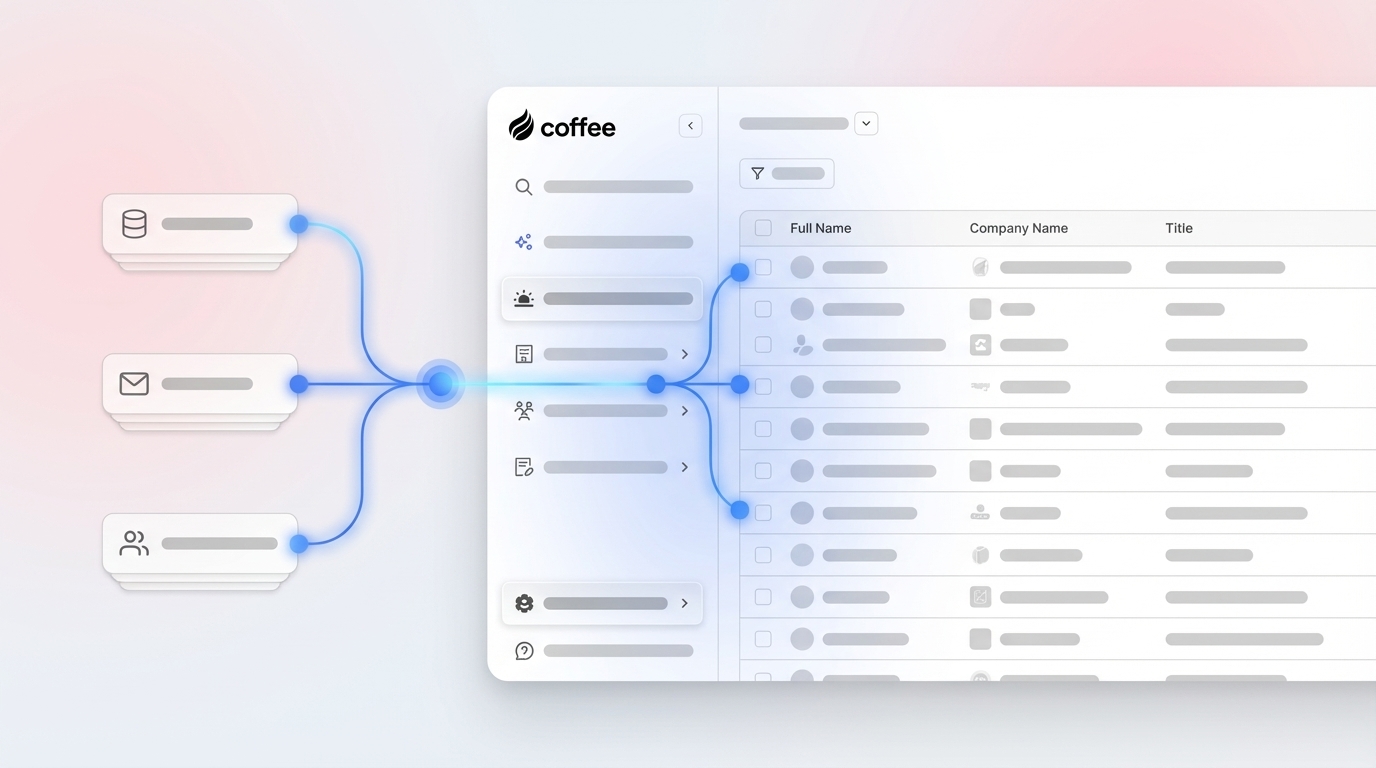
- Coffee uses autonomous agents that enrich data from emails and calendars and sync it directly with Salesforce and HubSpot.
- ZoomInfo offers deep enterprise data coverage at $15K+ per year, while Apollo fits mid-market teams from $149 per month.
- Core buying criteria include CRM integration depth, automation level, pricing clarity, data accuracy, and compliance such as GDPR and SOC 2.
- Coffee’s agent-powered enrichment typically saves 8 to 12 hours per week for each rep, as shown on the Coffee pricing page.

How to Choose a B2B Data Enrichment Tool That Actually Gets Used
Strong B2B enrichment tools deliver verified job titles, funding data, and contact details, and they keep this data fresh with frequent updates. Native Salesforce and HubSpot integrations prevent shadow CRMs and drive adoption because reps work inside familiar systems. Automation depth now separates modern agent-powered tools from older point solutions that still depend on manual uploads and exports. Clear pricing and ROI tracking, such as time saved and pipeline lift, make budget approvals easier. SOC 2 Type 2 and GDPR compliance protect prospect data and support global sales operations.
Top 15 B2B Contact & Company Data Enrichment Tools for 2026
1. Coffee
Coffee uses an autonomous agent that creates and enriches contacts from Google Workspace and Microsoft 365 emails and calendars, which removes manual data entry. The agent works as a Standalone CRM for SMBs or as a Companion App for Salesforce and HubSpot, and it enriches records in real time with job titles, funding data, and LinkedIn profiles. Coffee’s Pipeline Compare view highlights week-over-week deal movement, and List Builder supports natural language prospect searches. Coffee fits teams that want full automation with simple, predictable seat-based pricing.


2. ZoomInfo
ZoomInfo maintains one of the largest B2B databases with hundreds of millions of contacts, including direct dials, technographic data, and intent signals. Its CRM integrations support rules-based enrichment and scheduled batch updates for large deployments. Enterprise pricing ranges from $15,000 to $30,000 annually, which often excludes SMB budgets. ZoomInfo works best for enterprises that prioritize broad data coverage and complex workflows.
3. Apollo.io
Apollo ranks second with a large contact database and built-in email verification, and it adds firmographics and tech stack data through Salesforce and HubSpot integrations. Pricing starts at $149 per month for the Starter plan with 2,000 credits and scales to $800 per month for Pro with 50,000 credits. A free tier includes 1,000 credits each month. Apollo suits mid-market teams that want all-in-one sales intelligence with moderate automation.
4. Clay
Clay offers spreadsheet-style enrichment with many data provider integrations and flexible workflow automation. Pricing begins at $149 per month with a limited free plan for light usage. Clay works well for technical teams that prefer custom workflows and control over data sources. Native CRM automation remains lighter than agent-powered tools like Coffee.
5. Cognism
Cognism focuses on GDPR-friendly data and mobile dials, with strong European coverage and verified accuracy. Enterprise pricing ranges from $12,000 to $60,000 annually. Cognism fits companies that need strict compliance and international reach, even if enrichment workflows stay more manual.
6. Clearbit (HubSpot Breeze)
Clearbit ranks highly for real-time enrichment and IP-to-company matching and now appears as HubSpot Breeze. Credit-based pricing requires a paid HubSpot subscription. Clearbit works best for HubSpot customers that want real-time firmographic and technographic enrichment with granular field controls.
7. Lusha
Lusha offers a browser extension for direct dials and verified emails, with strong SMB coverage and one-click CRM sync. The Pro plan costs $22.45 per user each month, with Premium and Scale tiers for larger teams. Lusha fits individual reps and small teams that want simple enrichment without heavy automation.
8. Seamless.AI
Seamless.AI focuses on real-time contact discovery through a Chrome extension and CRM integrations. The Individual plan costs $99 per month and scales to a Team plan at $5,000 per year, with Enterprise pricing from $18,000 to more than $48,000 annually. The product emphasizes search and discovery, while automation depth remains lighter than agent-led platforms.
9. UpLead
UpLead delivers verified B2B contacts with real-time email verification and technographic data. Pricing starts at $99 per month with a credit-based model. UpLead suits small teams that value accurate contact data and straightforward CRM connections.
10. Hunter.io
Hunter.io specializes in email discovery and verification with domain-based search. The free tier includes 50 credits, and paid plans range from $56 per month for Starter to $345 per month for Scale. Hunter.io works best for email-first prospecting where company-level enrichment matters less.
11. RocketReach
RocketReach focuses on contact lookup with social media links and bulk enrichment options. Pricing depends on usage, and enterprise packages are available. The platform centers on individual contact discovery rather than full account-level enrichment.
12. LeadAngel
LeadAngel ranks highly for enterprise RevOps teams that need lead and account matching plus real-time deduplication. It offers CRM-native workflows and advanced matching logic. LeadAngel fits large enterprises that prioritize data governance and duplicate control.
13. SalesIntel
SalesIntel provides human-verified contacts backed by a research team and adds technographic insights. Enterprise pricing starts at several thousand dollars per year. The product emphasizes accuracy through manual verification.
14. FullEnrich
FullEnrich combines data from several providers to improve coverage and accuracy. Pricing at $29 per month keeps it accessible for small teams. The platform uses a waterfall enrichment method and supports automation for common workflows.
15. Adapt.io
Adapt.io targets SMB buyers with affordable contact and company enrichment. It offers competitive pricing for budget-conscious teams that need essential enrichment and standard CRM integrations.
Top Picks for 2026 by Use Case
|
Tool |
Best For |
CRM Score (1-10) |
Pricing Tier |
|
Coffee |
Agent Automation |
10 |
Seat-based SMB |
|
ZoomInfo |
Enterprise Scale |
9 |
$15K+ Annual |
|
Apollo |
All-in-One Value |
8 |
$149-800/month |
|
Clay |
Custom Workflows |
7 |
$149/month |
|
Cognism |
GDPR Compliance |
8 |
$12K+ Annual |
|
Clearbit |
HubSpot Native |
9 |
$45/100 credits |
Coffee earns the highest CRM score because its autonomous agent removes manual data entry for reps and managers. ZoomInfo delivers broad enterprise data coverage at a premium price point. Apollo balances features and cost for mid-market teams that want strong sales intelligence without enterprise contracts.
Automation vs Coverage: Key Tradeoffs Across Tools
|
Tool |
Automation Level |
CRM Integration (1-10) |
2026 Pricing |
|
Coffee |
Full Agent |
10 |
Seat-based |
|
ZoomInfo |
Partial |
9 |
$15K-30K/year |
|
Apollo |
Partial |
8 |
$149-800/month |
|
Clay |
Automated |
7 |
$149/month |
|
Cognism |
Manual |
8 |
$12K-60K/year |
|
Clearbit |
Partial |
9 |
$45/100 credits |
Coffee’s full agent automation replaces the manual enrichment steps that traditional tools still require and keeps CRM data in sync without extra clicks. Enterprise tools often favor data volume and coverage, while Coffee focuses on workflow efficiency and rep time savings. Buyers weigh Coffee’s agility against ZoomInfo’s depth based on team size, budget, and process complexity.
Best Choice for CRM Teams Using HubSpot or Salesforce
Coffee’s Companion App ranks first for Salesforce and HubSpot teams that want deep native integrations and automatic enrichment. The agent typically saves 8 to 12 hours per week by logging activities and updating records from email and calendar data. ZoomInfo and Apollo support strong CRMs but often need add-ons and manual triggers, while Coffee runs autonomously inside existing workflows. Customers report an 85% cut in data entry time compared with tools that still rely on CSV exports and imports. Get started with Coffee to streamline CRM hygiene and reporting.

2026 AI Agent Trends and Real-World ROI
AI agents now handle research, enrichment, and real-time routing in 2026, which reduces speed-to-lead from hours to seconds and signals a shift from copilot tools to fully autonomous systems. One company with tens of millions in revenue replaced spreadsheet-based sales tracking with Coffee’s agent and gained automated data entry from Google Workspace plus clear pipeline insights through Pipeline Compare. Industry data shows enriched records can improve lead quality by 88% and analytics ROI by 40% for organizations that invest in data governance.
Frequently Asked Questions
What are the most affordable B2B data enrichment tools?
Coffee offers simple seat-based pricing with unlimited agent automation, which keeps costs predictable for SMBs. Apollo includes a free tier with 1,000 credits per month and paid plans that start at $149 per month. FullEnrich charges $29 per month for teams with tight budgets, and Hunter.io provides 50 free credits each month. Free tiers usually lack automation and still require manual data entry, which reduces overall time savings.
What are the strongest ZoomInfo alternatives for mid-market teams?
Coffee stands out as a ZoomInfo alternative because its autonomous agent removes manual workflows while maintaining strong data accuracy at a lower price. Apollo delivers broad sales intelligence with more flexible pricing than ZoomInfo’s $15,000+ annual contracts. Cognism supports international teams that need GDPR-compliant data, and Clay helps technical users design custom enrichment flows when they value flexibility over full automation.
Which tools work best with HubSpot and Salesforce?
Coffee ranks first for CRM integration because the Companion App runs natively in Salesforce and HubSpot and enriches records from email and calendar data without manual triggers. Clearbit, now HubSpot Breeze, offers deep HubSpot integration and real-time enrichment for marketing and sales teams. ZoomInfo connects to major CRMs as well but often requires more complex setup and ongoing maintenance than Coffee’s autonomous approach.
How do AI agents differ from manual enrichment tools?
AI agents such as Coffee capture and enrich data from unstructured sources like emails and meeting transcripts, while manual tools need a user to request each enrichment. Agent automation usually saves 8 to 12 hours per week compared with point solutions that add extra steps to a rep’s workflow. Traditional tools focus on pulling data, and AI agents manage the full cycle from data capture to activity logging and pipeline analysis.

What ROI can teams expect from B2B data enrichment?
Teams using Coffee’s agent automation often see an 85% reduction in data entry time and 8 to 12 hours saved per rep each week. Enriched data can improve lead quality by 88% and analytics ROI by 40% based on industry benchmarks. AI-powered enrichment also shortens sales cycles by 20 to 30% through real-time updates and intent tracking, while manual tools mainly provide access to data without major workflow gains.
Conclusion: Why Coffee Leads B2B Data Enrichment in 2026
Coffee leads the 2026 B2B contact and company enrichment landscape because its autonomous agent removes the manual work that slows traditional tools. ZoomInfo still delivers unmatched enterprise data depth, and Apollo offers strong value for mid-market teams, yet both rely more on manual configuration. Coffee’s approach drives higher ROI through proactive enrichment from unstructured data and tight native CRM integrations. Get started with Coffee and turn data enrichment from a manual chore into a durable competitive advantage.