
In today’s fast-paced business environment, customer relationship management, or CRM, sits at the core of sales and marketing success. Yet, as customer expectations evolve and data volumes grow, many traditional CRM systems struggle to keep up. This has created a dynamic market landscape where innovation, particularly through artificial intelligence, is reshaping how companies engage with customers. AI-driven CRM solutions are emerging as essential tools for businesses aiming to stay competitive, offering ways to unify data, automate tasks, and gain actionable insights. This guide dives into the current trends, critical features, and practical steps for adopting AI CRM, with a focus on providing value to decision-makers looking to enhance their sales and marketing outcomes.
The CRM market reflects broader shifts in technology and business needs. Companies now handle more customer touchpoints than ever, from emails and social media to in-person interactions, often across fragmented systems. Studies indicate that sales teams lose significant time on administrative tasks, with some spending up to 71% of their day on non-selling activities. Meanwhile, the rise of AI offers a path forward by enabling smarter data handling and predictive analytics. As organizations navigate this transition, platforms like Coffee stand out as examples of how AI-first design can address longstanding challenges, fitting into a larger trend of technology-driven efficiency. Let’s explore how these solutions work and what they mean for your business.
Why Traditional CRM Systems Struggle in Today’s Market
Many traditional CRM systems fail to meet modern demands due to outdated design and fragmented data. Built for a different era, these platforms often create more work for sales teams instead of simplifying it. Customer information gets scattered across multiple tools, making it hard to form a clear picture of interactions.
Manually entering data is a persistent issue. Sales reps spend hours logging details instead of closing deals, which slows down productivity. This administrative burden reduces the time available for direct customer engagement.
Integration with new technologies also poses a challenge. Older CRMs may not easily support AI tools or handle large, diverse datasets, limiting their ability to deliver real-time insights. Without proper data tracking, historical trends become harder to analyze, impacting pipeline management.
User adoption adds another layer of difficulty. If reps view CRM as a tool for management rather than a personal aid, they often turn to personal spreadsheets or other workarounds. This creates gaps in data, reducing the system’s overall usefulness.
AI-first platforms aim to solve these problems by rethinking CRM from the ground up. They prioritize seamless data flow and automation, paving the way for more effective sales and marketing strategies.
Key Features of AI CRM That Boost Sales and Marketing
Unifying Data for a Complete Customer View
A strong AI CRM starts with bringing all customer data into one place. This means pulling in details from emails, calls, calendar events, and more to build detailed profiles without manual effort. Comprehensive data gives teams a full view of every interaction.
Quality matters as much as quantity. Accurate, updated information, like job roles or company size, fuels better AI insights. Without clean data, even advanced algorithms fall short. A unified system cuts down on the need for separate tools, saving time and maintaining consistency.
Automating Tasks to Free Up Sales Teams
Automation in AI CRM tackles repetitive work, letting sales reps focus on building relationships. Contacts and activities get created and updated automatically from emails or invites, complete with relevant business details.
Meetings benefit from this as well. AI can prepare summaries of key details before a call, like attendee backgrounds or past interactions. Afterward, it can outline next steps and draft follow-up messages, cutting down on post-meeting tasks. This shift moves reps from clerical work to strategic action.
Delivering Insights for Smarter Decisions
Unlike older CRMs that just store data, AI platforms analyze it to offer useful guidance. They highlight trends in sales pipelines, showing which deals are progressing or stalling. Leaders can spot patterns and adjust resources without sifting through raw numbers.
These insights help refine strategies over time. Historical data, stored systematically, supports long-term planning by revealing shifts in deal cycles or customer behavior, driving better forecasting and outcomes.
Streamlining Prospecting with Precision
Finding the right prospects is easier with AI tools that filter leads based on specific criteria. Sales teams can build targeted lists using simple queries, focusing on factors like industry, location, or company size. This precision cuts through noise, ensuring outreach aligns with customer needs.
Steps to Adopt AI CRM Effectively
Choosing Between Building or Buying a Solution
Deciding whether to develop an AI CRM in-house or purchase an existing platform depends on your resources. Building requires significant time, skilled staff, and ongoing maintenance. Buying a ready-made solution, on the other hand, offers faster deployment and lets teams focus on core operations.
Platforms like Coffee provide a practical option with quick setup and proven results. This approach often delivers value sooner while freeing up internal teams for other priorities.
Integrating with Your Current Tools
Replacing an established CRM entirely may not be feasible for many businesses. A flexible solution can work alongside existing systems like Salesforce or HubSpot, adding AI features without disrupting workflows. Data syncs between platforms, ensuring consistency while enhancing records with new insights.
This hybrid model suits companies with tailored setups or heavy investments in current tools. It offers a low-risk way to test AI benefits while maintaining familiar processes.
Tracking Success with Clear Metrics
Measuring the impact of AI CRM means setting specific goals. Look at time saved on routine tasks, often 8 to 12 hours per rep weekly, which opens up space for selling. Improved data accuracy and faster access to information also contribute to efficiency.
Pipeline metrics, like deal speed or forecast accuracy, show longer-term gains. Tracking these numbers helps quantify the return on investment and guides future adjustments.
Preparing Your Team for Change
Adopting AI CRM involves more than software; it requires team readiness. Leadership support sets the tone, showing the tool’s importance across the organization. Highlighting immediate benefits, like time savings, encourages reps to embrace the change.
Training should focus on practical use and maintaining data quality. Early users can act as advocates, sharing positive experiences to build wider acceptance among staff.
Common Challenges in AI CRM Rollout to Avoid
Ignoring the Need for Quality Data
AI relies heavily on good data. If information remains scattered or inaccurate, results will disappoint. Prioritize platforms that automatically gather and organize data to avoid gaps or errors that manual entry can introduce.
Chasing Features Instead of Results
Focusing on a long list of features rather than solving specific problems can derail AI CRM projects. Identify your key challenges first, then match solutions to those needs for a clearer path to value.
Overlooking User Experience
If a system feels clunky or unhelpful, reps won’t use it consistently. Choose tools designed with user needs in mind, where benefits are obvious, and adoption happens naturally without constant nudging.
Misjudging Integration Effort
Connecting AI tools to legacy systems can be complex if not planned well. Opt for solutions that streamline this process, minimizing delays and extra costs while maintaining a smooth flow of data.
Exploring Coffee: A Leading AI-First CRM Option
Coffee represents the growing wave of AI-first CRM platforms designed to overcome traditional system limitations. It focuses on automatic data collection and unification, ensuring AI tools operate with complete, reliable information. This foundation drives practical features for sales and marketing teams.
Coffee offers two approaches: a standalone CRM for smaller or mid-sized firms looking for a full replacement, and a companion app for those already using Salesforce or HubSpot. The companion model adds AI capabilities without forcing a switch, syncing data across platforms.
Key benefits include saving reps 8 to 12 hours weekly by automating data entry, handling meeting prep and follow-ups with structured summaries, and providing pipeline analysis through historical data. Coffee also combines multiple tools into one system, reducing costs and complexity while prioritizing a user-friendly design that reps adopt willingly.
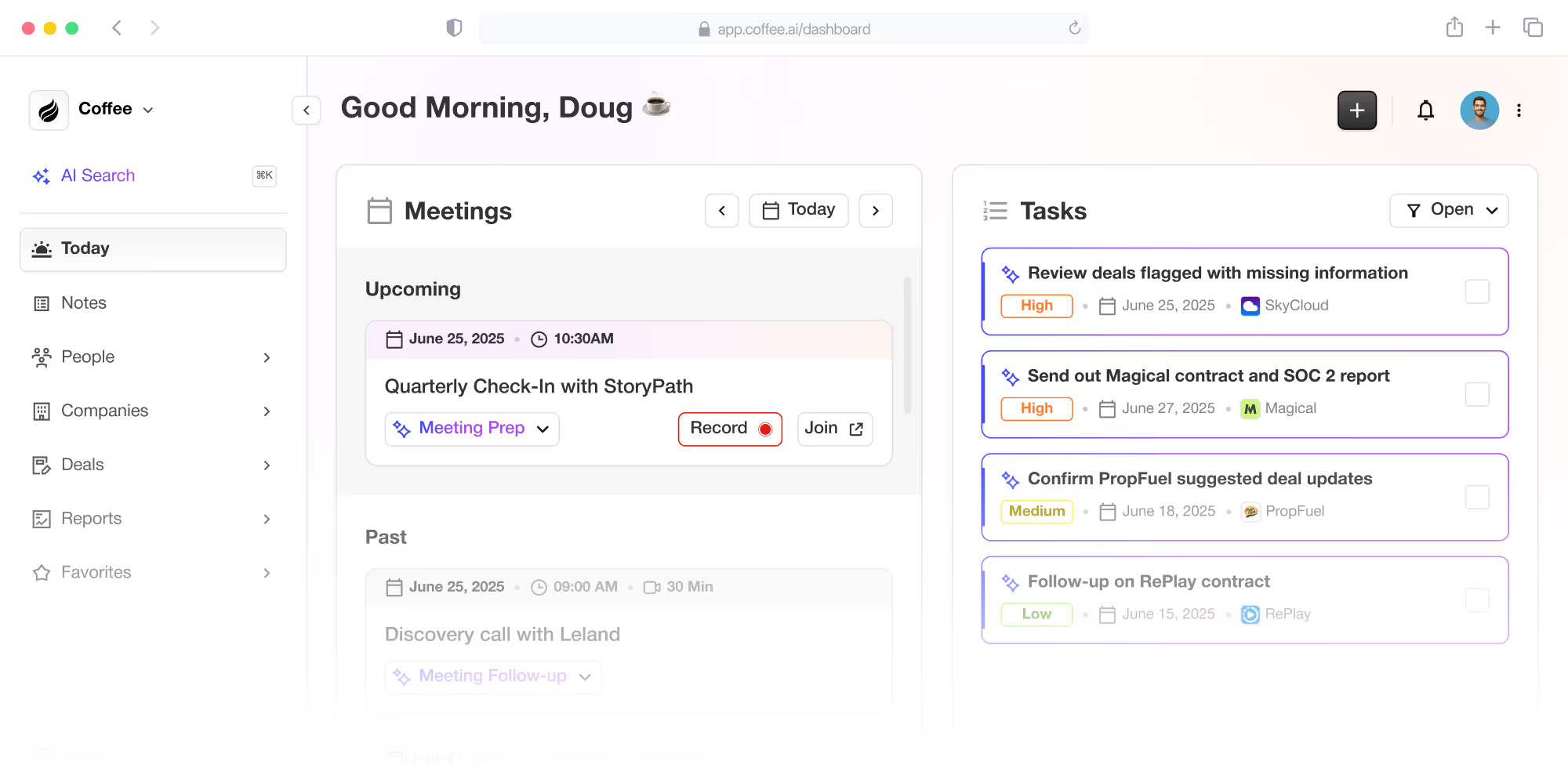
Interested in seeing these features in action? Request access to Coffee and explore how it can support your sales and marketing goals.
How Coffee Stacks Up Against Other CRM Options
Comparing AI-first platforms like Coffee to traditional CRMs reveals clear differences in capability and design. Here’s a breakdown across key areas:
- Data Unification: Coffee handles both structured and unstructured data in one place. Traditional CRMs with add-ons often remain fragmented, while legacy systems rely on manual input.
- Automatic Data Entry: Coffee fully automates contact creation and enrichment. Add-on solutions offer limited automation, and older CRMs typically require manual effort.
- Pipeline Insights: Coffee provides native tools for tracking deal trends over time. Others may need extra customization or manual data exports for similar visibility.
- Meeting Support: Coffee includes built-in AI for briefings and summaries. Traditional setups often depend on separate tools or lack this feature entirely.
The core difference lies in design philosophy. Coffee’s integrated AI approach ensures consistency, unlike older systems retrofitted with new features, which can feel disjointed.
Common Questions About AI CRM for Sales and Marketing
What Returns Can AI CRM Deliver for My Business?
AI CRM platforms like Coffee can save sales reps 8 to 12 hours weekly on repetitive tasks, improve pipeline visibility for better decisions, and reduce tool sprawl. Many companies notice efficiency gains within weeks of implementation.
How Does Coffee Protect Data in an AI Environment?
Coffee adheres to strict standards with SOC 2 Type 2 and GDPR compliance. Data is encrypted, regularly audited, and protected by access controls. Company information stays private and isn’t used to train broader AI models.
Can Coffee Work with Our Salesforce or HubSpot Setup?
Yes, Coffee’s companion app connects directly to Salesforce or HubSpot, syncing data both ways. This lets teams keep their existing processes while gaining AI-driven automation and insights.
How Does Coffee Handle Data Enrichment Compared to Standalone Tools?
Coffee builds data enrichment into its platform, updating records with details like job titles or company info without extra subscriptions. This integrated method matches the quality of many dedicated tools while streamlining workflows.
What Sets Coffee Apart from Other AI CRM Providers?
Coffee’s AI-first design emphasizes complete data unification and a user-focused experience, encouraging rep adoption. Its dual standalone and companion options offer flexibility for businesses at any stage of CRM use.
Looking Ahead: Strengthening Sales and Marketing with AI CRM
AI is redefining CRM, making it a critical asset for staying competitive. Companies stuck with outdated systems risk falling behind as newer platforms drive efficiency and deeper customer understanding.
Coffee serves as a strong example of this shift, addressing core CRM challenges with unified data, automated workflows, and actionable insights. Its adaptable model fits various business setups, providing a straightforward way to leverage AI.
Ready to update your CRM approach? Request access to Coffee and see how an AI-first platform can elevate your sales and marketing efforts.