
In today’s rapidly evolving business landscape, the integration of Customer Relationship Management (CRM) and Enterprise Resource Planning (ERP) systems has become a critical factor for sales leaders aiming to maintain a competitive edge. Companies are scaling at unprecedented rates, fueled by technological advancements and shifting customer expectations. Yet, many still grapple with fragmented data and disconnected systems that hinder efficiency and decision-making. Poor CRM-ERP integration often results in inefficient processes and diminishes the value of management systems, especially in environments leveraging AI technology. This playbook offers sales leaders and Revenue Operations (RevOps) professionals practical strategies and insights to adopt AI-powered CRM solutions, turning unified customer data into a powerful asset.
Moving away from manual, siloed sales operations to intelligent, connected systems requires more than just new tools. It’s about rethinking how sales teams access data, engage with customers, and collaborate internally. Organizations are increasingly adopting AI-driven platforms to streamline workflows and enhance human potential, with solutions like Coffee leading as examples of this broader trend. This guide provides clear steps for preparation and execution, showing how modern AI tools address the shortcomings of outdated systems.
Why Unified AI CRM Integration Matters for Sales Teams
Today’s sales environment requires substantial improvements beyond small tweaks to old methods. With rising customer demands and intensifying competition, companies using disconnected systems and manual processes fall behind. Unified AI CRM integration offers a direct path to staying relevant by aligning operations with current market needs.
How Fragmented Data Impacts Sales Efficiency
Many sales teams face inefficiencies due to legacy CRM systems that, instead of boosting productivity, create extra work. Customer data often sits in separate tools across a disjointed tech stack, leading to operational delays and increased costs.
The impact on sales reps is significant. They spend roughly 71% of their time on tasks unrelated to selling, with manual data entry alone taking up 8 to 12 hours each week. This leaves only about 35% of their time for activities that directly generate revenue. What was meant to be a productivity tool has turned into a source of frustration.
Older CRM platforms, some built decades ago, carry outdated designs that add to these issues. They often struggle to handle modern AI functions efficiently and may not store historical data changes without extra setup or tools, increasing both complexity and cost.
As a result, sales teams often resort to external tools like spreadsheets for their real work. This creates a negative loop where poor data quality discourages system use, which in turn worsens data accuracy and system effectiveness. Companies end up paying for tools that go unused, losing both money and productivity in the process.
Boosting Sales Performance with AI-Driven Data Unity
Having real-time, unified data in CRM systems is essential for enabling AI features like automation and informed decision-making. A single platform for customer data unlocks new ways to connect with prospects and clients at every stage of their journey.
Integrated AI systems shift sales strategies from reactive to proactive. Rather than manually analyzing past data, these platforms deliver instant insights and automate repetitive tasks. Sales reps gain a clear view of customer interactions and deal progress, allowing for more strategic conversations.
This central access to data also improves pipeline management. Leaders can monitor pipeline health, spot stalled deals early, and find opportunities for growth, leading to more accurate forecasts and smarter resource planning.
Companies that adopt unified AI CRM systems often see faster customer responses, more tailored engagement, and better fulfillment of commitments through streamlined processes.
Coffee: A Leading AI-First Tool for CRM Integration
As an example of the growing trend toward AI-driven solutions, Coffee redefines CRM by addressing the flaws of traditional systems from the ground up. Unlike older CRMs that add AI as an afterthought, Coffee is built for today’s fast-paced, data-centric sales environments.
Its core idea is simple: effective AI depends on quality data. While many systems suffer from errors due to manual input, Coffee pulls and organizes accurate data directly from emails, calendars, and call transcripts. This eliminates common data issues that weaken AI results in conventional setups.
Coffee offers two options to suit different needs. Its Standalone AI-First CRM fits small to mid-sized businesses looking for a full replacement of outdated tools. The Companion App, on the other hand, adds a smart layer to existing Salesforce or HubSpot setups, enhancing them without requiring a complete overhaul.
Key Benefits of Coffee for Streamlined CRM Integration
Here’s how Coffee stands out with specific features that simplify sales processes:
- Automatic Data Capture and Enrichment: Coffee removes the burden of manual entry, saving reps 8 to 12 hours weekly. It scans emails and meetings to create and update contacts and companies, linking every interaction to the right records. It also pulls in details like job titles, company info, and LinkedIn profiles from trusted sources, reducing reliance on separate tools.
- Smart Meeting Support: Coffee automates the entire meeting process. Before a call, it provides detailed briefings on attendees and past interactions. During, an AI bot joins to record and transcribe on platforms like Zoom or Teams. After, it summarizes key points, highlights tasks, and drafts follow-up emails, aligning with sales methods like BANT or MEDDIC.
- Pipeline Analysis with Comparison Tools: Using a data warehouse setup, Coffee stores historical pipeline data for deep analysis. Its comparison feature shows changes over time, identifying progressing or stalled deals, which simplifies pipeline reviews without manual spreadsheets.
- Simplified Tech Stack: Coffee combines CRM, data enrichment, call recording, and forecasting into one platform, cutting costs and complexity. This unified approach reduces the number of tools needed and streamlines connections across systems.
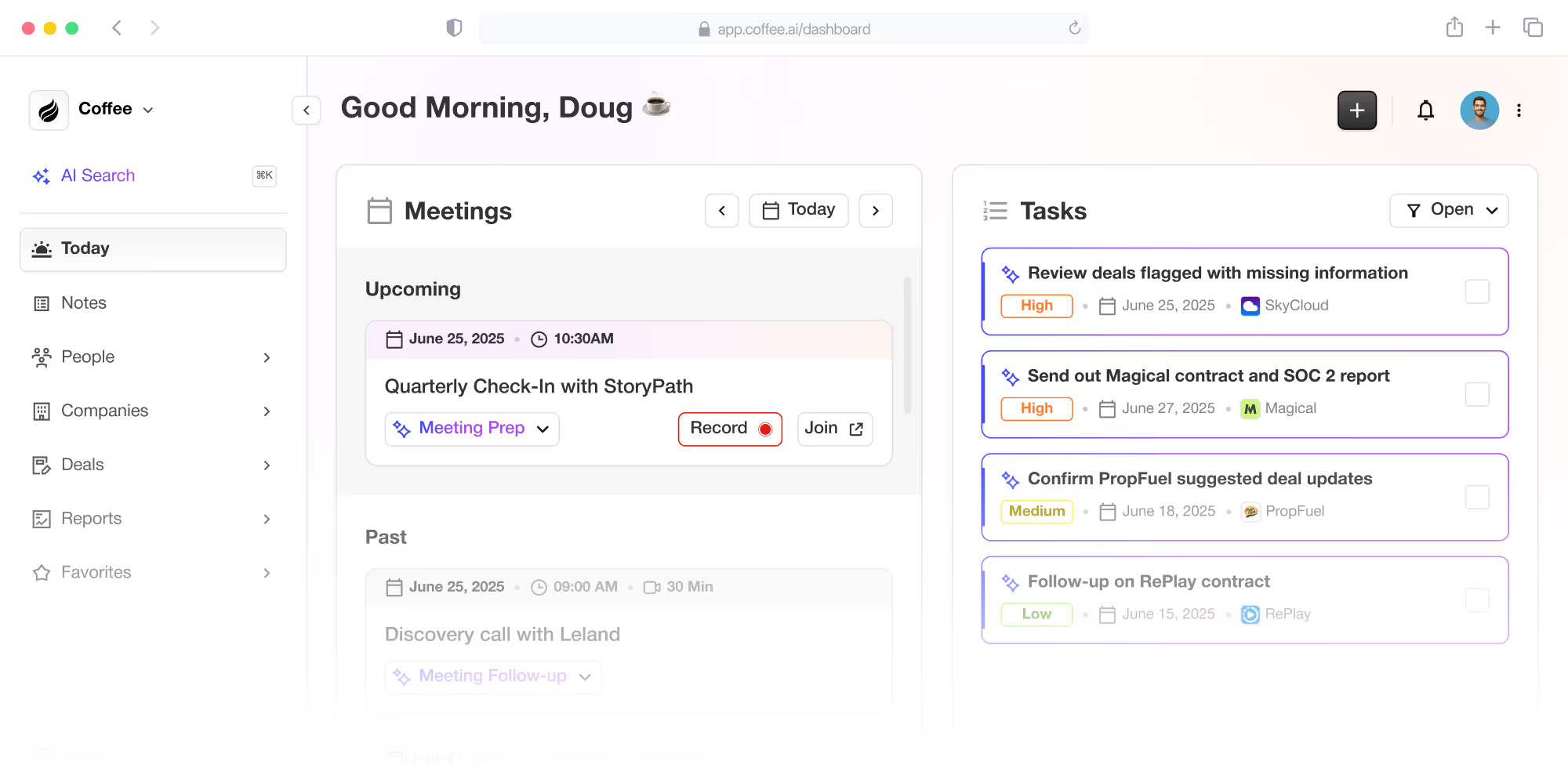
Interested in seeing how this works for your team? Request access to explore Coffee’s approach to sales workflow and data integration.
Essential Steps for Effective AI CRM Integration
Integrating AI CRM isn’t just about picking the right tool. It requires a thoughtful approach to organizational readiness, technical setup, and team adaptation. Sales leaders and RevOps teams need to assess multiple factors to ensure lasting impact and value from their efforts.
Evaluating Your Team’s Readiness for AI Adoption
Start with a thorough review of your current systems, data quality, and security measures. A readiness audit should cover infrastructure and data practices before making gradual upgrades instead of full replacements. This assessment looks at how you manage data, secure information, and operate within your existing tech environment.
Data governance is a key focus. Companies with strong data standards are better prepared for AI, while those with inconsistent practices may need foundational fixes first. Building new capabilities and ensuring readiness are vital to maximizing the benefits of unified, intelligent platforms.
Security checks are equally important, especially for handling sensitive customer information. Review current protocols and compliance needs to balance data sharing with protection during integration.
Finally, assess technical capacity. Look at integration options, API support, and data processing abilities. Modern systems with API access integrate more easily, while older setups might need intermediate solutions or phased updates.
Navigating Challenges with Legacy CRM Systems
Older CRM systems often pose hurdles due to their design. Outdated structures, isolated data, and limited access to historical records can complicate AI integration. Strategic solutions are needed to connect these systems with modern AI tools.
Using approaches like APIs and pre-built connectors can simplify the process. These modern methods cut down on complexity, speed up setup, and bring advanced features to teams with limited resources. Coffee’s Companion App, for instance, layers AI enhancements over Salesforce or HubSpot without replacing them, offering a practical upgrade path.
Tools like middleware or data pipelines can link legacy systems to real-time AI, consolidating key information for better CRM insights. Focus on incremental changes to avoid disruption, building connections that add value while keeping operations stable.
Measuring the Value of Unified CRM Investments
To gauge the return on AI CRM integration, set clear metrics that track both immediate gains and long-term impact. Develop a framework to measure improvements in sales performance and operational efficiency.
Focus on efficiency gains first. Tools like Coffee can save reps 8 to 12 hours weekly on data entry, directly increasing time for selling. Track enhancements in data accuracy, reduced administrative tasks, and shorter sales cycles due to better visibility.
Look at strategic outcomes too. Improved customer satisfaction, retention, and additional revenue from upsells often result from unified systems that enable personalized engagement and reliable information.
Consider long-term advantages as well. Assess how well your organization adapts to market shifts, scales operations, and meets changing customer needs. These benefits, though harder to quantify, often drive significant growth over time.
Avoiding Setbacks in AI CRM Integration
Even experienced teams face common obstacles when rolling out AI CRM integration. Knowing these challenges and planning ahead can help ensure success and maximize the value of your efforts.
Why Data Quality Is Non-Negotiable for AI Success
Data must be consistent and accurate for AI to work well. Fragmented or low-quality data can severely limit the effectiveness of AI and integration efforts. Underestimating this can lead to poor results despite heavy investment in tech.
The issue goes deeper than just cleaning data. Legacy systems reliant on manual input often have inconsistent formats and outdated entries, which hurt AI performance. Differences in data standards across platforms can further complicate integration.
Coffee tackles this by prioritizing high-quality data from real sales interactions like emails and calls. This automated capture ensures consistency and reduces manual errors, addressing a core problem in traditional systems.
Establish strong data governance to define standards and maintenance processes. Without this, even advanced AI tools struggle to provide reliable insights or automation.
Handling Team Adaptation and Skill Shortages
Integration isn’t just a technical task; it’s a people challenge. Effective change management, including training and communication, is critical for adapting to AI-driven workflows. Human factors often outweigh technical hurdles.
A lack of AI and data expertise can slow progress. Limited internal skills require costly training or hiring in a competitive market. The ongoing shortage of AI talent adds to workforce adaptation challenges.
Develop a change management plan that includes training and addresses cultural shifts. Sales teams used to manual methods may resist new systems, so communicate benefits clearly and provide hands-on support for learning.
Coffee helps by focusing on user-friendly AI that supports rather than replaces human work. Its design automates routine tasks, letting reps focus on relationships and strategy, easing the transition to new workflows.
Leadership plays a key role. Leaders should use the systems, highlight early successes, and emphasize the importance of AI to build support across the team.
Ensuring Security and Trust in AI Deployment
Security and clarity build confidence in AI systems. Transparent, compliant integrations are essential for stakeholder trust and meeting regulatory standards. Strong frameworks and open practices are a must.
Beyond basic data protection, address AI-specific risks like bias and ethical data use. Set policies for data access and decision-making, including retention rules and audit processes to meet privacy laws.
Coffee follows high standards with SOC 2 Type 2 and GDPR compliance. It offers clear data usage policies, ensuring customer information isn’t used for AI training without consent, tackling a common concern.
Monitor AI performance regularly to catch biases or errors. Form oversight groups with diverse team members to manage deployment and ensure ethical use.
Explain AI processes to users. Sales teams need to know how recommendations are made to balance AI input with human judgment effectively.
Comparing Coffee to Traditional CRM Solutions
Choosing between AI-first platforms and traditional CRM approaches is a critical decision. Here’s how Coffee, as a leader in this trend, compares to conventional methods:
|
Aspect |
Legacy CRM Solutions |
Coffee: AI-First CRM for Sales |
|
Data Unification & Quality |
Scattered data requiring manual updates, prone to errors from human input. |
Automated data collection and enrichment for consistent, accurate information. |
|
Automation & Efficiency |
Minimal automation, heavy manual workload, often needs multiple tools. |
Automates data entry and meeting tasks, freeing 8 to 12 hours weekly for sales. |
|
AI Capabilities & Insights |
Add-on AI limited by old designs, weak with real-time or unstructured data. |
Built-in AI for pipeline analysis and tailored insights from the start. |
|
Integration Complexity |
Requires custom setups with long implementation times. |
Offers easy native integrations and aCompanion App for existing systems. |
This comparison shows the clear benefits of AI-first platforms like Coffee. Traditional systems often demand constant upkeep and complex customization. Coffee, in contrast, provides advanced features with less hassle and quicker results, fitting into the larger movement toward smarter sales tools.
Ready to try an AI-first platform? Request access to see how Coffee can improve your sales operations and simplify your setup.
Common Questions About AI-Powered CRM Integration
What Are the Biggest Hurdles in AI CRM Integration?
Legacy system constraints and organizational gaps pose major challenges. Older CRMs often have outdated designs and isolated data, making it hard to access historical records vital for AI. Ensuring consistent, clean data is also critical, as poor quality undermines results. Talent shortages in AI and data skills add difficulty, alongside the need for team training and cultural shifts to adapt to new processes.
How Does AI Add Value to CRM for Sales Teams?
AI turns CRM into a strategic tool by automating tasks and providing actionable insights. It cuts manual data entry by 8 to 12 hours weekly, supports meetings with summaries and follow-ups, and offers real-time pipeline updates. This unified data helps sales reps spot trends, improve customer interactions, and increase conversions.
Does Coffee Work with Salesforce or HubSpot?
Yes, Coffee’s Companion App enhances existing Salesforce or HubSpot systems without replacing them. Simple authentication syncs data, allowing access to AI features like automated entry and pipeline insights while keeping your main CRM intact. This addresses issues like low adoption and poor data quality.
What Returns Can Companies Expect from AI CRM?
Benefits include immediate efficiency gains and strategic growth. Tools like Coffee save reps 8 to 12 hours weekly, improving productivity. Better data accuracy enhances forecasting and customer engagement. Over time, companies see stronger market positioning, scalability, and higher retention through improved relationship management.
How Does Coffee Handle Data Security?
Coffee meets high standards with SOC 2 Type 2 and GDPR compliance. It uses strong access controls, encryption, and audits to protect data. Clear policies ensure customer data isn’t used for AI training without consent, and regular monitoring keeps up with regulatory changes.
Strengthen Your Sales Approach with Smart Integration
The need for AI-powered CRM integration is evident. As customer expectations rise and competition grows, sticking with fragmented, manual systems creates a widening gap. Sales reps lose 71% of their time to non-selling tasks, data issues weaken AI, and complex tech stacks slow growth.
As part of a broader shift to intelligent platforms, Coffee offers a forward-thinking solution. It captures accurate data from real interactions, overcoming challenges of traditional systems while enabling AI insights and automation for better results.
The benefits go beyond short-term gains. Companies using unified AI systems can adapt faster to market shifts, scale efficiently, and improve customer experiences, driving loyalty and additional revenue.
Choosing between minor fixes to old setups or embracing AI-first tools will shape your future competitiveness. Acting now on smart integration builds lasting advantages in efficiency and responsiveness that others will struggle to replicate.
Success hinges on more than just tech. It requires commitment to team adaptation, data quality, and viewing AI as a core part of customer engagement. Those who treat this as a fundamental shift, not just an upgrade, will gain outsized benefits in their markets.
Want to move your sales from reactive to proactive and fragmented to unified? Request access to Coffee and learn how intelligent integration can advance your sales strategy.