
In today’s fast-paced sales environment, artificial intelligence is reshaping how teams connect with customers and streamline operations. The integration of automation within AI-first CRM systems offers a practical way to boost efficiency, enhance customer interactions, and gain valuable insights. This guide explores the role of AI-driven automation in modern sales, with a focus on platforms like Coffee that exemplify broader industry trends toward smarter, data-driven solutions.
How AI and Automation Are Changing the Sales Landscape
The sales world has moved from slow, manual processes to dynamic, technology-driven interactions. Buyers now demand fast responses, tailored communication, and smooth experiences across every channel. Teams stuck with outdated methods or disjointed tools often struggle to keep pace with competitors who leverage AI for speed and precision, highlighting the growing need for integrated systems.
Current market trends show a clear shift. Companies adopting AI tools in sales cycles see improved productivity and deal closures. Research indicates that AI adoption in sales has risen by over 75% in recent years, with a direct correlation to higher revenue growth. This reflects a broader push toward solutions that save time and align with buyer expectations. Amid this evolution, platforms like Coffee stand out by combining automation with data intelligence to help sales teams stay competitive.
Why Traditional CRMs Fall Short in Today’s Market
Legacy CRM systems often create bottlenecks for modern sales teams. Many require extensive manual input for tasks like logging calls or updating records, pulling focus away from actual selling. Without strong automation, reps can spend up to 20% of their day on administrative work, reducing time for customer engagement.
Data fragmentation adds another layer of difficulty. When customer information is spread across multiple tools, it becomes hard to build a complete picture of buying behavior or team performance. This can lead to missed opportunities and inconsistent follow-ups, directly impacting revenue potential.
User adoption is also a challenge with older systems. If the interface feels clunky or unintuitive, reps may avoid using it altogether, resorting to personal spreadsheets or other workarounds. This further scatters data and undermines the system’s value. A unified, AI-driven approach, as seen with newer platforms like Coffee, addresses these issues by prioritizing ease of use and streamlined processes.
What Automation Brings to AI CRM Systems
Automation in AI CRMs tackles the core inefficiencies of manual sales tasks. It handles repetitive activities like data entry, meeting scheduling, and follow-up drafting, freeing reps to focus on building relationships and closing deals.
Key features often include:
- Automatic capture of email and calendar data to update contacts and records.
- AI-generated meeting summaries and action items to simplify post-call workflows.
- Instant data enrichment with details like job roles or company updates for better personalization.
These capabilities cut down on time spent on logistics. Reps can redirect their energy to strategic tasks, directly improving productivity and deal momentum. Platforms like Coffee lead this trend by embedding automation into every step of the sales journey.
Unpacking AI CRMs: A New Standard for Sales Tools
AI CRMs differ from traditional systems by acting as active assistants rather than static databases. They pull together data from emails, calls, and calendars, offering real-time insights and automating routine workflows to support sales teams at every stage.
Unlike older CRMs with rigid formats, AI-driven platforms use flexible data models to store historical interactions and enable detailed analysis. This supports features like predictive pipeline tracking and automated task prioritization, which are harder to achieve with less advanced tools. Coffee, for instance, uses this approach to deliver actionable insights while keeping the user experience straightforward and engaging.
Coffee as a Leading Example of AI-First CRM Automation
Coffee offers a clear demonstration of how AI and automation can transform sales operations. Built with a focus on unified data and intuitive design, it reduces workflow friction and helps teams operate more effectively compared to fragmented or manual setups.
Streamlined Meeting Management with Coffee
Coffee simplifies customer interactions by automating contact creation and data updates. Once connected to Google Workspace or Microsoft 365, it scans emails and calendar events to populate records with relevant details, linking everything to the right accounts without manual input.
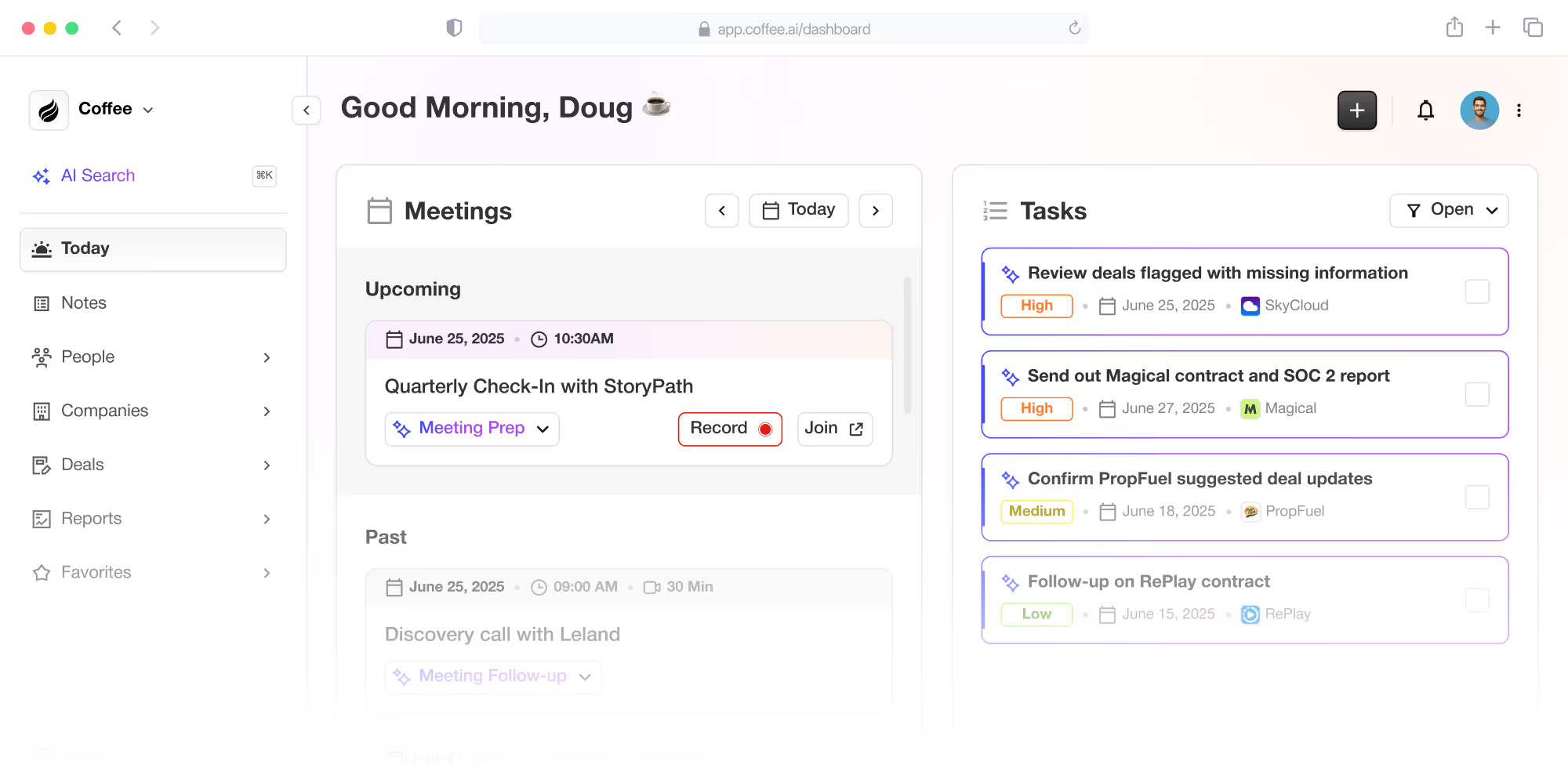
Before meetings, Coffee’s “Today” page delivers concise briefings with attendee information, company background, and past interaction notes. This preparation ensures reps approach every call with confidence and context. After meetings, the system generates summaries, identifies next steps, and drafts follow-up emails, saving hours of post-call effort.
Improved Data Quality and Workflow Efficiency
Coffee captures all customer interactions in one place, updating activity logs and contact details automatically. It enriches records with external data like job titles or company funding status through trusted partners, ensuring accuracy without extra effort from the team.
This focus on eliminating manual updates lets reps prioritize relationship-building and deal progression. Ready to see how this works for your team? Request access to Coffee and explore AI-powered sales automation firsthand.
How to Implement AI CRM Automation for Maximum Impact
Evaluate Your Current Setup for Automation Readiness
Start by reviewing your existing tools and processes. Look at CRM usage levels, time spent on repetitive tasks, and gaps in data quality or integration. Quantifying these inefficiencies helps build a case for automation and sets a benchmark for measuring improvement.
Consider the complexity of your tech stack. Many teams juggle separate systems for CRM, data enrichment, and analytics, adding cost and confusion. A platform like Coffee can consolidate these functions, reducing overhead and simplifying workflows.
Choose the Right Integration Model for Your Needs
Coffee offers two practical options for deployment. Its Standalone CRM suits smaller businesses looking for a full replacement to outdated tools. The Companion App fits larger teams with existing CRMs, layering Coffee’s AI features on top without disrupting current systems.
This flexibility extends to rollout strategies. Test Coffee with a small group or specific segment before a full launch. This approach minimizes risk and lets early users experience the benefits, paving the way for wider adoption.
Ensure Data Security and Compliance Standards
Data protection remains a top priority when adopting new tools. Coffee meets rigorous standards with SOC 2 Type 2 certification and GDPR compliance, safeguarding customer information across automated processes. Its encryption and access controls further protect data integrity, while strict policies prevent customer information from being used in AI training.
Measure the Full Value of Automation Beyond Time Savings
Automation’s impact goes beyond reducing workload. Track metrics like deal velocity, data accuracy, and forecasting reliability to capture its broader benefits. These improvements often translate into stronger sales outcomes and better strategic planning, offering a comprehensive view of return on investment.
Key Benefits of Combining Automation with AI CRM
Boost Sales Efficiency by Cutting Administrative Tasks
Automation frees up significant time for sales reps. Handling data entry and meeting logistics through AI tools allows more focus on direct customer engagement and deal-closing activities, directly lifting team productivity.
Elevate Customer Interactions with Consistent Data
Buyers value polished, informed communication. AI CRMs unify customer data to ensure reps have full context for every interaction, leading to smoother engagements and higher satisfaction rates without added effort.
Gain Deeper Insights from a Single Data Source
A unified data setup unlocks powerful analysis. Features like Coffee’s Pipeline Compare track weekly progress, spotlighting stalled deals and engagement patterns. This clarity supports better decision-making and long-term strategy development.
Common Challenges and How to Avoid Them
Drive Adoption with Effective Change Management
Introducing new tech can face pushback, especially if past tools underdelivered. Communicate clearly how automation benefits reps by reducing grunt work. Pair this with hands-on training to show immediate value, using pilot groups to build momentum for full rollout.
Prevent Data Silos with Integrated Systems
Adding tools without proper integration risks scattering customer data. Coffee counters this by centralizing information within its platform, ensuring every interaction feeds into one reliable record instead of creating separate pools of data.
Maintain Human Connection Alongside Automation
Automation should support, not replace, the personal touch in sales. Reps need to retain control over key decisions, using AI to handle routine tasks while preserving the judgment and creativity that build strong customer relationships.
Why Coffee Stands Out Among AI CRM Solutions
Coffee’s design focuses on seamless AI integration, offering a cohesive experience compared to older CRMs that often rely on external add-ons for similar features. Its unified data structure minimizes inconsistencies, making it a practical choice for teams aiming to simplify their tech stack.
Comparing Automation in Legacy CRMs vs. Coffee
|
Feature Category |
Older CRM Systems |
Coffee (AI-First CRM) |
|
Data Entry & Unification |
Often manual, risk of scattered data |
Automatic from email/calendar, fully unified |
|
Meeting Workflow |
Manual preparation and follow-up |
AI briefings, automated summaries |
|
Intelligence & Insights |
Limited automated reporting |
Predictive pipeline tracking, activity logs |
|
User Experience |
May feel outdated or complex |
Intuitive design, productivity-focused |
Coffee also reduces costs by consolidating multiple tools into one platform. Its user-friendly approach encourages consistent use, improving data quality and amplifying the impact of automation. Interested in seeing the difference? Request access to Coffee and test its capabilities for yourself.
Answers to Common Questions About AI CRM Automation
How Does Coffee Work with Existing CRM Tools?
Coffee’s Companion App integrates with current platforms, adding AI automation and data enrichment while keeping your primary CRM as the main record. Syncing is straightforward via authentication, with options to push enriched insights back to your existing system.
Does Automation Remove the Need for Manual Task Management?
Automation cuts down on repetitive work like logging data or drafting follow-ups, but reps still oversee critical choices. It streamlines logistics while maintaining human control over strategic customer engagement.
What Value Can Sales Leaders Expect from AI CRM Automation?
The returns include major time savings for reps, improved data reliability for forecasting, and enhanced strategic focus. These combine to drive better sales results and operational clarity across the board.
Is AI CRM Automation Only for Large Companies?
No, Coffee serves businesses of varying sizes. Its Standalone CRM fits small teams of 1-20, while the Companion App enhances existing setups for mid-market firms. Simple pricing ensures access to advanced features without high costs.
How Does Coffee Protect Data in Automated Processes?
Coffee upholds high security standards with SOC 2 Type 2 certification and GDPR compliance. It uses end-to-end encryption and access controls, ensuring customer data isn’t used for AI training and remains protected.
Looking Ahead: Build a Future-Ready Sales Strategy
Embracing automation within an AI CRM isn’t just an option, it’s a critical step to stay relevant. As customer needs shift, the teams that succeed will be those using technology to remove barriers and amplify their strengths.
Coffee illustrates this trend with its focus on unified data and practical automation. By cutting manual tasks and delivering clear pipeline insights, it redefines how sales teams operate. The result is better productivity, accurate data, and stronger customer connections. Ready to step into this future? Request access to Coffee and see how AI can reshape your sales process.