
In the current B2B sales environment, the shift to digital interactions has reshaped how businesses engage with buyers. Sales leaders now face growing pressure to adapt to these changes or risk falling behind. The market landscape reflects a clear trend: companies are moving away from cumbersome, manual processes and fragmented tools toward integrated, intelligent systems. AI sales assistants, embedded within AI-driven CRM platforms, are at the forefront of this shift, offering solutions that automate routine tasks, deliver actionable insights, and allow sales teams to prioritize building customer relationships. This guide offers a detailed look at the role of AI in modern sales, exploring its potential to improve efficiency and drive revenue while addressing the challenges of transitioning from traditional systems. Backed by research and practical insights, it aims to equip sales leaders with the tools to navigate this evolving space.
Why AI Sales Assistants Matter in Today’s Sales Environment
AI sales assistants have become a critical focus for sales leaders as businesses seek ways to stay competitive. These tools address longstanding inefficiencies in traditional CRM systems, paving the way for smarter, more effective sales operations.
Breaking Free from Legacy CRM Limitations
Traditional CRM systems often create more obstacles than solutions for sales teams. Many reps juggle multiple tools for tasks like data enrichment, outreach, and call recording, leading to disjointed workflows and high costs. Manual data entry remains a significant drain, with reps spending hours updating records instead of focusing on sales. This cycle of poor data quality and low adoption turns CRMs into little more than reporting tools for management, rather than practical resources for sales teams. Additionally, some legacy systems struggle to manage unstructured or historical data, limiting their ability to support advanced AI capabilities. As a result, many teams resort to alternative solutions like spreadsheets, further fragmenting their operations.
Moving Beyond Automation to Intelligent Support
The rise of advanced AI models offers a chance to rethink how CRMs function. Unlike basic automation, AI sales assistants within modern platforms actively analyze data and provide contextual recommendations. They reduce operational costs by streamlining workflows and eliminating inefficiencies that have long burdened sales teams. This shift allows reps to focus on strategic activities, such as nurturing leads and closing deals, rather than administrative tasks.
Understanding AI Sales Assistants: A Framework for Sales Leaders
AI sales assistants are more than just automation tools. They use machine learning and natural language processing to support sales teams directly within a CRM system. Unlike rigid, rule-based systems, these assistants adapt to each interaction, offering tailored insights and actions based on context. Their ability to process unstructured data, such as emails or call transcripts, sets them apart from traditional tools, making them valuable partners in the sales process.
Key Features That Drive Sales Performance
AI sales assistants bring specific capabilities that directly improve different stages of the sales cycle. Here’s how they make a difference:
- Automated Data Entry and Enrichment: These tools scan emails and calendars to update CRM records without manual input. They also pull in detailed information like job titles or company data, reducing the need for separate services and ensuring accurate, up-to-date records.
- Meeting Preparation and Follow-Up: Before meetings, AI compiles background details on attendees and past interactions. During calls, it records and transcribes conversations. Afterward, it creates summaries, flags action items, and drafts follow-up emails for quick review and dispatch.
- Pipeline Analysis and Forecasting: AI provides real-time insights into deal progress, showing which opportunities are advancing or stalling. This eliminates the need for manual data exports, offering immediate visibility through simple dashboards.
- Unified Tech Stack: By combining CRM features with data enrichment and call analysis, AI assistants reduce the complexity of managing multiple tools. This integration cuts costs and ensures smoother data flow across sales processes.
Exploring Coffee: An AI-First CRM Built for Sales Growth
As part of the broader movement toward AI-driven sales solutions, Coffee stands out with its ground-up design focused on intelligent automation and unified data management. It tackles the core issues of traditional CRMs by prioritizing high-quality data and user-friendly experiences that encourage adoption among sales teams. Coffee exemplifies how modern platforms are redefining sales operations for better outcomes.
Streamlining Data Management
Coffee automatically pulls data from emails, calendars, and calls to build CRM records, removing the need for manual updates. Once connected to Google Workspace or Microsoft 365, it creates contacts and logs activities in real time. Its built-in enrichment feature adds detailed information from licensed data sources, replacing standalone tools. By using a data warehouse instead of traditional databases, Coffee retains historical data for deeper insights, ensuring AI functions are built on accurate, reliable information.
Enhancing Meeting Effectiveness
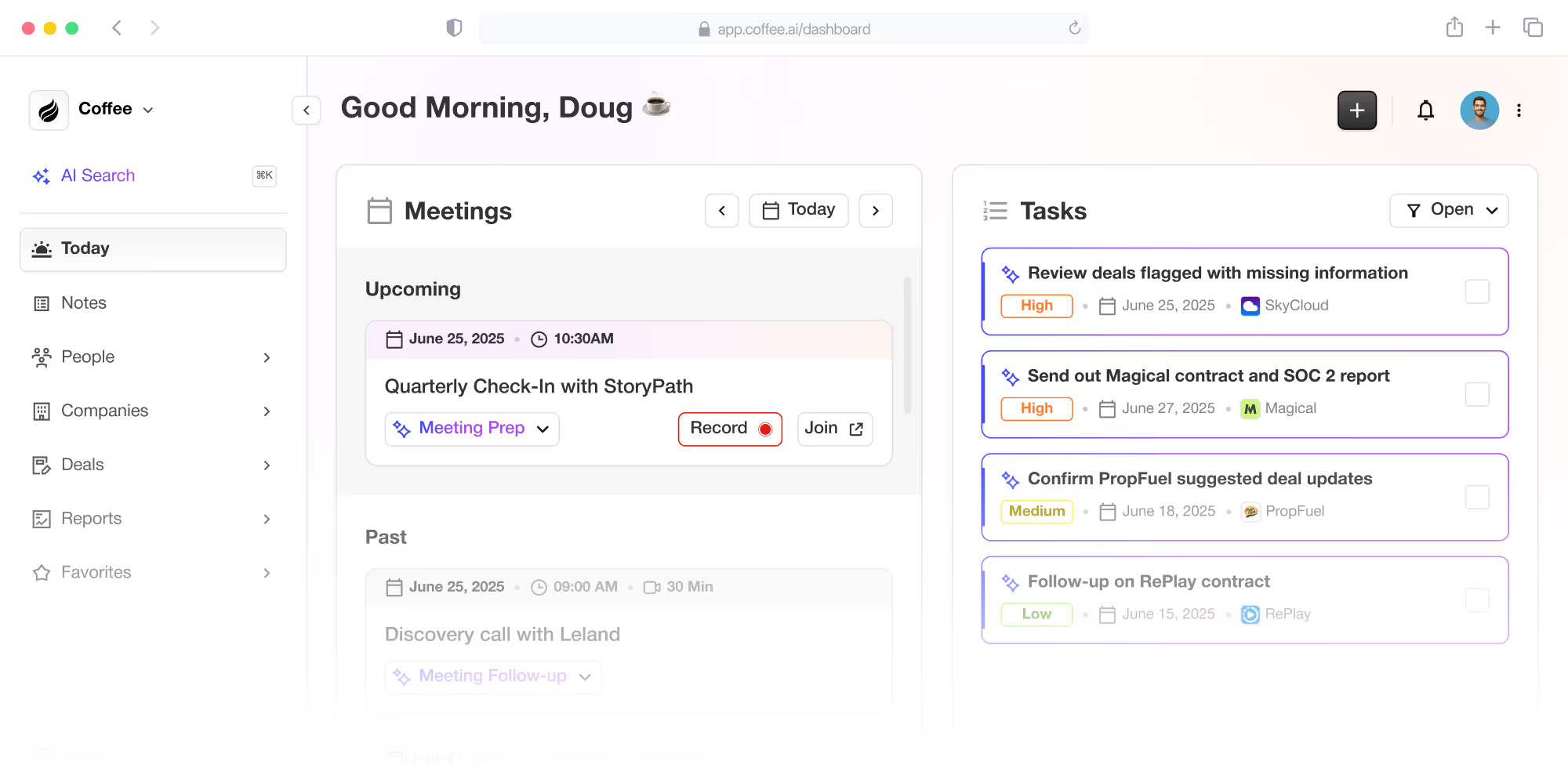
Coffee supports sales reps at every stage of customer meetings. Its “Today” page offers briefings with attendee details and interaction history. During calls on platforms like Google Meet or Zoom, AI bots record and transcribe discussions. Post-meeting, it delivers summaries, identifies tasks, and prepares follow-up emails ready for sending through Gmail. Coffee also adapts to sales frameworks like MEDDIC or BANT, organizing insights to align with specific qualification methods.
Delivering Real-Time Pipeline Insights
With its “Pipeline Compare” feature, Coffee simplifies pipeline tracking by showing week-over-week changes in deal status. Sales reps and leaders can spot new opportunities or stalled deals with a single click, bypassing the manual analysis required by older CRMs. This capability supports faster, data-driven decisions on resource allocation and deal focus.
Fostering User Adoption
Coffee is designed to be a tool sales reps actually want to use. By automating tedious tasks and offering practical features like meeting prep and follow-ups, it acts as a supportive partner. The platform’s intuitive interface ensures quick access to value, driving consistent usage and, in turn, better data quality for actionable insights.
How to Implement AI Sales Assistants: Strategic Steps for Success
Choosing the Right Approach: Build, Buy, or Integrate
Sales leaders must decide whether to build custom AI solutions, buy standalone platforms, or integrate AI with existing CRMs. Building in-house requires significant resources and technical expertise, often impractical for smaller firms. Buying a comprehensive platform like Coffee provides all-in-one functionality with less complexity. Integrating AI, such as through Coffee’s Companion App for Salesforce and HubSpot, allows companies to enhance current systems without full replacement, preserving existing workflows while adding value.
Preparing Your Team for AI Adoption
Adopting AI successfully hinges on team readiness and cultural shifts. Start by assessing data quality, technical skills, and openness to change. Clear communication is key to positioning AI as a tool that supports, not replaces, human effort. Training should focus on using AI insights for better decisions while maintaining the personal touch in sales. Collaboration across sales, IT, and operations ensures smooth integration with other systems and addresses security or data flow concerns.
Measuring the Impact of AI Investments
Track both tangible and intangible benefits to evaluate AI’s return on investment. Monitor metrics like pipeline speed, forecasting accuracy, and time saved on administrative tasks. For instance, quantify hours freed up from data entry or meeting follow-ups. Also, assess improvements in customer interactions, such as faster responses or higher satisfaction, to gauge external effects. These combined measures help justify the investment and highlight areas for further optimization.
Overcoming Common Challenges in AI Sales Adoption
Ensuring Data Quality for Reliable Insights
Effective AI relies on clean, consistent data. Many legacy CRMs suffer from incomplete or inaccurate records due to manual processes and low usage. Before adopting AI, evaluate your data and establish improvement plans. Poor data leads to unreliable AI outputs, which can misguide sales efforts. Platforms like Coffee address this by pulling data directly from communication sources, ensuring accuracy from the start.
Integrating AI Within Your CRM System
AI works best when embedded in a CRM, not as a separate tool. Standalone solutions create silos and workflow friction, reducing their impact. Deep integration, as seen in Coffee’s design, ensures AI insights are accessible within familiar processes, improving adoption and value. This unified approach avoids the inefficiencies of managing multiple systems.
Balancing AI with Human Skills
AI excels at data analysis and routine tasks, but human judgment remains essential for relationship building and complex decisions. Training should emphasize collaboration between AI tools and reps, ensuring technology enhances rather than replaces personal skills. A culture of ongoing learning and review helps refine AI use while maintaining high standards in customer engagement.
Addressing Legacy System Constraints
Older CRM architectures can hinder AI integration due to outdated data models or limited APIs. These constraints often complicate adding modern AI features. Coffee’s design sidesteps such issues with a structure built for AI from the start, using advanced data storage and APIs to enable seamless functionality that legacy systems struggle to match.
Common Questions About AI Sales Assistants and CRM
Differences Between AI Sales Assistants and Traditional Automation
AI sales assistants use machine learning to adapt and provide contextual support, unlike traditional automation, which follows fixed rules. AI can interpret varied data sources and adjust recommendations, while automation repeats the same steps. Coffee’s assistant, for example, evolves with user interactions to offer relevant guidance.
Impact on Sales Reps’ Daily Work
AI sales assistants reduce time spent on repetitive tasks, letting reps focus on meaningful customer engagement. Data entry, meeting prep, and follow-ups are handled automatically, freeing up hours for strategic activities. This often boosts job satisfaction by shifting focus to impactful, revenue-focused work.
Compatibility with Existing CRM Systems
Many AI assistants, including Coffee’s Companion App, are built to work with platforms like Salesforce and HubSpot. They sync data for analysis and enrichment, allowing you to enhance your current setup without overhauling it. This preserves established processes while adding AI benefits.
Expected Returns from AI Investment
Businesses often see notable gains from AI sales assistants, including time savings of 8 to 12 hours weekly per rep. This efficiency translates to higher productivity and lower costs through streamlined operations, directly impacting revenue potential.
Assessing Readiness for AI Adoption
Evaluate your organization’s data quality, tech comfort, and willingness to adapt before implementing AI. Fragmented data or resistance to change may require preparatory steps. Solutions like Coffee can help by improving data accuracy and user engagement, addressing common barriers to adoption from the outset.
Conclusion: Shape Your Sales Future with AI and Coffee
Adopting AI sales assistants within modern CRMs is a vital step for organizations aiming to boost growth and efficiency. Legacy systems, with their manual workloads and fragmented processes, can hinder progress over time. Coffee addresses these challenges with an AI-first design that automates routine tasks, unifies data, and provides real-time insights, making it a practical choice for sales teams. By reducing administrative burdens, AI allows reps to focus on building relationships and solving complex challenges, ultimately driving better results. This shift represents a broader trend toward smarter, more integrated sales tools that redefine how teams operate.