
The sales industry is at a turning point. Artificial intelligence is reshaping how businesses connect with customers, pushing sales leaders to rethink the tools and strategies they rely on. Traditional CRM systems, once the backbone of sales operations, often fall short in today’s fast-paced, data-rich environment. They struggle to keep up with the volume of interactions, the need for real-time insights, and the demand for automation. This has paved the way for a new breed of technology: AI-driven CRM platforms integrated with conversation analytics software.
These tools are not just upgrades. They represent a shift in how sales teams operate, moving from manual processes and fragmented data to systems that capture, analyze, and act on customer conversations automatically. For sales executives, VPs of Revenue Operations, and CEOs, adopting this technology offers a chance to improve efficiency, uncover deeper customer insights, and stay ahead in a competitive market. This guide will walk you through the essentials of AI CRM and conversation analytics, showing how they can work together to strengthen your sales strategy.
Modern sales organizations need platforms that go beyond storing data. They require systems that interpret interactions, streamline repetitive tasks, and deliver actionable advice. If you’re looking to adapt to this change, integrating AI and conversation analytics could be the key to driving better outcomes for your team.
Curious about how this technology can fit into your organization? Request access to see Coffee’s approach to AI-driven sales in action.
Why AI CRM with Conversation Analytics Matters for Sales Leaders
Addressing the Gaps in Traditional CRM Systems
Many older CRM systems can’t fully meet the needs of modern sales teams. Customer data is often scattered across tools like ZoomInfo for enrichment, SalesLoft for outreach, and separate platforms for call recordings, creating disjointed workflows. This fragmentation makes it hard to get a complete picture of customer interactions.
Additionally, traditional systems often struggle to process unstructured data, such as email content or call transcripts. This limits the insights sales teams can draw from their interactions. Moving to platforms that integrate data and automate processes is essential for staying responsive in today’s market.
Moving Toward Proactive Sales Strategies
Sales success now depends on being proactive rather than reactive. This requires systems that analyze customer interactions as they happen, providing insights instantly. When customer data is unified, teams can make informed decisions quickly. Automation also reduces manual tasks, freeing up sales reps to focus on building relationships instead of entering data.
Intelligent systems capture information automatically and streamline workflows. They offer guidance on next steps, helping sales teams respond to customer needs faster. This data-driven approach improves both customer satisfaction and team performance.
Driving Business Results with Integration
Combining conversation analytics with AI CRM boosts efficiency and effectiveness. Sales teams save time by automating repetitive tasks, allowing more focus on engaging with customers. The actionable insights from these systems help refine strategies, leading to better sales outcomes and stronger relationships.
Breaking Down AI CRM and Conversation Analytics for Sales
Understanding AI CRM in Sales Contexts
AI CRM goes beyond basic contact management. These platforms use artificial intelligence to analyze patterns in customer behavior and sales performance, offering specific recommendations instead of just raw data. They handle both structured information, like contact details, and unstructured content, such as emails or call notes, for a fuller view of relationships.
This comprehensive approach improves pipeline accuracy and supports better sales planning. With AI, teams gain insights that help them prioritize efforts and close deals more effectively.
Defining Conversation Analytics Software
Conversation analytics software captures and examines customer interactions to provide useful insights. It transcribes and analyzes sales calls and meetings, pulling out key points automatically. This gives sales teams visibility into how conversations unfold.
These tools help managers coach their teams with concrete data and let reps see which approaches work best. By looking at conversation trends, organizations can spot opportunities to improve their sales tactics.
How AI CRM and Conversation Analytics Work Together
When AI CRM integrates with conversation analytics, it creates a powerful system that automates data entry, summarizes meetings, generates follow-up tasks, and provides context for every customer touchpoint. This connection ensures that insights from conversations feed directly into the CRM, making the system smarter over time.
Such integration helps teams respond to customers with more relevance and speed. It builds a foundation for sustained improvement in sales performance and customer engagement.
Exploring the Sales Tech Market and Emerging Trends
The sales technology market has come a long way from basic contact databases. Today, platforms use AI to automate data capture, analyze interactions, and suggest next steps. This shift reflects a growing need for tools that handle the complexity of modern sales processes.
Established players like Salesforce and HubSpot have added AI features to their offerings, adapting to changing demands. Meanwhile, newer solutions like Coffee are built with AI at their core, designed for today’s sales challenges. A clear trend is the move toward unified systems that combine CRM, conversation analytics, data enrichment, and automation, reducing the need for multiple tools.
AI-native CRM platforms stand out because they’re engineered to prioritize intelligent automation and user-friendly design. Research indicates that companies adopting these integrated systems see measurable gains in efficiency and sales outcomes. Market analysis highlights the rapid adoption of AI-driven sales tools as a key driver of productivity.
Key Factors for Implementing AI CRM Solutions
Weighing Build vs. Buy Options
Deciding whether to develop custom conversation analytics or purchase an integrated platform involves evaluating resources, timelines, and goals. Building in-house requires significant technical expertise and ongoing support, which can pull focus from core sales activities.
Most companies find that opting for a ready-made AI CRM with built-in analytics accelerates deployment and reduces costs. When choosing a platform, consider how well it connects with existing tools, its ability to scale, the vendor’s reliability, and the full cost of implementation and support.
Navigating Organizational Change
Adopting AI CRM with conversation analytics demands careful planning around user adoption and training. Sales reps accustomed to older systems may hesitate to embrace new tools. Showing them the direct benefits, like reduced admin work, is crucial for buy-in.
Effective rollouts prioritize features that help reps day-to-day over those focused on management reporting. Training should center on practical use, ensuring users feel confident applying the technology in their workflows.
Tracking ROI and Success Indicators
Defining clear metrics for success and return on investment helps validate the adoption of new tools and guides ongoing improvements. Track measurable factors like reduced data entry time or improved pipeline accuracy, alongside user feedback on satisfaction and adoption.
Set baseline measurements before rollout and monitor progress afterward. This approach provides hard data on the platform’s impact, supporting budget discussions and continuous refinement.
Ensuring Data Security and Compliance
Handling sensitive customer data requires robust security and adherence to regulations like GDPR. Evaluate vendors based on their security certifications, data protection practices, and compliance with industry standards.
Look for encryption of data during transfer and storage, strict access controls, and detailed activity logs. Ensure the vendor has transparent policies on how data is used for AI training, protecting your information from being shared. Compliance needs vary by region and sector, so choose a provider familiar with your specific requirements.
Coffee: A Standout AI CRM with Built-In Conversation Analytics
As an example of the broader trend toward integrated, AI-driven sales tools, Coffee offers a compelling solution. Designed as an AI-first CRM, it incorporates conversation analytics to address the shortcomings of older systems. Its focus on automation and unified data sets it apart in a crowded market, making it a strong choice for sales teams seeking modernization.
What Coffee Brings to Sales Teams
Coffee delivers practical value through features tailored to sales needs. Here are some key benefits:
- Automates contact creation and updates by scanning emails and calendars, saving reps an estimated 8-12 hours weekly.
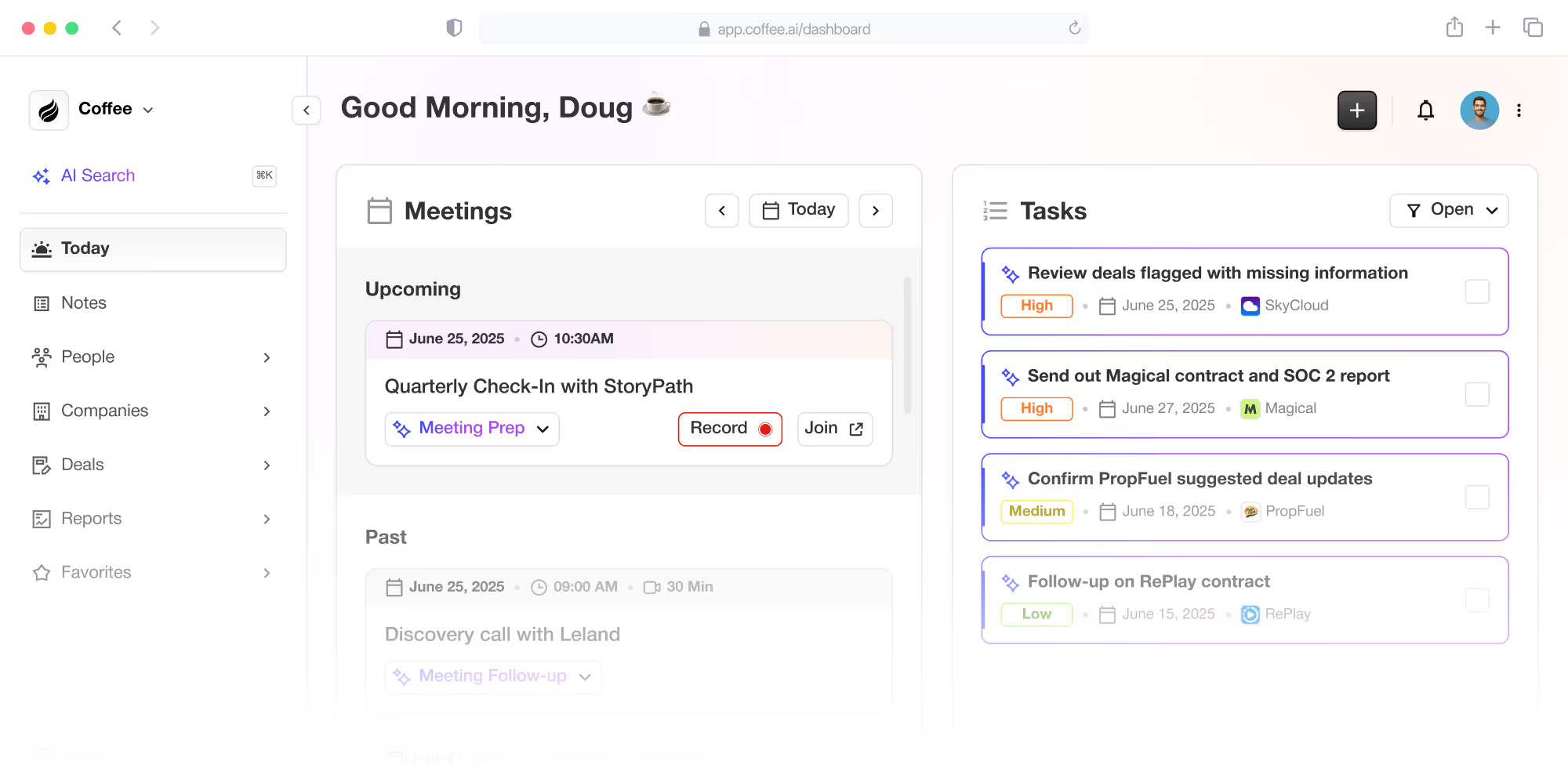
- Prepares reps with AI-generated meeting briefings and post-meeting summaries, including action items and follow-up drafts.
- Offers pipeline insights with a “Compare” feature for tracking weekly changes, simplifying deal monitoring.
- Combines CRM, data enrichment, and call recording into one platform, reducing tool sprawl and data silos.
- Prioritizes user-friendly design, acting as a daily assistant for reps with actionable insights.
Transforming Sales with Conversation Analytics
Coffee’s conversation analytics enhance its CRM capabilities in distinct ways:
- An AI meeting bot joins calls on Google Meet, Microsoft Teams, and Zoom, recording and transcribing without manual effort.
- Generates meeting summaries, identifies tasks, and drafts follow-up emails for quick review and sending.
- Structures insights using sales methodologies like BANT or MEDDIC, supporting consistent deal qualification and coaching.
- Integrates conversation data with CRM records for a complete view of customer relationships, aiding strategic planning.
Want to see this integration in action? Request access to Coffee’s platform and explore its impact on sales performance.
Assessing Your Organization’s Readiness for Implementation
Evaluating Your Current CRM Setup
Before adopting new technology, assess your existing sales tools and processes. Look at data quality, user engagement with current systems, integration challenges, and how well workflows support sales goals.
Focus on areas like the accuracy of customer information, the time spent on manual tasks, and rep satisfaction with tools. Organizations with heavy admin burdens or scattered systems are prime candidates for an AI CRM with analytics.
Also, gauge your readiness for change, considering technical capacity, training resources, and leadership backing. This thorough review sets the stage for a smooth rollout and effective adoption.
Engaging the Right Stakeholders
Implementation success hinges on involving key groups across your organization, from sales leaders to IT teams and end users. Each brings unique needs and perspectives that shape the project.
Sales leaders care about business results like productivity gains. Operations teams focus on data flow and process efficiency. IT prioritizes security and system compatibility. Reps value ease of use and time savings. Build a plan that addresses these priorities, with regular updates and feedback to keep everyone aligned.
Planning a Phased Rollout for Best Results
Start implementation with a staged approach to show quick wins while building toward full use. Begin with core features like automation and data capture that deliver immediate time savings and prove the tool’s worth.
Later phases can introduce advanced analytics and workflows, giving users time to adapt. Define success metrics, offer targeted training, and gather input at each stage to refine the process. This gradual method prevents overwhelm and supports long-term adoption.
Using Frameworks to Guide Decisions
Structured tools like maturity models and decision matrices help map your current state and plan next steps. Assess factors such as data quality, automation levels, user adoption, and system integration to identify gaps.
A decision matrix can compare platforms based on features, cost, vendor support, and setup complexity. These approaches ensure choices align with your strategic goals and organizational capacity.
Common Challenges Sales Teams Face During Adoption
Overlooking the Importance of Data Quality
Poor data quality can undermine even the best AI tools, leading to unreliable insights and user distrust. Accurate, consistent data is vital for effective analytics and predictions.
Invest in cleaning and standardizing data upfront, alongside policies for ongoing quality control. Train users on best practices to maintain data integrity. Addressing this early ensures AI delivers valuable, trustworthy results.
Neglecting User Adoption by Sales Reps
Technology alone doesn’t guarantee success. If reps don’t use the system, its potential goes unrealized. Focus on tools that offer clear, immediate benefits to their daily work, rather than just management oversight.
When reps see value in features like automated data entry, they’re more likely to engage. Prioritize user experience in training and selection to drive consistent use and better outcomes.
Getting Stuck with Disconnected Tools
Using multiple standalone tools instead of a unified platform often creates inefficiencies and data gaps. Sales reps juggling different systems lose time and focus, reducing the value of each tool.
Opt for integrated solutions that combine key functions like CRM and analytics. This streamlines workflows, improves data consistency, and enhances the user experience overall.
Missing Strong Leadership Support
Without committed executive backing, implementations can falter due to limited resources or weak adoption. Leaders must advocate for the tool beyond the initial decision, ensuring support for training and optimization.
Active involvement from sponsors, clear expectations, and visible commitment help align the organization. This top-level support is critical for overcoming hurdles and achieving lasting impact.
Common Questions About AI CRM and Conversation Analytics
How Does Coffee Enhance Sales Forecasting?
Coffee uses a data warehouse to store historical pipeline snapshots, enabling a “Compare” feature for week-over-week analysis. This provides detailed visibility into deal progress and risks, making forecasting more accurate and less reliant on manual effort.
Can Coffee Work with Salesforce or HubSpot?
Yes, Coffee’s Companion App connects with Salesforce and HubSpot, enriching data and adding AI insights without replacing existing systems. Users authenticate to sync data, selecting which insights to push back to their primary CRM.
What Are the Benefits of Built-In Conversation Analytics in Coffee?
Having conversation analytics within Coffee centralizes all sales data for a complete customer view. It automates call notes, meeting summaries, and follow-ups, saving time and providing insights that shape better interactions.
Is Coffee a Full CRM or an Add-On?
Coffee serves both purposes. It’s a standalone AI-first CRM for smaller businesses moving beyond basic tools, and a Companion App for larger teams enhancing Salesforce or HubSpot with AI features.
How Does Coffee Protect Data and Ensure Compliance?
Coffee adheres to SOC 2 Type 2 and GDPR standards, with encryption for data at rest and in transit, strict access controls, and audit logs. It also ensures customer data isn’t used to train AI models for others.
Conclusion: Shape Your Sales Future with Integrated AI Tools
The fusion of AI CRM and conversation analytics marks a turning point for sales technology. Older systems may not deliver the real-time insights or automation needed for today’s challenges. Leaders who adopt integrated platforms can gain an edge in efficiency and customer engagement.
Coffee exemplifies this trend with its AI-driven design, addressing traditional CRM gaps through automation and unified data. By reducing manual tasks and leveraging conversation insights, it helps teams shift focus to building relationships.
These tools offer more than operational gains. They improve decision-making and drive revenue growth through better data and user experiences. Early adopters stand to build lasting advantages as sales tech continues to evolve.
Ready to elevate your sales strategy with actionable insights? Request access to Coffee’s platform and see how integrated analytics can redefine your team’s performance.