
Key Takeaways
- Affinity excels in relationship mapping and Notetaker call summaries but still needs manual review for unstructured data.
- Copper offers strong Gmail integration and Copper GPT for queries but lacks autonomous actions and depends heavily on Google Workspace.
- Affinity outperforms Copper in auto-contact creation and meeting automation, while Copper wins on deep Google sync.
- Both CRMs save 4-7 hours weekly yet fall short on full agent autonomy compared to Coffee’s higher time savings and accuracy.
- Explore Coffee for truly hands-off CRM automation that removes manual data entry from daily work.
How Affinity CRM Handles Automated Data Entry
Affinity has significantly expanded its automation capabilities throughout 2025 and 2026. The Affinity Notetaker received major updates in Winter 2024 and February 2025, enabling auto-joining of Zoom, Meet, and Teams calls to generate error-free summaries that sync directly to CRM records. The March 2025 update extended this functionality to Slack message-to-notes conversion so teams can capture ad-hoc insights without copying content manually.
The platform’s automated relationship intelligence represents its strongest feature. It auto-creates contact records and updates them in real time from emails, calendars, and external sources, eliminating 90% of manual entry. Affinity automatically captures data from email, calendar, and meetings to keep pipelines current without manual updates, which reduces routine admin work for sales teams.
The following table summarizes how Affinity’s automation features balance efficiency gains with current limitations.
| Feature | Pros | Cons |
|---|---|---|
| Relationship Intelligence | Real-time contact updates from all communication channels | Limited to structured relationship data |
| Affinity Notetaker | Auto-joins calls, Slack integration | Requires manual review of summaries |
| Email/Calendar Sync | Automatic contact creation | Struggles with unstructured data processing |
Despite these advances, Affinity lacks full agent autonomy for complex, unstructured data scenarios that require contextual understanding and decision-making.
Copper CRM Automated Data Entry: Task Automation Scope
Copper CRM automates specific tasks, especially those tied to Gmail and Google Workspace. The platform’s November 2025 launch of Copper GPT integration with ChatGPT enables conversational exploration, summarization, and next-step suggestions using real CRM data. This means users can query CRM data in natural language, such as “Show me my open deals for this quarter,” which reduces time spent on manual data retrieval.
Copper features Gmail integration for automatic email synchronization and contact addition via Chrome extension, with calendar sync and an activity dashboard that support task automation. The platform supports 11 custom field types with Field Keys for running automated processes behind the scenes, including multi-select dropdowns and number fields that support filtering for workflow triggers. The table below breaks down Copper’s automation capabilities by feature, showing where it performs well and where manual work remains necessary.
| Feature | Copper Capability | Automation Level | Limitations |
|---|---|---|---|
| Gmail Sync | Full integration | High | Google Workspace dependency |
| Copper GPT | Natural language queries | Medium | Read-only, no autonomous actions |
| Workflow Triggers | Custom field automation | Medium | Requires manual setup |
| Contact Creation | Chrome extension | Medium | Manual browser interaction needed |
While Copper automates basic tasks effectively, its AI assistant remains read-only and lacks autonomous data processing capabilities.
Affinity vs Copper Automated Data Entry: Practical Differences
The core differences between Affinity and Copper appear clearly when you compare their automation approaches. With 79% of opportunity-related data never entering CRMs due to manual entry friction, both platforms attempt to reduce that gap, but they do so in different ways.
| Feature | Affinity | Copper | Winner |
|---|---|---|---|
| Auto-Contact Creation | Relationship intelligence | Gmail/Chrome extension | Affinity |
| Data Enrichment | Built-in enrichment | Limited native enrichment | Affinity |
| Meeting Automation | Notetaker with summaries | Manual entry required | Affinity |
| Google Integration | Standard email/calendar | Deep Gmail/Workspace sync | Copper |
Affinity’s 2026 roadmap includes Affinity MCP integration to pull pipeline and network data into LLMs for AI workflows. Copper, by contrast, focuses on expanding its GPT capabilities. However, both platforms still require significant human oversight for complex data scenarios, which limits their ability to deliver truly hands-off automation. Coffee’s autonomous agent handles these complex scenarios without human oversight, and you can see how it works at coffee.ai/pricing.
Why Coffee Beats Both for Automated Data Entry
Coffee Agent represents the next evolution in CRM automation and functions as a truly autonomous agent rather than a passive database. Available as both a standalone CRM and a Companion App for Salesforce and HubSpot, Coffee addresses the core limitations that hold back traditional CRM systems.
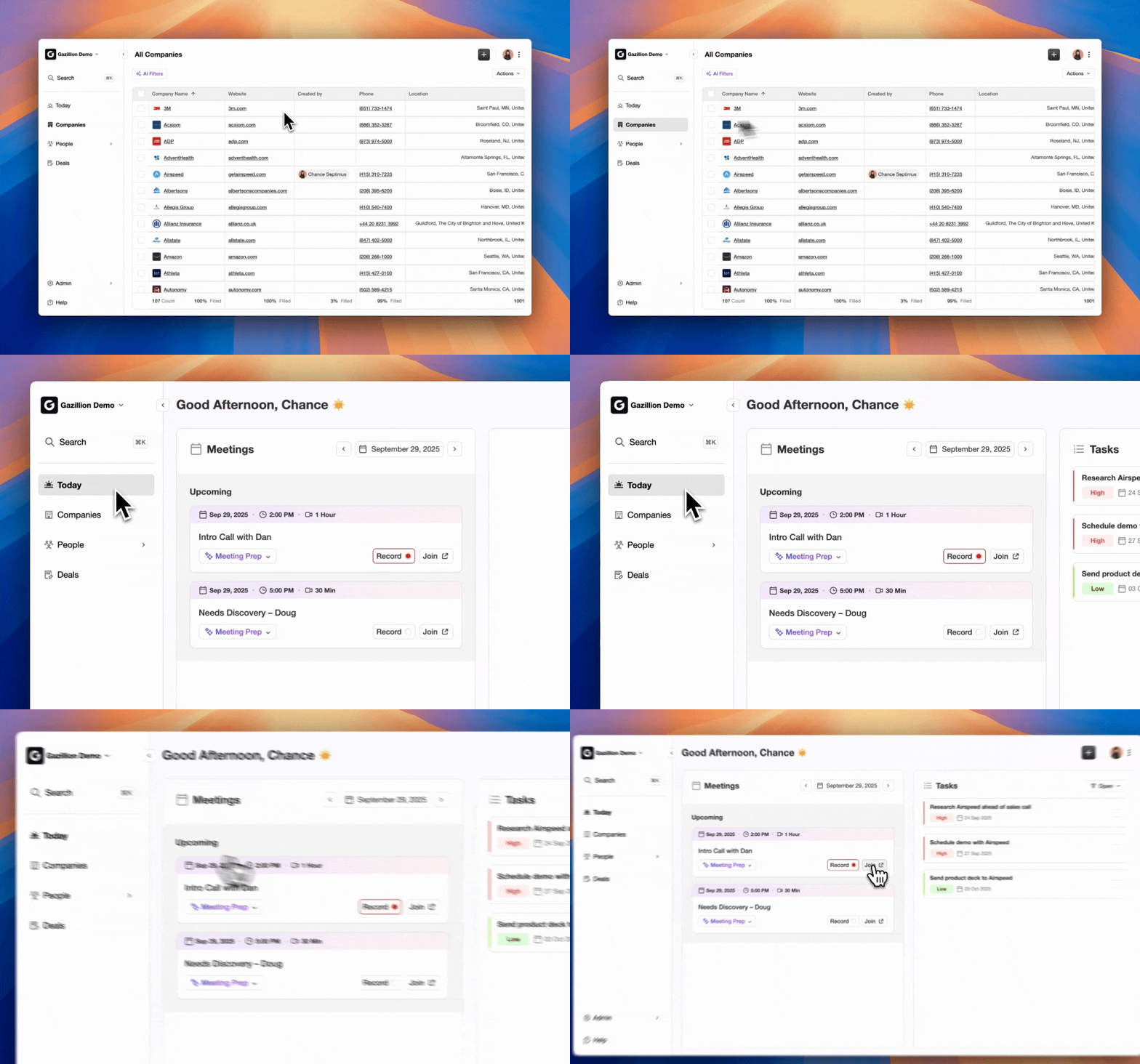
Affinity and Copper still rely on humans for data validation and processing, while Coffee Agent automatically handles data entry and enrichment from Google Workspace or Microsoft 365. The agent joins meetings, generates summaries, creates action items, and logs all interactions without human intervention. Automated CRM systems typically save 5-10 hours of administrative work weekly, and Coffee Agent delivers significantly greater time savings through comprehensive automation, as shown in the comparison below.
| Metric | Affinity | Copper | Coffee |
|---|---|---|---|
| Weekly Time Savings | 5-7 hours | 4-6 hours | 8-12 hours |
| Data Accuracy | 85-90% | 80-85% | 95%+ |
| Unstructured Data | Limited | None | Full processing |
| Agent Autonomy | Partial | Minimal | Complete |
These metrics translate to real-world impact. A company generating tens of millions in revenue, previously managing sales through spreadsheets, chose Coffee Agent over Salesforce and HubSpot because of its automated data input capabilities and Pipeline Compare feature, which removed the need for manual weekly reviews. The agent’s API access allowed the team to create custom briefings while still keeping the user experience intuitive for reps.

Coffee maintains SOC 2 Type 2 compliance while delivering the autonomous workforce that sales teams need so they can focus on selling instead of data entry. Experience truly hands-off CRM automation at coffee.ai/pricing.
Use Cases and Migration with Coffee
Coffee Agent serves small to mid-sized businesses that want to eliminate manual data entry entirely. The platform targets tech-savvy leaders frustrated with legacy CRM limitations and RevOps teams that need accurate pipeline data without administrative overhead. Migration runs through Google Workspace or Microsoft 365 authentication, and Zapier integration supports connections to existing tools with minimal disruption.

Frequently Asked Questions
Can Copper CRM automate tasks?
Copper CRM can automate basic tasks like Gmail synchronization, contact creation through its Chrome extension, and workflow triggers based on custom fields. The 2025 Copper GPT integration extends this automation to natural language queries for data retrieval and summarization. However, these capabilities remain limited to read-only functions and require manual setup for most automation workflows. Copper still lacks autonomous data processing and enrichment capabilities.
What is the best Copper CRM alternative for automation?
Coffee Agent offers a strong alternative to Copper for automation, with autonomous data entry, enrichment, and pipeline management. Unlike Copper’s manual setup requirements and limited AI capabilities, Coffee Agent functions as a tireless worker that handles CRM maintenance automatically. The platform works as either a standalone CRM or a Companion App for existing Salesforce and HubSpot installations, which gives teams flexibility in how they adopt it.

How do Affinity vs Copper compare for pipeline automation?
Affinity provides stronger relationship mapping and automatic contact creation through its relationship intelligence engine, while Copper excels in Gmail integration and Google Workspace synchronization. Affinity’s Notetaker offers better meeting automation, and Copper delivers more seamless email workflow integration. Both platforms still require human oversight for complex pipeline management tasks, while Coffee Agent delivers fully autonomous pipeline automation with complete hands-off operation.
Which CRM offers the best automated data entry for SMBs?
For small to medium businesses, Coffee Agent provides a comprehensive automated data entry solution that reduces weekly administrative work compared to traditional CRMs. Coffee’s autonomous agent handles unstructured data processing, automatic enrichment, and complete pipeline management without manual intervention or complex setup procedures that burden SMB teams.

How secure are automated CRM data entry solutions?
Modern automated CRM solutions maintain enterprise-grade security standards. Coffee, for example, is SOC 2 Type 2 and GDPR compliant, which ensures that automated data processing meets strict security requirements. Beyond compliance certifications, the platform does not use customer data to train public AI models, adding an extra layer of data privacy protection while still delivering autonomous CRM functionality. Both Affinity and Copper also maintain security certifications appropriate for business use.