
In today’s fast-evolving sales landscape, customer expectations are shifting toward highly personalized, data-driven interactions. Artificial Intelligence is redefining how businesses connect with clients, pushing sales teams to adapt or risk falling behind. Many companies still rely on traditional CRM systems that struggle with fragmented data and manual processes, creating gaps in efficiency. Meanwhile, AI-first solutions are emerging as a powerful way to streamline operations and deliver tailored engagement. This guide explores the broader market trends, evaluates the trade-offs of adopting AI-driven tools, and highlights platforms like Coffee as part of this transformative wave, offering specific benefits for sales teams aiming to stay competitive.
Why AI-First CRM Matters for Modern Sales Teams
AI-first CRM platforms offer a new approach to sales by focusing on real-time data analysis and automation. Unlike traditional systems, which often prioritize data storage over actionable insights, these tools help sales reps engage customers with precision and speed.
Older CRM systems can create bottlenecks. They often require sales teams to manage customer data across multiple disconnected tools, leading to fragmented insights and wasted time. Reps might spend hours aligning information from emails, calendars, and call logs, pulling focus away from actual selling.
Manual tasks add to this inefficiency. Logging interactions, updating records, or scheduling follow-ups by hand consumes valuable hours. One study suggests sales reps spend nearly 66% of their time on administrative work rather than building relationships. This imbalance slows down revenue growth.
Additionally, many legacy platforms lack the ability to analyze complex data sources like email content or meeting transcripts. Built for a simpler era of sales, they often fall short in delivering the real-time insights needed for today’s dynamic market.
AI-first CRMs address these issues by integrating intelligent automation from the ground up. They capture data continuously, analyze it for patterns, and provide actionable guidance, helping sales teams operate with greater efficiency. This shift reflects a broader move toward proactive, data-driven sales strategies.
Key Benefits of AI-Driven Sales Tools
AI-first platforms improve sales outcomes by focusing on three core areas. These elements create a foundation for more effective customer interactions.
- Data Integration: Combining information from emails, calls, and calendars into one accessible view ensures sales reps always have the full context for every interaction.
- Task Automation: Handling repetitive jobs like data entry or follow-up scheduling frees up time for building connections and closing deals.
- Guided Insights: Beyond just storing data, AI tools interpret it to recommend next steps, making each customer touchpoint more relevant.
Platforms built on these principles, like Coffee, act as active partners in the sales process. They help reps move from simply tracking information to using it strategically.
How Coffee Tackles Common Sales Challenges
Coffee stands out in the AI-first CRM space by directly addressing pain points that slow down sales teams. Its design focuses on simplifying workflows and boosting productivity.
Fixing Fragmented Data Issues
Many sales teams rely on a patchwork of tools for CRM, outreach, and analytics. This setup often leads to duplicated efforts and higher costs. Coffee combines these functions into a single platform, pulling together data from various sources for a unified view. This cuts down on the need for separate solutions, saving both time and resources.
Reducing Manual Workload
Constant data entry eats into a sales rep’s day. Tasks like logging calls or updating contact details pull focus from high-value work. Coffee automates these processes, creating and enriching records from emails and calendars. Users can save an estimated 8 to 12 hours per week, allowing more time for engaging prospects and closing deals.
Overcoming Outdated Architecture
Legacy CRMs often struggle to process diverse data types or support modern AI features. Coffee, built with an AI-native framework, includes a data warehouse that handles both structured and unstructured inputs in real time. This setup supports deeper analysis and automation, providing insights that older systems can’t match.
Interested in seeing how this works for your team? Request access to Coffee and explore a more efficient sales process.
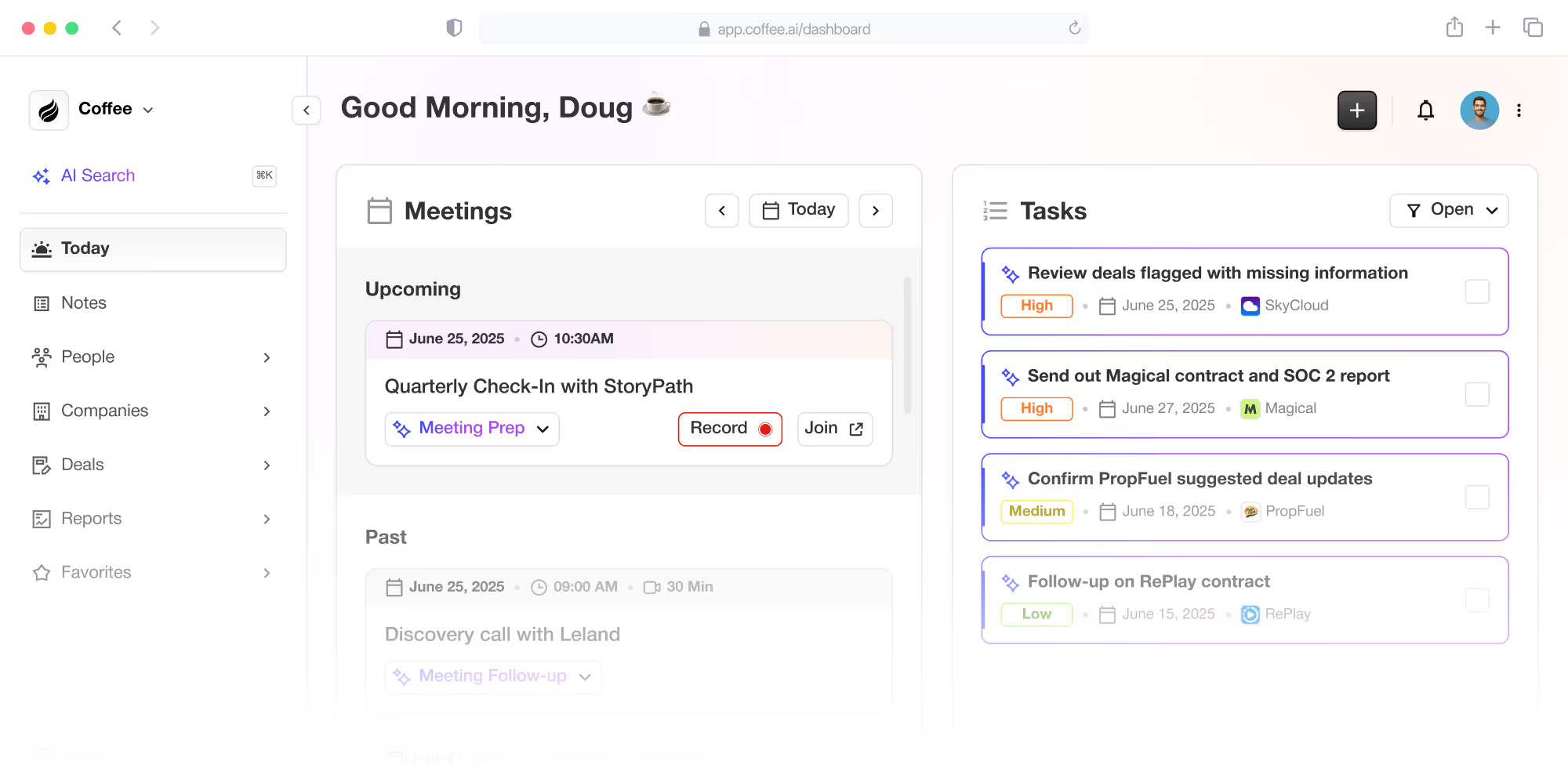
Standout Features of Coffee for Sales Success
Coffee offers practical tools that use AI to improve how sales teams manage relationships and drive results. Here are some key capabilities.
Automatic Data Enrichment
Coffee scans emails and calendars to build detailed contact and company profiles. It pulls in data like job titles and LinkedIn details from trusted partners, ensuring reps have all the context they need before reaching out.
Clear Pipeline Visibility
With its “Pipeline Compare” feature, Coffee shows week-over-week changes in deal status. Sales leaders can quickly see which opportunities have moved forward or stalled, making review meetings more focused and productive.
Streamlined Meeting Management
Coffee automates the entire meeting process, from pre-call briefs to real-time transcriptions on platforms like Zoom or Teams. It also generates summaries and follow-up drafts, capturing key details without extra effort from reps.
Efficient Prospect Targeting
Using natural language queries, Coffee’s List Builder helps sales teams create precise prospect lists based on criteria like industry or company size. This speeds up outbound efforts with better-targeted leads.
Comparing Coffee to Traditional CRM Systems
AI-first tools like Coffee differ significantly from traditional CRMs in how they handle data and support sales teams. Below is a side-by-side look at the advantages.
|
Feature Area |
Coffee (AI-First CRM) |
Traditional CRMs |
|
Data Handling |
Automates entry and enriches profiles using AI, saving 8 to 12 hours weekly. |
Often requires manual input, needing extra tools for full data updates. |
|
System Design |
AI-native with a data warehouse, processes diverse data types in real time. |
Can struggle with complex data or modern AI integration. |
|
Customer Engagement |
Delivers real-time insights and tailored follow-ups for stronger interactions. |
May need additional effort for personalized engagement. |
|
Pipeline Tracking |
Offers clear visibility into deal progress with weekly comparison tools. |
Tracking can be less intuitive, often requiring separate analytics. |
This table shows how Coffee leverages automation and modern design to address gaps in older systems. While traditional CRMs still have a place, especially for basic record-keeping, AI-first platforms provide a more integrated approach.
Steps to Adopting an AI-First CRM Like Coffee
Moving to an AI-first CRM involves thoughtful planning to ensure smooth integration. Here are critical considerations for sales leaders.
Deciding Between Building or Buying
Developing custom AI tools in-house demands significant expertise and budget. Platforms like Coffee provide ready-to-use solutions with robust features, connecting easily to existing systems via APIs for faster deployment.
Preparing Your Team
Adoption depends on both technical setup and team readiness. Coffee emphasizes a user-friendly design to encourage quick uptake, helping reps see immediate value without a steep learning curve.
Tracking Results
Measure success through metrics like time saved on tasks, user engagement levels, and overall sales improvements. Coffee’s built-in analytics help monitor these factors, allowing teams to adjust as needed.
Ready to elevate your sales game? Request access to Coffee and start seeing results.
Common Mistakes to Avoid with AI-First CRM Adoption
Sales leaders can run into hurdles when implementing AI tools. Addressing these early helps ensure a successful rollout.
- Poor Data Quality: AI depends on clean, accurate data. Without strong data practices, insights will fall short. Companies must prioritize data hygiene before deployment.
- Misaligned Processes: AI tools need to fit within existing sales frameworks like BANT or MEDDIC. Tailoring workflows to incorporate AI recommendations prevents disruption.
- Weak Change Management: Low adoption often stems from inadequate training. Investing in support and education helps teams adapt to new systems.
Key Questions About AI-First CRMs Answered
Here are clear explanations to common concerns about using AI-first CRMs for sales.
How do AI-first CRMs improve sales compared to traditional options? They analyze a wide range of data, automate routine tasks, and provide specific guidance for customer interactions. Systems like Coffee reduce manual workload, allowing reps to focus on high-impact activities.
Can smaller businesses benefit from AI-first CRMs? Yes, tools like Coffee are built for accessibility. With straightforward setup and flexible pricing, they suit small to mid-sized teams looking to enhance efficiency without enterprise-level complexity.
How does Coffee ensure data security? It meets high standards like SOC 2 Type 2 and GDPR compliance, protecting customer information with robust safeguards. Data isn’t used for general AI training, maintaining privacy for sensitive records.
Conclusion: Strengthen Your Sales with Coffee’s AI-First Approach
As sales continues to evolve, adopting AI-first strategies becomes essential for staying ahead. Traditional CRMs, while useful for basic organization, often can’t keep pace with the need for speed and personalization. Coffee exemplifies the potential of AI-native tools, offering automation, deep insights, and a unified platform to simplify operations.
By addressing core challenges like data fragmentation and manual tasks, Coffee helps sales teams focus on what matters, building relationships and driving revenue. As part of a broader trend toward intelligent sales technology, it provides a practical way to modernize workflows.
Take the next step to improve your sales outcomes. Request access to Coffee and see how AI can enhance your team’s performance.