
Key Takeaways
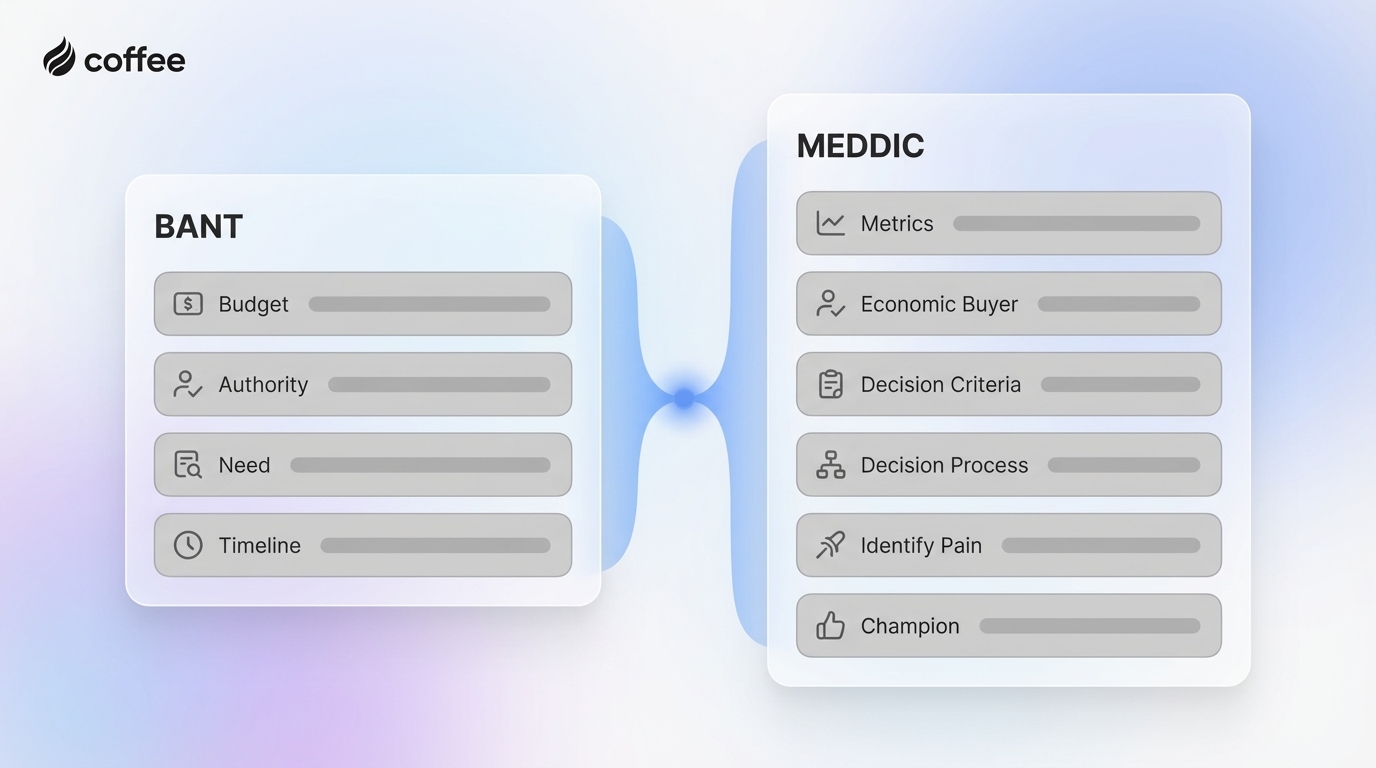
- BANT uses four qualification pillars (Budget, Authority, Need, Timeline) and fits SMB teams running high-volume, short sales cycles.
- MEDDIC adds deeper analysis across six elements (Metrics, Economic Buyer, Decision Criteria, Process, Pain, Champion) for complex enterprise deals.
- BANT works best for transactional sales under $25K, while MEDDIC supports $50K+ opportunities with multiple stakeholders and longer cycles.
- A hybrid motion performs strongest: BANT for top-of-funnel triage, MEDDIC for high-value opportunities that advance in your pipeline.
- Supercharge either methodology with AI-powered automation that handles note structuring, data entry, and qualification, saving reps 8-12 hours each week.
How BANT Sales Methodology Works in Fast-Moving Pipelines
BANT gives your team a clear, four-pillar framework that keeps qualification fast and simple. The framework evaluates prospects across these core criteria:
- Budget – Does the prospect have allocated funds available for your solution?
- Authority – Is the person you speak with the decision-maker or a key influencer?
- Need – Does your product or service address a genuine pain point?
- Timeline – When does the prospect plan to make a purchasing decision?
BANT performs especially well in SMB environments with shorter sales cycles of 30-45 days and straightforward buying paths with few stakeholders. Its simplicity makes it ideal for training new reps, handling high-volume inbound leads, and building your first repeatable sales process. In 2026, BANT has seen an AI-driven revival as automation tools now handle rapid qualification and data logging at scale.
How MEDDIC Methodology Supports Complex Enterprise Deals
MEDDIC provides a structured qualification system for complex, multi-stakeholder sales environments. The framework examines six critical elements:
- Metrics – What quantifiable ROI or business impact can you deliver?
- Economic Buyer – Who controls the budget and final purchasing authority?
- Decision Criteria – What specific requirements must your solution meet?
- Decision Process – How does the organization evaluate and approve vendors?
- Identify Pain – What root business issues drive the buying initiative?
- Champion – Who internally advocates for your solution?
MEDDIC targets enterprise deals with complex sales cycles involving deep buyer pain, stakeholder mapping, and formal procurement processes. The methodology improves win rates in multi-vendor competitions by clarifying metrics, economic dynamics, and internal politics that shape purchasing decisions. Now that each framework is clear, you can compare them directly across the dimensions that matter most.

BANT vs MEDDIC: Key Differences for Modern Sales Teams
The following comparison highlights how these frameworks differ across six critical dimensions, from complexity and sales cycle length to AI compatibility.
| Aspect | BANT | MEDDIC | Best For |
|---|---|---|---|
| Complexity | Simple 4-point check | Comprehensive 6-element analysis | BANT: High-volume leads, MEDDIC: Strategic deals |
| Sales Cycle | Days to weeks | Months to quarters | BANT: Transactional, MEDDIC: Enterprise |
| Deal Size | Under $25K | $50K-$1M+ | BANT: SMB, MEDDIC: Mid-market/Enterprise |
| Stakeholders | 1-2 decision makers | 6-10 buying committee | BANT: Simple org, MEDDIC: Complex hierarchy |
| Training Time | Hours to days | Weeks to months | BANT: New reps, MEDDIC: Experienced sellers |
| AI Compatibility | High automation potential | Structured note-taking support | Both benefit from Coffee’s auto-structuring |
BANT Pros: Fast qualification, easy adoption, ideal for high-volume inbound triage, minimal training required.
BANT Cons: Oversimplifies complex deals, can prematurely disqualify early-stage prospects, insufficient for enterprise sales.
MEDDIC Pros: Accurate forecasting, comprehensive stakeholder mapping, higher win rates in competitive situations, thorough deal inspection.
MEDDIC Cons: Time-intensive, requires extensive training, can turn into a rigid checklist, overwhelming for SMB deals.
Choosing Between MEDDIC and BANT for Your Sales Motion
Your sales environment and deal complexity determine which framework performs better. BANT delivers strong results for SMB velocity and high-volume qualification scenarios, with teams achieving 41% higher productivity in core sales activities when they use BANT for pre-sales qualification work.
MEDDIC dominates mid-market and enterprise environments where deal complexity demands thorough stakeholder analysis. Sales teams using intelligence-driven AI tools with MEDDIC achieve 56% higher quota attainment in complex B2B environments.
The strongest approach combines both methodologies. Use BANT for top-of-funnel triage, then apply MEDDIC for serious opportunities that progress through your pipeline. This hybrid strategy keeps qualification efficient while still giving high-value prospects the depth they require.
Is BANT Outdated? 2026 Data and Reality Check
BANT remains relevant in 2026 and has been revived and enhanced by AI automation. Modern B2B teams use BANT at the top of funnel for baseline viability assessment, especially when intelligent automation supports the process.
The framework still fits specific use cases: high-volume inbound lead qualification, transactional sales cycles, SMB markets, and training new sales development representatives. Organizations report 35% fewer missed pipeline opportunities when follow-ups are managed consistently using qualification frameworks like BANT.
The key evolution focuses on augmenting BANT with AI agents that handle manual data entry and note-taking. Coffee’s AI agent turns BANT from a manual checklist into an automated qualification engine.

BANT vs MEDDIC vs SPICED: Where Each Framework Fits
To see where SPICED fits in the qualification landscape, this comparison shows how all three frameworks differ in focus, complexity, and ideal use cases.
| Aspect | BANT | MEDDIC | SPICED |
|---|---|---|---|
| Focus | Quick qualification | Deal inspection | Needs-led selling |
| Complexity | Simple (4 elements) | Comprehensive (6 elements) | Moderate (6 elements) |
| Best Fit | SMB, high-volume | Enterprise, strategic | Solution selling, consultative |
SPICED (Situation, Pain, Impact, Critical Event, Decision) works as an alternative for needs-led sales approaches. It focuses more on customer pain and business impact than on budget and authority checks.
Real-World Use Cases for BANT, MEDDIC, and Coffee
BANT Success Scenarios: Small sales teams handling inbound leads, SaaS companies with monthly recurring revenue models, transactional B2B sales under $25K, and organizations that prioritize speed over deep deal analysis.
MEDDIC Success Scenarios: Mid-market companies selling enterprise software, complex technical solutions that require multiple stakeholder buy-in, deals exceeding $50K with 90+ day sales cycles, and organizations competing against multiple vendors in formal procurement processes.
These distinct use cases show why no single framework fits every team. Coffee’s ideal customer profile spans both scenarios: small companies outgrowing spreadsheets that need BANT automation, and mid-market teams using Salesforce or HubSpot that want MEDDIC structure without manual data entry.
BANT Implementation Checklist for Growing Teams
- Define budget ranges and qualification thresholds for your market segment.
- Create authority mapping templates for typical customer organizations.
- Develop need assessment questions aligned with your value proposition.
- Establish timeline categories (immediate, 3 months, 6+ months) with clear follow-up cadences.
- Train reps on disqualification criteria so they avoid spending time on poor-fit prospects.
- Implement CRM fields and workflows that capture BANT data consistently.
- Set up automated lead scoring based on BANT criteria completion.
Even with these processes in place, teams still face significant manual pain points. Reps juggle constant note-taking during calls, CRM data entry after each conversation, and the challenge of maintaining consistent qualification standards across team members.

MEDDIC Qualification Checklist for Enterprise Pipelines
- Quantify business metrics and ROI expectations with economic buyers.
- Map the complete organizational chart, including influencers and decision makers.
- Document formal decision criteria and evaluation processes.
- Identify and validate internal champions with real political influence.
- Uncover root business pain that drives the purchasing initiative.
- Understand the competitive landscape and differentiation requirements.
- Create detailed stakeholder communication and follow-up plans.
These MEDDIC requirements create substantial manual challenges. Teams must maintain extensive stakeholder maps, organize detailed notes across many touchpoints, and keep comprehensive deal documentation accurate throughout long sales cycles.
Supercharge BANT or MEDDIC with AI Agents in 2026
Coffee’s AI agent removes the manual burden that limits both BANT and MEDDIC effectiveness. The agent automatically structures meeting notes according to your chosen methodology, whether BANT, MEDDIC, or SPICED, while handling the 71% of time reps typically waste on data entry and administrative tasks.

Coffee operates in two modes. Standalone CRM supports SMBs that have outgrown spreadsheets. Companion App supports teams committed to Salesforce or HubSpot. The agent captures structured and unstructured data from emails, calendars, and call transcripts, then organizes insights according to your qualification framework.
A leading AI solutions company generating tens of millions in revenue replaced legacy CRMs with Coffee’s automated approach. The team needed qualification structure without manual overhead. Coffee’s agent handled automatic contact creation from Google Workspace, Pipeline Compare features for weekly reviews, and API access for custom briefing automation. The result: 8-12 hours saved per rep weekly with SOC 2 Type 2 security compliance.
See how automation delivers similar results for your team, whether you run BANT, MEDDIC, or a hybrid motion.
2026 Verdict: Matching Your Team to the Right Methodology
Use this decision matrix to match your team profile with the right qualification framework and the Coffee deployment mode that supports it.
| Team Profile | Recommended Framework | Why This Choice | Coffee Mode |
|---|---|---|---|
| SMB (1-20 reps) | BANT + AI automation | Speed and volume prioritized | Standalone CRM |
| Mid-market (20-100 reps) | MEDDIC + AI structure | Deal complexity requires depth | Companion App |
| High-volume inbound | BANT triage → MEDDIC | Hybrid approach for efficiency | Either mode |
| Enterprise strategic | Full MEDDIC implementation | Stakeholder complexity demands rigor | Companion App |
The winning strategy combines smart methodology selection with AI automation. Coffee’s agent handles the operational burden of either framework so reps can focus on selling instead of data entry. Whether you choose BANT for velocity or MEDDIC for depth, Coffee keeps execution consistent without manual overhead.
Automate your chosen methodology and remove the manual qualification burden that slows your team.
Frequently Asked Questions
Is MEDDIC better than BANT?
The right choice depends on your sales environment. For a detailed comparison with supporting data, see the “Choosing Between MEDDIC and BANT for Your Sales Motion” section above. The short version: use BANT for high-volume SMB sales and MEDDIC for complex enterprise deals.
What is the difference between BANT, MEDDIC, and SPICED?
BANT focuses on quick qualification through Budget, Authority, Need, and Timeline. MEDDIC provides comprehensive deal inspection via Metrics, Economic Buyer, Decision Criteria, Decision Process, Identify Pain, and Champion. SPICED emphasizes needs-led selling through Situation, Pain, Impact, Critical Event, and Decision. BANT fits high-volume SMB sales, MEDDIC fits enterprise complexity, and SPICED supports consultative solution selling.
Is BANT outdated in 2026?
No. BANT has evolved with AI automation and still works well for high-volume qualification. For specific use cases and 2026 data, review the “Is BANT Outdated? 2026 Data and Reality Check” section above.
Can AI automate sales qualification methodologies?
AI can automate much of sales qualification by structuring meeting notes according to BANT, MEDDIC, or SPICED, removing manual data entry, and enforcing consistent qualification standards across teams. Coffee’s AI agent captures and organizes qualification data from emails, calls, and meetings, then integrates with CRM systems through Zapier, Salesforce, and HubSpot connections. This automation delivers the time savings discussed earlier while also improving data quality and forecast accuracy.
Which qualification methodology should small sales teams use?
Small sales teams (1-20 reps) usually benefit most from BANT because it stays simple, supports quick adoption, and works well for high-volume qualification. BANT requires minimal training and lets teams process more leads efficiently. As deal complexity increases or average contract values grow above $25K, layering in MEDDIC elements becomes valuable. The most practical path for small teams starts with BANT and gradually adds MEDDIC components as the sales organization matures.