
Key Takeaways
- Affinity delivers deep relationship mapping and integrations from 40+ sources, while 4Degrees focuses on AI workflows, pipeline management, and transparent pricing for VC teams.
- Both platforms still rely on manual data entry, which hurts adoption and creates fragmented workflows even after their 2026 AI updates.
- Affinity fits proprietary deal sourcing teams that can support higher costs ($15K–$150K annually), while 4Degrees suits 3–8 person teams at $100–$200 per user each month.
- Coffee’s autonomous CRM Agent removes manual work by capturing data from emails and calendars, enriching contacts, and surfacing pipeline intelligence.
- Upgrading to Coffee’s agent-led CRM gives VC teams full automation and reliable relationship intelligence without the adoption problems of traditional CRMs.
Why VC Teams Compare Affinity and 4Degrees in 2026
VC teams often lose 8–12 hours each week to manual CRM updates instead of sourcing deals and nurturing relationships. This time drain pushes firms to evaluate tools like Affinity and 4Degrees that promise relationship intelligence and automation. The real decision is which platform reduces this manual burden while still supporting deal flow and portfolio management.
The fundamental distinction between these platforms lies in their approach to relationship intelligence and workflow automation. Affinity emphasizes relationship mapping through AI-powered relationship intelligence and automated data capture. 4Degrees emphasizes AI-powered relationship intelligence that measures network strength for warm introductions.
Affinity excels at relationship mapping depth, while 4Degrees stands out in workflow flexibility and pricing clarity. The comparison below shows where each platform wins and where both share the same core weakness: ongoing manual data entry that undermines adoption.
| Feature | Affinity | 4Degrees | Winner |
|---|---|---|---|
| Relationship Intelligence | Strength scoring, intro paths | AI matching, network analysis | 4Degrees |
| Data Entry Automation | Email/calendar sync, manual-heavy | Exchange/Gmail sync, manual-heavy | Tie |
| AI Features 2026 | MCP beta, note synthesis | Relationship matching workflows | Affinity |
| Meeting Intelligence | Basic note syncing | Limited transcription features | Tie |
| Pipeline Management | Basic deal tracking | Customizable pipelines, Kanban | 4Degrees |
| Integrations | 40+ data sources | Pitchbook, Crunchbase, Salesforce, Outlook/Gmail | Affinity |
| Pricing Transparency | Quote-based, $2.4K–$4.8K/user/yr | Seat-based, $100–$200/user/mo | 4Degrees |
| VC/PE Ease | Quick setup, basic workflows | Pre-loaded VC workflows | 4Degrees |
Both platforms struggle with a core adoption problem. According to industry data, 71% of sales reps spend too much time on data entry, which leaves only 35% of their time for actual relationship building and deal sourcing. Affinity’s January 2026 updates can synthesize 100 notes in 10 seconds and surface relationship trends instantly. Even with these improvements, the underlying need for humans to capture and maintain data still limits long-term adoption.
Understanding these feature differences is only half the picture. The next step is to see how these capabilities translate into real strengths and limitations for VC teams in daily use.
Strengths and Weaknesses for VC Use Cases
| Platform | Strengths | Weaknesses | Best VC Scenario |
|---|---|---|---|
| Affinity | Deep relationship mapping, auto-enrichment from 40+ sources, relationship strength scoring | Workflow customization requires setup, recurring manual entry needs | Proprietary deal sourcing via network connections |
| 4Degrees | AI workflows, customizable pipelines, warm intro optimization, user-friendly interface | Not ideal for transactional CRM, smaller ecosystem than large enterprise platforms | Structured pipeline management for 3–8 person teams |
| Both | Email/calendar sync, relationship tracking | Ongoing manual updates, fragmented workflows, recurring adoption issues | Teams with dedicated ops resources for maintenance |
Affinity delivers advanced relationship tracking with AI-driven insights based on engagement levels. 4Degrees delivers strong AI-powered relationship matching and structured pipeline management. Both platforms still depend on users to keep records current, which recreates the “bad data in, bad data out” cycle that many VC teams experience.
Given these trade-offs, your choice comes down to your team’s priorities, budget, and tolerance for the manual work described earlier.
When Affinity or 4Degrees Makes Sense in 2026
Choose Affinity if you prioritize relationship mapping depth and can support annual contract values between $15,000 and $150,000 depending on team size. This higher investment makes sense for teams focused on proprietary deal sourcing through network connections, where relationship depth justifies both the cost and the setup complexity.
Choose 4Degrees if you want structured pipeline management at $100–$200 per user each month with pre-loaded VC workflows. This option fits 3–8 person teams that value a user-friendly interface and quick deployment more than extensive customization.
| Tier | Affinity Range | 4Degrees Range |
|---|---|---|
| Small Teams (5–15 users) | $15K–$45K annually | $6K–$36K annually |
| Mid-sized (15–50 users) | $45K–$150K annually | $18K–$120K annually |
Skip both platforms if the manual upkeep described earlier consistently kills CRM adoption in your team. See how Coffee’s autonomous agent eliminates the manual burden entirely.

Why Coffee’s CRM Agent Solves the Adoption Problem
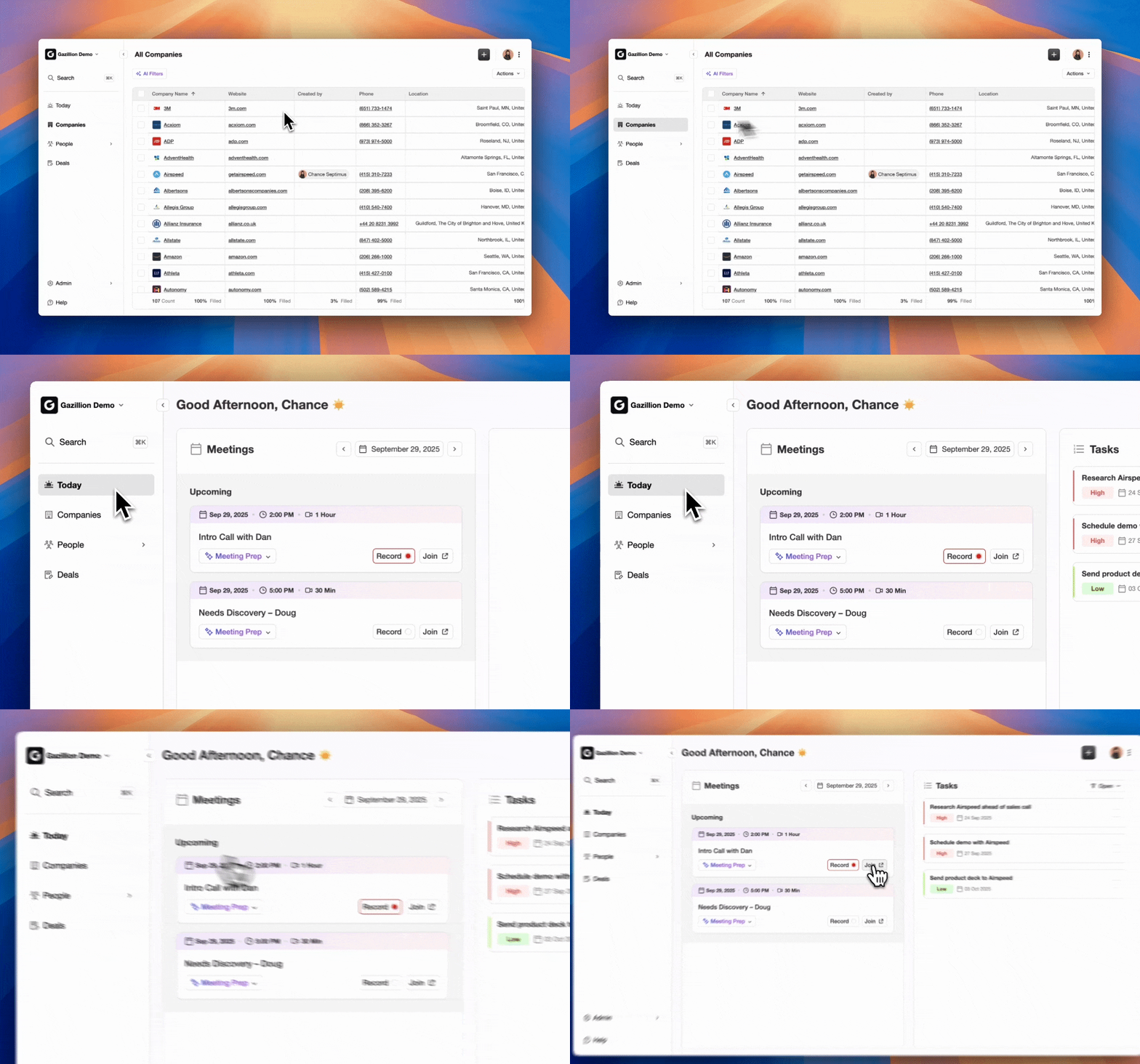
Coffee’s autonomous CRM Agent directly addresses the “bad data in” problem that affects both Affinity and 4Degrees. The Agent removes the need for busy team members to enter data, which keeps records accurate without extra effort. Coffee’s Agent automatically captures and enriches data from emails, calendars, and meetings, then uses that data to deliver accurate insights and forecasts.

The Coffee Agent creates contacts and companies automatically, which then feed into real-time data enrichment that keeps records current without manual updates. This enriched data powers AI-generated meeting briefings and summaries. The built-in data warehouse then uses complete, accurate information to provide pipeline intelligence and forecasting. Unlike traditional CRMs that act as passive databases waiting for human input, Coffee functions as an active agent that handles data unification, task automation, and note-taking on its own.

One company generating tens of millions in revenue rejected both Salesforce and HubSpot because of their manual work requirements. That team chose Coffee’s Agent for automated data capture, actionable pipeline insights, and seamless workflow integration. The result was 8–12 hours saved per week while maintaining consistently high data quality.

Coffee works as a standalone AI-first CRM or as a Companion App that enhances existing Salesforce or HubSpot installations. This flexibility makes Coffee a strong alternative for teams that want agent-led CRM capabilities without replacing their entire stack. Explore Coffee’s pricing and deployment options.
Decision Framework for VC and PE Teams
| Primary Pain Point | Affinity/4Degrees Fit | Coffee Agent Upgrade |
|---|---|---|
| Manual data entry | Automation support with recurring manual elements | Fully autonomous data capture |
| Poor relationship insights | Advanced scoring and mapping | Pipeline intelligence and accurate forecasts |
| Fragmented workflows | Robust integration ecosystems | Unified agent orchestration |
| Low CRM adoption | Quick setup with automation features | Agent handles all busywork |
FAQ
What is the cost difference between Affinity and 4Degrees?
Affinity typically costs $2,400–$4,800 per user annually, with total contract values ranging from $15,000–$150,000 based on team size. 4Degrees uses seat-based pricing at $100–$200 per user each month, which translates to $1,200–$2,400 per user annually. Both platforms often add implementation costs, data migration fees, and premium support, which can increase first-year total cost of ownership by 10–25%.
Which relationship intelligence CRM works best for small VC funds?
For small funds with 3–8 people, 4Degrees usually offers better value because of its pre-loaded VC workflows, user-friendly interface, and transparent pricing. Both Affinity and 4Degrees still require significant manual data entry, which creates the adoption problem described earlier. Coffee’s CRM Agent removes this burden through autonomous data capture, which makes it a strong fit for small teams that cannot staff dedicated ops roles for CRM maintenance.
How does Coffee compare to Affinity for VC teams?
Affinity provides relationship mapping and strength scoring but still depends on users for data entry and ongoing maintenance. Coffee’s Agent, described above, handles data capture and enrichment autonomously and then delivers accurate insights and forecasts. Coffee can run as a standalone CRM or enhance existing systems, which gives VC teams automation benefits without the manual workload that often hurts adoption.
Does Coffee integrate with HubSpot and Salesforce?
Yes. Coffee operates in two models: as a standalone AI-first CRM or as a Companion App that enhances existing Salesforce or HubSpot installations. The Coffee Agent syncs data, enriches records, and writes insights back to your primary CRM automatically. This approach removes manual data entry while preserving your existing system of record.
What is the difference between 4Degrees AI and Affinity’s relationship intelligence?
4Degrees focuses on AI-powered relationship matching and warm introduction optimization with customizable workflows. Affinity focuses on relationship strength scoring and intro path mapping with broader data source coverage. Both platforms still require manual data input to perform well. Coffee’s Agent goes further by capturing data autonomously and generating accurate insights without human data entry or maintenance.
Conclusion
This comparison shows a clear pattern. Affinity and 4Degrees both deliver sophisticated relationship intelligence, yet both keep the traditional CRM dependence on manual data entry. The real decision is not only which traditional CRM to choose, but whether to move beyond the traditional CRM model entirely. Coffee’s autonomous CRM Agent represents this next step, providing stronger automation and more reliable insights without the manual burden. See how Coffee transforms CRM for VC and PE teams.