
If you’re looking for the right CRM for your sales team, you’re making a decision that will shape productivity and results for years. A CRM’s user experience goes beyond how it looks. It determines whether your team will use the platform effectively, keep data accurate, and spend more time selling instead of struggling with complicated tools.
The CRM market offers a wide range of options, from established systems to newer, tech-driven solutions. Legacy platforms, like Salesforce and HubSpot, have long dominated the space, offering robust features for large organizations. However, many sales teams find these systems complex, with steep learning curves and heavy reliance on manual processes. This can lead to frustration and low adoption. On the other hand, a growing trend of AI-first CRMs focuses on simplifying workflows through automation and intelligent insights. These platforms aim to address the pain points of traditional systems by prioritizing ease of use and efficiency.
Understanding this landscape is key. The shift toward AI-driven tools reflects a broader need for sales technology that supports reps directly, rather than burdening them with administrative tasks. This guide will dive into the specific challenges of legacy CRMs, outline what defines a great user experience, and compare how AI-first platforms, like Coffee, stack up against older systems. The goal is to help you choose a solution that fits your team’s needs and boosts performance.
Why Poor User Experience in Legacy CRMs Hurts Sales Teams
Legacy CRMs often come with usability issues that slow down sales reps and hurt overall productivity. These challenges can cost valuable time and reduce data reliability.
- Fragmented tools create extra work. Sales reps often juggle multiple platforms, such as ZoomInfo for contacts or SalesLoft for outreach, each with separate logins and workflows. Switching between systems and copying data manually wastes time.
- Manual data entry is overwhelming. After every call or meeting, reps must update notes, emails, and opportunity fields across systems. About 71% of reps say they spend too much time on data entry, leaving only a fraction of their day for actual selling.
- Outdated designs limit capabilities. Many traditional CRMs were built years ago and struggle to handle modern needs, like processing unstructured data from emails or call transcripts into useful insights.
- Low adoption creates hidden problems. When a CRM feels cumbersome, reps avoid it, leading to incomplete data. Many turn to personal spreadsheets or other “shadow CRMs,” which further fragments information.
These issues reduce a CRM’s value, turning it into a reporting tool for managers rather than a practical aid for sales reps. Ready to explore a better option? Request access to Coffee and see how an AI-first approach changes the game.
What Makes a CRM User Experience Effective for Sales?
A great CRM user experience focuses on saving time and supporting sales reps in their daily tasks. Let’s break down the key elements that matter most.
Automatic Data Handling for Less Manual Work
Data entry shouldn’t be a burden. A strong CRM captures information without extra effort from reps.
- It pulls contacts and company details from emails or calendar invites automatically.
- It adds useful data, like job titles or company info, without needing separate tools.
- It logs activities and links them to the right records, keeping everything up to date.
This automation lets reps focus on building relationships instead of filling out fields.
Streamlined Workflows with Smart Automation
A CRM should make high-impact tasks easier, especially around meetings and deal management.
- Before calls, it provides context on attendees and past interactions, saving research time.
- After meetings, it summarizes discussions and suggests next steps, cutting down on follow-up work.
- Deal tracking updates naturally as reps work, without separate updates.
Automation like this keeps reps focused on strategic selling, not routine tasks.
Useful Insights to Guide Decisions
Sales teams need data they can act on, not just store.
- Pipeline changes are visible in real time, without manual reports.
- AI highlights key opportunities or risks, helping reps prioritize their efforts.
These insights improve decision-making and drive better outcomes for the team.
Easy to Learn and Use Daily
A CRM should feel intuitive and helpful from the start.
- New users get up to speed quickly, with little training needed.
- The interface matches how reps naturally work, avoiding unnecessary complexity.
- It acts like a supportive tool, enhancing their skills rather than adding stress.
When a CRM is easy to adopt, it ensures consistent use and reliable data across the team.
Comparing User Experience: AI-First CRM (Coffee) vs. Legacy Systems (Salesforce, HubSpot)
Let’s look at how specific platforms perform against these user experience standards, focusing on practical differences for sales teams.
Salesforce: Strong Features, Complex Experience
Salesforce is a powerhouse for large organizations with complex needs. It offers deep customization and supports intricate sales processes if you have the resources to tailor it. However, for many sales reps, the user experience falls short. The platform often requires significant setup and ongoing training, which can frustrate users. Adoption rates suffer when reps see it as more of a management tool than a personal aid. Manual processes and integrations can also slow down daily tasks.
HubSpot: User-Friendly Start, Scaling Challenges
HubSpot provides a simpler start than Salesforce, with a modern design that’s easier for smaller teams to adopt. Its roots in marketing automation give it strength in that area, but sales workflows can feel less prioritized. As teams grow, additional tools or integrations may be needed, which can reintroduce fragmentation. This makes it less ideal for scaling sales teams looking for a fully unified experience.
Coffee: Built for Sales Reps with AI at the Core
As part of the AI-first trend, Coffee stands out by focusing on user experience from the ground up. It uses automation to address the common frustrations of traditional CRMs, making it a strong example of how modern technology can rethink sales tools.
- Data entry happens automatically. Coffee scans emails and calendars to create and update contacts and companies, adding details like job titles or funding data from licensed sources. This saves reps an estimated 8 to 12 hours weekly.
- Meeting support is seamless. Before calls, a “Today” page offers briefs on attendees and history. During virtual meetings, an AI bot records and transcribes. Post-call, it summarizes key points and drafts follow-ups, all within Gmail.
- Pipeline tracking is instant. The “Pipeline Compare” feature shows week-over-week changes, highlighting progress or stalled deals without manual effort.
- Everything is in one place. Unlike legacy systems needing multiple add-ons, Coffee combines CRM, data enrichment, and analytics in a single platform, reducing complexity.
- Reps come first. Designed as a “co-pilot,” Coffee focuses on making individual reps more effective, encouraging consistent use.
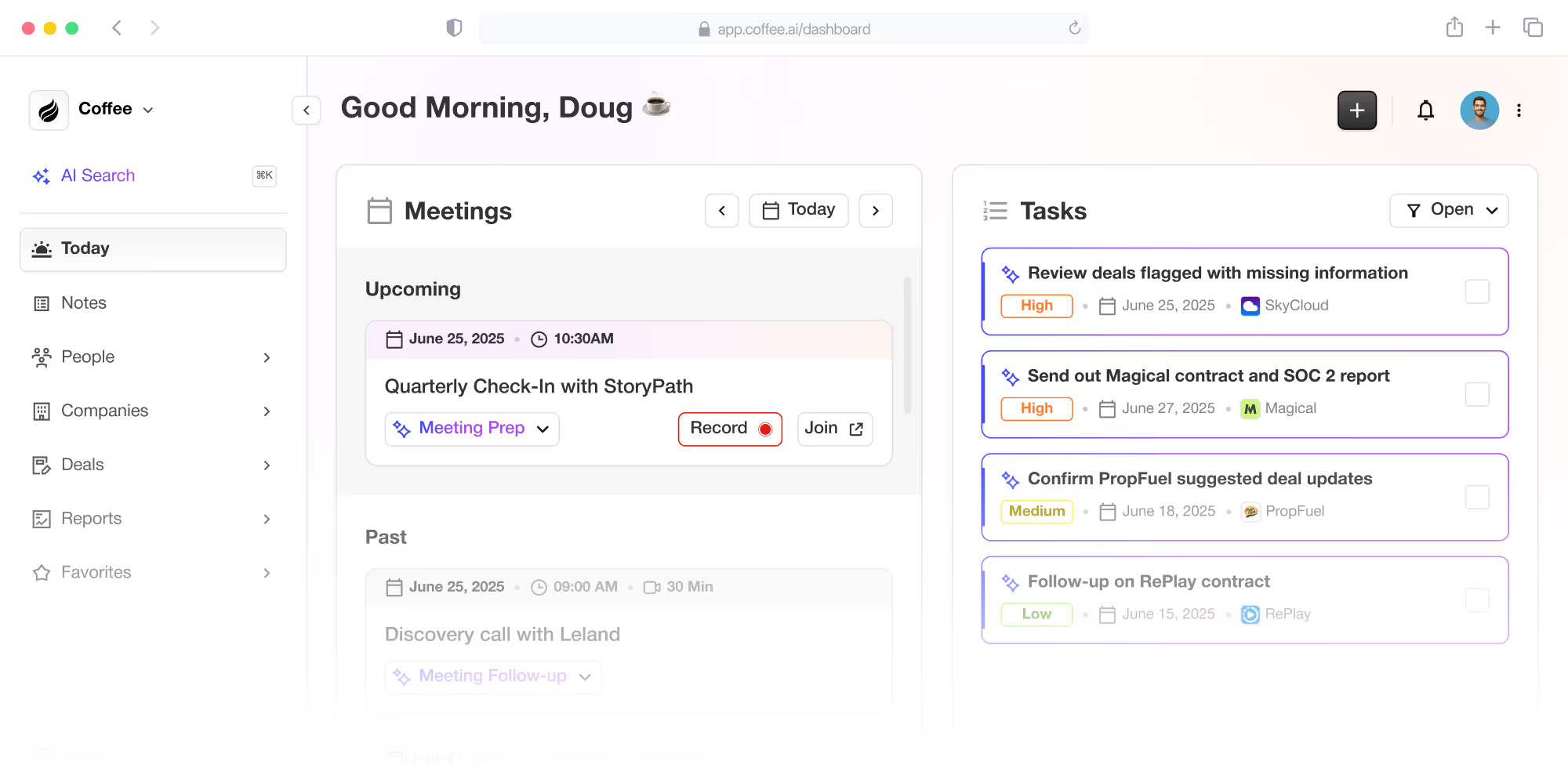
Quick Comparison: Legacy vs. AI-First CRMs
|
Feature |
Legacy CRMs (Salesforce/HubSpot) |
AI-First CRM (Coffee) |
|
Data Entry Effort |
High, with manual steps |
Low, automated by AI |
|
Meeting Support |
Manual notes or external apps |
AI briefings and summaries |
|
Pipeline Tracking |
Static, requires updates |
Dynamic, real-time view |
|
Tool Integration |
Multiple systems needed |
Unified platform |
Want to see how Coffee can improve your team’s day? Request access now to explore its AI-first approach.
Which CRM User Experience Fits Your Sales Stage?
Your company’s size and current tools influence which CRM experience will work best. Here’s how different scenarios align with platform strengths.
Small Teams Moving Beyond Spreadsheets
For startups or small businesses using basic tools like spreadsheets, a CRM should offer quick value without complexity. Coffee’s Standalone CRM fits well here. It automates data capture and provides AI-driven meeting support, ensuring small teams focus on selling. The simple setup means no heavy customization or IT costs, which is critical for early-stage companies.
Mid-Sized Teams with Existing CRMs
If you’re already using Salesforce or HubSpot, a full switch might not be practical. Coffee’s Companion App adds value by layering AI automation on top of your current system. It improves data quality and adoption by syncing with your CRM and letting reps work more efficiently. You control what data flows back, maintaining governance while enhancing daily use.
Long-Term Costs of CRM User Experience
Beyond subscription fees, consider the hidden costs of a CRM’s usability over time.
- Setup effort: Legacy systems often need extensive customization. AI-first tools like Coffee work effectively with minimal configuration.
- Training needs: Complex CRMs require ongoing education. Coffee’s design cuts down on learning time.
- Maintenance load: Traditional setups need constant updates as processes change. Coffee’s automation adapts more easily.
- Scaling impact: Growing teams face added costs with legacy CRMs for extra modules. Coffee scales without losing simplicity.
Common Questions About CRM User Experience
How Does AI Reduce Manual Tasks for Sales Reps?
AI-first CRMs like Coffee cut down on manual work by automating key tasks. It builds contact lists from emails and calendars, enriches data with relevant details, and logs activities without input. After meetings, AI summarizes calls and drafts follow-ups, saving reps an estimated 8 to 12 hours each week on administrative duties.
Can Coffee Work with Our Current Salesforce or HubSpot Setup?
Yes, Coffee’s Companion App integrates smoothly with Salesforce and HubSpot. A quick authentication syncs your data, adding AI features without disrupting your workflow. You decide what enhanced data gets added to your main CRM, balancing innovation with control.
How Does Coffee Keep Data Accurate with Automation?
Coffee prioritizes data quality by pulling directly from emails, calendars, and call transcripts. AI organizes and enriches this information using trusted sources, ensuring accuracy. Its data warehouse also tracks historical changes, maintaining a reliable record over time.
Is Coffee Right for a Small Team Avoiding Complex Systems?
For teams of 1 to 20, Coffee’s Standalone CRM offers modern features without heavy setup. It connects to Google Workspace or Microsoft 365, providing instant value through automation. This simplicity makes it a fit for smaller companies focused on growth.
Will an AI-First CRM Disrupt Our Sales Processes?
Coffee supports existing methods by aligning AI summaries with frameworks like BANT or MEDDIC. For Companion App users, it enhances current workflows without forcing changes, ensuring reps stay efficient while benefiting from automation.
Final Thoughts: Boost Your Sales Team with the Right User Experience
Choosing a CRM is about more than features. It’s about how the tool impacts your team’s daily work. Legacy systems like Salesforce and HubSpot offer established options but often come with manual burdens and usability challenges that can hinder sales reps. Meanwhile, AI-first CRMs are reshaping the industry by focusing on automation and intuitive design.
Coffee, as a leading example of this trend, shows how AI can turn a CRM into a true asset for sales teams. Whether used standalone for small businesses or as a companion to existing systems, it prioritizes reps’ needs, saving time and improving data through smart technology. When your team finds a CRM helpful rather than frustrating, productivity and results follow.
Ready to experience this difference for your sales team? Request access to Coffee today and see how an AI-first user experience drives success.