
In today’s fast-evolving sales landscape, artificial intelligence is reshaping how businesses connect with customers, streamline operations, and drive growth. The market for customer relationship management (CRM) tools is undergoing a significant shift as companies recognize the limitations of traditional systems in handling complex, data-heavy environments. With global CRM software revenue projected to reach $50.5 billion by 2025, the demand for innovative solutions is clear. AI-first CRM platforms are at the forefront of this change, offering automation and insights that traditional tools struggle to provide. This guide explores the challenges of legacy systems, the benefits of AI integration in sales processes, and how platforms like Coffee are leading the way as part of this broader industry trend.
Why Legacy CRM Systems Struggle in Today’s Sales Environment
Many organizations find that older CRM systems, once viewed as comprehensive solutions for managing customer data, no longer meet the demands of modern sales teams. These platforms often create inefficiencies that hinder productivity and competitive edge.
Fragmented Data and Time-Consuming Manual Entry
Sales teams frequently juggle multiple tools, like ZoomInfo for data enrichment or SalesLoft for outreach, alongside their primary CRM. This fragmented setup means reps spend significant time piecing together information instead of focusing on prospects. Studies show that 71% of sales reps dedicate too much time to data entry, leaving only about 35% of their week for actual selling. After every interaction, they must manually update notes, opportunity fields, and emails, often leading to errors and inconsistent records.
Outdated Technology Not Suited for AI
Built on rigid relational databases, legacy CRMs were designed for structured data, not the dynamic, unstructured inputs like emails or call transcripts that AI thrives on. This makes it difficult to gain real-time insights or conduct advanced trend analysis. Organizations attempting to layer AI on these older systems often encounter barriers that limit the technology’s full potential.
Low Adoption Due to Poor User Experience
Complex workflows and manual tasks in traditional CRMs frustrate sales reps, who may see the system as more of a reporting tool for managers than a helpful resource. As a result, some maintain customer data in separate apps or personal files, leaving the official CRM incomplete and less valuable. This cycle of low adoption and poor data quality underscores the need for systems that reps find intuitive and useful.
Want to reduce manual tasks and boost your sales team’s focus on selling? Request access to Coffee and see how AI can simplify the sales process.
How AI Enhances Key Sales Functions for Better Results
AI integration into CRM systems offers specific improvements across essential sales activities. By automating routine tasks and providing actionable insights, AI helps teams work smarter, as demonstrated by platforms like Coffee.
Automating Data Capture and Enrichment
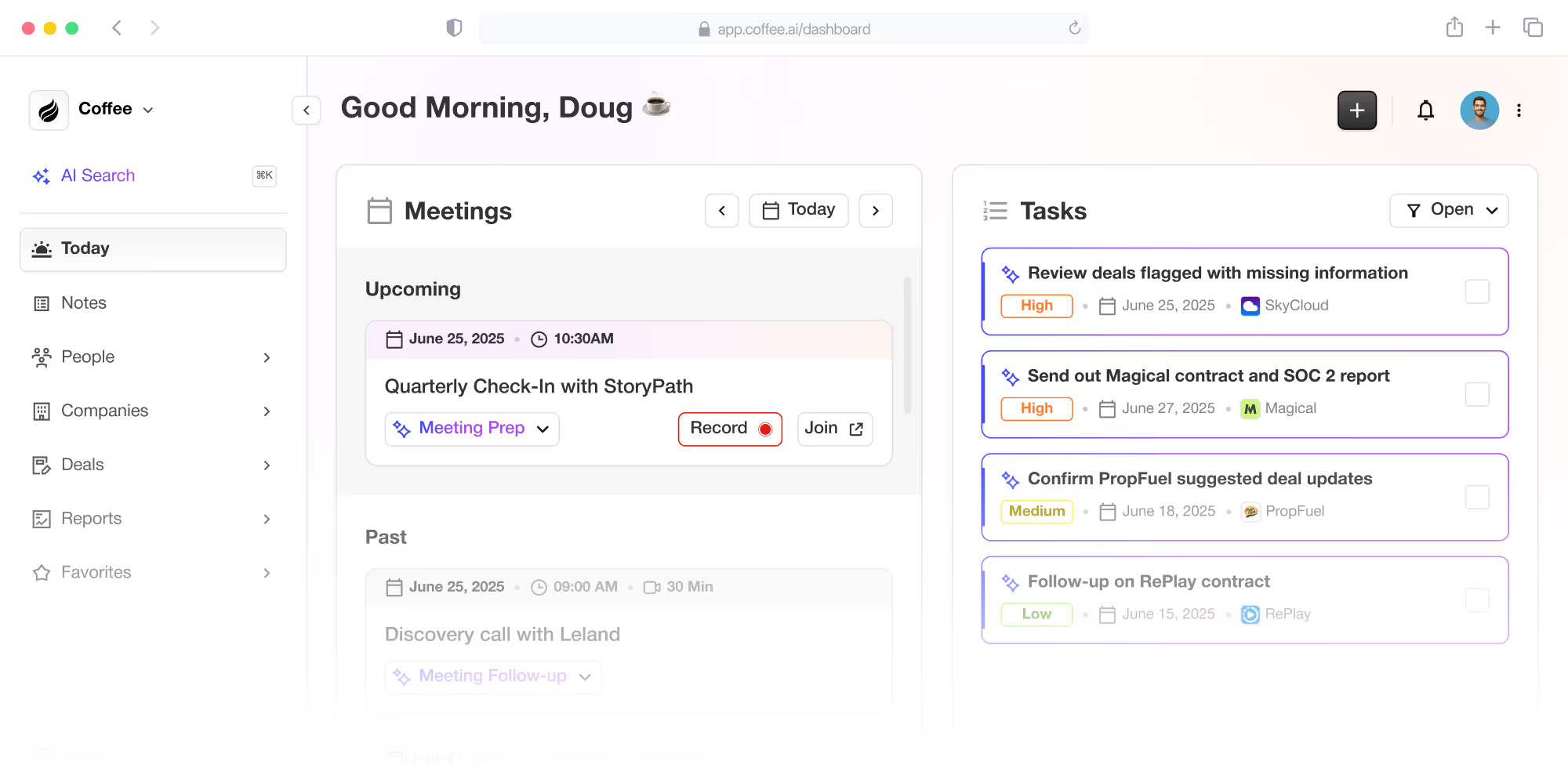
AI-driven systems automatically pull and enhance customer data from emails, calendars, and interaction logs, saving reps 8 to 12 hours weekly on manual entry. Coffee, for instance, connects to Google Workspace or Microsoft 365 to scan emails and calendar invites, creating detailed contact and company profiles with job titles, funding details, and LinkedIn data. This unified approach reduces the need for separate enrichment tools and improves data accuracy for stronger sales strategies.
Streamlining Meeting Preparation and Follow-Up
AI enhances the entire meeting process, from prep to action items. Before calls, Coffee provides a detailed briefing on attendees, their roles, and past interactions via its ‘Today’ page. During meetings, its AI bot records and transcribes conversations on platforms like Google Meet or Zoom. Afterward, it generates summaries, identifies tasks, and drafts personalized follow-up emails in Gmail, cutting down post-meeting workload. Coffee also aligns summaries with sales frameworks like BANT or MEDDIC, ensuring consistent documentation.
Improving Pipeline Insights with Predictive Analytics
AI offers a clearer view of sales pipelines through data-driven analysis. Coffee’s Pipeline Compare feature tracks changes over time, showing progressed deals, new opportunities, and stalled ones through historical snapshots. This helps managers spot patterns and refine strategies without manual spreadsheet work, supporting more informed decisions.
Simplifying Workflows with Personalized Automation
AI automates complex tasks while tailoring them to specific needs. Coffee’s natural language list builder lets users create prospect lists with simple queries, like finding VPs of sales in mid-sized North American firms using Salesforce. By combining CRM, data enrichment, and forecasting into one platform, Coffee reduces tech stack clutter and operational costs.
Key Factors to Consider When Adopting AI-First CRM
Moving to an AI-driven CRM involves careful planning across technical, cultural, and financial aspects. A thoughtful approach ensures the transition aligns with business goals and delivers measurable outcomes.
Deciding Between Building, Buying, or Enhancing Solutions
Organizations can choose to develop custom AI tools, buy full platforms like Coffee’s Standalone solution, or add AI layers to existing systems via Coffee’s Companion App. The Standalone option suits smaller teams of 1 to 20 employees needing a modern tool without heavy setup. The Companion App works with platforms like Salesforce, adding AI benefits without abandoning current investments. Decisions should weigh resources, timelines, and long-term goals, including training and maintenance needs.
Preparing Your Team for Change
Adopting AI-First CRM requires shifting from manual to automated processes, which demands strong leadership support and clear success metrics. Training programs should highlight personal benefits for reps, while pilot rollouts can identify issues before full implementation. Data migration and system integration must also be planned to maintain continuity.
Tracking Success and Return on Investment
Measuring the impact of AI-First CRM means looking at both hard numbers and user feedback. Key metrics include time saved on data entry, improved conversion rates, shorter sales cycles, and higher adoption rates. Cost savings from consolidating tools should also be tracked to assess overall value.
Ensuring Data Security and Compliance
AI in CRM raises important questions about data handling. Coffee adheres to strict standards like SOC 2, Type 2, and GDPR, and ensures client data isn’t used to train its AI models, offering a model for secure practices. Companies should prioritize providers with transparent, robust security policies.
Discover how Coffee combines strong security with powerful AI tools for sales. Request access to learn more about meeting your data and sales needs.
Coffee: A Leading Example of AI-First CRM Innovation
As part of the wider movement toward AI-driven sales tools, Coffee stands out with a platform designed to integrate AI directly into daily sales tasks. Its focus on automation, user-friendly design, and actionable insights makes it a strong choice for teams looking to modernize.
Built for Sales Reps, Valuable for Leaders
Coffee prioritizes ease of use, encouraging adoption by removing manual data entry and offering practical tools like pre-meeting briefings and automated follow-ups. Leaders benefit from detailed pipeline views through features like Pipeline Compare, aiding in coaching and planning.
Adaptable Options for Different Needs
Coffee offers flexibility with its Standalone CRM for smaller teams seeking a fresh start, and a Companion App that enhances existing systems like Salesforce or HubSpot. This dual approach ensures organizations of varying sizes can leverage AI without major disruption.
Unified Data and Smarter Workflows
By consolidating structured and unstructured data, automating repetitive tasks, and providing clear insights, Coffee tackles common legacy CRM issues. Its straightforward, seat-based pricing also supports scalability without hidden costs.
Common Mistakes to Avoid in AI CRM Integration
When incorporating AI into sales strategies, certain missteps can limit success. Here’s how to address them, with Coffee as an example of effective solutions.
- Ignoring Data Quality: AI relies on accurate data. Coffee pulls information from reliable sources like emails, minimizing manual errors.
- Neglecting User Buy-In: Without team support, even advanced tools fail. Coffee’s intuitive design encourages regular use by focusing on rep needs.
- Prioritizing Features Over Goals: Focus on outcomes, not just capabilities. Coffee delivers quick value through automation and insights, aligning with business objectives.
Key Questions About AI in CRM Answered
What Sets AI-Native CRMs Apart in Managing Unstructured Data?
Platforms like Coffee handle unstructured data, such as emails and call transcripts, by automatically extracting valuable details, unlike traditional systems built for structured inputs only.
What Return Can Businesses Expect from AI-Native CRM?
With tools like Coffee, companies often see time savings of 8 to 12 hours per rep weekly through automation, alongside better data and lower tech costs, with benefits visible within 6 to 12 months.
How Does AI Boost Sales Productivity in CRM?
Coffee improves efficiency by automating routine tasks, providing meeting prep summaries, crafting follow-up messages, and offering pipeline analysis, freeing teams for high-impact work.
Can AI-First CRM Work with Systems Like Salesforce or HubSpot?
Yes, Coffee’s Companion App syncs with Salesforce and HubSpot, enriching data and adding insights without interrupting current workflows.
How Does AI Improve Forecasting and Pipeline Oversight?
In Coffee, features like Pipeline Compare provide historical data and real-time updates on deal progress, supporting better planning and resource use.
Ready to enhance your sales with AI-driven tools? Request access to Coffee and explore its impact on your team’s performance.
Conclusion: Elevate Your Sales with AI-First CRM Solutions
Adopting AI-first CRM systems is a strategic step to stay competitive in sales. Coffee exemplifies this trend by offering automation, unified data, and designs that reps and leaders value. Whether as a standalone platform or an add-on to existing tools, it helps teams move past manual tasks and focus on growth. Take the next step to strengthen your sales approach. Request access to Coffee and see how AI can transform your operations.