
The sales industry is at a turning point, shaped by rapid advancements in artificial intelligence and evolving customer expectations. As businesses strive to stay competitive, the ability to harness data effectively has emerged as a critical factor. Many organizations, however, are held back by outdated CRM systems that scatter data across platforms, costing time and missed opportunities. The market landscape reflects a growing divide between those adapting to AI-driven solutions and those clinging to traditional tools, with data integration becoming a key battleground for efficiency and insight.
AI-first CRMs are leading this shift, prioritizing unified data to power intelligent automation and decision-making. Among these, Coffee stands out as a forward-thinking example, illustrating how seamless integration can redefine sales processes. This article explores the challenges of fragmented data, the benefits of unified systems, and how platforms like Coffee are paving the way for smarter, more effective sales strategies.
Want to see the impact of unified data firsthand? Request access to Coffee’s AI-driven CRM platform and explore its potential for your team.
Why Data Fragmentation Holds Sales Teams Back
Data fragmentation remains a major obstacle for sales teams using traditional CRMs. When information is spread across disconnected tools, sales reps lose time piecing together customer profiles instead of focusing on selling. This inefficiency often results in incomplete data, slowing down decision-making and harming performance.
Key issues caused by fragmentation include:
- Hours spent on manual data entry, reducing time for client interactions.
- Inconsistent customer information due to scattered data sources.
- Difficulty in gaining a full view of customer interactions, leading to missed opportunities.
These challenges create a ripple effect, lowering productivity and frustrating sales teams. Businesses using legacy systems often fall behind competitors who have adopted integrated, AI-powered solutions.
Limitations of Traditional CRMs in an AI Era
Time Lost to Manual Tasks
Manual data entry is a significant drain on sales reps’ time. Logging every email, call, or meeting note by hand pulls focus away from building relationships and closing deals. This administrative burden can lead to errors, incomplete records, and delayed updates, all of which weaken the accuracy of customer insights.
The cost of this inefficiency is high. Sales teams stuck with manual processes risk burnout and lower morale, while competitors with automated systems gain ground by prioritizing high-value tasks. Sales reps can spend up to 34% of their time on administrative tasks, highlighting the urgent need for better tools.
Disconnected Tools Create Complexity
Many sales organizations use a variety of tools for different needs, such as contact management, email outreach, and meeting scheduling. While each tool serves a purpose, poor integration often leads to data silos. Sales reps must toggle between platforms to access information, increasing the chance of oversight and errors.
Beyond workflow issues, managing a sprawling tech stack raises costs. Training staff on multiple systems, maintaining integrations, and fixing breakdowns demand significant resources. This complexity can hinder consistent processes and data accuracy, further impacting results.
Legacy Systems Struggle with AI Demands
Older CRMs were built for structured data like names and numbers, not the unstructured data, such as emails or call transcripts, that modern AI thrives on. This architectural mismatch limits their ability to support advanced AI features, resulting in less reliable insights and predictions.
Without access to comprehensive, well-organized data, AI tools in traditional systems often underperform. Sales teams may miss out on actionable insights, and the lack of historical data tracking can prevent deeper analysis of trends or pipeline health.
How Coffee Addresses Data Integration Challenges
Data Quality as the Foundation for AI
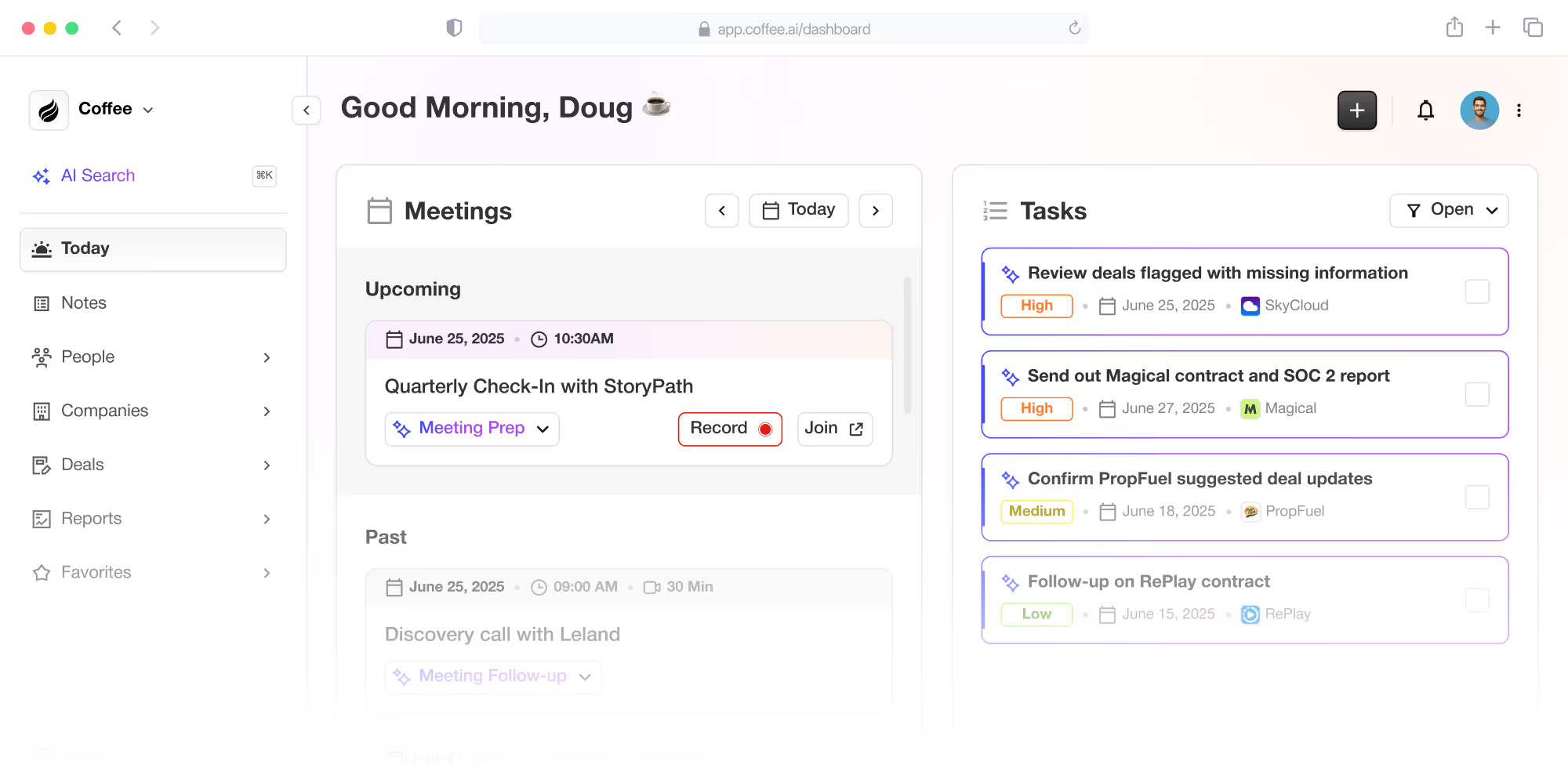
Coffee, an AI-first CRM, operates on the principle that effective AI depends on high-quality data. Unlike traditional systems where data input is often manual and error-prone, Coffee automates the process by pulling information directly from sources like emails and calendars. This reduces workload and ensures accuracy from the start.
By training its AI on reliable, real-time data, Coffee delivers precise predictions and actionable recommendations. The platform creates a cycle of improvement: accurate data enhances AI output, which boosts user engagement and generates even better data over time.
Automation for Effortless Data Handling
Coffee eliminates manual data entry with automated capture and enrichment. Once connected to Google Workspace or Microsoft 365, it scans emails and calendar events to build detailed contact and company profiles. It also tracks interactions and relationships without any input from users.
The platform enhances records with verified details, such as job titles, company information, and social profiles, sourced from trusted data partners. Activity updates, like last and next interactions, are logged in real time, giving sales managers clear visibility into deal progress without extra effort.
Combining Structured and Unstructured Data
Unlike older CRMs focused on structured data, Coffee integrates both structured and unstructured inputs, including emails, call notes, and chat logs, into one system. Its AI processes this information to uncover insights and fuel predictive tools.
With a data warehouse design, Coffee stores historical snapshots of customer interactions, enabling features like Pipeline Compare to track changes over time. This unified setup ensures a single, accurate source of truth, empowering sales teams with consistent, reliable information.
Key Benefits of Unified Data in AI-First CRMs
Stronger AI Insights for Better Decisions
Unified data boosts AI performance by providing a complete, up-to-date view of customer interactions. Coffee uses this foundation to offer accurate sales forecasts, spot at-risk deals, and suggest next steps. Features like Pipeline Compare analyze historical data to reveal bottlenecks and trends, aiding strategic planning.
These capabilities help sales teams prioritize efforts and improve outcomes. With dependable insights, managers can refine forecasts and allocate resources more effectively. Companies using AI-driven insights see a measurable uptick in forecast accuracy.
Increased Efficiency for Sales Teams
Automation in platforms like Coffee saves sales reps significant time, often 8 to 12 hours per week. Pre-meeting briefings compile attendee details and interaction history automatically, ensuring reps are prepared without manual research. Post-meeting, AI-generated summaries and follow-up drafts streamline next steps.
This efficiency lets teams manage more prospects and close deals faster. For growing businesses, the ability to scale operations without additional headcount offers a clear edge over competitors stuck with slower, manual processes.
Simplified Tech Stack and Lower Costs
An AI-first CRM like Coffee combines multiple functionalities, including data enrichment and forecasting, into one platform. This reduces the need for separate tools, cutting subscription fees and simplifying IT management. Fewer integrations mean less time spent on troubleshooting and training.
Centralizing data also strengthens security and compliance. With information in a single, secure system, applying consistent policies and meeting regulations like GDPR becomes manageable, reducing risks compared to fragmented setups.
Higher User Engagement with Practical Tools
Coffee boosts user adoption by making the CRM a helpful tool rather than a chore. Automated features and immediate value, such as meeting prep and follow-up assistance, encourage sales reps to engage with the system regularly. This contrasts with traditional CRMs often seen as administrative burdens.
When reps use the platform consistently, data quality improves, enhancing AI insights. This cycle benefits the entire organization, from more accurate forecasts to better strategic decisions at the management level.
Comparing AI-First CRMs to Traditional Systems
| Feature | Traditional CRM | Coffee (AI-First CRM) |
|---|---|---|
| Data Integration | Manual, fragmented across tools | Automated, unified in one system |
| Data Types | Mainly structured, limited scope | Structured and unstructured combined |
| AI Functionality | Added on, restricted by data gaps | Built-in, powered by complete data |
| User Workflow | Heavy data entry workload | Automation-focused, user-friendly |
Steps to Implement Unified Data Systems Effectively
Plan Migration with Clear Goals
Adopting an AI-first CRM starts with evaluating current data sources and workflows. Identify key areas for integration and set priorities for migration. Coffee offers flexibility with standalone and companion app options for existing CRMs, easing the transition based on specific needs.
Engaging users early through training and support builds acceptance. Highlight quick wins, like time saved on routine tasks, to show the platform’s value and encourage adoption across teams.
Track Progress with Specific Metrics
Define measurable goals to assess the impact of a new CRM. Focus on revenue growth, sales cycle duration, and conversion rates. Operational metrics, such as time spent on admin tasks and tool consolidation, also provide insight into efficiency gains.
Customer satisfaction indicators, like response times and retention rates, reflect improved service quality. Platforms like Coffee deliver early results in these areas, validating the investment with tangible outcomes.
Maintain Data Standards Over Time
High data quality requires ongoing governance. Set rules for validation and ownership to keep information accurate. Coffee’s automation helps by detecting duplicates and updating records, but human review ensures alignment with business context.
Security remains a priority as data consolidates. Coffee supports compliance with encryption and access controls, meeting standards like SOC 2 and GDPR. Organizations should reinforce these with internal policies tailored to their operations.
Common Mistakes to Avoid During Implementation
Overlooking User Buy-In
Neglecting the human side of CRM adoption often leads to failure. Sales teams may resist new tools if their needs aren’t considered. Involve reps in platform selection and pilot testing to address real challenges and build trust.
Ongoing education beyond initial training helps sustain engagement. Coffee’s intuitive design lowers barriers, but consistent support ensures users fully leverage its features for maximum benefit.
Choosing Fragmented Tools Over Integration
Opting for specialized tools to solve specific issues can worsen data silos. This approach strains resources with integration challenges and limits AI potential. Coffee’s unified system supports advanced features, like pipeline tracking, that disconnected tools can’t match.
Evaluating CRMs based on their ability to consolidate functions saves time and unlocks deeper insights. A comprehensive platform reduces complexity while enhancing overall effectiveness.
Ignoring Privacy and Compliance Needs
Centralized data increases the importance of privacy and security. Overlooking these risks penalties and loss of trust. Coffee incorporates safeguards like encryption and audit logs, aligning with GDPR and SOC 2 standards for robust protection.
For global operations, consider data residency rules. Conduct regular audits to ensure compliance with local regulations, customizing Coffee’s settings to fit specific legal requirements.
Ready to strengthen your data strategy with confidence? Request access to Coffee’s secure, compliant AI-first CRM.
Answers to Common Questions About AI CRM Data Integration
How Does Unified Data Improve Sales Predictions?
Unified data enhances sales forecasting by giving AI access to all customer touchpoints in real time. Coffee combines various data types to build a full view of deals, allowing more accurate pattern recognition and outcome predictions.
Can It Lower Tech Stack Expenses?
Yes, integrating data in an AI CRM cuts costs by consolidating tools. Coffee bundles features like analytics and enrichment into one platform, reducing the need for separate subscriptions and simplifying maintenance.
How Does Coffee Protect Data During Integration?
Coffee upholds strict security with encryption for data at rest and in transit, role-based access controls, and detailed audit logs. Its SOC 2 and GDPR compliance ensures robust protection compared to disjointed systems.
What Returns Can We Expect from AI CRM Adoption?
AI CRMs like Coffee deliver value through higher revenue, streamlined operations, and better customer retention. Teams often see faster sales cycles, improved conversion rates, and weekly time savings of 8 to 12 hours per rep.
How Long Does Coffee’s Setup Take?
Coffee’s setup is quicker than traditional CRMs thanks to automated data handling. A standalone system takes 1 to 2 weeks, while integration as a companion app with existing CRMs typically spans 2 to 4 weeks, including training.
Final Thoughts on Harnessing Data for Sales Growth
The shift away from fragmented, manual CRM processes is underway. Businesses adopting unified data systems gain a clear edge with smarter AI insights and more efficient teams. Coffee exemplifies this trend, turning CRM into a powerful ally with automation and cutting-edge features.
Ready to elevate your sales with integrated data? Request access to Coffee’s AI-first CRM and discover the difference for yourself.