
The customer relationship management (CRM) market has evolved significantly over the past decade, driven by rapid technological advancements and shifting business needs. Sales teams once relied on basic tools to track contacts and deals, but today’s landscape demands more dynamic solutions. With the rise of artificial intelligence (AI), CRM systems are moving beyond static data storage to become proactive partners in sales strategies. AI is reshaping how businesses interact with customers, analyze data, and optimize workflows, creating both opportunities and challenges for sales leaders navigating this shift.
Legacy CRMs, built for a different era, often struggle to keep pace with modern demands, leaving teams bogged down by manual tasks and fragmented tools. Meanwhile, AI-driven platforms are emerging as key players, offering automation and insights that help sales professionals focus on building relationships rather than managing data. This guide explores the current state of AI in CRM, detailing specific benefits and trade-offs. As an example of this broader trend, Coffee’s AI-first approach stands out, integrating intelligent features to enhance sales efficiency. For those looking to explore this potential, request access to see Coffee in action.
Challenges with Traditional CRMs in Today’s Sales Environment
Many traditional CRM systems fall short in meeting the needs of modern sales teams. Designed for basic record-keeping, these platforms often create hurdles that slow down productivity and limit strategic growth.
Time Lost to Manual Data Entry
Sales reps frequently spend hours updating records instead of engaging with clients. After every call or meeting, they must log notes, adjust deal statuses, sync emails, and ensure contact details are current. This repetitive process eats into valuable selling time.
When data entry feels burdensome, adoption rates drop. Incomplete or outdated information weakens the CRM’s usefulness, pushing reps to use alternative tools like spreadsheets or personal apps. This creates scattered data, making it harder to maintain a clear view of customer interactions.
Disconnected Tools and Data Silos
Sales teams often rely on multiple tools for different tasks, such as one platform for outreach, another for data enrichment, and yet another for call recording. Using separate systems means customer data is spread across isolated environments, leading to inefficiencies.
Without a unified data source, reps struggle to build complete customer profiles. Important details can slip through the cracks, and maintaining consistency across platforms becomes a constant challenge. This fragmented setup often results in missed opportunities to deliver tailored customer experiences.
Limitations of Older CRM Architecture for AI Integration
Many older CRMs were not designed with AI in mind. Their core structures struggle to handle unstructured data, like email threads or call transcripts, which are vital for modern AI applications. While some have added AI features, these are often surface-level and lack deep integration.
How AI-Driven CRM Supports Sales Teams
AI-driven CRM marks a shift toward smarter, more adaptive tools that anticipate sales needs. These systems use data analysis to automate tasks and provide actionable guidance, helping teams work more effectively.
What AI Brings to Sales CRM
AI in CRM goes further than basic task automation. It processes vast amounts of data from customer interactions to uncover patterns and suggest next steps. By reducing manual workloads, AI allows sales reps to prioritize relationship-building over administrative duties.
Key Features: Automation and Unified Data
AI-driven CRM systems pull together data from emails, calendars, calls, and traditional CRM fields to create comprehensive customer views. This unified approach powers automation, cutting down repetitive tasks and ensuring information is always up to date.
Advanced Support Through Intelligent Assistance
Unlike simple automation, intelligent assistance adapts to real-time data. It offers personalized recommendations for complex sales situations, drafts follow-up messages, and handles backend tasks, acting as a virtual support system for sales reps.
Core Benefits of AI in CRM: Insights from Coffee’s Approach
Coffee exemplifies how AI can enhance sales processes with practical, user-focused features. Its design highlights key areas where AI makes a measurable difference for sales teams.
Streamlining Workflows with Automation
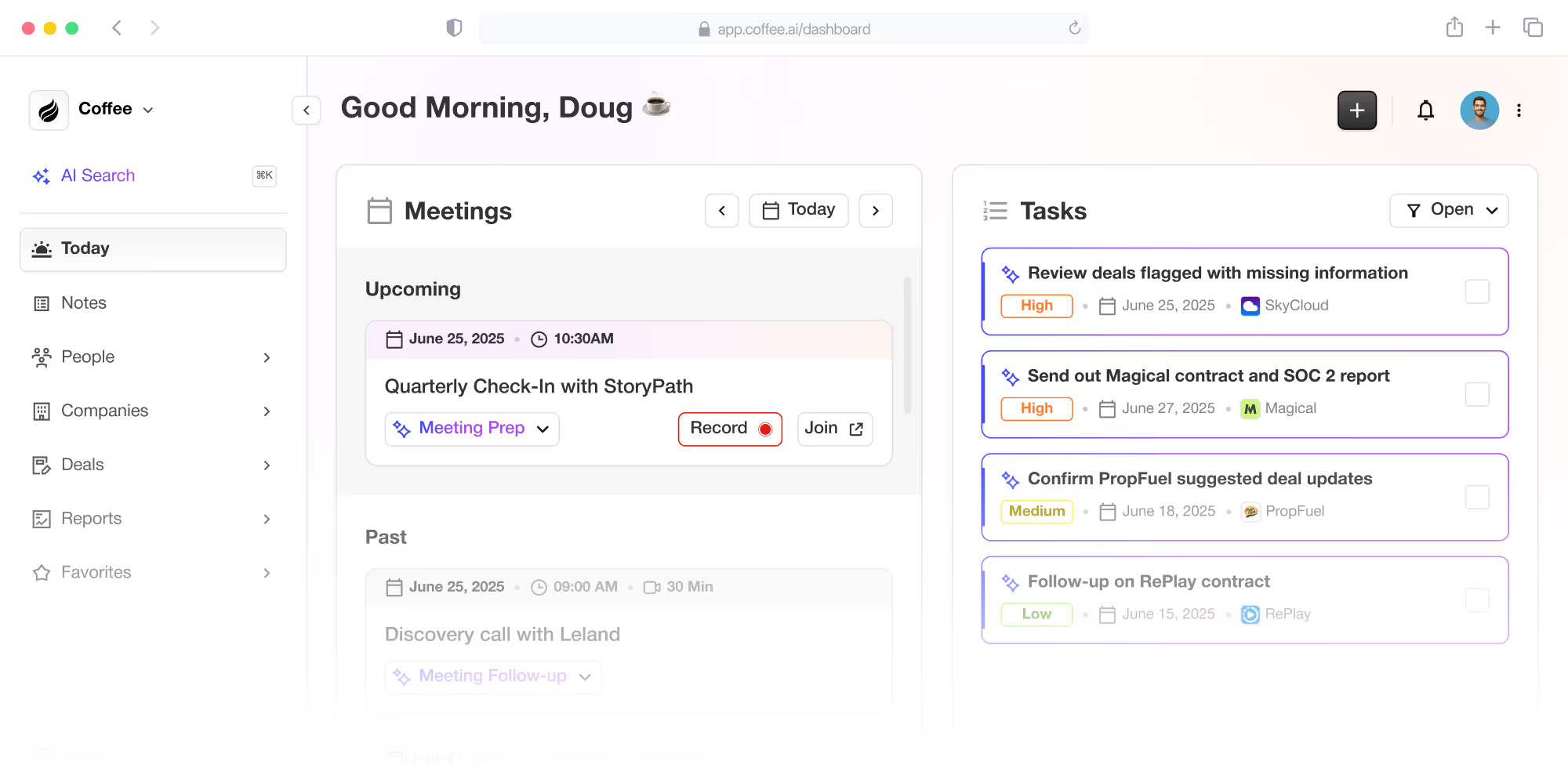
Coffee automates routine tasks like creating contacts and updating deal statuses based on email and calendar data. This reduces manual effort significantly, saving reps an estimated 8 to 12 hours per week. Deals stay current without constant input from team members.
If your team is ready to cut down on manual data management, request access to explore Coffee’s automated workflows.
Improving Meetings and Follow-Up Processes
Coffee includes an AI Meeting Bot that joins virtual calls on platforms like Zoom, Google Meet, and Microsoft Teams. It records, transcribes, and summarizes discussions, identifies action items, and drafts follow-up emails ready to send from Gmail.
Before meetings, Coffee’s “Today” page provides briefings with attendee details, roles, company background, and past interaction summaries. These can align with sales frameworks like BANT or MEDDIC, ensuring consistent deal qualification.
Enhancing Pipeline Visibility and Forecasting
Coffee offers a data warehouse setup that stores historical pipeline data for easy analysis. A “compare” feature tracks week-over-week changes, showing deal progression or stagnation at a glance. This eliminates the need for manual data exports or complex spreadsheet work.
Steps to Adopt an AI-Driven CRM Successfully
Transitioning to an AI-driven CRM requires thoughtful preparation. Sales leaders need to evaluate readiness, choose the right setup, and track outcomes to ensure long-term value.
Evaluating Your Team’s Readiness for AI
Start by reviewing your current data quality and tech setup. AI relies on clean, complete data, so fragmented systems or inconsistent records may need attention first. Cultural willingness to adopt new tools also plays a critical role in success.
Choosing Between Standalone or Companion Models
Coffee offers flexibility with two options. Its standalone CRM works well for smaller businesses moving away from spreadsheets or outdated systems, providing a full AI-driven solution. For larger teams with existing CRMs like Salesforce or HubSpot, Coffee’s companion app adds AI features without replacing the core system.
Tracking Progress and Measuring Value
Set clear goals to evaluate AI CRM impact. Focus on metrics like time saved on administrative tasks, improved data accuracy, and sales outcomes such as faster deal closures or higher conversion rates.
Where Coffee Fits in the AI-Driven CRM Landscape
As part of the growing trend toward AI-first solutions, Coffee offers distinct advantages through its design and focus on user needs. It stands as a strong example of how modern architecture can address sales challenges effectively.
Built for AI from the Ground Up
Coffee’s system uses a data warehouse to store and analyze historical data, supporting robust AI functions. It handles both structured and unstructured data within a single platform, ensuring comprehensive insights.
Designed as a Sales Team Partner
Coffee acts as a virtual assistant for sales reps, automating tasks and delivering insights that make daily work easier. This user-friendly approach boosts adoption and improves data consistency across teams.
Simplifying Tech Stacks for Better Efficiency
Instead of juggling multiple tools, Coffee combines features like data enrichment, call recording, and pipeline analysis into one system. This reduces costs and ensures all data feeds into AI processes seamlessly.
Curious about how AI-driven CRM can support your sales goals? Request access to learn more about Coffee’s capabilities.
Comparing Coffee to Traditional CRMs on AI Features
| Feature Category | Coffee (AI-First CRM) | Traditional CRMs |
|---|---|---|
| AI & Automation Architecture | Built with native AI, processes data in real time, unified data storage | Often retrofitted with AI, integration may vary |
| Data Quality & Automation | AI captures and enriches data automatically, no manual updates needed | Relies more on manual input, risk of inconsistent data |
| Sales Rep Productivity | Automates 8-12 hours of tasks weekly, supports meetings, offers insights | Administrative tasks can reduce selling time |
| Pipeline Intelligence | Historical data tracking and instant comparison features | May need extra tools or effort for similar analysis |
Real-World Impact: A Coffee Case Study
A mid-sized company generating tens of millions in revenue built custom AI solutions for Fortune 500 clients but managed sales via spreadsheets. Realizing this wouldn’t scale, they evaluated CRM options and selected Coffee. Its intuitive interface, automatic contact creation from Google Workspace, weekly pipeline reviews via the comparison tool, and API access for custom briefings made it a strong fit.
Looking Ahead: AI as the Future of Sales CRM
AI-driven CRM systems are redefining sales by shifting focus from manual processes to strategic engagement. While traditional platforms often burden teams with outdated methods, solutions like Coffee demonstrate how automation and intelligence can improve results.
Coffee’s approach, with its emphasis on user needs and integrated features, represents the direction of modern CRM. By reducing tech complexity and administrative workload, it helps sales teams prioritize relationships and deal-closing.
Interested in seeing how an AI-first CRM can benefit your organization? Request access to discover Coffee’s potential for your team. AI is shaping the future of sales, and now is the time to explore its advantages.