
Key Takeaways
- AI-first CRM lead scoring uses machine learning on structured and unstructured data for real-time lead prioritization, delivering 20-30% conversion lifts.
- Legacy CRMs fail because manual data entry consumes 71% of rep time, data lives in silos, and static rules cannot keep up with buyer behavior.
- Coffee’s autonomous agent unifies data from Google Workspace and Microsoft 365, processes emails and calls, and delivers intelligent lead scoring without setup work.
- Coffee outperforms HubSpot and Salesforce Einstein by removing manual entry, improving data quality, and working as either a standalone CRM or a companion app.
- Teams see fast productivity gains and stronger ROI when they deploy Coffee’s AI-first lead scoring, which transforms how sales pipelines are managed.
How AI-First CRM Lead Scoring Changes Sales Performance
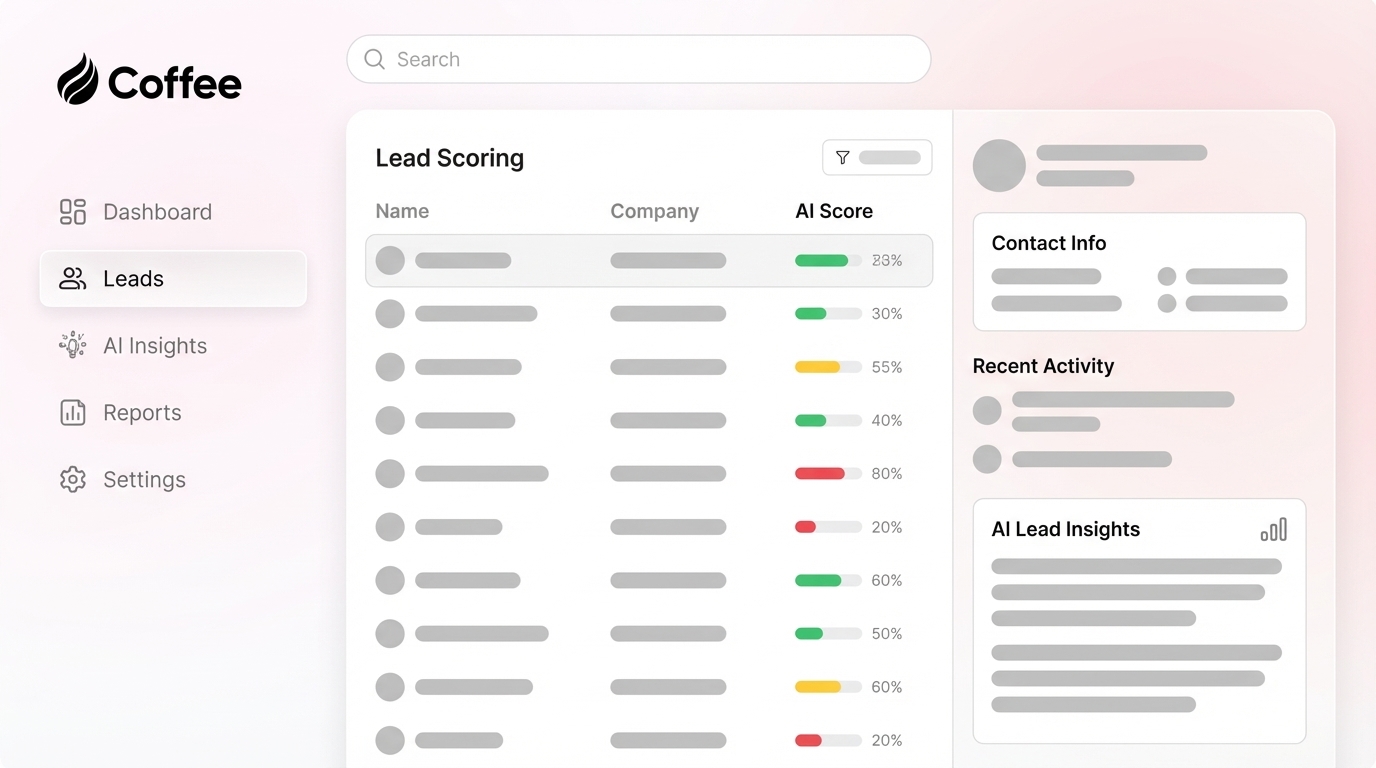
AI-first CRM lead scoring uses machine learning algorithms to automatically analyze prospect behavior, engagement patterns, and firmographic data. The system predicts conversion likelihood with dynamic scores that update in real time. This approach delivers lead prioritization that adapts to buyer actions, 30% productivity gains, and autonomous data processing that replaces manual scoring rules.
Key benefits include:
- Real-time scoring updates based on behavioral signals
- Predictive analytics that highlight buying intent patterns
- Automated lead routing to the right sales representatives
- Continuous model improvement through machine learning
AI-driven lead scoring adapts dynamically to changing buyer behavior, unlike traditional static rule-based systems. Predictive lead scoring users achieve 28% higher conversion rates and 25% shorter sales cycles compared to manual methods. Start capturing and prioritizing every prospect interaction automatically with Coffee’s AI-first lead scoring.
Why Legacy CRMs Fail at Lead Scoring
Legacy CRM systems like Salesforce and HubSpot assume busy sales reps will reliably input accurate data. That assumption breaks in real sales environments and creates cascading problems that weaken lead scoring. Industry data shows that 73% of leads sent to sales are unqualified, which wastes valuable selling time on non-buyers.
Critical legacy CRM failures include:
- Manual data entry requirements that consume 71% of rep time
- Fragmented data across multiple disconnected tools
- Inability to process unstructured data like email content and call transcripts
- Static scoring rules that do not adapt to changing buyer behavior
- Poor user experience that drags down adoption rates
The “good data in, good data out” principle breaks when human data entry clerks feel overwhelmed with administrative tasks. Because manual entry creates this data quality crisis, Coffee’s autonomous agent solves the foundational problem by automatically capturing, enriching, and structuring all prospect interactions without human intervention.
How Coffee’s AI-First Lead Scoring Operates Day to Day
Coffee’s AI-first lead scoring follows a clear five-step process that protects data quality and sharpens prioritization.
- Automated Data Unification: The Coffee agent connects to Google Workspace or Microsoft 365 and automatically captures emails, calendar events, and contact interactions.
- Machine Learning Analysis: Advanced algorithms process structured data such as demographics and company size, along with unstructured data such as email content and call transcripts, to detect buying signals.
- Real-Time Scoring: Dynamic scores update instantly based on prospect behavior, engagement patterns, and intent signals.
- Intelligent Prioritization: High-priority leads move to the top of rep focus lists, supported by contextual briefings.
- Continuous Calibration: The system learns from outcomes and improves prediction accuracy over time.
Consider a VP of Sales at a target company who opens several emails, visits the pricing page, and books a demo. Coffee’s agent logs these activities, enriches the contact record, and generates pipeline intelligence. The agent then prepares a briefing for the rep with relevant context and suggested next steps. This workflow removes manual data entry and keeps every high-intent prospect visible to the team.

Top AI-First CRM Lead Scoring Tools for 2026
The AI-first CRM lead scoring landscape includes several platforms with different strengths. Coffee’s comprehensive agent approach focuses on autonomous data capture and unification, which removes the manual entry dependency that holds back many tools. The table below highlights how Coffee’s agent-led model compares to other options.
|
Tool |
Key Strength |
Coffee Differentiator |
|
Coffee (#1) |
Agent auto-data in/out |
Full agent unification |
|
HubSpot Predictive |
CRM-embedded insights |
Manual entry reliant, no warehouse |
|
Salesforce Einstein |
Enterprise predictions |
Legacy baggage, 71% data waste |
|
Warmly |
Signal-layered scoring |
Lacks standalone/companion flexibility |
Coffee stands apart by fixing the core data quality problem that weakens other platforms. HubSpot Predictive and Salesforce Einstein still depend on reps to enter data, while Coffee’s agent captures and enriches information automatically. Companies using AI-enabled sales platforms report 30% higher win rates and 25% faster deal cycles, and Coffee delivers this with the most complete agent-led approach. Experience Coffee’s agent-led approach that eliminates manual data entry while delivering superior prediction accuracy.
Deploying Coffee’s AI-First Lead Scoring in Your Stack
Coffee’s implementation process delivers value quickly without complex setup. Teams can choose between two flexible deployment models that match their current tools.
Standalone CRM: Connect Google Workspace or Microsoft 365 to enable automatic contact creation, data enrichment, and scoring. The agent immediately begins capturing email interactions and calendar events while building complete prospect profiles.

Companion App: Integrate Coffee with existing Salesforce or HubSpot instances to improve data quality and scoring accuracy. Coffee’s agent feeds enriched data back to your primary CRM and powers advanced pipeline intelligence through Pipeline Compare and List Builder.

Traditional manual lead scoring setups often demand extensive configuration and ongoing rule maintenance, as noted in manual lead scoring guides. Coffee’s agent handles data normalization and scoring calibration autonomously. Teams usually see the system delivering value within days, with measurable conversion improvements appearing within 4 to 6 weeks.
Coffee Case Study and 2026 ROI Impact
A company generating tens of millions in revenue managed sales through spreadsheets after rejecting Salesforce and HubSpot due to heavy manual work. The team needed an automated solution that could scale without adding administrative burden.
Coffee’s agent delivered immediate impact by capturing data from Google Workspace and removing manual contact creation and activity logging. The Pipeline Compare feature replaced manual weekly reviews with automated pipeline intelligence, and API access supported custom briefing workflows tailored to their process.
Results included large time savings on administrative tasks and faster visibility into deal health. Based on industry benchmarks showing $8.71 ROI per $1 invested in CRM, combined with Coffee’s automation, the investment produced substantial returns within the first quarter.
Conclusion: From Static Databases to Active AI Agents
AI-first CRM lead scoring marks the shift from passive databases to active agents that protect data quality and deliver predictive intelligence. Coffee’s autonomous agent removes the heavy manual data entry burden that slows legacy systems and gives teams accurate, always-current lead prioritization.
Transform your sales team’s productivity with Coffee’s autonomous agent approach to lead scoring.
Frequently Asked Questions
What is an AI-first CRM lead scoring example?
An AI-first CRM lead scoring example with Coffee starts when the agent detects that a VP of Sales opens multiple emails, visits the pricing page, and schedules a demo. Coffee enriches the contact record with company data, logs all activities, and prepares a contextual briefing for the sales rep with relevant talking points and next steps. This entire process runs automatically without any manual data entry.
How does Salesforce Einstein compare to Coffee for lead scoring?
Salesforce Einstein depends on manual data entry and expects sales reps to consistently input accurate information, which creates a “garbage in, garbage out” problem. Einstein also operates within Salesforce’s 25-year legacy architecture that struggles with unstructured data processing. Coffee’s agent approach automatically captures and structures all prospect interactions from email, calendar, and communication tools, which protects data quality. Coffee is SOC2 Type 2 and GDPR compliant, and its data security controls prevent customer information from being used to train public AI models.
Can Coffee integrate with HubSpot for predictive lead scoring?
Yes, Coffee offers a Companion App that enhances existing HubSpot installations. The Coffee agent automatically feeds enriched prospect data, activity logs, and scoring insights back to HubSpot through native integrations and Zapier connectivity. This approach fixes HubSpot’s manual data entry limitations while preserving your current workflows and user adoption. The agent keeps your HubSpot instance supplied with accurate, complete data for stronger lead scoring and pipeline management.
Is Coffee secure for AI-first lead scoring?
Coffee maintains enterprise-grade security with SOC2 Type 2 certification and full GDPR compliance. All customer data is encrypted in transit and at rest, supported by strict access controls and audit logging. Coffee does not use customer data to train public machine learning models, which keeps prospect information private and secure. The platform undergoes regular security assessments and follows industry-standard data protection practices suitable for businesses handling sensitive sales and customer information.
What makes Coffee’s AI lead scoring more accurate than traditional methods?
Coffee’s accuracy advantage comes from fixing the data quality problem that undermines traditional lead scoring. Legacy systems rely on incomplete manual data entry, while Coffee’s agent captures prospect interactions automatically from email, calendar, and communication channels.
The system processes structured data such as job titles and company size, along with unstructured data from email content and call transcripts that traditional CRMs often miss. This complete data foundation allows machine learning models to detect subtle buying patterns and intent signals that manual scoring rules cannot see, which produces higher prediction accuracy and stronger conversion rates.