
In today’s fast-evolving sales landscape, AI is redefining how businesses manage customer relationships and drive revenue. The global CRM market, valued at over $52 billion in 2021, is expected to grow at a compound annual rate of 13.3% through 2030, fueled by the demand for smarter, data-driven solutions. As companies strive to stay competitive, the integration of AI into existing CRM systems like Salesforce and HubSpot has emerged as a critical strategy. This isn’t just about adopting new technology; it’s about solving persistent challenges like manual data entry, fragmented tools, and poor data quality that hinder sales performance. With AI, organizations can enhance productivity and gain actionable insights without discarding their current tech investments.
This guide is designed for sales leaders and executives seeking practical ways to blend AI capabilities with their established CRM platforms. We’ll dive into the benefits, potential hurdles, and key steps for effective integration. Along the way, we’ll highlight tools like Coffee, a notable example of the growing trend toward AI-first CRM companion apps that work alongside traditional systems to deliver real value. Let’s explore how these solutions can address longstanding pain points and position your team for growth.
Request access to see how Coffee can enhance your sales operations with AI integration.
Why AI CRM Integration Matters for Sales Teams
Legacy CRM systems often fail to meet modern sales needs, creating inefficiencies that slow down teams. Many sales reps spend up to 71% of their time on data entry and administrative tasks instead of focusing on closing deals. This burden turns CRMs into obstacles rather than enablers.
Fragmented workflows add to the problem. Sales teams frequently toggle between multiple tools, such as CRM platforms, data enrichment services, and call recording software. This disjointed setup wastes time, creates inconsistent data, and pulls focus away from building customer relationships.
Data quality suffers as a result. When CRM updates feel like a chore, adoption drops, leading to incomplete or outdated information. Some reps even resort to unofficial systems like spreadsheets, further undermining the CRM’s effectiveness. These issues impact forecasting, reduce revenue potential, and waste the significant investments companies make in CRM infrastructure.
AI offers a way to tackle these challenges by automating routine tasks and improving data flow. However, success depends on integrating AI with existing systems in a way that ensures high-quality information and minimal disruption. Let’s look at how AI-first CRM approaches address these core issues.
What AI-First CRM Integration Really Means
AI-first CRM integration goes beyond just syncing data between systems. It builds an intelligent layer that automates processes, provides real-time insights, and enhances customer relationship management.
Using machine learning and natural language processing, AI-first solutions handle repetitive tasks like data entry and offer suggestions to guide sales strategies. The companion app model, a practical approach for many businesses, augments platforms like Salesforce or HubSpot without replacing them. This respects the significant investments companies have in their current setups, avoiding the cost and disruption of a full overhaul.
Tools like Coffee embody this model by adding AI-driven features to existing CRMs. They capture data automatically, generate insights, and streamline workflows while preserving established systems. Unlike basic syncing, which merely transfers data, AI-first integration turns information into actionable steps for sales teams, helping prioritize efforts and improve outcomes.
Navigating the Current CRM and AI Landscape
The CRM market blends long-standing players with fresh innovations. Cloud-based solutions dominate, offering mobile access and real-time updates, which are essential for modern sales teams. However, many legacy systems were designed for manual data entry and simpler workflows, making them less suited for today’s AI-driven needs.
Older integration methods struggle to support the dynamic, real-time demands of AI. This gap has spurred a shift toward systems that autonomously capture data from emails, calls, and calendars, providing proactive insights rather than just reactive reports. These advancements help sales teams anticipate customer needs and spot opportunities early.
Companion apps like Coffee play a key role in this evolution, bridging traditional CRM investments with cutting-edge AI features. They represent a broader trend of enhancing, rather than replacing, existing tools, offering a balanced path for companies to adopt AI without starting from scratch.
Key Factors for Effective AI-First CRM Integration
Should You Build or Buy an AI Solution?
Deciding between creating a custom AI integration or adopting a ready-made companion app involves weighing cost, time, and expertise. Building in-house allows for tailored solutions but demands significant resources, technical skills, and ongoing maintenance as CRM platforms evolve.
Opting for a specialized app like Coffee provides quicker access to AI features without the burden of development. These tools often come with faster setup, lower initial costs, and continuous updates from dedicated teams. Most organizations find that buying a solution lets them focus on core business goals while leveraging proven AI capabilities.
Driving Adoption Through Change Management
Integration isn’t just a technical task; it requires getting your team on board. Sales reps often resist new tools if past CRM changes added work without clear benefits. Highlighting how AI reduces manual tasks and boosts effectiveness can help win them over.
Training should focus on tangible outcomes, showing how AI insights improve meeting prep and deal prioritization. Leadership support hinges on tying integration to measurable results like faster sales cycles or better forecasting. A clear return on investment builds confidence across the organization.
Ensuring Data Security and Compliance
AI integration must protect data integrity while meeting compliance standards. Regulations like GDPR and SOC 2 apply equally to AI-enhanced systems. Companies need to confirm that their chosen tools adhere to these standards and maintain strong security practices for data handling.
Solutions like Coffee prioritize security with SOC 2 Type 2 and GDPR compliance, offering peace of mind while delivering AI-driven insights. Clear policies on data access and usage are essential to safeguard customer information during integration.
Tracking the Impact of AI Integration
Measuring the value of AI-first CRM integration helps justify the investment and guide future decisions. Track time saved on tasks like data entry; reps often gain 8 to 12 hours per week with automation. Monitor data accuracy through CRM completeness and adoption rates.
Pipeline metrics, such as deal progression speed and conversion rates, reveal how AI insights sharpen focus. Ultimately, revenue growth shows the broader business impact, connecting productivity gains and better data to tangible financial outcomes.
How Coffee Enhances CRM with AI as a Companion App
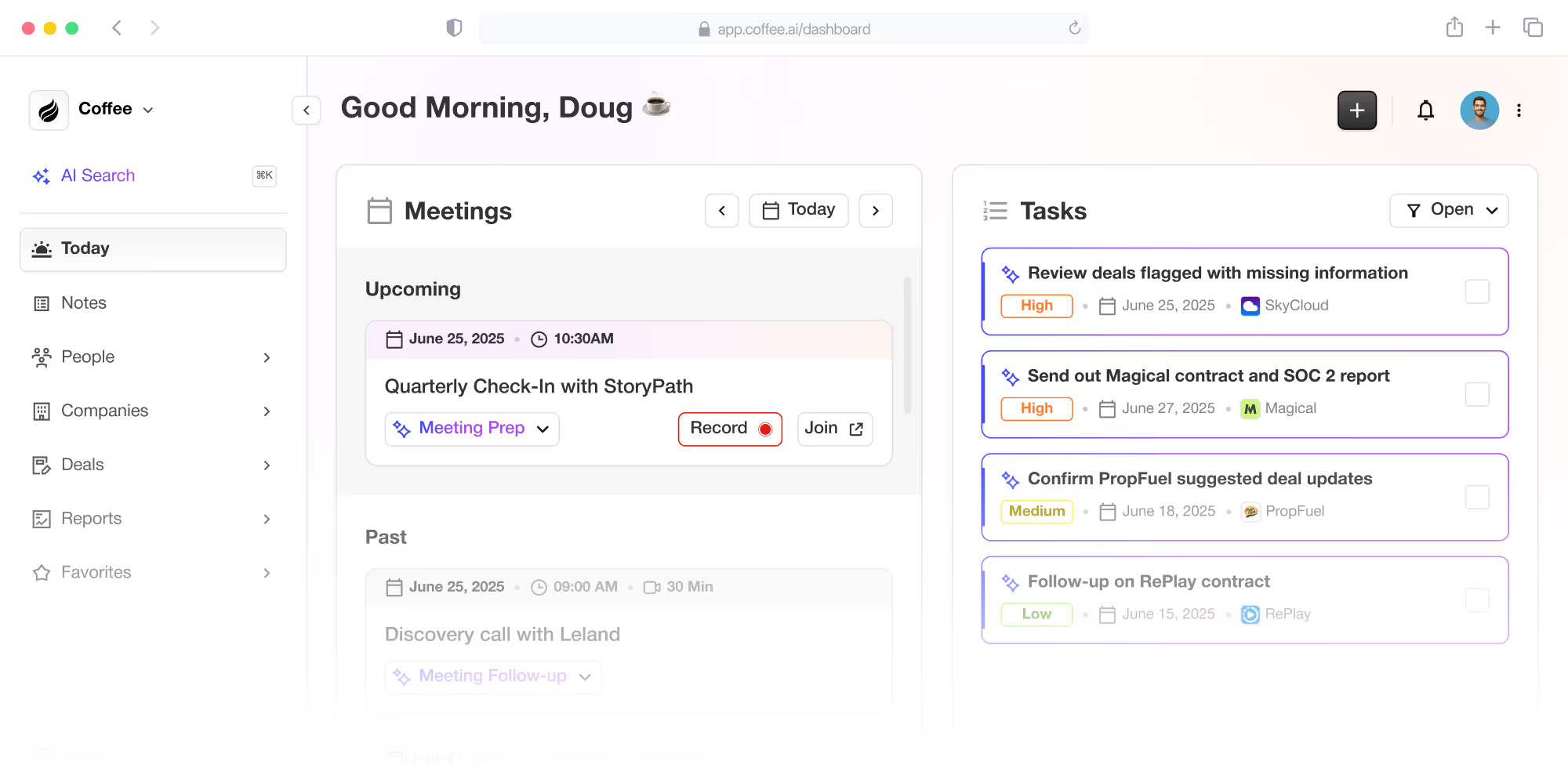
Coffee stands out as a companion app that integrates AI into existing Salesforce or HubSpot systems. Instead of requiring a full system replacement, it adds a smart layer that automates processes and delivers insights, making legacy CRMs more effective for today’s sales demands.
Key capabilities include:
- Automatic data capture from emails, calendars, and calls, syncing enriched information directly to your CRM.
- Meeting support with pre-meeting briefings on attendees and past interactions, plus post-meeting summaries and action items.
- Pipeline tracking with historical snapshots for week-over-week comparisons, identifying trends without manual analysis.
- Unified functionality that often reduces the need for separate tools, cutting costs and simplifying workflows.
Request access to explore how Coffee integrates with your CRM setup.
Comparing Coffee to Other CRM Approaches
Here’s how Coffee’s companion app stacks up against traditional integration and full CRM replacement options:
| Feature | Coffee Companion App | Traditional Integration | Full CRM Replacement |
|---|---|---|---|
| Cost | Low to Moderate | Moderate to High | Very High |
| Setup Time | Fast | Moderate | Slow |
| Disruption | Minimal | Moderate | High |
| AI Features | Advanced and Proactive | Limited and Reactive | Varies by Provider |
| Data Quality | High with Automation | Manual and Error-Prone | Varies by Provider |
Are You Ready for AI CRM Integration?
Before diving into AI integration, assess your current CRM setup and organizational readiness. Identify pain points like low adoption, incomplete data, or time lost to manual tasks. Engage stakeholders from sales, revenue operations, and IT to align on goals and ensure a smooth rollout.
Start with small, impactful use cases like automated data entry to show quick wins. Gradually expand to features like meeting automation or pipeline insights as teams adapt. This phased approach builds confidence and minimizes resistance.
Consider these questions to evaluate your fit for AI integration:
- Do sales reps struggle with CRM adoption or outdated data?
- Are manual data entry tasks eating into selling time?
- Do fragmented tools create workflow inefficiencies?
- Is there a need to enhance Salesforce or HubSpot without starting over?
If several of these resonate, AI-first CRM integration could offer substantial benefits for your team.
Common Mistakes to Avoid During Integration
Failing to prioritize user adoption can derail integration efforts. Involve reps early and show how AI cuts administrative work while improving sales outcomes. Neglecting data quality also undermines AI’s potential; ensure clean, real-time data flows into the system.
Avoid the temptation to replace entire CRM systems unless absolutely necessary. Tools like Coffee enhance existing platforms, reducing disruption. Finally, don’t skip measuring impact. Set benchmarks for productivity, data accuracy, and revenue to track progress and justify the investment.
Answers to Common AI CRM Integration Questions
How does Coffee protect data when integrated with my CRM? Coffee maintains SOC 2 Type 2 and GDPR compliance, ensuring data security and privacy. Customer information isn’t used to train broader AI models, and strict protocols safeguard your data.
Will Coffee require major changes to my Salesforce or HubSpot setup? No, Coffee works as an add-on layer, integrating via a simple authentication process. It enhances your system without altering existing workflows or customizations.
How soon can we expect results from Coffee’s integration? Many teams notice time savings within weeks, with reps gaining 8 to 12 hours by automating tasks. Data quality and pipeline visibility improve as adoption grows.
Take the Next Step with AI-Enhanced CRM
AI-first CRM integration is becoming a cornerstone for sales success, helping teams move beyond manual processes to smarter, insight-driven approaches. Coffee represents a practical way to add AI to your Salesforce or HubSpot setup, offering automation, better data, and streamlined tools without upheaval.
By adopting solutions like Coffee, companies can boost productivity, improve data accuracy, and focus on what matters: building relationships and closing deals. This approach fits into a larger shift toward combining established systems with AI innovation for lasting impact.
Request access to Coffee today and see how AI can elevate your CRM investment.