
In today’s competitive sales landscape, the tools you choose can make or break your team’s success. Customer Relationship Management (CRM) systems have long been marketed as solutions to streamline sales, yet many traditional platforms overwhelm users with clunky interfaces and time-consuming tasks. As the market evolves, a clear trend emerges: sales teams need intuitive, AI-driven tools that reduce friction and prioritize actionable outcomes. Research indicates that sales reps spend only about a third of their time selling, with the rest consumed by administrative work due to inefficiencies in legacy systems. This gap highlights a growing demand for solutions that focus on usability and automation.
Amid this shift, AI-powered CRMs are redefining how sales teams operate by cutting down on manual effort and delivering insights directly to users. Among these innovations, Coffee stands out as a practical example of this trend, offering a user-friendly platform that integrates seamlessly into daily workflows. This article explores the challenges of outdated CRMs, the advantages of AI-driven usability, and how tools like Coffee fit into the broader movement toward smarter sales technology.
Legacy CRMs: Why They Slow Down Your Sales Team
Traditional CRMs often create more obstacles than solutions for sales reps. Let’s break down the core issues that hinder productivity.
Manual Data Entry Eats Up Valuable Time
Sales reps lose significant hours to manual data entry, spending just 35% of their week on actual selling activities based on industry analysis. After every meeting, they must log notes, update contact records, and adjust opportunity stages, often taking several minutes per interaction. Multiply this by numerous daily engagements, and it becomes clear why so little time remains for closing deals.
This repetitive work also leads to incomplete or outdated data. When updates are rushed or skipped, the CRM fails to reflect accurate customer relationships, impacting forecasting and strategy. Over time, reps see the system as a chore rather than a helpful resource, further reducing data quality.
Fragmented Tools Create Workflow Chaos
Many sales teams rely on a disjointed set of tools for CRM, outreach, call tracking, and data storage. This setup scatters information across platforms, forcing reps to piece together customer insights manually. The result is a fragmented view of relationships, making it difficult to act decisively.
Older CRM architectures often struggle to integrate with modern tools, leading to costly overlaps and maintenance challenges. Companies can spend thousands monthly on multiple subscriptions that don’t communicate well. For reps, switching between these systems adds mental strain, pulling focus away from selling.
Complex Interfaces Discourage Adoption
Poor user experiences in traditional CRMs drive low adoption rates. Reps often perceive these tools as built for management reporting rather than their own benefit. As a workaround, many create personal tracking systems in spreadsheets or apps like Notion, which further isolates data from the team.
This lack of engagement creates a cycle of incomplete information, reducing the system’s value. Managers make decisions based on flawed data, while new hires face steep learning curves with complex setups. The disconnect between system design and real sales needs becomes a persistent barrier.
How AI CRM Usability Changes the Game for Sales Teams
AI-powered CRMs address these pain points by focusing on simplicity and automation. Here’s how they directly improve sales efficiency.
Automation Saves Hours on Routine Tasks
Modern platforms eliminate manual data entry by automatically capturing and organizing customer details. Sales reps can save an estimated 8 to 12 hours weekly, redirecting that time to prospecting and deal-closing. With data updated in real time, the system remains accurate without extra effort.
Intelligent Insights Prepare Reps for Success
AI tools provide actionable insights before and after customer interactions. Pre-meeting briefings summarize attendee details, company info, and past communications, ensuring reps are well-prepared. Post-meeting, automated summaries and follow-up drafts cut down on administrative follow-through, keeping the focus on relationships.
Streamlined Processes Increase Touchpoints
By reducing busywork, AI CRMs allow reps to manage more prospects without added stress. Automated workflows for meeting prep and follow-up mean more time for outreach and engagement. This efficiency directly contributes to pipeline growth and higher revenue potential.
Targeted Prospecting Made Simple
Advanced prospecting features in AI CRMs let users build precise contact lists using natural language queries. Instead of wrestling with complex search tools, reps can describe their ideal prospects and get tailored results quickly, improving the effectiveness of outbound efforts.
Coffee: A Leading Example of AI CRM Usability
Coffee embodies the shift toward user-focused, AI-driven CRM design. Built to adapt to how sales reps work, it offers a standalone platform or a companion app for existing Salesforce and HubSpot users. Its core goal is clear: make the system support the rep, not the other way around.
Key features include automatic data capture from email and calendar integrations, ensuring no manual input is needed. Contact records are enriched with details like job titles and company funding, pulled from licensed data sources. Meeting management is streamlined with AI-generated briefings, call transcriptions, and follow-up drafts, saving significant time. Coffee also offers pipeline tracking with a one-click comparison view and a natural language List Builder for prospecting.
As part of the larger trend toward intuitive sales tools, Coffee prioritizes ease over complexity, positioning itself as a valuable asset for teams seeking practical automation. Its dual deployment options make it flexible for businesses at different stages of CRM adoption.
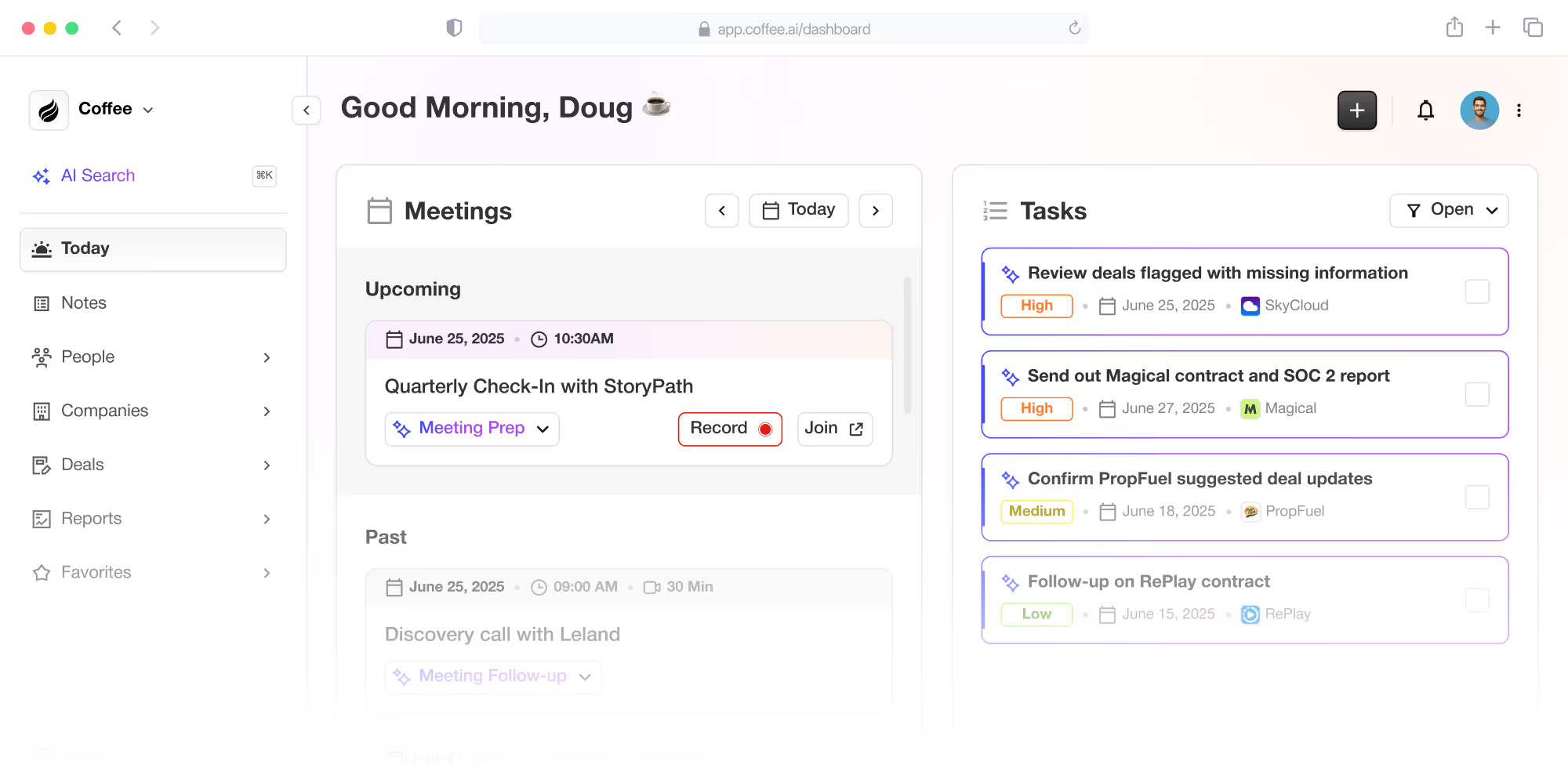
Comparing Coffee to Traditional CRMs: Key Differences in Usability
Coffee’s approach contrasts sharply with older CRM systems. Below is a breakdown of specific features and their impact on user experience.
| Feature / Characteristic | Legacy CRM (e.g., Salesforce/HubSpot Alone) | Coffee (Standalone or Companion App) |
|---|---|---|
| Data Entry | Often requires manual input | Automatic from emails and calendars |
| Data Enrichment | May need external tools | Built-in and automated |
| Meeting Preparation | Relies on manual research | AI-driven briefings |
| Post-Meeting Tasks | Involves manual note-taking and follow-up | AI summaries and drafted emails |
| Pipeline Intelligence | Often needs extra setup or tools | One-click comparison view |
| User Adoption | Varies, often resisted due to complexity | High, viewed as a helpful assistant |
This comparison shows a fundamental difference in design philosophy. While traditional systems often require reps to adapt to rigid processes, Coffee molds to natural workflows with automation at its core.
Measurable Benefits of Switching to an Easy-to-Use AI CRM
Adopting an AI-driven CRM with a focus on usability creates tangible improvements for sales organizations. Here’s what businesses can expect.
- Higher Revenue Potential: Reps spend more time engaging prospects, leading to more deals closed and stronger relationships.
- Better Data Accuracy: Automatic data capture ensures comprehensive records, giving managers clearer pipeline visibility and aiding customer success teams.
- Cost Efficiency: Consolidating tools into a single platform reduces subscription overlap and boosts results through integrated features.
Ready to see these benefits in action? Request access to Coffee and experience how usability drives results.
Tips for Implementing an AI CRM with High Usability
Transitioning to a user-friendly AI CRM like Coffee requires a clear plan for success. Start by communicating the specific time-saving benefits to your team, framing the change as a support tool rather than a burden. For companies with existing systems, using Coffee as a companion app offers a low-risk way to test AI features without disrupting current workflows. Focus on quick wins, like automating data entry, to build early momentum and encourage adoption.
Common Questions About AI CRM Usability
How Does Usability in AI CRM Improve Sales Productivity?
AI CRMs with strong usability, such as Coffee, cut down on manual tasks that take up 8 to 12 hours weekly for reps. By automating data updates and meeting follow-ups, reps can focus on engaging prospects and closing deals, directly boosting productivity.
Can Coffee Work with Our Current Salesforce or HubSpot Setup?
Yes, Coffee integrates smoothly with Salesforce and HubSpot as a companion app. It syncs data through simple authentication, allowing users to choose which insights or enriched data to transfer back to their main CRM.
Is Coffee a Good Fit for Small to Mid-Sized Businesses?
Coffee suits small to mid-sized businesses looking to move beyond basic tools or avoid overcomplicated legacy CRMs. Its straightforward design and automation deliver value without requiring extensive setup or training.
What Security Measures Protect Data in Coffee?
Coffee maintains high security standards with SOC 2 Type 2 certification and GDPR compliance, aligning with global benchmarks for data protection and privacy.
Conclusion: Step Into the Future with User-Friendly AI CRM
The days of struggling with cumbersome CRMs are fading as AI-driven platforms pave the way for smarter sales processes. Sticking with outdated systems puts businesses at a disadvantage in a fast-moving market. Tools like Coffee highlight the power of usability, with features like automatic data capture and intelligent meeting support showing what’s possible when technology serves the user. Want to elevate your team’s efficiency? Request access to Coffee and see firsthand how a focus on ease transforms sales outcomes.