
Sales teams face an overwhelming amount of data in today’s market, yet actionable insights remain elusive. The landscape of customer relationship management has evolved significantly over the past decade, driven by rapid technological advancements and shifting buyer expectations. Traditional CRMs, once the backbone of sales operations, now struggle to keep pace with the need for real-time analysis and automation. Many organizations find themselves juggling multiple tools to fill the gaps, leading to fragmented systems and inefficiencies. Amid this complexity, AI-powered solutions have emerged as a critical trend, offering the potential to unify data and provide deeper visibility into customer interactions. This article dives into how integrating AI conversational intelligence into your CRM, with platforms like Coffee leading the way, can refine sales analytics by turning everyday conversations into valuable data points.
Why Traditional Sales Analytics Often Fall Short
Many sales teams struggle with the limitations of traditional CRM analytics. A significant amount of time goes into manual tasks like data entry, pulling focus away from actual selling. These older systems often provide reports based solely on past events, missing the context of customer conversations and failing to offer predictive guidance.
Key challenges include:
- Manual data entry that leads to incomplete or inconsistent records.
- Limited insights from customer interactions due to a focus on basic data points.
- Analytics that only reflect historical trends, not future opportunities.
- Fragmented tools for call recording, data enrichment, and pipeline tracking, creating isolated data sets.
- Unreliable forecasting due to gaps in comprehensive data.
This creates a cycle of poor data quality, unreliable insights, and reduced system use, ultimately costing teams potential growth and efficiency.
How AI Conversational Intelligence Boosts Sales Analytics
AI conversational intelligence offers a fresh approach by capturing and analyzing customer interactions in detail. Platforms like Coffee integrate this technology directly into the CRM, automating transcription and analysis of conversations to deliver immediate, actionable insights across every touchpoint.
This process converts unstructured dialogue into organized data, seamlessly embedded within the CRM. By focusing on the specifics of each interaction, such solutions enhance pipeline visibility and overall sales effectiveness through automation and unified information. Coffee, for instance, demonstrates how this integration can streamline workflows and improve outcomes for sales teams.
If you’re looking to refine your sales analytics, consider a platform that prioritizes AI-driven insights. Request access to Coffee to explore its impact on sales performance.
7 Specific Benefits of AI Conversational Intelligence for Sales Analytics
1. Refine Sales Strategies with Automated Call Summaries
Coffee’s platform uses AI to transcribe and summarize sales calls from tools like Google Meet, Microsoft Teams, and Zoom. These summaries align with sales methodologies such as BANT or MEDDIC, ensuring insights are relevant and directly usable within the CRM for strategic planning.
2. Gain Clearer Pipeline Insights with Historical Data
With a built-in data warehouse, Coffee tracks pipeline changes over time through a ‘Pipeline Compare’ feature. This shows week-over-week progress or delays in deals, making pipeline reviews more focused and data-driven without the need for manual exports.
3. Personalize Customer Interactions Using Past Data
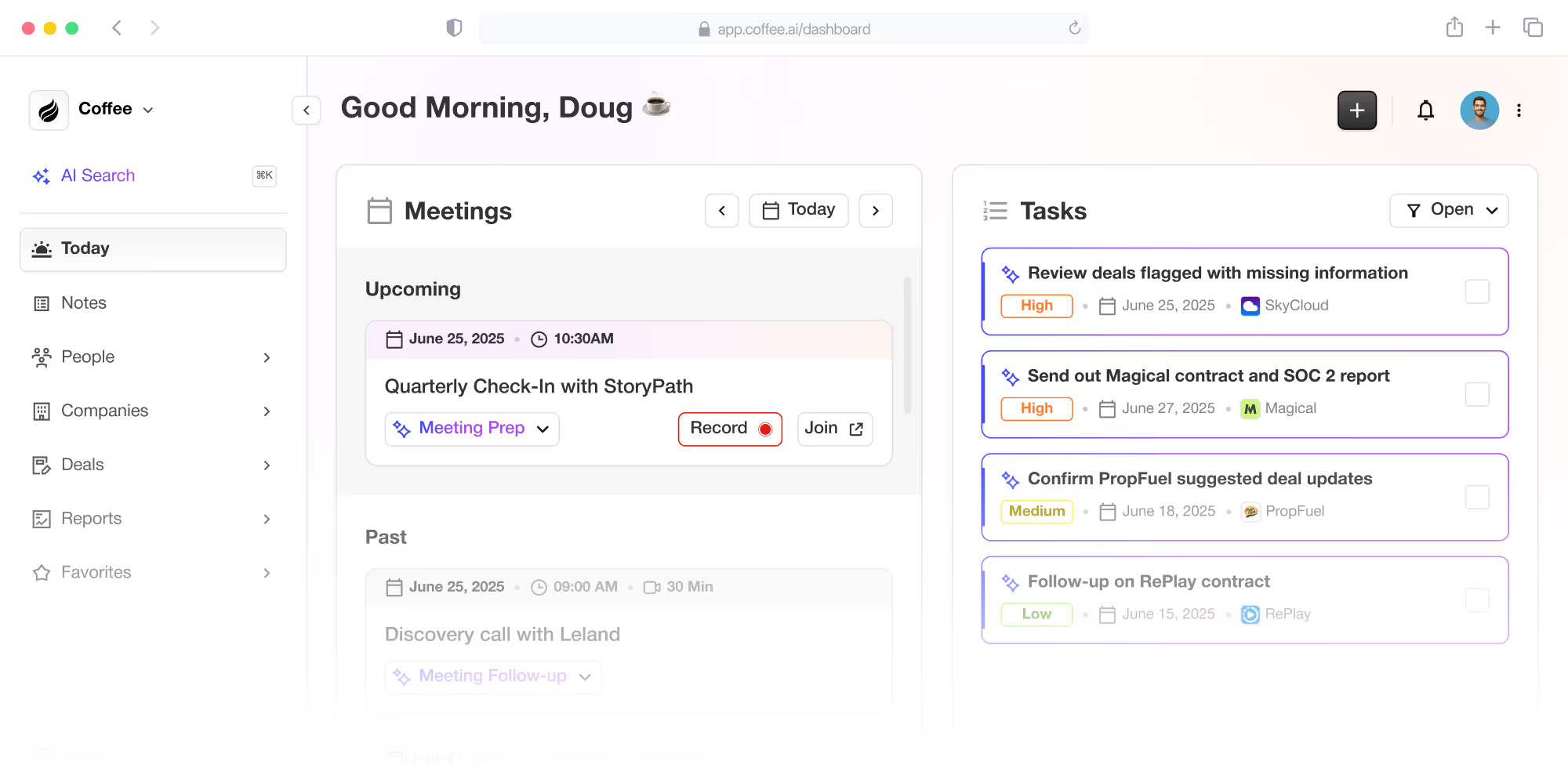
Coffee pulls from interaction history to provide pre-meeting briefings on its ‘Today’ page. These briefings include details like attendee roles, company background, and past conversation summaries, helping sales reps engage customers with informed, tailored approaches.
4. Save Time by Automating Routine Tasks
Through AI, Coffee handles repetitive tasks like logging meeting notes, creating summaries, identifying next steps, and drafting follow-up emails. This can save sales reps an estimated 8 to 12 hours weekly, allowing more focus on closing deals. Automation also updates deal statuses using email and calendar inputs.
5. Strengthen Sales Processes with Organized Insights
Coffee structures conversation summaries based on specific sales frameworks like BANT or MEDDIC. This consistency helps teams qualify deals effectively and maintain process discipline, with insights readily available inside the CRM for daily use.
6. Build a Complete Picture of Deal Progress
By aggregating data from emails, calls, and meetings, Coffee offers a full view of deal health. Its Pipeline Compare feature flags deals at risk of stalling, allowing managers to step in early and guide opportunities to closure with greater confidence.
7. Simplify Your Tools and Cut Operational Costs
Coffee combines CRM, data enrichment, call recording, and pipeline analytics into one platform. This reduces the need for multiple subscriptions, lowering costs and simplifying workflows for teams seeking an all-in-one solution for sales management.
Want to streamline your sales tools and increase efficiency? Request access to Coffee to see how a unified platform can impact your operations.
Comparing Coffee’s Integrated Platform to Traditional CRMs
| Feature | Traditional CRM with Separate Tools | Coffee (AI-First CRM) |
|---|---|---|
| Data Entry | Mostly Manual and Time-Consuming | Automated by AI |
| Interaction Insights | Often Limited, Requiring Manual Effort | Automatic Summaries and Analysis |
| Pipeline Management | Frequently Subjective or Manual | Data-Backed Pipeline Comparison |
| Time to Value | Delays Due to Setup and Integrations | Immediate Insights on a Single Platform |
While traditional CRMs paired with separate tools can work, they often demand more effort for setup and data handling, with trade-offs in speed and accuracy. Coffee, as an AI-first solution, prioritizes automation and integration, reducing these hurdles. However, teams with heavily customized legacy systems may need to weigh the transition effort against long-term gains in efficiency.
Key Questions About AI in Sales Analytics Answered
What Does Conversational Intelligence Mean for Sales CRMs?
In platforms like Coffee, conversational intelligence refers to AI that analyzes interactions from calls and meetings. It turns these exchanges into structured data, automating tasks and providing insights that improve pipeline management and sales approaches directly within the CRM.
How Is Coffee’s AI-First Design Different from Other CRMs?
Coffee builds its CRM with AI at the foundation, emphasizing high-quality data collection and automation. Unlike some traditional CRMs that add AI as an afterthought, Coffee integrates data from emails, calendars, and call transcripts to support sales teams as a practical assistant, not just a database.
Can AI Fully Replace Human Judgment in Sales?
AI conversational intelligence, as seen in Coffee, supports rather than replaces human judgment. It handles data analysis and routine tasks, freeing sales reps to focus on relationship-building and deal-closing, blending data insights with personal expertise for better results.
How Secure Is Company Data with AI Tools Like These?
Coffee ensures data protection with compliance to standards like SOC 2 Type 2 and GDPR. When choosing any AI tool, it’s wise for companies to confirm such certifications and review data policies to safeguard their information.
How Soon Can Teams Expect Results from AI Conversational Intelligence?
With Coffee, benefits like automated summaries and contact creation appear right after connecting email and calendar systems. More detailed pipeline and performance insights build over time as the system processes additional interaction data.
Conclusion: Elevate Every Sales Interaction with AI-Driven CRM Solutions
The next step for sales analytics is clear: AI conversational intelligence within a unified CRM platform offers a path to greater efficiency. Platforms like Coffee illustrate this trend, addressing the pitfalls of manual processes found in many older systems. By harnessing interactions for smarter decision-making, sales teams can focus on what matters most, closing deals.
Coffee stands out with its AI-first approach, tackling common issues in traditional CRMs through automation and an easy-to-use interface. While other tools may still serve specific needs, the move toward integrated solutions reflects a broader shift in how sales teams operate. Weighing the balance between sticking with familiar systems and adopting new technology is key, but the potential for streamlined workflows is evident.
Move past manual inefficiencies and focus on selling smarter. Request access to Coffee to discover how AI-enhanced analytics can support your sales goals.