
In today’s fast-evolving sales landscape, the ability to streamline customer interactions through technology is more critical than ever. Sales teams face increasing pressure to perform in a market where customer expectations are high, data is abundant, and competition is fierce. The rise of artificial intelligence has shifted how companies approach customer relationship management, moving away from cumbersome, manual processes toward automated, insight-driven systems. For sales leaders and revenue operations professionals, integrating communication tools with AI-powered CRM platforms offers a practical way to enhance efficiency, gain deeper insights from data, and equip teams with the clarity needed to close deals.
The challenge lies in navigating a fragmented tech environment where tools often operate in isolation. Many organizations still rely on disconnected systems for email, meetings, and CRM updates, creating inefficiencies that slow down sales cycles. This guide explores how AI-first CRMs address these pain points by unifying communication channels, automating repetitive tasks, and providing actionable intelligence, with solutions like Coffee leading as a notable example of this broader trend toward smarter sales operations.
Why Current Sales Communication Systems Often Fail
Sales teams frequently work with a patchwork of tools, from CRM platforms like HubSpot to outreach systems like SalesLoft and data tools like ZoomInfo. While each serves a specific purpose, the lack of integration creates gaps in workflow, forcing reps to spend valuable time manually connecting data across platforms.
Manual data entry remains a significant hurdle. After every call or meeting, sales reps must log notes, update records, and transfer information, a process that eats into their selling time. Research indicates that sales professionals spend nearly two-thirds of their day on non-selling tasks, with data entry being a major contributor. Only about 35 percent of their time goes to direct customer engagement.
This inefficiency not only reduces productivity but also leads to incomplete or outdated CRM data, undermining forecasting and decision-making. Legacy systems, designed for a different era, often fail to address these modern challenges, leaving sales teams frustrated and organizations missing out on potential revenue.
How AI CRM Unifies Sales Communication for Better Results
AI-first CRMs rethink the traditional model by automating data capture and connecting directly with the tools sales teams use daily. These platforms focus on reducing manual work while enhancing the quality of customer insights, allowing reps to prioritize relationships over administration.
As an example of this trend, Coffee stands out by emphasizing data quality as the foundation for effective AI. Unlike older systems that depend on inconsistent manual input, Coffee pulls information directly from emails, calendars, and call transcripts. This approach saves sales reps an estimated 8 to 12 hours per week on administrative tasks while ensuring organizations have accurate, comprehensive data for analysis. Its design includes a data warehouse to store historical information for detailed trend tracking, something traditional CRMs often lack.
What Benefits Come from Integrating Communication Tools with AI CRM?
Integrating communication tools with an AI-driven CRM like Coffee delivers measurable improvements across sales operations. The system connects seamlessly with everyday platforms, capturing data without requiring reps to switch between apps or manually update records.
- Email Connectivity with Google Workspace and Microsoft 365: Coffee automatically logs email exchanges and links them to the correct contacts and accounts, building a complete customer history without extra effort.
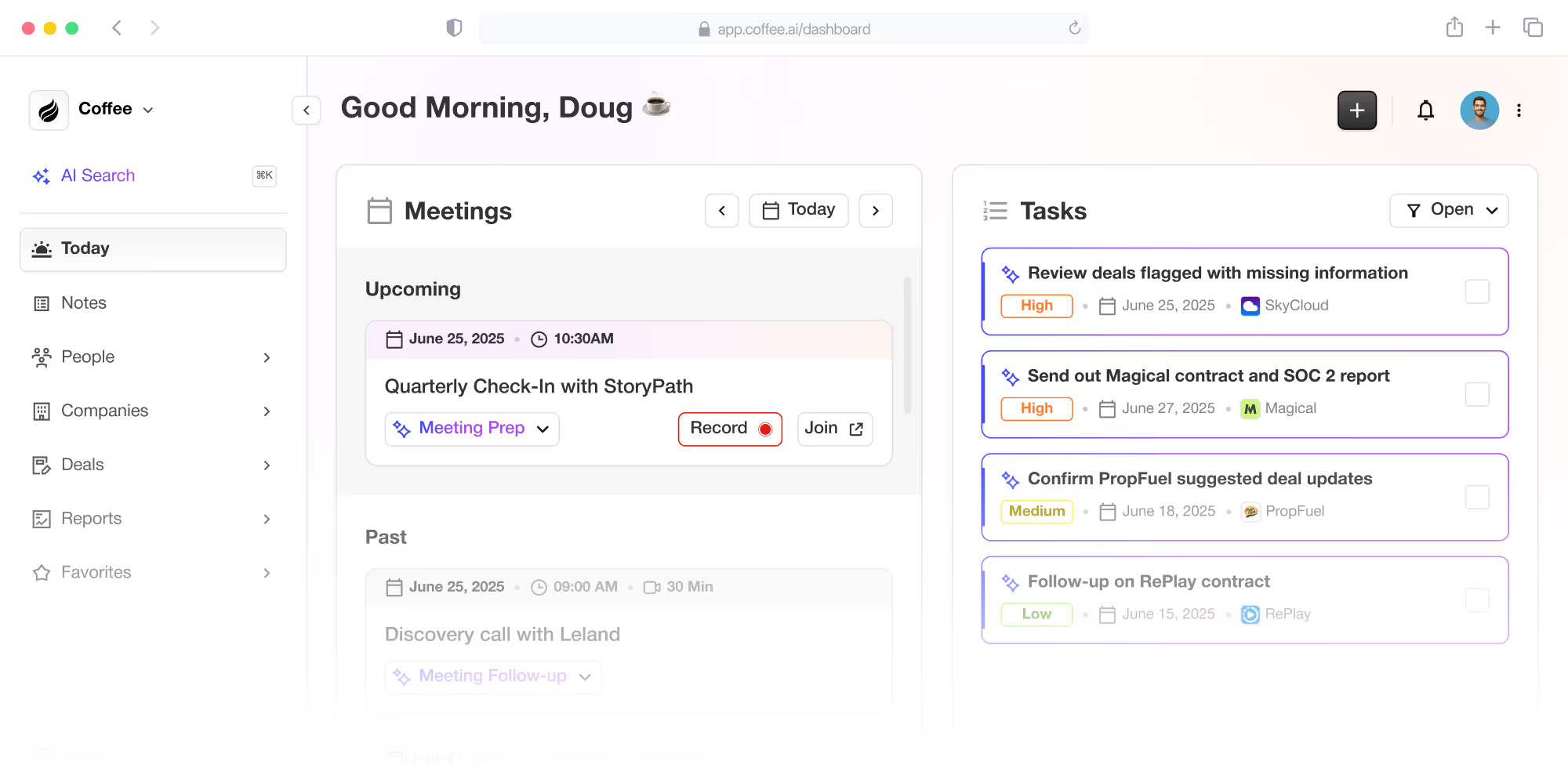
- Calendar Sync with Google and Outlook: It tracks activities and preps for meetings by offering a daily overview page with attendee details, company info, and past interaction summaries.
- Video Call Support for Zoom, Google Meet, and Microsoft Teams: An AI bot joins calls to record and transcribe discussions, then produces summaries, action items, and draft follow-ups editable directly in Gmail.
Curious about how integrated tools can transform your sales process? Explore Coffee’s AI-first platform to turn interactions into actionable insights. Request access to streamline your workflow now.
How Integration Boosts Productivity and Insights
The most noticeable advantage of combining communication tools with AI CRM is the reduction in administrative workload. With systems like Coffee automating email logging, meeting summaries, and contact updates, sales reps can focus on engaging clients and closing deals. Higher adoption rates follow, as reps view the CRM as a helpful tool rather than a chore, leading to better data quality for organizational insights.
Pipeline visibility also improves. Coffee’s features allow sales leaders to track deal progression week by week, identifying new opportunities or stalled deals through clear, data-driven views. Its historical data storage supports long-term pattern analysis, refining forecasting accuracy. This level of detail helps teams adjust strategies based on real customer interaction trends.
Can AI CRM Lower Costs by Simplifying Your Tech Stack?
Adopting an AI-first CRM like Coffee can consolidate multiple tools into one platform, reducing the need for separate licenses for CRM, call recording, data enrichment, and analytics. This unification cuts costs directly through fewer subscriptions and indirectly by simplifying training and onboarding for sales teams.
With fewer systems to manage, data consistency improves, and technical complexity decreases. Organizations can roll out new features within familiar workflows, ensuring faster adaptation without disrupting existing processes.
Steps to Adopt AI CRM in Your Sales Strategy
Choosing the right AI CRM model depends on your organization’s size and existing systems. Coffee offers two approaches to fit varied needs. For small teams of 1 to 20 employees moving from spreadsheets or basic CRMs, its standalone platform provides a modern, all-in-one solution. For small to mid-sized firms already using Salesforce or HubSpot, Coffee’s companion app integrates seamlessly, adding AI capabilities and automation while syncing data to the primary system.
Implementation success hinges on gaining team buy-in. Focus training on tangible outcomes, showing reps how automation frees up time for selling and how insights improve their performance. With a user-friendly design, Coffee aims to be a tool reps actively choose to use, easing the transition through a focus on productivity over paperwork.
Looking Ahead: The Shift to Integrated, Intelligent Sales Tools
Combining communication tools with AI CRM platforms marks a significant step forward for sales operations. Solutions like Coffee, as part of a wider movement toward automation and integration, help eliminate manual data entry, increase productivity, and provide clearer pipeline visibility. This approach benefits sales reps with streamlined workflows and offers leaders powerful analytics to drive decisions.
By aligning daily tools with intelligent systems, organizations can move beyond the limitations of fragmented tech stacks. Coffee serves as a strong example of how AI-first platforms can reshape sales, delivering value through efficiency and insight across all levels of the team.
Want to elevate your sales process? See how Coffee’s AI-first platform uses communication tool integration to improve efficiency and growth. Request access today to explore the future of sales technology.
“