
Key Takeaways
- Privacy regulators now focus on enforcing existing laws, with special attention on automated decision-making technology and inferred data from customer behavior.
- Clear definitions of data security, data privacy, conversational intelligence, inferred data, and automated decision-making help teams align on risk and responsibilities.
- AI agents that automate data capture, meeting management, and enrichment reduce manual input, improve accuracy, and simplify compliance in customer-facing workflows.
- Staying ahead of regulations such as California SB 243, CCPA rules for ADMT, and Maryland’s MODPA requires structured governance, cross-functional oversight, and recurring risk assessments.
- Coffee’s AI Agent helps sales organizations secure conversational data, maintain SOC 2 Type 2 and GDPR compliance, and automate CRM workflows while protecting customer privacy. Explore Coffee pricing and get started.
Understand the data security and privacy landscape for conversational intelligence
The conversational intelligence landscape continues to evolve as regulators scrutinize automated systems and data practices. Regulators are prioritizing enforcement of existing privacy laws and paying close attention to automated decision-making and data inferred from user behavior.
Clear terminology helps leaders frame decisions and delegate responsibilities:
- Data security covers the technical safeguards that protect information from unauthorized access, alteration, or loss.
- Data privacy governs how personal data is collected, used, shared, and retained across systems.
- Conversational intelligence refers to AI that analyzes emails, calls, and meetings to extract insights and drive workflows.
- Inferred data includes traits, intent, or risk levels derived from behavioral patterns and historical activity.
- Automated decision-making technology (ADMT) includes systems that influence or make decisions historically handled by humans.
The regulatory environment around these concepts is increasingly specific. California SB 243 created chatbot-focused rules that require AI disclosure and safety measures, especially where users could confuse bots with humans. At the same time, the effective date for California’s AI Transparency Act moved to August 2, 2026, giving organizations more time to adjust.
Traditional CRMs rely on manual data entry and struggle with unstructured data from calls, emails, and meetings. These systems often conflict with modern privacy expectations around data minimization and purpose limitation, which complicates compliance when conversational intelligence tools enter the stack.
Use Coffee’s agent to secure and streamline conversational data
Coffee’s AI Agent introduces an agent-led approach to CRM data, guided by the principle “Good data in, good data out.” Automation replaces much of the manual work that causes data quality issues, while built-in controls support data security and privacy.
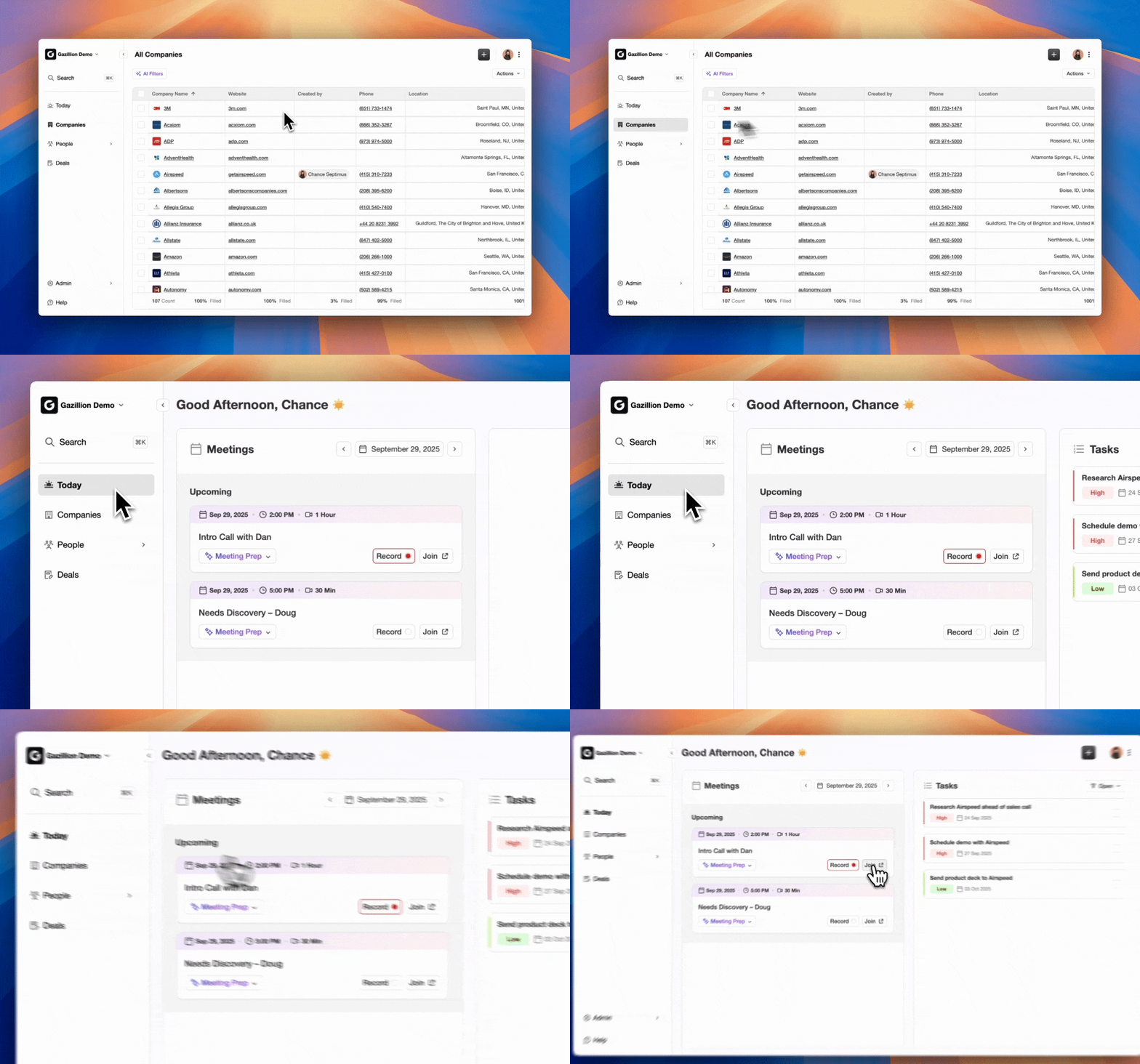
Key capabilities that support secure conversational intelligence include:
- Automated data entry and enrichment: The agent captures relevant information from emails and calendars and enriches records, which reduces manual input and improves accuracy while limiting excess data collection.
- AI-powered meeting management: Coffee’s bot can join calls, record and transcribe conversations, and generate summaries and follow-ups so that customer data is processed consistently and remains tied to the correct account or opportunity.
- Pipeline intelligence and data warehousing: Accurate capture of activity data feeds reporting, forecasting, and trend analysis, while a built-in warehouse maintains historical context in one controlled environment.
- Consolidated sales stack: Combining CRM, enrichment, call recording, and intelligence functions in Coffee reduces data fragmentation across tools and simplifies oversight of permissions, retention, and access.
- SOC 2 Type 2 and GDPR alignment: Coffee follows established security controls and privacy practices, and customer data is not used to train public AI models.

These capabilities help revenue teams capture the data needed for operations and analytics while maintaining clearer boundaries around what is collected, how long it is stored, and who can access it. Review Coffee pricing to see how the agent fits your team.
Prepare your organization for responsible conversational AI deployment
Business leaders must balance the benefits of conversational intelligence with compliance obligations and stakeholder trust. Build-versus-buy decisions often favor specialized platforms like Coffee, which package data protections, auditability, and operational workflows into a single system.
Maryland’s MODPA introduces a “reasonably necessary and proportionate” standard for personal data. That requirement aligns well with agent-based systems that capture only the information needed for defined sales and customer success processes.
Implementation readiness checklist
Successful deployment of conversational intelligence depends on preparation across governance, legal, and operations:
- Data governance frameworks: Define which conversational data is collected, how it is used, and how long it is retained. Include rules for handling sensitive information, deletion requests, and consent preferences.
- Legal and compliance oversight: Involve legal and privacy teams early so they understand the agent’s capabilities, applicable laws, and required safeguards such as access controls, audit logs, and human review for high-impact decisions.
- Cross-functional collaboration: Align sales, revenue operations, IT, and legal teams on where the agent operates, which systems it touches, and how data flows between tools to avoid gaps in compliance.
- Change management and training: Prepare front-line teams to explain AI usage to customers, honor opt-out requests, and follow internal guidelines on data entry, note-taking, and recording.

Stay ahead of evolving conversational AI regulations
The rules that govern conversational intelligence continue to shift, and sales organizations benefit from a structured view of how regulations affect their tools and workflows.
Key regulatory updates that affect conversational AI
California’s CCPA regulations for ADMT now require risk assessments and human oversight when organizations rely on automated systems in ways that materially influence individuals.
Rhode Island’s Data Transparency and Privacy Protection Act expanded state privacy obligations at the start of 2026, while California’s chatbot legislation set expectations for disclosures, protections for minors, and responsible use of conversational AI.
Privacy pitfalls that even mature teams face
Teams with established privacy programs still encounter common challenges when they introduce conversational intelligence:
- Mixing structured and unstructured data: Combining CRM fields with call transcripts, emails, and notes increases the risk that personal data appears in unexpected contexts or systems without clear governance.
- Insufficient anonymization: Treating conversational logs as low-risk data can result in transcripts and summaries that still expose identifiable details when shared for training, quality review, or analytics.
- Static privacy assessments: One-time evaluations of AI tools often fall behind regulatory updates or product changes, which can leave decision logic, data uses, or retention policies out of date.
Comparison table: legacy CRM vs Coffee Agent for privacy and security
|
Feature |
Legacy CRM |
Coffee Agent |
|
Data input |
Manual entry that varies by user and often contains gaps or errors |
Automated capture from emails, calendars, and meetings for more consistent records |
|
Data handling |
Ad hoc rules and manual oversight that can drift over time |
Agent-driven processing aligned with defined policies and workflows |
|
Data storage |
Information is scattered across CRM, call tools, spreadsheets, and note apps |
A unified data warehouse that centralizes conversational and CRM activity |
|
Compliance management |
Case-by-case reviews and manual reporting that are hard to scale |
Automation and central logging that simplify audits, reporting, and access control |
This comparison highlights how an AI agent can reduce human error, centralize records, and make it easier to apply consistent privacy and security measures across customer interactions. View Coffee pricing to evaluate fit for your data protection strategy.
Next steps: strengthen conversational data security with Coffee
Leaders who rely on conversational intelligence need tools that protect customer data, align with emerging regulations, and still deliver reliable insights for revenue teams. Coffee’s Agent helps organizations automate CRM workflows, secure conversational records, and maintain clear controls over how data is collected and used.
With support for SOC 2 Type 2 and GDPR-aligned practices, Coffee offers a practical path to responsible AI deployment in sales and customer-facing operations. Get started with Coffee to modernize your CRM and protect your data.
Frequently asked questions about conversational intelligence security
How does Coffee’s Agent support compliance with regulations like the CCPA’s ADMT requirements?
Coffee’s Agent automates data processing while operating within a framework that supports SOC 2 Type 2 and GDPR compliance. Users retain control over key decisions, and clear controls around access, logging, and configuration help organizations demonstrate accountability for automated processing.
Is conversational data used to train public AI models?
No. Coffee does not use customer data to train public models. Your conversational data stays within your environment and is used only to deliver services to your organization.
How does Coffee handle stricter data collection standards, such as Maryland’s MODPA?
Coffee’s Agent focuses on capturing sales and customer success data that is directly relevant to defined workflows. That focus helps organizations align with standards that require personal data to remain reasonably necessary and proportionate for the stated purpose.
How does Coffee address international privacy requirements?
Coffee supports GDPR-aligned practices across data access, retention, and subject rights. These controls help international teams apply consistent protections as they operate in multiple regulatory environments.