
In the fast-moving world of sales, customer relationship management (CRM) tools have become essential for staying competitive. Over the past decade, the market has shifted from static, manual systems to dynamic platforms that aim to automate processes and provide actionable insights. With businesses increasingly relying on data to drive decisions, the demand for CRMs that integrate artificial intelligence (AI) has surged, promising to ease the burden of repetitive tasks and fragmented information. However, not all solutions deliver on these promises equally, as legacy platforms often struggle to adapt to modern needs, while newer AI-first tools aim to redefine efficiency. This article explores the evolving CRM landscape by comparing HubSpot, a well-established player, with Coffee, an AI-first solution, focusing on how each supports sales teams through data integration and automation.
Choosing the right CRM can significantly impact your sales operations. As we dive into the specifics, you’ll see how these tools address common pain points like manual data entry and poor workflow efficiency. If you’re looking to streamline your processes, request access to explore AI-first CRM solutions tailored for sales success.
How CRMs Have Changed to Support Sales Teams
What Makes a Modern CRM Valuable for Sales?
Modern CRMs go beyond storing customer data; they focus on saving time and delivering insights that help sales reps build stronger relationships. By automating repetitive tasks and pulling together scattered information, these tools aim to let sales teams prioritize selling over paperwork.
AI plays a key role here, handling tasks like logging interactions and suggesting next steps. A valuable CRM today focuses on cutting down manual work, connecting data from various sources, and offering real-time guidance to improve deal outcomes.
Why Older CRMs Often Fall Short
Older CRMs, built on outdated frameworks, frequently fail to meet the demands of current sales environments. Their structures weren’t designed for the level of automation and integration needed today, creating bottlenecks for sales teams.
One major issue is scattered data. When customer details are spread across different tools, sales reps must piece together information manually, wasting time and risking errors. This often leads to incomplete records and missed opportunities. Many reps turn to makeshift solutions like spreadsheets, showing a gap in the CRM’s ability to centralize data.
Heavy reliance on manual input also lowers data accuracy and discourages consistent use. This creates a cycle of inefficiency that hampers sales performance and team morale.
Key Factors to Assess CRM Support for Sales Teams
How Automation Boosts Workflow Efficiency
A strong CRM for sales teams uses AI to take over mundane tasks, freeing reps to focus on closing deals. Automation can manage data entry, prepare meeting notes, and handle follow-up emails, reducing administrative workload.
Effective systems go further by spotting key action items and drafting messages based on customer interactions. This ensures sales reps spend more time engaging with clients and less on routine updates.
Why Unified Data and Instant Insights Matter
Having all customer data in one place is critical for informed sales decisions. A unified system lets reps see the full history of interactions without jumping between apps, saving time and reducing frustration.
Real-time updates from this data help teams monitor pipeline progress, spot emerging patterns, and focus on the most promising leads. This immediate feedback can be the difference between a lost opportunity and a closed deal.
Does User Experience Drive Adoption?
A CRM is only effective if sales reps actually use it. Intuitive design and minimal friction are essential to make the tool feel like a helper, not a burden. When reps find a system easy to navigate, they’re more likely to keep data updated.
High adoption rates lead to better data quality, which benefits forecasting and strategy. A user-friendly CRM supports the entire sales cycle by ensuring consistent engagement from the team.
HubSpot’s Strategy for Sales Support with AI
What HubSpot Brings to Sales Teams
HubSpot builds on its established CRM base by adding AI features to improve sales efficiency. Its platform connects with a range of tools, giving reps access to customer histories for smoother collaboration across teams.
Automation in HubSpot targets everyday tasks, aiming to lighten the load on sales reps. While it offers solid functionality, the extent of AI-driven support can depend on specific user needs and workflows.
Where HubSpot Faces Challenges
HubSpot’s AI integration doesn’t always meet the needs of users looking for extensive automation. In complex sales scenarios, the system may not provide the depth of AI support some organizations expect.
Manual data entry remains a hurdle in certain areas, affecting data consistency and the reliability of AI outputs. For teams dealing with varied or unstructured data, additional specialized tools might be necessary to fill gaps in functionality.
Coffee’s AI-First Design for Sales Team Support
How Coffee Ensures High-Quality Data
Coffee starts with AI at its foundation, addressing data issues by automatically pulling in and organizing information from emails, calendars, and call transcripts. This creates an up-to-date view of customer interactions without manual effort.
By removing the need for manual updates, Coffee saves sales reps an estimated 8 to 12 hours per week, as interactions like meetings and calls are logged directly into the system. This improves data accuracy for better decision-making, as time spent on administrative tasks drops significantly.
The platform also enriches customer profiles with external details like job roles and company size, giving reps deeper context without relying on separate tools for research.
How Coffee Automates Sales Workflows
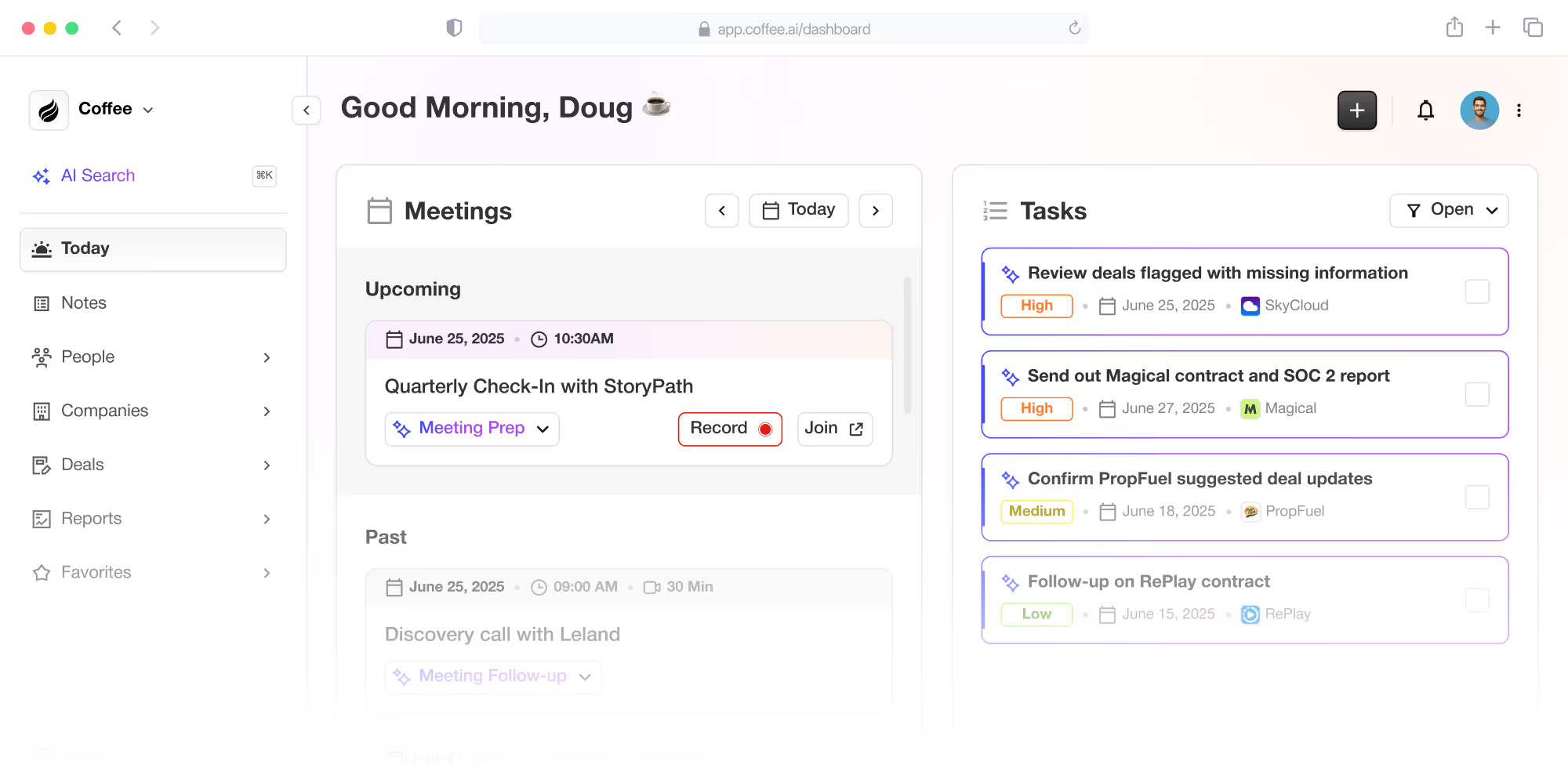
Coffee streamlines meeting preparation and follow-up with AI. Before a call, reps get briefings with attendee backgrounds and past interaction summaries, delivered through a dedicated page or notifications on platforms like Slack.
After meetings, an AI tool records and transcribes sessions on common platforms, creating summaries and pinpointing next steps. It can even format these summaries to align with sales frameworks like BANT or MEDDIC for consistent evaluation.
Pipeline tracking is enhanced with a feature showing week-to-week changes, helping reps and managers identify deals that are advancing or stalling. This eliminates the need for manual reporting or expensive add-ons, making reviews more data-driven and actionable.
Flexible Options: Standalone or Companion Use
Coffee offers two ways to fit into a business setup. As a standalone CRM, it suits smaller companies looking for a modern, automated system without complexity. As a companion app, it works alongside existing tools like Salesforce or HubSpot, adding AI capabilities without requiring a full overhaul.
Integration is straightforward with the companion app, syncing data through simple setup. Teams can choose which AI-generated insights to add to their main CRM, balancing innovation with current investments.
Comparing HubSpot and Coffee for Sales Support
What Sets HubSpot and Coffee Apart?
| Feature Area | HubSpot’s Method | Coffee’s AI-First Method | Effect on Sales Teams |
|---|---|---|---|
| Data Handling | Some workflows need manual input; connects multiple sources | Automatically collects and organizes all data types | Coffee gives a fuller picture for decision-making |
| Task Automation | Handles basic repetitive tasks | Cuts 8-12 hours of manual work weekly; automates meeting tasks | Coffee frees up more time for client focus |
| Pipeline Tracking | Basic history views without extras | Week-to-week change insights with ‘Pipeline Compare’ | Coffee sharpens pipeline management |
| Core Design | Traditional CRM with added AI | Built with AI as the foundation | Coffee integrates AI more deeply |
These contrasts show different impacts on sales efficiency. Coffee’s focus on AI from the ground up offers stronger automation and data handling compared to systems that layer AI onto older frameworks.
Evaluating Cost and Efficiency Gains
Coffee simplifies operations by automating tasks that often require manual effort in traditional systems. Its ability to pull in and enhance data reduces the need for complex setups, while its clear design speeds up onboarding and encourages team use, lowering overall operational costs.
Practical Use Cases: Picking the Best AI CRM for Your Sales Needs
Boosting Productivity for Sales Reps
If your sales team spends too much time on paperwork or meeting prep, Coffee’s automated workflows can make an immediate difference. Its AI handles data logging and follow-ups, letting reps focus on building client relationships.
For small businesses with up to 20 staff moving away from basic tools, Coffee’s standalone option provides advanced automation with straightforward pricing and ease of use.
Enhancing an Existing HubSpot Setup with AI
Companies already using HubSpot but facing inconsistent data or low rep engagement can add Coffee’s companion app. This overlays AI features to improve automation and user interaction without disrupting current systems.
Adopting a Fully AI-Driven CRM for Growth
Startups or businesses replacing outdated CRMs can benefit from Coffee’s standalone platform. Its AI-focused design sets up strong data practices and efficiency from the start, fitting well for small to medium-sized teams.
Interested in seeing how AI can improve your sales support? Request access to learn more about Coffee’s tailored approach.
Common Questions About AI CRMs for Sales Support
How Does Coffee’s AI Help Sales Teams Specifically?
Coffee automates data entry, summarizes meetings, drafts follow-up messages, and tracks pipeline shifts with tools like ‘Pipeline Compare.’ This cuts down on administrative work, allowing reps to prioritize client engagement.
Can Coffee Work with My Current HubSpot System?
Yes, Coffee’s companion app integrates with HubSpot or Salesforce, adding AI and automation features. Data syncs easily, and teams can decide which insights to transfer back to their main CRM for consistency.
What Makes Coffee’s Data Quality Different?
Coffee pulls data directly from emails, calendars, and call records, unlike traditional CRMs that depend on manual updates. This ensures reps have accurate, complete information for every customer interaction.
Final Thoughts: Finding the Right CRM for Sales in the AI Age
Comparing HubSpot and Coffee reveals different approaches to supporting sales teams. HubSpot provides a reliable foundation with added AI features, though the depth of automation can vary depending on specific needs.
Coffee stands out as part of a broader trend toward AI-first CRMs, directly tackling common issues with automatic data integration and robust automation. Its flexibility as either a standalone system or a companion to tools like HubSpot makes it adaptable for various business sizes and stages.
For teams focused on maximizing productivity and data reliability, Coffee offers clear benefits. If you’re ready to equip your sales team with effective AI support, request access to Coffee now and see the impact on your operations.