
Sales teams in the U.S. face a persistent challenge: too much time spent on administrative work instead of selling. The modern sales landscape demands that representatives not only drive revenue but also manage a growing list of non-selling activities like data entry, CRM updates, and internal coordination. These tasks, while necessary, often consume hours that could be spent engaging with customers. This imbalance reflects a broader issue in the sales industry, where tools meant to support efficiency can sometimes create additional burdens.
The consequences are clear. Lengthened sales cycles, missed opportunities, and frustrated reps are common outcomes of this inefficiency. As traditional CRM systems struggle to keep pace with the demands of today’s sales environment, a shift is underway. AI-powered solutions are emerging to address these pain points by automating repetitive tasks and prioritizing selling time. This article dives into seven key non-selling activities that drain productivity and highlights how tools like Coffee, an AI-first CRM, fit into this evolving trend to help sales teams work smarter.
Why Non-Selling Activities Are a Growing Problem for Sales Teams
Sales reps often spend a large part of their day on tasks unrelated to closing deals. Research indicates that many dedicate over half their work hours to administrative duties, with manual data entry topping the list as a major time sink. This not only limits customer-facing time but also impacts overall performance.
The costs go beyond lost time. When reps focus on non-selling tasks, deals take longer to close, and revenue potential shrinks. Frustration and burnout can set in as well, especially when salespeople feel disconnected from their core role of building relationships. Add to this the challenge of juggling multiple tools and manual research, and it’s easy to see why productivity suffers. AI-driven CRM platforms, such as Coffee, offer a way forward by automating these burdens and refocusing energy on sales.
Understanding Coffee: An AI-Driven CRM Built for Sales Efficiency
Coffee stands out in the CRM market by prioritizing automation to tackle the inefficiencies of traditional systems. Designed with sales reps in mind, this AI-first platform minimizes time spent on repetitive tasks through smart data handling and integrations. It aims to let salespeople focus on what they do best: connecting with customers and driving revenue.
Coffee offers two flexible options. For smaller businesses, it serves as a standalone CRM with all the necessary tools in one place. For larger organizations with existing systems like Salesforce or HubSpot, it acts as a companion app, enhancing workflows without requiring a full overhaul. Key features include automated data entry, meeting management powered by AI, pipeline tracking with actionable insights, and a unified tech stack to reduce tool-switching.
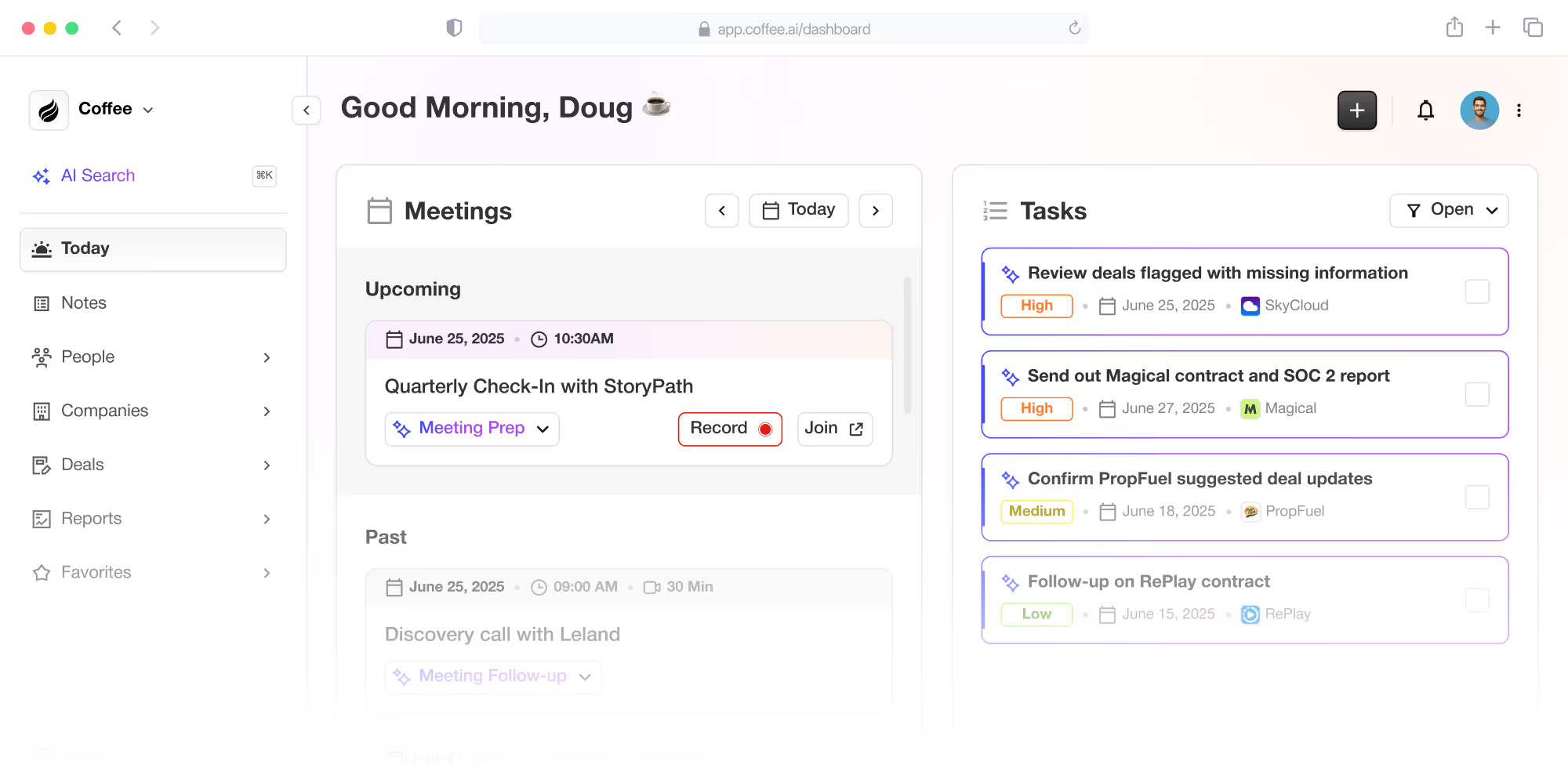
Want to see how Coffee can streamline your sales process? Request access now and explore the benefits of AI-driven efficiency.
7 Non-Selling Tasks That Slow Sales Teams Down (and How AI CRM Helps)
1. Manual Data Entry: A Persistent Time Drain
Data entry remains a significant hurdle for sales reps, who spend hours updating CRM fields and logging notes. This manual effort often leads to errors or incomplete records, prompting some to track data elsewhere, like in spreadsheets.
Coffee addresses this with automatic data capture. By syncing with email and calendar tools such as Google Workspace or Microsoft 365, it creates and updates contacts and company records without user input. It also enriches data using licensed sources, saving reps an estimated 8 to 12 hours weekly on these tasks.
2. Meeting Preparation and Follow-Up: Streamlining the Process
Getting ready for sales meetings and handling follow-ups eats into valuable time. Reps often research attendees manually and draft emails or summaries afterward, which can lead to inconsistent outcomes.
With Coffee, AI takes over meeting workflows. A dedicated page offers pre-meeting briefings on attendees and past interactions. During calls, an AI bot transcribes conversations on supported platforms. Afterward, it generates summaries and follow-up drafts aligned with methodologies like BANT or MEDDIC, keeping qualification consistent.
3. Prospecting and Research: Simplifying Information Gathering
Finding and researching prospects across platforms like LinkedIn or company sites is time-intensive. Switching between tools disrupts focus and slows down the process.
Coffee cuts through this with built-in data enrichment and a list-building feature. It pulls details from licensed partners to enhance contact records and lets users create targeted prospect lists using natural language inputs, such as querying for specific roles in defined industries. This reduces research time significantly.
4. Pipeline Reviews: Turning Data Prep Into Quick Insights
Internal pipeline reviews often require reps to compile data manually, export it to spreadsheets, and analyze changes. This preparation pulls hours away from selling.
Coffee simplifies reviews with a feature that tracks historical pipeline data. A single click reveals week-over-week changes, spotlighting progressed or stalled deals. This turns reviews into focused strategy sessions without the grunt work.
5. Managing Multiple Tools: Reducing Tech Overload
Sales teams frequently use several tools, leading to fragmented data and lost time switching between systems. This setup creates inefficiencies and inconsistent information.
Coffee consolidates essential functions into one platform, combining CRM, data enrichment, call recording, and forecasting. This unified approach minimizes context switching and keeps data consistent, allowing reps to stay focused on sales tasks.
6. Internal Approvals and Communication: Cutting Through Delays
Waiting for approvals or chasing updates across multiple channels slows down sales cycles. Reps often spend time coordinating with other teams for decisions.
While Coffee doesn’t handle approvals directly, it reduces related friction. By centralizing deal information, activity logs, and meeting summaries, it gives stakeholders quick access to current data, speeding up internal processes and reducing unnecessary back-and-forth.
7. Unofficial Tracking Systems: Ending the Need for Workarounds
Frustration with complex CRMs leads many reps to create personal tracking systems in separate tools. This fragments data and hurts organizational visibility.
Coffee counters this by offering an intuitive interface and automating data input from emails and meetings. When reps find value in the platform, they’re more likely to use it consistently, improving data accuracy and adoption across teams.
How Coffee Stacks Up Against Traditional CRMs for Non-Selling Tasks
AI-powered CRMs like Coffee differ sharply from older systems in how they handle time-consuming tasks. Here’s a direct comparison of common activities, showing the practical advantages of an AI-first approach.
| Task | Traditional CRMs/Manual Methods | Coffee AI CRM Benefit | Estimated Time Saved |
|---|---|---|---|
| Data Entry and Updates | Manual input, frequent errors, separate tracking common | Auto-creates records, enriches data, logs activities from email/calendar | 8-12 hours per week |
| Meeting Prep and Follow-Up | Manual research, note-taking, email drafting | AI briefings, transcriptions, automated summaries and drafts | Notable per meeting |
| Prospecting and Research | Manual searches across tools, frequent context switching | Integrated enrichment, natural language list-building | Substantial research reduction |
| Pipeline Reviews | Manual data export, tedious change tracking | One-click comparison of pipeline shifts | Hours per review |
This comparison shows how Coffee’s focus on automation tackles inefficiencies head-on, offering measurable time savings and better data handling compared to legacy systems.
Ready to cut down on non-selling tasks? Request access to Coffee and see how AI can help your team focus on selling.
Common Questions About AI CRM and Sales Productivity
How Much Time Can Sales Reps Save With AI CRM?
Teams using Coffee often save 8 to 12 hours per week by automating routine tasks. This extra time lets reps prioritize customer engagement and strategic selling, which can lead to better results overall.
Is AI CRM Costly or Hard to Set Up?
Coffee uses a clear, seat-based pricing structure that avoids unexpected costs. Setup is designed to be simple, whether opting for the standalone CRM or the companion app for existing systems. Integration typically involves basic authentication with email or calendar tools, requiring little IT support.
How Does Coffee Ensure Accurate Data in Automation?
Data quality is a priority for Coffee. It pulls information from reliable sources like emails and calendars, enhances records with licensed data partners, and uses validation steps to keep information accurate over time.
Can AI CRM Improve the Quality of Sales Meetings?
Coffee supports better meetings through AI features. Pre-meeting briefings provide context on attendees, transcriptions capture details during discussions, and automated summaries with follow-up drafts ensure consistency, often aligning with frameworks like BANT or MEDDIC.
What Happens to Existing CRM Data When Switching to Coffee?
For users with current CRM setups, Coffee’s companion app syncs and enriches data, with the option to update the primary system. Standalone users can migrate historical data to Coffee, maintaining continuity while benefiting from improved organization.
Final Thoughts: Focus on Selling With AI-Powered CRM
Non-selling tasks like data entry and tool management weigh heavily on sales teams, cutting into time for revenue-focused work. As part of a broader shift toward AI in sales tech, Coffee automates these routine activities, provides actionable insights, and streamlines workflows into a single platform. This allows reps to spend more energy on customer relationships.
Organizations using Coffee report saving 8 to 12 hours per rep weekly, alongside improved data accuracy and more effective meetings. Its user-friendly design encourages consistent use, benefiting both individual reps and broader team visibility. AI is reshaping how sales teams operate, and Coffee exemplifies this trend.
Looking to prioritize selling over administrative work? Request access to Coffee today and find out how AI CRM can support your team’s goals.