
Last updated: March 30, 2026
Key Takeaways for Busy Sales Leaders
- Sales reps spend about 71% of their time on manual tasks, and leading Salesforce add-ons reclaim a significant portion of that week through AI automation.
- Coffee leads the AI agent category with autonomous data capture from Gmail and Google Workspace, which removes the need for manual CRM entry.
- Outreach excels at sales engagement cadences, Gong at conversation intelligence, and ZoomInfo at data enrichment for B2B teams.
- Coffee outperforms point solutions by unifying automation across data capture, meetings, and pipeline insights in a single agent-driven platform.
- Transform your Salesforce workflows today, and explore Coffee’s pricing options for immediate productivity gains.
Quick-Rank: Top 4 Automation Add-Ons by Category
The following table compares the leading automation tools across four core categories, so you can quickly see where Coffee stands out in AI agents.
| Category | Top Pick | Key Win | Pricing Tier |
|---|---|---|---|
| AI Agents | Coffee | Large weekly auto-data time save | Seat-based |
| Engagement | Outreach | Multi-channel cadences | $100+/user/mo |
| Data Enrichment | ZoomInfo | B2B intent signals | $10k+/yr |
| Conversation Intel | Gong | Call analysis | $100+/user/mo |
AI Agents That Automate Salesforce at Scale
Coffee serves as a dedicated AI agent for Salesforce automation and removes manual data entry through deep workspace integration. The agent automatically creates and enriches contacts from Gmail and calendar interactions, which frees teams from repetitive administrative work. This autonomous operation replaces the constant human oversight that traditional tools demand and keeps Salesforce data consistently accurate. With reliable data in place, leaders gain trustworthy forecasts and clear pipeline insights for better decisions.

Salesforce Agentforce delivers native AI capabilities but introduces significant complexity and higher costs. Agentforce pricing starts at $125 per user per month for unmetered usage or Flex Credits consumption, which can create unpredictable bills. Teams often need advanced technical expertise to implement and manage it, and the product still lacks the seamless workspace integration that Coffee provides out of the box.
Troops focuses on Slack-based notifications, CRM updates, and cross-platform automation that syncs with tools like Zoom and email. These capabilities help with alerts and simple workflows, yet complex automation often requires extra configuration and manual tuning. Coffee’s autonomous agent handles those higher-order workflows without that ongoing setup burden.
Top Sales Engagement Add-Ons for Multi-Touch Outreach
Sales teams also need tools that coordinate multi-touch outreach across email, calls, and social channels, which is where engagement platforms shine.
Outreach dominates multi-channel sales engagement with sophisticated cadence automation that typically starts around $100 per user monthly. The platform excels at email sequences and call scheduling and connects well with Salesforce for activity tracking. Some teams still add separate data tools to complete their stack, while Coffee reduces that need through its unified automation and enrichment.
Salesloft offers similar engagement capabilities with strong email tracking and social selling features, along with smooth CRM integration. Revenue teams value its communication workflows, yet many still look for additional tools to cover advanced automation gaps. Coffee’s agent fills those gaps by handling CRM updates, enrichment, and pipeline intelligence in one system.
Data Enrichment and Workflow Automation Tools
Modern sales operations also depend on accurate data and reliable workflows, which has created a large market for enrichment and integration tools.
ZoomInfo leads B2B data enrichment with extensive company and contact databases, and mid-market teams often pay $10,000 or more annually. The platform delivers broad coverage and intent signals, yet teams must still manage manual integration work and separate workflow automation. Coffee includes enrichment capabilities directly in its agent, which means data capture and follow-up workflows run automatically from prospecting through deal closure.

Apollo provides more affordable data enrichment that starts around $50 per user monthly and combines prospecting data with basic email sequences. This approach works for lightweight outreach, but Apollo lacks the advanced AI agent features needed for autonomous CRM management. Sales teams often end up moving insights between systems by hand, while Coffee keeps that information synchronized without extra effort.
Zapier connects Salesforce with other tools through workflow automation, with paid plans starting at $19.99 per month because premium apps like Salesforce require a move beyond the free tier. However, Zapier users face high maintenance burdens from brittle, rule-based “Zaps” that break when processes or APIs change. These failures demand frequent troubleshooting, and Coffee’s adaptive agent removes much of that ongoing maintenance work.
Conversation Intelligence Platforms for Sales Calls
Once data and workflows are in place, conversation intelligence tools help teams learn from calls and meetings and then feed those insights back into Salesforce.
Gong offers industry-leading conversation analysis with automatic call recording and AI-powered insights, and pricing often starts at $100 or more per user monthly. Gong identifies talk patterns, coaching moments, and deal risks, yet it usually operates as a standalone system. Teams then move insights into Salesforce manually, while Coffee’s integrated approach captures similar conversational context and updates CRM records automatically with next steps.

Fathom delivers affordable call recording, transcription, AI summaries, and CRM integrations such as Salesforce on its paid plans. It works well for meeting documentation and analysis, although teams may still need other tools to achieve full sales automation. Coffee covers that broader workflow through its meeting orchestration and pipeline features.
Pipeline and Scheduling Tools for Revenue Teams
Scheduling and pipeline visibility round out the sales stack, and several tools focus on these operational gaps.
Chili Piper streamlines meeting scheduling and lead routing with real-time calendar integration, and routing features typically start around $30 per user monthly. The product works well for inbound lead management, yet teams still rely on separate tools for pipeline analysis and forecast accuracy. Coffee addresses those needs with its Pipeline Compare feature, which connects scheduling activity directly to pipeline health.

Revenue Grid synchronizes email, calendar, and activities with Salesforce and adds pipeline intelligence features, starting at about $30 per user monthly. The platform improves activity tracking and visibility, but it may not match the full scope of automated enrichment and agent-driven insights that Coffee delivers as a single, integrated solution.
Side-by-Side Comparison Matrix for Core Tools
This matrix compares Coffee with leading competitors across four dimensions that shape real-world sales productivity, from automation depth to how each product fits into Salesforce.
| Feature | Coffee | Outreach | Gong | ZoomInfo |
|---|---|---|---|---|
| Automation Depth | Full AI agent handling data and workflows | Engagement cadences only | Call transcripts and insights | Data enrichment only |
| Data Quality | Built-in warehouse and enrichment | Relies on manual updates | Partial CRM sync | External database |
| Time Savings | Large weekly reduction in admin work | Moderate outreach time savings | Coaching and review time savings | Research time savings |
| Salesforce Fit | Companion agent tightly integrated | Add-on engagement layer | Add-on analytics layer | External data source |
Coffee stands out across these dimensions by using an agent-driven model that removes manual data entry and improves data quality through its warehouse architecture. Traditional tools often require several point solutions and ongoing maintenance, while Coffee consolidates three to five tools into one autonomous agent.
How to Choose and Implement the Right Automation Add-On
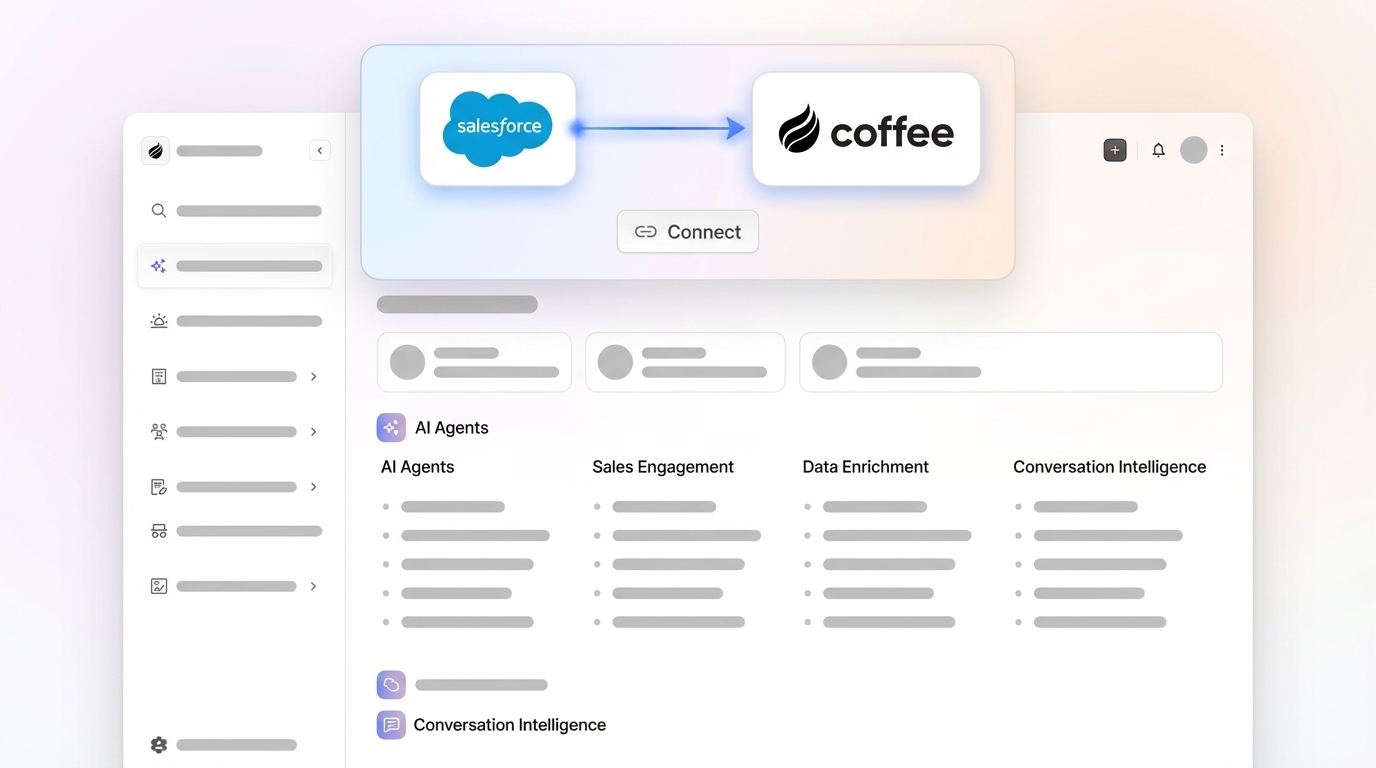
Small to mid-market businesses gain the most from Coffee’s Companion approach, which delivers broad automation without heavy complexity. Teams typically connect Salesforce and Google Workspace through a simple authentication flow, then allow the agent to start data synchronization and pipeline intelligence. Begin your Coffee implementation to experience immediate productivity gains from intelligent automation.

Teams should avoid fragmented solutions that rely on many separate integrations and constant maintenance, because each extra tool increases technical overhead and failure risk. Coffee’s agent handles data unification, meeting orchestration, and pipeline analysis inside one platform, which directly reduces integration complexity and long-term costs.
FAQ
What is the best free Salesforce automation option?
Zapier offers a free tier for basic automation, yet it demands significant maintenance and lacks the intelligence required for full sales automation. Coffee provides a free trial that showcases its advanced automation, making it more cost-effective once you factor in time savings and a simpler tool stack.
How do AI agents compare to traditional automation tools?
AI agents such as Coffee run autonomously and handle complex, multi-step workflows that rule-based tools often cannot manage. Traditional automation needs frequent human oversight and tends to break when processes change, while Coffee adapts to new situations and keeps data quality high without manual intervention.
What is the difference between Coffee and Gong for Salesforce users?
Coffee delivers broad sales automation that includes conversation intelligence, data entry, and pipeline management through a single agent. Gong focuses on call analysis and still requires separate tools for CRM automation, enrichment, and workflow management. Coffee therefore offers wider functionality with a lower total cost of ownership.
How has Salesforce automation pricing changed in 2026?
Traditional per-user pricing has grown more expensive, and tools like Agentforce now charge about $125 per user monthly for unmetered usage or Flex Credits models. Coffee uses seat-based pricing that provides unlimited agent labor without metering, which keeps costs predictable for growing sales teams.
Which automation add-on delivers the quickest ROI?
Coffee delivers rapid return on investment by immediately removing the manual work burden described earlier. Unlike tools that need long setup projects and complex integrations, Coffee’s agent starts automating data entry and pipeline management within days, so teams see measurable gains from the first week.
Conclusion
Coffee leads the 2026 Salesforce automation landscape by addressing the core challenge covered in this guide, which is ensuring high-quality data flows into Salesforce without human intervention. Traditional tools rely on complex integrations and constant maintenance, while Coffee’s agent operates autonomously so accurate data and insights remain available for strategic decisions.
The era of fragmented sales tools and manual CRM upkeep is fading, and teams that adopt agent-powered automation through Coffee gain clear advantages in productivity, data quality, and forecast accuracy. Start reclaiming those 8-12 hours weekly by transforming your sales operations with Coffee.