
Last updated: March 30, 2026
Key Takeaways
- Manual CRM data entry keeps sales reps away from selling, and only 35% of teams fully trust their forecast data.
- Pipeline intelligence tools can reach up to 95% forecast accuracy by automating data capture and enrichment from real-time signals.
- Coffee ranks #1 for SMB and mid-market teams with agent automation that prevents bad data and includes Pipeline Compare and AI search.
- Clari excels at enterprise scale and Gong at conversation intelligence, but both lack Coffee’s automation depth for smaller teams.
- Ready to improve CRM forecasting? Try Coffee’s agent-powered automation and see the impact on your pipeline.

Why Data Quality Kills Forecasts and How We Evaluated Tools
Pipeline intelligence platforms pull real-time signals such as deal stages, risk indicators, and activity data to power forecasting models. Poor CRM hygiene undermines those models, and 76% of organizations report that less than half of CRM entries are complete and accurate. Bad inputs create unreliable forecasts and erode trust in the numbers.
Our evaluation criteria focused on four critical dimensions that directly address this data quality problem.
- Data Automation: Ability to ensure “good data in” through agent-driven capture and enrichment
- Forecast Accuracy: Demonstrated bias under 5% and visibility above 95%
- CRM Integration: Native compatibility with Salesforce and HubSpot
- SMB/Mid-Market Fit: Pricing and user experience designed for 1–500 employee teams
These criteria highlight the main divide between tools. Some platforms mainly analyze existing, often messy data, while others prevent bad data through automation. According to Clari Labs research, effective forecast measurement combines quarterly attainment rates with pipeline slippage metrics. With these criteria in place, you can clearly see how each tool supports accurate forecasting while tackling the data quality challenge.
The 10 Best Pipeline Intelligence Tools for CRM Forecasting Accuracy in 2026
1. Coffee
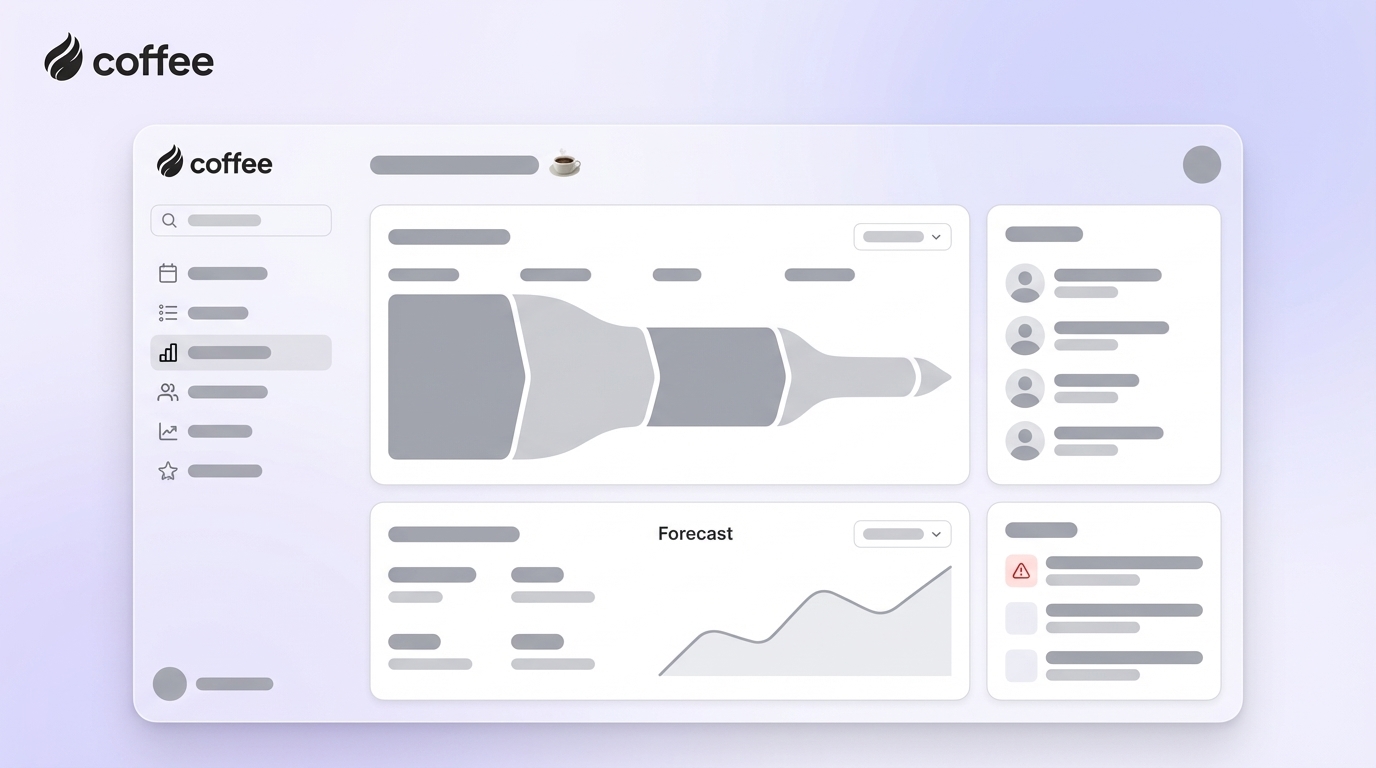
Coffee serves as a CRM agent for SMB and mid-market teams that want to remove manual data entry. The platform acts as an autonomous assistant that handles the work of putting good data into your system.
Key Features:
- Pipeline Compare for clear week-over-week change visualization
- Automatic contact and company enrichment from email and calendar data
- AI meeting bot for recording and transcription
- AI search on deals that answers natural-language questions like “Which deals are stuck in negotiation?”
Accuracy and Integration: Coffee delivers accurate pipeline insights through an agent-managed data warehouse. It can run as a standalone CRM or as a companion app for Salesforce and HubSpot with simple seat-based pricing.
Pros: Removes manual CRM work and gives reps an automated workflow
Cons: Some integrations remain early in the product roadmap
Best For: Teams ready to stop maintaining CRM records by hand

2. Clari
Clari leads the enterprise revenue intelligence category with broad forecasting and pipeline management for large organizations.
Key Features:
- AI-powered deal inspection and risk alerts
- Revenue process automation
- Advanced pipeline analytics
Accuracy and Integration: Clari reports up to 96% forecast accuracy with unified, governed revenue data. It offers deep Salesforce integration with enterprise-level pricing.
Pros: Proven at enterprise scale with a broad feature set
Cons: High cost and complex implementation
Best For: Large enterprises with dedicated RevOps teams
3. Gong
Gong focuses on conversation intelligence, analyzing sales calls and meetings to surface deal health and forecasting signals.
Key Features:
- Conversation AI for deal health scoring
- Competitive intelligence from call analysis
- Pipeline risk identification through sentiment analysis
Accuracy and Integration: Gong reaches 82–87% forecast accuracy using conversation data. It integrates with Salesforce and HubSpot.
Pros: Deep conversation insights and strong call analytics
Cons: Works best with high call volume and offers limited data automation
Best For: Teams that rely heavily on phone-based selling
4. ZoomInfo
ZoomInfo blends data enrichment with revenue intelligence, with a strong focus on intent data and pipeline prioritization.
Key Features:
- Intent data for pipeline prioritization
- Contact and company enrichment
- Buyer behavior tracking
Accuracy and Integration: ZoomInfo delivers strong data quality through its proprietary database. It offers native Salesforce integration with usage-based pricing.
Pros: Broad data coverage and strong intent signals
Cons: Higher cost and limited automation beyond enrichment
Best For: Teams that prioritize enrichment and intent signals
5. Chorus.ai
Chorus.ai, now part of ZoomInfo, offers conversation intelligence and deal risk assessment through call and meeting analysis.
Key Features:
- Automated call recording and transcription
- Deal risk flags based on conversation patterns
- CRM activity sync
Accuracy and Integration: Chorus.ai provides moderate forecast accuracy through conversation analysis and syncs with Salesforce and HubSpot.
Pros: Useful conversation insights and automated transcription
Cons: Limited scope beyond call analysis and requires integration setup
Best For: Teams that focus on improving conversation quality
6. People.ai
People.ai centers on activity-based revenue intelligence, capturing and analyzing sales activities to surface deal insights.
Key Features:
- Automatic activity capture
- Deal health scoring
- Pipeline analytics
Accuracy and Integration: People.ai offers strong activity tracking accuracy and supports multiple CRM integrations.
Pros: Robust activity capture and solid analytics
Cons: Enterprise-focused pricing and complex setup for smaller teams
Best For: Teams that need clearer visibility into sales activities
7. Salesloft
Salesloft combines sales engagement with forecasting, with an emphasis on cadences and pipeline management.
Key Features:
- Sales engagement automation
- Pipeline forecasting
- Activity tracking
Accuracy and Integration: Salesloft delivers moderate forecasting accuracy and strong Salesforce integration.
Pros: Integrated engagement and forecasting with helpful workflow automation
Cons: Limited intelligence beyond engagement and complex pricing
Best For: Teams that prioritize engagement workflows with built-in forecasting
8. InsightSquared
InsightSquared focuses on sales analytics and forecasting, with an emphasis on pipeline visibility and performance tracking.
Key Features:
- Pipeline analytics dashboards
- Forecast accuracy tracking
- Performance reporting
Accuracy and Integration: InsightSquared offers basic forecasting accuracy and requires CRM integration for data access.
Pros: Clear reporting and straightforward analytics
Cons: Minimal automation and a strong dependence on clean input data
Best For: Teams that mainly need pipeline reporting
9. Forecast
Forecast specializes in AI-driven sales predictions using time-series analysis and machine learning.
Key Features:
- Time-series forecasting models
- Predictive analytics
- Pipeline probability scoring
Accuracy and Integration: Forecast delivers strong predictive accuracy when data quality is high and supports standard CRM integrations.
Pros: Powerful predictive models and reliable accuracy with governed data
Cons: Requires manual data preparation and offers limited automation
Best For: Teams with strong data governance that want advanced predictions
10. Aviso
Aviso provides AI-based revenue forecasting and claims high accuracy through momentum tracking and deal analysis.
Key Features:
- Deal momentum tracking
- AI forecasting models
- Risk identification
Accuracy and Integration: Aviso reports accuracy rates up to 98% and supports multiple CRM integrations.
Pros: Ambitious accuracy claims and a broad AI feature set
Cons: Higher price point and significant data preparation needs
Best For: Large teams with complex forecasting requirements
Use-Case Fit and Side-by-Side Tool Comparison
The table below helps you quickly compare automation depth, forecast accuracy, and SMB suitability across the leading tools. Use it to see which platform best matches your team’s size and data automation needs.
| Tool | Automation Depth | Forecast Accuracy | SMB Score |
|---|---|---|---|
| Coffee | High (Agent-driven) | High | 10/10 |
| Clari | Medium | 96% | 4/10 |
| Gong | Medium | 82-87% | 6/10 |
| ZoomInfo | Low | 75-80% | 5/10 |
Coffee stands out for its deep automation, which focuses on preventing bad data at the point of entry instead of only analyzing what is already in the CRM. This focus on proactive data quality explains Coffee’s strong performance for SMB and mid-market teams that lack large RevOps resources.

Best Choice for SMB and Mid-Market Teams
Coffee is the strongest fit for small and mid-market businesses that want either a standalone CRM or a companion app. It delivers this flexibility without the cost and complexity that usually come with enterprise platforms.

Best Choice for Enterprise Organizations
Clari remains the standard for large enterprises that need broad revenue intelligence and proven scale. The tradeoff comes through higher cost and more complex deployment.
Best Choice for Salesforce-Centric Teams
Coffee’s companion app model works well for Salesforce users who want better data quality without changing their core CRM. It adds an intelligent automation layer that keeps workflows intact while improving the underlying data.
2026 Trends in Pipeline Intelligence and Buyer Checklist
The 2026 AI landscape highlights agentic systems, cross-functional super agents, and real-time workflow orchestration. Pipeline intelligence tools now move from passive analytics to active agents that handle data entry, enrichment, and analysis on their own. These trends align closely with how Coffee and similar tools were evaluated earlier in this guide.
2026 Buyer Checklist:
- Automates data entry and enrichment instead of relying on manual updates
- Delivers 95% or higher forecast accuracy on a consistent basis
- Integrates natively with Salesforce and HubSpot
- Offers transparent, SMB-friendly pricing
- Provides trial access without long-term commitments
Explore Coffee’s pricing and features to see how it aligns with this checklist and supports your 2026 planning.
FAQ
What is the best AI tool for CRM forecasting accuracy?
Coffee currently leads as the top AI tool for CRM forecasting accuracy in 2026 for SMB and mid-market teams. Instead of only analyzing existing data, Coffee’s automation prevents bad data by handling entry, enrichment, and activity logging. This “good data in, good data out” approach supports accurate forecasts while removing most manual CRM upkeep.

What is the difference between pipeline intelligence and revenue intelligence?
Pipeline intelligence focuses on deal flow, stages, and forecasting accuracy within the sales pipeline. Revenue intelligence covers a wider set of metrics, including marketing attribution, customer success performance, and cross-functional revenue analytics. Pipeline intelligence tools such as Coffee specialize in accurate deal data and forecasts, while revenue intelligence platforms like Clari support enterprise-wide revenue operations.
How do you measure forecast accuracy?
As mentioned earlier, effective forecast measurement combines quarterly attainment rates with pipeline slippage analysis. Strong tools keep forecast bias under 5% and pipeline visibility above 95%. Helpful leading indicators include week-over-week pipeline changes, deal progression rates, and the percentage of forecasted deals that actually close. Coffee’s Pipeline Compare feature tracks these metrics automatically, so teams avoid manual spreadsheet work.
How does Coffee compare to Clari and Gong?
Coffee focuses on automation that prevents bad data, while Clari and Gong primarily analyze existing information. Coffee handles data entry, enrichment, and activity logging automatically, which suits SMB and mid-market teams that need reliable pipeline insight. Clari shines in enterprise-scale revenue operations with strong data unification. Gong delivers powerful conversation intelligence but offers limited automation beyond call analysis. Coffee’s companion app model also lets teams keep Salesforce or HubSpot while adding intelligent automation on top.
Does Coffee integrate with HubSpot?
Yes, Coffee supports both standalone CRM use and companion app integration with HubSpot. The companion app enriches HubSpot records, logs activities, and provides pipeline intelligence without changing existing workflows. This setup lets teams keep their HubSpot investment while gaining automated data quality and stronger forecasting.
Conclusion
Coffee emerges as the leading choice for pipeline intelligence in 2026, giving SMB and mid-market teams accurate forecasts through automated data quality. While many competitors focus on analyzing whatever data exists, Coffee prevents bad data through automated entry, enrichment, and activity capture. This advantage allows smaller teams to reach enterprise-level forecasting performance without enterprise-level complexity.
Start your Coffee trial today and experience accurate forecasting without the burden of manual CRM maintenance.