
In today’s fast-moving sales landscape, staying ahead requires more than just grit and intuition. The market for customer relationship management (CRM) tools has evolved dramatically, driven by the integration of artificial intelligence (AI). Sales teams now face a dual challenge: managing an ever-growing volume of customer interactions while navigating complex, data-rich environments. Traditional methods of tracking reminders and follow-ups through spreadsheets or outdated CRM systems often fall short, leading to missed opportunities and frustrated teams. AI-driven CRM solutions are emerging as a game-changer, offering automation that saves time and sharpens focus on what matters most: building relationships and closing deals. This guide explores how sales leaders can harness these tools to improve productivity, with a deep dive into the technology, trade-offs, and real-world applications.
Why Traditional Sales Reminders Often Fail
Sales professionals spend too much time on administrative tasks, pulling focus away from selling. Manual reminders or outdated CRM systems frequently lead to missed follow-ups and lost deals. These older tools rely on static rules, lacking the ability to adapt to nuanced sales situations. As a result, reps get overwhelmed by irrelevant alerts or miss key moments to engage prospects.
Shifting to AI-driven follow-up systems offers a way forward. These tools don’t replace human insight but instead handle repetitive tasks, freeing up time for strategic work. With the right automation, sales teams can stay on top of every opportunity without the constant burden of micromanagement.
How AI Transforms Reminders and Follow-Ups
Drawbacks of Legacy CRM Reminder Systems
Older CRM platforms often struggle with effective reminder automation. They depend heavily on manual input and disconnected data, making it hard to create timely, relevant alerts. Many lack integration with modern communication channels, requiring constant updates to stay useful. This creates extra work for sales reps, who may abandon these systems for personal tools like email or sticky notes, further scattering critical data.
AI CRM: Smarter, Context-Driven Automation
AI-powered CRM platforms stand out by pulling together data from emails, calendars, and call logs to create reminders that match the current context. This approach ensures follow-ups are relevant, reducing unnecessary notifications. AI systems can analyze patterns across multiple touchpoints to prioritize tasks effectively. Unlike static tools, they adapt over time, learning from interactions to improve accuracy and timing.
Coffee: A Leading Example of AI-First Sales Automation
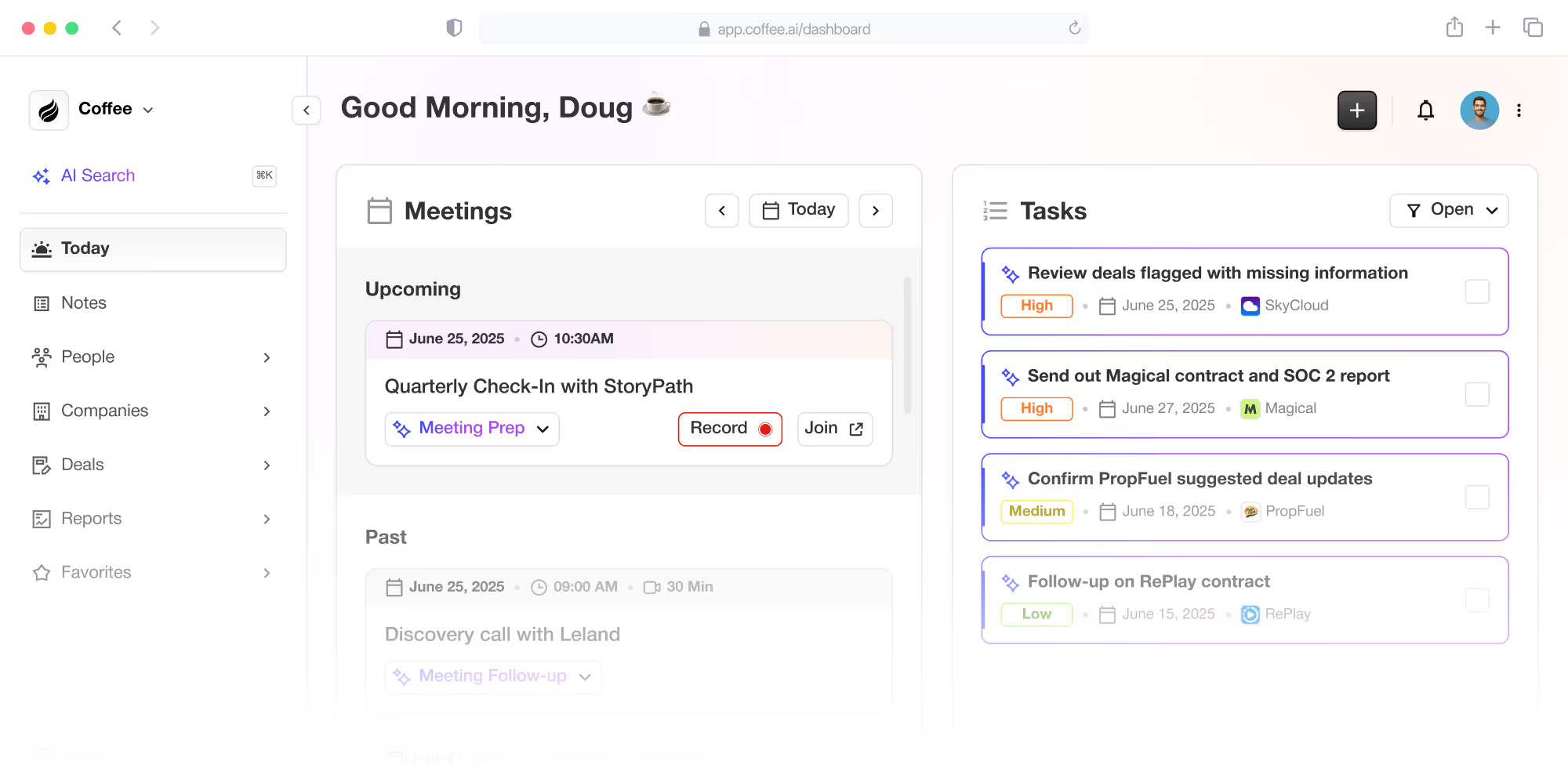
As part of the broader trend toward AI-driven CRM, Coffee stands out with its focus on intelligent automation. Built from scratch to prioritize AI, Coffee acts as a virtual assistant for sales reps, cutting down on repetitive tasks while enhancing productivity. Its system pulls data from emails, calendars, and call records to build a complete picture of customer relationships, ensuring reminders and follow-ups are always relevant.
Coffee automates the entire follow-up process, spotting key tasks and drafting tailored messages. This keeps momentum in relationships without requiring constant manual input from reps. As an example of the industry’s shift toward data-driven tools, Coffee demonstrates how unified information can power better sales outcomes.
Standout Features of Coffee for Reminders
Coffee offers several practical tools designed to streamline follow-ups and boost efficiency. Here’s what sets it apart:
- Automatic Data Capture: Coffee scans emails and calendars to update contact details and log activities, ensuring reminders reflect the latest information.
- Meeting Support: Before meetings, it provides summaries of past interactions. During calls, it records and transcribes conversations on platforms like Zoom or Teams. After, it drafts follow-up emails and identifies next steps.
- Pipeline Insights: With its “Compare” feature, Coffee tracks changes in deal progress week by week, helping reps focus on high-priority follow-ups.
Request access to see how Coffee can improve your team’s productivity with automated reminders.
Key Factors for Adopting AI-Driven Reminders
Evaluating Your Team’s Readiness for AI CRM
Before integrating AI reminders, assess your organization’s data quality and team mindset. Accurate, centralized data is crucial for automation to work well. Teams must also be open to changing workflows, as resistance can stall adoption. Infrastructure plays a role too. Companies with complex legacy systems might need a gradual transition, while those with flexible setups can move faster.
Build or Buy? Weighing AI CRM Options
Sales leaders face a choice: customize existing CRMs with AI features or adopt a built-for-purpose platform like Coffee. Adding AI to older systems can be costly and limited by outdated design. On the other hand, platforms designed for AI from the start offer smoother functionality and often better long-term value, though they may require rethinking current processes. Custom solutions demand significant resources, while ready-made tools can deliver quicker results.
Tracking the Impact of Automated Follow-Ups
To gauge the value of AI reminders, focus on metrics like deal speed, conversion rates, and time saved on admin work. Coffee, for instance, reports that reps save 8 to 12 hours weekly through automation. Additionally, track team satisfaction and system usage to ensure the tool supports, rather than hinders, daily work.
Fitting AI Reminders into Your Sales Process
AI reminders work best when they complement existing workflows. Coffee’s Companion App connects with platforms like Salesforce and HubSpot, adding automation without disrupting familiar systems. The goal is for automation to feel intuitive, so reps see it as a helpful partner rather than an extra burden.
Common Mistakes in Setting Up Automated Reminders
Implementing automation can go wrong if not handled carefully. Over-relying on automation may lead to generic, off-putting interactions. Poor integration with other tools can create data gaps. Coffee counters this with strong connectivity options. Ignoring data accuracy or failing to update systems regularly can also reduce effectiveness, so ongoing maintenance is essential.
| Feature | Traditional CRM Reminders | AI CRM Reminders | Coffee’s Approach |
|---|---|---|---|
| Setup Needs | Manual rule setup | Self-learning automation | Low-effort configuration |
| Context Depth | Limited to internal data | Multi-channel insights | Combines email, calendar, calls |
| Personalization | Basic templates | Adapts to behavior | Uses interaction history |
| Improvement Over Time | Fixed rules | Learns continuously | AI refines outputs |
Answers to Common Questions About AI Reminders
How AI Reminders Differ from Traditional Alerts
AI reminders stand out by using data from multiple sources, like emails and meetings, to deliver timely, relevant alerts. Unlike traditional CRM alerts tied to fixed triggers, platforms like Coffee adjust dynamically, reducing manual setup and notification overload.
Do AI CRMs Cut Down Admin Time for Sales Reps?
AI CRMs save significant time on routine tasks. Coffee, for example, reduces admin work by 8 to 12 hours per week per rep through automating data entry and follow-up drafting, letting teams focus on closing deals.
How Does Coffee Make Reminders Feel Personal?
Coffee builds detailed customer profiles using data from emails, calls, and calendars. This ensures reminders and follow-ups match recent interactions, making them specific to each contact’s situation.
Can Coffee Work with Existing Salesforce or HubSpot Systems?
Coffee supports both new and established setups. Its Companion App enhances Salesforce and HubSpot with AI features, while its standalone CRM offers a full solution for teams ready to switch.
Which Metrics Show the Value of AI Reminder Systems?
Sales leaders should monitor deal progression speed, conversion success, time saved on tasks, and team feedback. These numbers highlight how automation improves efficiency and outcomes.
Conclusion: Gain an Edge with AI-Driven Follow-Ups
Automating reminders and follow-ups with AI is no longer optional for competitive sales teams. Tools like Coffee, as part of the wider move toward intelligent CRM, help reps prioritize relationships over paperwork with context-aware automation. Ready to see the difference? Request access to Coffee now and explore how AI can lift your team’s productivity.