
In today’s competitive sales environment, the pressure to perform is higher than ever. The market landscape for customer relationship management (CRM) tools has evolved significantly over the past decade, with a growing demand for solutions that address the inefficiencies of traditional systems. Sales professionals often find themselves bogged down by administrative tasks, spending just 35% of their time on actual selling. This gap highlights a broader trend: legacy CRMs, while once revolutionary, now struggle to keep pace with modern needs due to manual data entry, disjointed workflows, and rigid structures. Meanwhile, the rise of artificial intelligence (AI) offers a promising shift, enabling automation that can cut through these burdens and refocus efforts on building relationships and closing deals.
AI-driven CRM tools are not just a passing fad; they are part of a larger movement toward smarter, more efficient sales processes. Companies adopting these technologies report measurable gains in productivity and data accuracy. This guide explores seven essential AI CRM automation features that can streamline operations and elevate sales outcomes, with a focus on how tools like Coffee fit into this transformative wave. You’ll find detailed insights, research-backed benefits, and fair comparisons to help you make informed decisions.
Why AI CRM Automation Matters for Sales Teams Today
Traditional CRM systems often fall short in supporting sales productivity. Many require extensive manual input and complex setups, creating more work for users instead of less. Key challenges include scattered data across multiple tools and time-consuming updates to contact records or activity logs. These inefficiencies drain hours that could be spent engaging with prospects or advancing deals.
Coffee stands out as a leader in this shift toward AI-first CRM platforms, prioritizing ease of use for sales reps. Built with automation at its core, it tackles administrative overload by pulling high-quality data directly from emails, calendars, and call transcripts, bypassing manual entry. This approach ensures data reflects real interactions, forming a reliable foundation for AI-driven insights. As an example of the broader trend toward intelligent systems, Coffee empowers individual contributors rather than just serving as a reporting tool for management.
Its main benefits address common CRM pain points. It automates contact creation and enrichment, unifies fragmented tools into a single platform, simplifies meeting workflows, and offers built-in pipeline analytics without extra costs. Curious about how these features can help your team? Request access to see Coffee’s capabilities firsthand.
7 Critical AI CRM Automation Features for Sales Success
1. Automated Contact Creation and Data Enrichment
Manually updating contact details and logging activities wastes significant time for sales reps. AI automation changes this by pulling information from communication channels like emails and calendars to build and update CRM records without user effort.
These systems scan interactions to create profiles for people and companies, then enrich them with details such as job titles, company size, funding status, and location, often sourced from external data providers. This reduces errors and keeps data current. Automated data entry saves hours each week for sales teams.
Coffee excels here by integrating with Google Workspace or Microsoft 365 to instantly populate and enrich records. Contacts, companies, and activities are logged automatically, maintaining high data quality. Their system can save reps 8 to 12 hours weekly, freeing them to focus on selling rather than admin work.
2. Simplified Meeting Preparation and Follow-Up
Preparing for meetings and following up afterward takes up a large chunk of a sales rep’s day. AI automation streamlines this cycle by providing ready-to-use materials before meetings, capturing details during calls, and drafting follow-ups after.
Before a meeting, AI compiles attendee profiles, company backgrounds, and past interaction summaries. During calls, it records and transcribes conversations, eliminating manual notes. Afterward, it creates summaries, pinpoints action items, and prepares email drafts for quick review and sending.
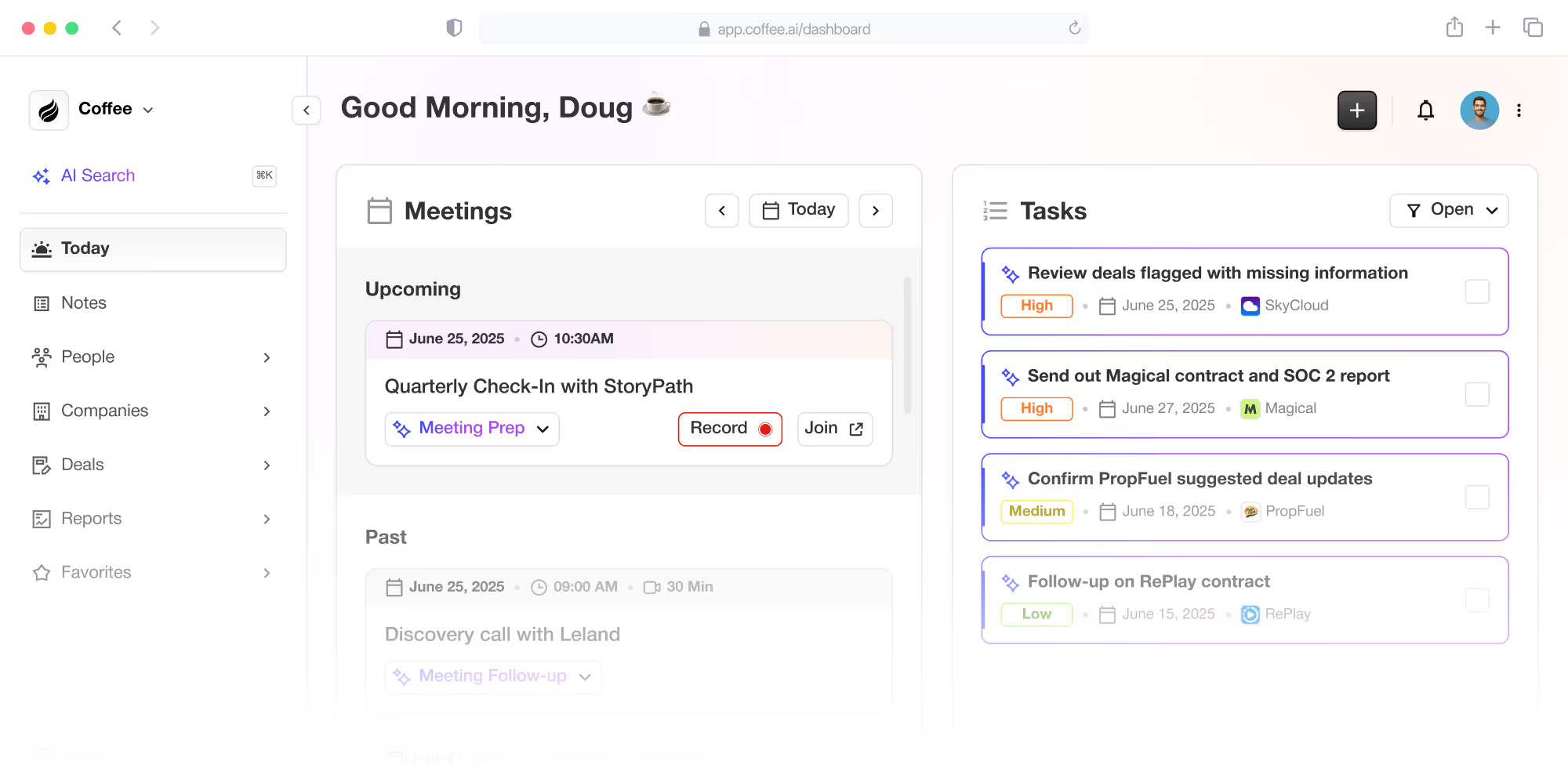
Coffee’s meeting tools act like a virtual assistant. Its ‘Today’ page offers daily briefings with key details about upcoming calls, including attendee roles and history. The platform joins virtual meetings on Google Meet, Microsoft Teams, or Zoom to handle recording and transcription. Post-meeting, it delivers concise summaries and follow-up drafts, even aligning content with sales methodologies like BANT or MEDDIC. This consistency boosts deal tracking and saves time for more client interactions.
3. Efficient Task Automation and Workflow Management
Routine sales tasks, such as scheduling follow-ups or updating deal stages, pile up quickly when done manually. AI-driven workflow automation identifies patterns in activities and handles these steps without rep involvement.
Coffee automates these smaller tasks, letting sales teams prioritize revenue-generating work. This creates more predictable processes and ensures prospects receive timely attention, improving both efficiency and customer experience.
4. Clear Pipeline Tracking with Comparison Tools
Managing a sales pipeline manually often leads to unclear insights about deal progress. AI-powered monitoring analyzes movement and offers concrete data for better decision-making.
These systems store historical pipeline data for detailed trend analysis, helping managers spot stalled deals or opportunities. Coffee’s ‘Pipeline Compare’ tool lets users see changes over any time frame with one click, highlighting progressed deals, new entries, and lagging prospects. This immediate visibility shifts pipeline reviews from guesswork to data-driven discussions, pinpointing where attention is needed.
5. Accurate Sales Forecasting with AI Insights
Forecasting sales accurately is tough with traditional methods that lean on subjective input. AI systems evaluate historical trends and current pipeline status to provide reliable predictions.
Coffee uses AI to enhance forecasting and pipeline management, offering actionable insights for leaders. This helps teams allocate resources effectively and address risks early, focusing efforts on high-potential deals. AI improves decision-making in sales forecasting.
6. Unified Tools for a Simpler Tech Stack
Using separate tools for CRM, data enrichment, and forecasting creates inefficiencies and added costs. A single platform that combines these functions cuts complexity and saves money.
Coffee integrates multiple capabilities into one system, removing the need for numerous apps or integrations. This streamlined setup benefits small to mid-sized teams especially, letting them work efficiently without toggling between tools. The result is lower expenses and more focus on client relationships.
7. Targeted Prospecting with AI List Building
Finding the right prospects takes effort when relying on manual research or disconnected data. AI simplifies this by allowing natural language searches to build lists of ideal contacts based on specific criteria.
With Coffee’s List Builder, users can input queries like, “Find VPs of sales in North American companies with 50 to 500 employees using Salesforce,” and get tailored results fast. The tool pulls from internal and external data, adding enriched details for immediate outreach. This cuts research time and sharpens focus on high-value leads. AI tools enhance prospecting precision. Ready to try it? Request access to Coffee’s features.
Comparing Coffee’s AI Automation to Traditional CRM Systems
AI-first platforms like Coffee differ fundamentally from legacy CRMs in design and capability. Modern systems are built for automation, while older ones often require bolting on extra tools or integrations, leading to less fluid experiences. Below is a detailed comparison:
| Feature | Coffee (AI-First CRM) | Traditional CRM | Key Benefit |
|---|---|---|---|
| Data Entry & Enrichment | Fully automated from direct sources | Relies on manual updates or added integrations | Saves 8-12 hours per rep weekly |
| Meeting Support | Automated briefings and follow-up drafts | Often requires manual note-taking | Ensures consistent follow-through |
| Pipeline Analysis | Built-in historical tracking and comparison | May need exports or extra tools | Clear insights without added cost |
| Tool Integration | Unified platform with native features | Frequently involves multiple systems | Lowers complexity and expense |
The data warehouse structure in Coffee allows for advanced tracking and analysis that older relational databases can’t match easily. While traditional CRMs have value in established setups, their limitations in automation often stem from designs not originally built for AI. Choosing between the two depends on your team’s needs: if automation and simplicity are priorities, newer platforms offer clear advantages.
How to Implement AI CRM Automation for Best Results
Getting the most from AI CRM automation requires a thoughtful plan to ensure adoption and measurable impact. Start by setting specific goals, provide thorough training, and track progress with clear metrics.
First, pinpoint the most time-intensive manual tasks, such as data entry or meeting follow-ups. Focus automation on these areas for quick wins. Change management is equally important. Offer hands-on training, show clear benefits, gather user feedback, and adjust as needed.
To measure success, establish baseline metrics before rollout, like time spent on admin tasks or data accuracy rates. Monitor improvements in these areas, along with overall sales productivity. Regular reviews keep the system delivering value over time. Ready to start? Request access to Coffee and experience its impact.
Common Questions About AI CRM Automation
How Much Time Can Automation Actually Save?
Automation can free up considerable time for sales teams. Coffee estimates reps save 8 to 12 hours weekly by cutting out manual data entry, meeting prep, and follow-up tasks. This extra time boosts client engagement and deal-closing activities.
Do Small Businesses Benefit from AI Automation?
Small businesses often gain substantial value from AI automation. With limited staff handling multiple roles, tools like Coffee’s Standalone CRM, designed for teams of 1 to 20, simplify workflows and deliver quick efficiency gains without complex setups.
How Does Coffee Maintain Data Quality and Security?
Coffee prioritizes data quality by using direct sources like emails and call transcripts instead of manual input, minimizing errors. For security, it complies with SOC 2 Type 2 and GDPR standards, ensuring customer data isn’t used for AI training.
Does Automation Make Client Interactions Less Personal?
Effective AI automation strengthens client relationships. Coffee provides detailed briefings and follow-up reminders, helping reps offer attentive service. By handling admin details, it lets reps focus on genuine connections rather than paperwork.
Can Coffee Work with Existing Salesforce or HubSpot Systems?
Yes, Coffee’s Companion App integrates with Salesforce and HubSpot, adding AI automation while preserving your main CRM. Syncing is straightforward, and users can choose which enriched data or insights to transfer back to their primary system.
Final Thoughts on Enhancing Sales with AI Automation
The shift away from manual sales processes is underway, driven by AI automation that lets teams prioritize relationships over routine tasks. The features covered here form the backbone of a more efficient, data-rich sales approach.
Adopting these tools offers a tangible edge. Sales reps focusing on high-value work build stronger client bonds and close deals sooner. Coffee, as a frontrunner in this AI-first wave, provides a platform that anticipates needs and removes obstacles, showcasing the potential of this broader industry trend.
Sticking with outdated methods or patchwork systems holds teams back. Moving to intelligent automation can reshape your sales operation for the better. Request access to Coffee and see how these features can elevate your team’s productivity.