
Key Takeaways
- High-quality, automated data capture creates a reliable foundation for every sales report and forecast.
- Real-time pipeline and velocity monitoring helps sales leaders spot risk early and act before revenue slips.
- AI-powered conversational intelligence turns sales calls into structured insights for more targeted coaching.
- Balanced metrics, automated forecasting, and a unified tech stack improve forecast accuracy and day-to-day management.
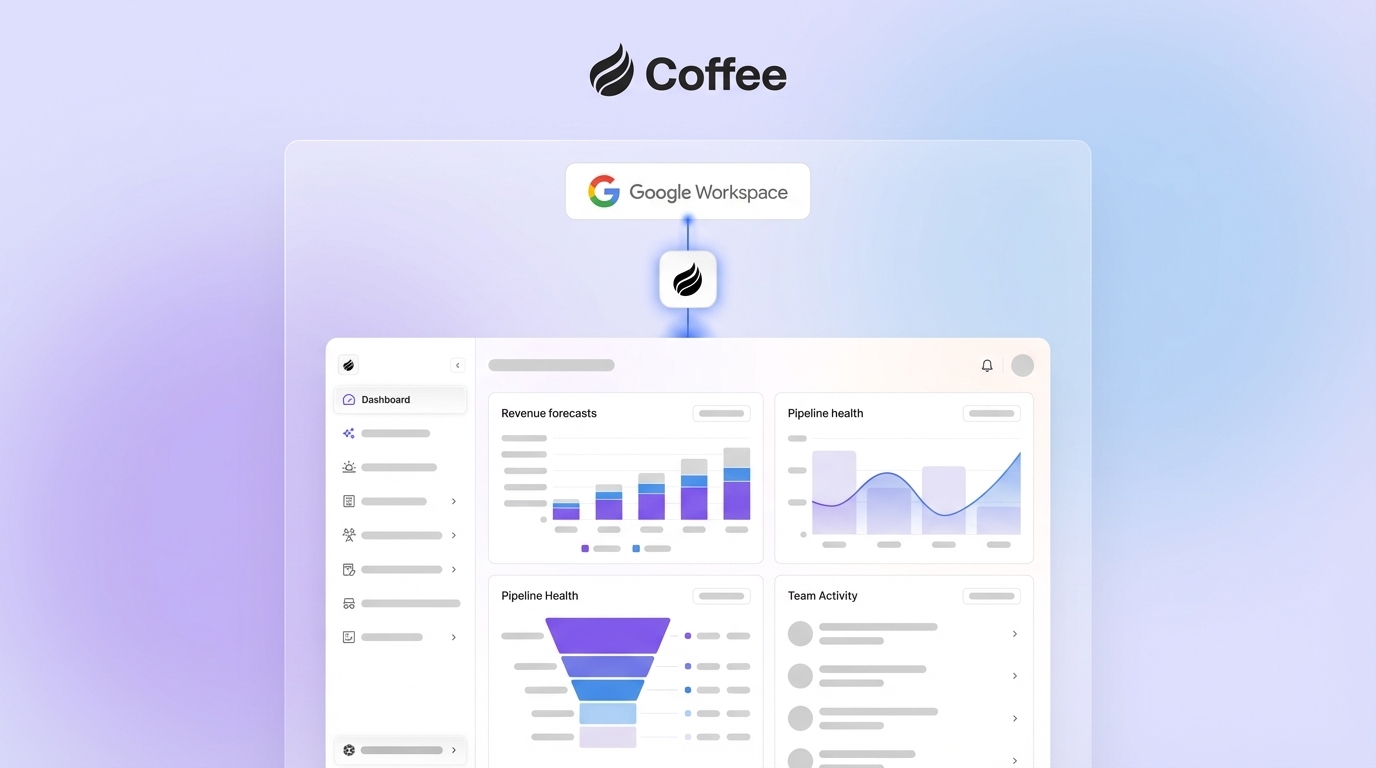
- Coffee’s AI Agent automates data entry, meeting capture, and pipeline analysis so teams spend more time selling, not updating CRM. Get started with Coffee.
1. Combat Data Entry Fatigue with Automated Data Capture
Reliable sales reporting starts with accurate data. Manual CRM updates often introduce errors, gaps, and inconsistent standards, which weaken every dashboard and forecast that depends on them.
Automated data capture improves this foundation. An AI-powered agent like Coffee collects and enriches information from emails, calendars, and calls, then creates structured records without extra work from reps. This approach can save 8 to 12 hours per rep each week while keeping contact details, activities, and deal stages current.
Better inputs lead to better analytics. Reports start to match reality, pipeline velocity becomes trustworthy, and conversion analysis reflects actual performance rather than incomplete snapshots.

2. Drive Proactive Decisions with Real-time Pipeline & Velocity Monitoring
Pipeline velocity measures deal movement speed through your sales process. It combines deal size, win rate, and sales cycle length to reveal both bottlenecks and opportunities.
Real-time dashboards turn velocity into a daily management tool. Sales leaders can track stage conversion rates, time in stage, and overall pipeline health across segments, products, and reps, then step in quickly when deals stall or patterns shift.
Segmentation and trends make this especially useful. Viewing velocity by deal size, territory, or customer segment highlights where coaching, enablement, or process changes will have the most impact.
3. Enhance Coaching & Performance with AI-Powered Conversational Intelligence
Sales conversations contain rich context about buyer needs, objections, and decision criteria. 71% of top-performing sales teams already use call analysis to understand what their best reps do differently.
AI-driven conversational intelligence goes deeper than manual call reviews. Analytics identify effective questions, talk time balance, and use of sales methodologies like BANT or MEDDIC, which help managers coach specific behaviors rather than rely on general advice.
Coffee’s AI Meeting Bot joins calls, records and transcribes conversations, summarizes key points, and suggests next steps. Those insights feed performance dashboards that show how reps handle objections, qualify deals, and move opportunities forward.

4. Balance Leading & Lagging Indicators for Predictive Sales Insights
Strong sales analytics programs track both leading and lagging indicators. Leading indicators like calls made and meetings booked predict future performance; lagging indicators like win rate and sales cycle length confirm past results.
Leading metrics act as early warning signals. A drop in activity levels, meeting volume, or email engagement shows up before revenue slows, which gives leaders time to adjust territories, priorities, or coaching.
Linking leading and lagging data produces simple, predictive models. When teams know how many qualified meetings or proposals are needed for a typical revenue outcome, they can set realistic activity targets and react quickly if current levels fall short.
5. Optimize Sales Activity Management with Data-Driven Benchmarks
Activity management becomes clearer when data defines what good performance looks like. Activity metrics like Meeting Completion Rate and Mobile CRM Engagement connect daily effort to revenue results.
Benchmarks built from your own high performers help set fair expectations for prospecting, meetings, and follow-up. Metrics such as calls, emails, demos, and follow-through rates create a shared standard for coaching and territory planning.
Quality still matters more than raw volume. Advanced analytics often show that top reps run fewer, better-targeted activities with higher connection and conversion rates. Training can then focus on improving effectiveness, not just increasing count. Get started with Coffee to turn activity data into clear, practical benchmarks.
6. Achieve Forecast Accuracy with Automated Forecasting & Pipeline Comparison
Forecast accuracy suffers when data is incomplete or delayed. Manual updates and fragmented data sources lead to inaccurate predictions that weaken planning and resourcing decisions.
Automated forecasting tools use historical patterns, seasonality, and rep-level performance to project outcomes, then update those projections as deals move or change stage. This approach reduces administrative work and produces more dependable revenue expectations.
Coffee’s Pipeline Compare feature visualizes week-over-week pipeline changes, highlights new, progressed, and stalled deals, and makes trend shifts easy to see. Forecast reviews become focused on risk, upside, and next actions instead of manual spreadsheet work.
7. Unify Your Tech Stack for Comprehensive Sales Reporting
Disconnected sales tools create data silos and partial reporting. When CRM, sequencing tools, enrichment, and call intelligence operate separately, analytics often miss context or contain conflicting information.
Consolidated platforms provide a single source of truth. Integrated systems reduce sync errors, simplify training, and make adoption easier for reps because more of their work happens in one environment.
An AI-driven platform like Coffee combines CRM, data enrichment, meeting management, and pipeline intelligence in one place. This structure lowers complexity and cost while giving leaders consistent, end-to-end visibility into performance.

How Coffee’s Agent Revolutionizes Your Sales Reporting & Analytics
The Agent Handles Data Entry: Good Data In For Good Reports
Coffee’s AI Agent automates the creation and enrichment of contacts, companies, and activities. Every email, calendar event, and call turns into structured CRM data that updates in the background. Core metrics like pipeline velocity, conversion rates, and activity levels then reflect what is actually happening in the field.
Pipeline Intelligence & “Compare” Feature: Actionable Insights on Autopilot
The Agent tracks seller and buyer activity across deals, then surfaces patterns through the Pipeline Compare view. Week-over-week changes in pipeline value, stage, and effort become clear, so leaders can quickly see where to focus attention and which deals need support.
A CRM Reps Use Consistently: Higher Adoption, Better Data, Clearer Analytics
Coffee reduces manual admin work, which makes CRM use less of a burden for reps. Higher adoption produces more complete data, and that data feeds stronger reports, forecasts, and coaching conversations. Teams gain a practical system that supports their daily workflow instead of slowing it down.
Get started with Coffee to see how the Agent can support your reporting and analytics strategy.
Conclusion: Unlock Sales Productivity Through Intelligent Reporting
Sales organizations in 2026 achieve better outcomes when they base decisions on accurate, timely data instead of manual reports. Automated capture, balanced metrics, conversational intelligence, and unified tools all contribute to more reliable analytics and forecasts.
The strategies in this guide help leaders build a reporting framework that supports coaching, planning, and execution. Explore Coffee’s AI Agent to reduce admin work and strengthen your sales reporting.
Frequently Asked Questions (FAQ)
How does automating data entry improve reporting accuracy?
Automated data entry captures every relevant activity and update in real time, without relying on manual inputs. Coffee’s Agent pulls information from emails, calendars, and calls, then logs it consistently. Reports that depend on this data, such as pipeline, conversion, and activity dashboards, become far more accurate and useful for decision-making.
Can Coffee integrate with my existing Salesforce or HubSpot CRM for reporting?
Yes. Coffee offers a Companion App that layers on top of Salesforce or HubSpot. The Agent handles contact creation, activity logging, and enrichment, while your team continues to use your existing CRM for workflows and reports. Your primary CRM stays current with less effort from the sales team.
How does Coffee’s “Pipeline Compare” feature enhance sales forecasting?
Pipeline Compare presents week-over-week changes in pipeline value and composition. The view shows which deals are advanced, stalled, dropped out, or entered recently. Sales leaders can connect these changes to forecast shifts, then adjust strategy, coaching, or resource focus based on a clear picture of pipeline momentum.
What metrics should I prioritize when implementing new sales reporting strategies?
Pipeline velocity, win rate, average deal size, and sales cycle length form a solid starting point. Pair these with leading metrics such as meetings set, meeting completion rate, and qualified opportunities created. A focused group of 8 to 10 metrics usually gives enough insight without overwhelming the team.
How can AI-powered analytics improve sales team coaching and development?
AI analytics analyzes calls, emails, and activity patterns to reveal behaviors linked to strong results. Managers gain concrete examples of what top performers do differently, which supports specific, actionable coaching. Coffee’s conversational intelligence and activity insights help turn coaching sessions into data-backed discussions about skills and next steps.