
In the rapidly evolving world of sales, where every decision can impact revenue and growth, staying ahead requires more than just intuition or outdated tools. The market landscape for CRM systems has undergone a significant shift over the past decade. Traditional platforms, once seen as the backbone of sales operations, now often struggle to keep pace with the demands of modern businesses that require agility, precision, and data-driven strategies. Sales teams face mounting pressure to predict customer behavior, optimize pipelines, and close deals faster, all while grappling with fragmented data and time-consuming manual processes. Against this backdrop, AI-powered CRM analytics have emerged as a critical solution, offering the ability to transform raw data into actionable insights. Platforms like Coffee exemplify this trend, providing sales leaders, RevOps professionals, and founders with tools to enhance forecasting, pipeline management, and team performance. This guide will walk you through the transition from basic reporting to AI-driven intelligence, offering a clear framework to adopt these capabilities and drive meaningful results for your organization.
How AI Has Changed Sales Analytics
Why Traditional CRM Analytics Fall Short
Many sales teams find that traditional CRM systems don’t fully deliver a unified view of customer interactions. Data often becomes fragmented across multiple tools, creating inefficiencies that hinder revenue growth.
Manual data entry remains a significant burden. Sales reps spend hours logging notes and updating records, cutting into time that could be spent on selling or nurturing client relationships.
Fragmented data sources make it hard to gain a complete picture of customer behavior or sales trends. Without proper integration, generating actionable insights becomes a complex, time-intensive task.
Perhaps most limiting, legacy systems focus on past performance rather than future potential. Sales leaders often base decisions on historical data, missing out on predictive insights to anticipate opportunities or risks.
What AI Brings to Sales Analytics
AI introduces a fundamental change to CRM functionality, solving many persistent issues of traditional systems. Platforms built with AI at their core, such as Coffee, use automation and machine learning to improve data accuracy and deliver deeper insights.
AI systems automatically pull in and organize data from emails, calendars, and call transcripts. This cuts down on manual entry, saves time, and reduces errors, ensuring a more reliable dataset.
With AI, sales strategies move from reactive to proactive. By unifying data and automating routine tasks, these tools help teams focus on high-priority actions and make decisions based on real-time information.
Want to see how AI can enhance your sales processes? Request access to Coffee and explore its approach to intelligent automation.
Key Elements of AI-Powered Sales Analytics
Building a Strong Data Foundation
Effective AI analytics start with high-quality data. Traditional CRMs often suffer from incomplete or inaccurate inputs due to manual processes. AI platforms tackle this by automating data collection and organization.
For instance, Coffee connects with tools like Google Workspace and Microsoft 365 to capture emails, calendar events, and meeting details in real time. This creates a comprehensive view of customer interactions without requiring manual updates.
Data is further improved through automatic enrichment, adding details like job roles or company profiles from licensed sources. This ensures a robust base for analytics within a single system.
Coffee also uses a data warehouse to store historical records, allowing teams to analyze trends over time, something traditional databases often struggle to support efficiently.
Improving Forecasts with Predictive Analytics
AI enhances sales forecasting by examining factors like deal stages and engagement patterns. Platforms like Coffee provide clearer pipeline visibility, helping teams spot opportunities and potential issues early.
With features that track changes in pipeline data, Coffee enables sales reps to focus their efforts effectively. This supports leaders in allocating resources and refining strategies with confidence.
Guiding Pipeline Management with Actionable Insights
Coffee delivers specific recommendations for pipeline management by analyzing deal progress, identifying new opportunities, and flagging stalled deals. Its “Pipeline Compare” tool simplifies week-over-week analysis, making reviews quicker than manual methods.
These insights allow teams to concentrate on impactful tasks, address bottlenecks, and adapt strategies using up-to-date information. Pipeline discussions become more strategic rather than just a review of numbers.
Streamlining Reporting with Real-Time Dashboards
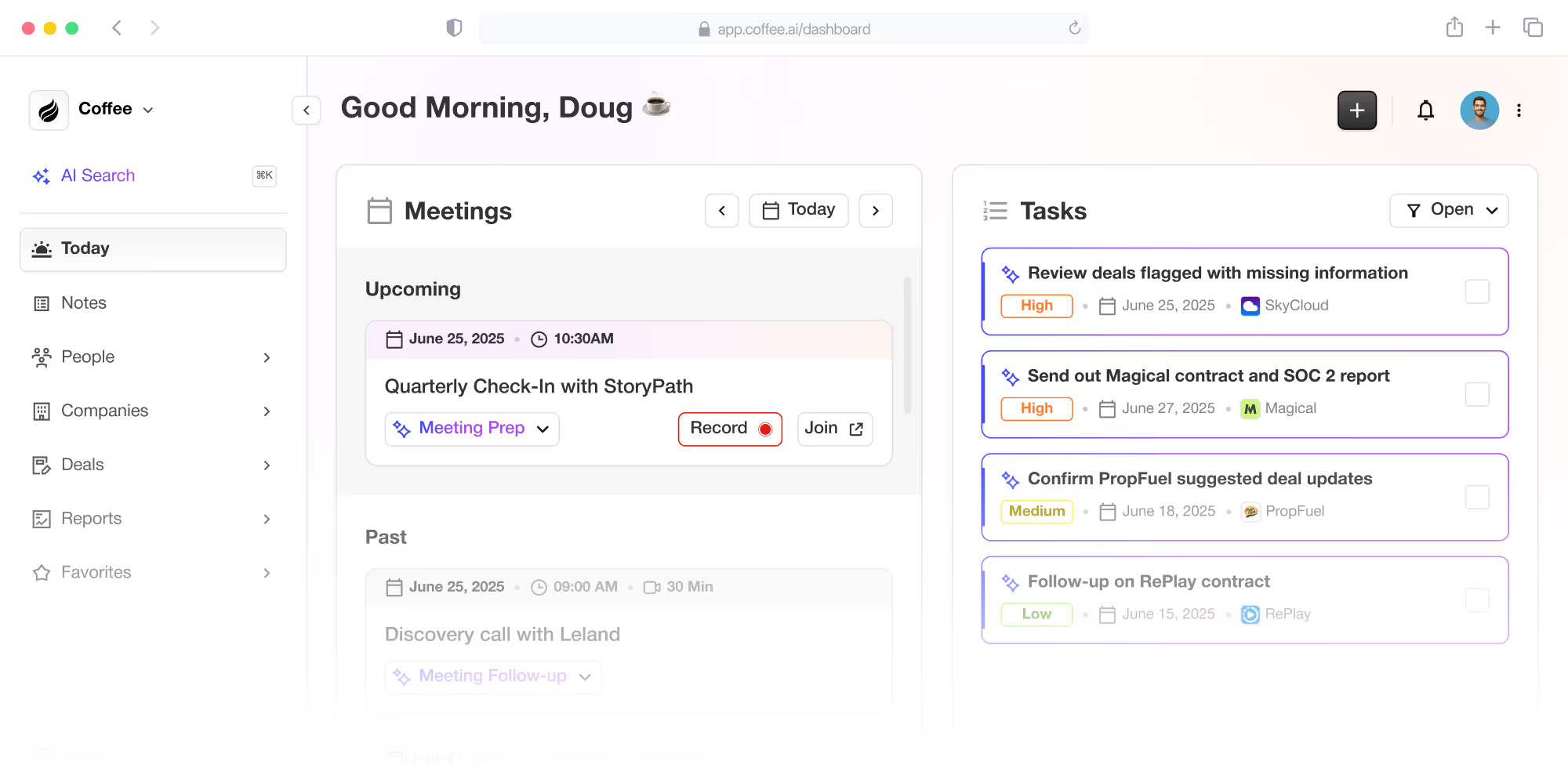
AI in platforms like Coffee automates sales reporting, minimizing manual work while providing instant access to key metrics. Real-time dashboards display pipeline updates, deal status, and activity levels without the need for data compilation.
This immediate access speeds up decision-making and adjustments. Coffee tailors insights for various roles, ensuring everyone from reps to executives gets relevant information to stay ahead.
How AI CRM Analytics Boost Sales Productivity
Finding and Prioritizing Key Opportunities
Coffee’s analytics pinpoint high-potential deals by offering clear pipeline updates. Tools like “Pipeline Compare” show deal movement, helping reps focus on activities that drive results.
For outbound efforts, Coffee’s List Builder lets users create targeted prospect lists using simple language queries. This keeps prospecting efficient and integrated, reducing reliance on separate tools.
Enhancing Sales Process Efficiency
With automated data capture, Coffee provides a detailed view of sales workflows and pipeline dynamics. Reps save an estimated 8-12 hours weekly on administrative tasks, streamlining pre- and post-meeting actions with AI-generated summaries and follow-ups.
Automation frees up time for relationship-building and deal-closing. Over time, this leads to consistent processes and stronger team performance.
Supporting Personalized Sales Coaching
Coffee offers tailored guidance through meeting prep materials, interaction summaries, and follow-up drafts. It organizes summaries using frameworks like BANT or MEDDIC for uniform deal evaluation.
These tools help reps prepare thoroughly for client meetings and follow up promptly, improving outcomes through practical, data-backed support.
Enabling Smarter Decision-Making
Coffee equips leaders with real-time pipeline and performance data. Features like “Pipeline Compare” aid in strategic planning for resource distribution and process enhancements.
This focus on data helps align sales plans with execution, leading to more reliable results through timely insights.
Ready to elevate your sales decisions with AI insights? Request access to Coffee and start leveraging its intelligent platform.
Steps to Implement AI CRM Analytics Successfully
Evaluating Readiness and Gaining Support
Implementing AI CRM analytics starts with understanding your organization’s capacity and goals. Assess current tech, data quality, team skills, and readiness for change.
Key leaders, such as Heads of Sales or RevOps, need to back the initiative and secure necessary resources. Coffee suits small to mid-sized firms frustrated by manual work or costly traditional CRMs, especially those with low adoption or scattered data.
Change management plays a vital role as AI alters daily workflows. Coffee focuses on clear communication, training, and ongoing support to ensure teams adapt and see value.
Navigating Challenges and Planning Strategically
Opting for a solution like Coffee avoids the complications of developing AI internally. Its straightforward setup and integrations with existing CRMs minimize risks of new data silos if configured correctly.
Coffee emphasizes useful analytics, helping teams avoid data overwhelm by focusing on practical insights. Continuous optimization and training ensure long-term benefits from the platform.
Measuring Success with Clear Metrics
To gauge Coffee’s impact, track metrics like time saved on repetitive tasks, faster pipeline movement, and higher CRM usage rates. Productivity gains, such as cutting data entry by 8-12 hours weekly per rep, show clear operational value.
Data quality improvements, reflected in completeness and accuracy, further enhance AI performance. These metrics demonstrate how Coffee improves sales efficiency and effectiveness.
Why Coffee Stands Out in AI-First Sales Analytics
Solving Common CRM Pain Points
Coffee redefines CRM by embedding AI into every function, addressing challenges like scattered data and manual input. It automatically gathers information from emails, calendars, and transcripts, ensuring accurate tracking without extra effort.
By combining CRM, data enrichment, call recording, and pipeline tools into one system, Coffee reduces both complexity and cost. Its intuitive design acts as a supportive tool for reps, boosting usage rates and data reliability for better insights.
Comparing Coffee to Traditional CRM Analytics
| Feature | Legacy CRM Analytics | Coffee’s AI-Powered Analytics |
|---|---|---|
| Data Source | Manual input, fragmented | Auto-captured from emails/calendars |
| Insights | Historical, basic | Actionable pipeline and meeting analysis |
| Reporting | Manual, slow | Automated, real-time access |
| Pipeline View | Static, error-prone | Dynamic, historical change tracking |
| Data Quality | Inconsistent from manual entry | High accuracy via automation |
| User Experience | Task-heavy, low adoption | Supportive, widely used |
Standout Features for Sales Productivity
Coffee automates data entry by creating contacts and company profiles from Google Workspace or Microsoft 365 interactions. It adds valuable details like job titles through trusted data partners.
For meetings, Coffee’s AI provides pre-call briefings with relevant attendee and company info, plus post-call summaries and action items. It aligns summaries with sales frameworks like BANT or MEDDIC for consistency.
The “Pipeline Compare” tool simplifies week-over-week pipeline reviews, highlighting deal progress or delays in one click, replacing tedious manual exports.
With List Builder, reps use everyday language to create targeted prospect lists, such as finding sales VPs at specific company sizes, embedding prospecting directly into CRM tasks.
Interested in boosting your sales with AI-driven analytics? Request access to Coffee and discover its capabilities.
Common Questions About AI CRM Analytics
How Does AI Improve Sales Forecast Accuracy?
AI platforms like Coffee analyze pipeline details and deal progress to offer practical insights, unlike traditional methods that rely heavily on historical data and manual tweaks. Tools like “Pipeline Compare” track changes over time, helping leaders allocate resources and plan strategies with greater clarity.
Does AI Replace Human Insight in Sales Management?
AI doesn’t replace human judgment in sales. Instead, tools like Coffee provide data-driven insights to support decisions, while intuition and relationship skills remain vital for strategy and adapting to market changes. Combining AI with human expertise yields the best outcomes.
What Data Powers Coffee’s Analytics and How Is Quality Maintained?
Coffee draws data from Google Workspace or Microsoft 365, covering emails, calendars, and meeting transcripts. Additional details come from licensed partners. Quality is upheld through automation and deduplication, avoiding manual errors, with a data warehouse preserving historical accuracy.
How Soon Can Businesses See Returns from AI CRM Analytics?
With Coffee, many businesses notice benefits within weeks, as reps save 8-12 hours weekly on routine tasks. Deeper impacts, like pipeline improvements, often appear within 60-90 days as data builds. Full returns typically show within 6 months through increased efficiency.
What Technical Skills Are Needed for AI CRM Setup and Maintenance?
Coffee requires little technical know-how for setup. Connecting to Google Workspace or Microsoft 365 starts data collection automatically. A RevOps or sales leader can manage optimization, with Coffee’s resources and support team available for guidance.
Final Thoughts: Maximize Your Sales Potential with AI CRM Analytics
Traditional CRM systems often weigh sales teams down with manual work and disconnected data. AI-driven solutions like Coffee address these challenges through automation and a unified data approach.
By removing repetitive tasks, Coffee lets reps focus on generating revenue. Its benefits extend to sharper pipeline visibility and informed decision-making, fostering steady sales growth.
Companies adopting Coffee view AI analytics as a core strength. It provides sales leaders and RevOps teams with essential tools to elevate performance.
Ready to enhance your sales efficiency? Request access to Coffee and see how it can strengthen your sales organization.