
In today’s competitive sales environment, organizations face mounting pressure to grow quickly while maintaining efficiency. The market landscape for customer relationship management (CRM) tools has evolved dramatically over the past decade, driven by the need for systems that support larger teams without adding complexity. Many companies still rely on traditional CRM platforms built for smaller-scale operations, often struggling with manual processes and fragmented data as they expand. This creates a gap between the potential for growth and the operational reality of scaling sales teams. Meanwhile, advancements in artificial intelligence (AI) have introduced new possibilities, with AI-driven CRM platforms emerging as a way to streamline workflows and enhance productivity. As sales leaders navigate this shift, finding tools that balance human effort with automation becomes critical to staying competitive. This guide explores how AI-powered CRM systems, like Coffee, address scaling challenges by focusing on efficiency, data quality, and actionable insights, reflecting a broader trend toward intelligent sales solutions.
Scaling a sales team isn’t just about hiring more people. It’s about equipping them with tools that boost their output without bogging them down in repetitive tasks. AI-first CRM platforms offer a practical way to achieve this balance. Curious to see how this works in action? Request access to Coffee and explore how it can support your team’s growth.
Why Legacy CRMs Struggle to Support Growing Sales Teams
Scaling Limits: When More People Mean Less Efficiency
Adding team members often leads to lower per-person productivity if the right systems aren’t in place. Legacy CRM platforms, designed for simpler workflows, can exacerbate this issue by burdening sales reps with inefficiencies that grow alongside the team.
As sales teams expand, each new hire needs training and support to handle outdated systems not built for modern demands. Current staff spend more time on administrative tasks to keep things running, pulling them away from closing deals. Data shows that sales reps can spend up to 35% of their day on non-selling activities, a problem that worsens with team size due to system limitations.
For instance, daily workflows in older CRM setups often involve redundant manual input. The larger the team, the more time gets lost to these tasks, creating a hard cap on output. Simply hiring more people doesn’t solve the problem; it can magnify the inefficiencies across the organization.
Hidden Burdens: Manual Data Entry and Disconnected Tools
Legacy CRM systems come with costs beyond their price tag. They often fragment data across multiple tools, like separate platforms for lead management, outreach, and enrichment, leading to workflow disruptions.
This setup causes two major issues. First, data quality suffers when sales reps must manually move information between systems, often skipping steps or entering incomplete details under time pressure. Second, juggling several tools distracts from actual sales work, adding mental strain. Studies indicate that context switching between apps can reduce productivity by up to 40% due to cognitive overload.
For growing teams, these challenges multiply. A small group might cope with disconnected tools, but larger teams struggle with coordination, risking missed opportunities and buried insights. Manual data needs grow with headcount, while the resulting value doesn’t keep pace, stalling growth potential.
Old Technology: A Roadblock to Modern Sales Needs
Many legacy CRM systems rely on architectures built years ago, before the rise of multi-channel sales and data-heavy environments. These designs often can’t keep up with today’s fast-paced, complex sales processes.
Specific limitations include difficulty handling unstructured data, such as emails or call notes, in a meaningful way. Real-time analysis and seamless integrations, vital for current sales strategies, can also be challenging without extensive customization. Research highlights that 60% of CRM users face integration issues with older platforms due to outdated frameworks.
As teams grow, these constraints become more evident. What functions for a small operation turns cumbersome with larger, intricate deals. Sales leaders need systems adaptable to the speed and scale of modern business, an area where legacy tools often fall short.
How AI CRM Platforms Redefine Sales Growth
Building Efficiency with AI at the Core
AI-first CRM platforms mark a significant shift in how sales operations handle growth. Unlike traditional systems that tack on automation as an afterthought, these tools embed intelligence into their foundation, tackling scaling issues directly.
For example, platforms like Coffee pull data from everyday communications, such as emails and calendars, to organize information automatically. They deliver relevant insights and handle routine tasks, so sales reps spend less time navigating clunky interfaces. This approach turns the CRM into a helpful tool rather than a chore, improving user engagement and data accuracy.
What’s more, AI-first systems get better as teams grow. More users and interactions feed the system with data, sharpening its ability to offer tailored insights. Growth becomes a strength rather than a strain, aligning with the needs of expanding organizations.
Breaking Through Limits with Automation
Automation in AI CRM platforms directly counters the productivity drop-off seen in traditional scaling. By handling repetitive tasks, such as data logging or meeting follow-ups, these tools free up sales reps to focus on high-impact work.
The impact grows with team size. If an automated task saves each rep a few hours weekly, the total gain for a larger team becomes substantial. Consistency also improves since processes run the same way for everyone, reducing errors or oversight. Data suggests automation can boost sales productivity by up to 14.5% when applied effectively.
Platforms like Coffee take this further by analyzing customer interactions to suggest next steps. This turns the CRM into an active partner in driving sales outcomes, not just a passive record-keeper.
Coffee AI CRM: A Leading Solution for Sales Productivity
Core Idea: Quality Data Fuels Effective AI
Coffee stands out as a key player in the AI CRM trend, built with the belief that modern sales growth demands a fresh approach. Its AI-native design prioritizes automation from the start, focusing on capturing high-quality data automatically from sources like emails and meetings.
Unlike older systems reliant on manual input, Coffee ensures its AI works with accurate, up-to-date information. This focus on data quality creates reliable automation and insights. The platform also emphasizes ease of use, aiming to be a tool sales reps actually enjoy, which boosts adoption and keeps the system effective.
As a company grows, Coffee’s structure supports that expansion. Each user interaction adds to the data pool, refining the AI’s capabilities. This scalability makes it a fitting example of how AI-first CRM platforms address growth challenges more broadly.
Key Benefits for Scaling Sales Teams
Ending Manual Data Work
Coffee automates data capture by linking to Google Workspace or Microsoft 365 accounts, creating contacts and company profiles from interactions. This cuts out manual entry, saving reps an estimated 8 to 12 hours weekly.
It also enriches data with details like job titles or company funding from licensed sources, reducing the need for separate research tools. New hires start contributing faster without data entry training, while existing staff focus on sales over admin tasks, aiding scalability.
Streamlining Meeting Processes
Coffee simplifies the entire meeting cycle. Before meetings, it provides briefings with attendee details and past interaction summaries, preparing reps efficiently.
During calls on platforms like Zoom or Google Meet, its AI bot records and transcribes discussions, removing the need for manual notes. Afterward, it summarizes key points, flags action items, and drafts follow-up emails, keeping customer engagement consistent without extra effort.
Offering Clear Pipeline Insights
With its Pipeline Compare feature, Coffee tracks historical pipeline changes, showing deal progress or stalls instantly. This gives managers a quick view of trends across teams, far easier than manual tracking in older systems, supporting smarter resource decisions as teams grow.
Unifying Sales Tools
Coffee combines CRM functions, data enrichment, and analytics into one platform, cutting down on multiple subscriptions and training needs. This reduces data silos and simplifies IT management, a significant advantage for larger organizations maintaining uniform processes.
Designing for User Engagement
The platform’s intuitive interface avoids complex menus, letting reps access information fast. This user-friendly design drives consistent use, improving data quality and enabling sharper AI insights, a cycle that benefits growing teams.
Flexible Options: Standalone or Companion App
Coffee offers two ways to integrate its features, catering to different company needs. Its Standalone AI CRM suits smaller businesses with 1 to 20 employees moving beyond basic tools, providing a full system without complex setup.
The Companion App fits companies already using Salesforce or HubSpot, adding AI automation while keeping their existing CRM as the main record. Users sync data with simple authentication, choosing which insights to push back to their primary system. This flexibility lets companies adopt AI at their own pace, reflecting a wider trend of adaptable sales tech solutions.
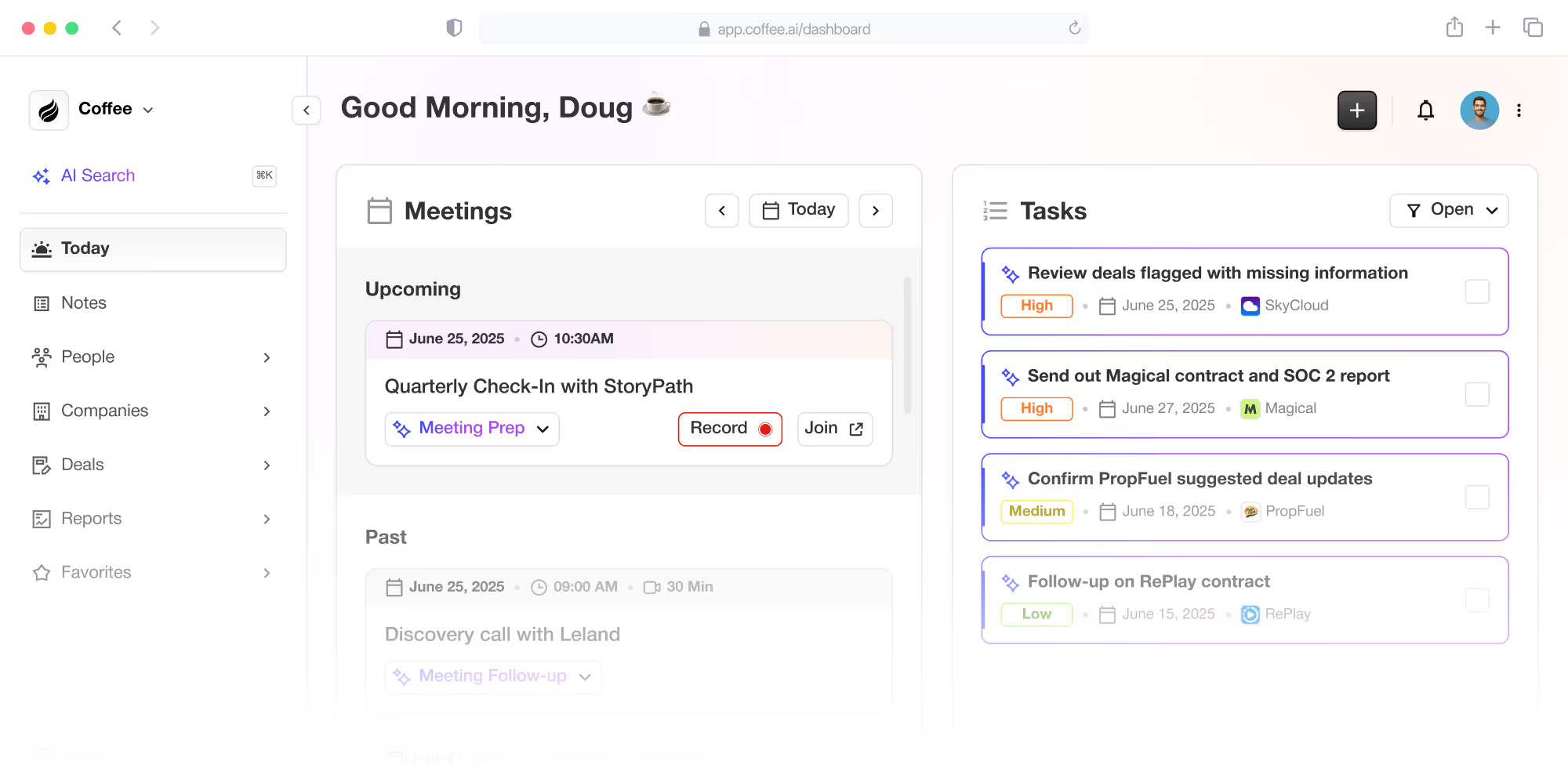
Ready to enhance your sales team’s efficiency? Request access to Coffee and see how AI can power your growth.
Planning for Success: Building a Scalable Sales System with AI CRM
Solving Common Productivity Hurdles
Growing sales teams often hit bottlenecks where manual tasks slow progress. AI in platforms like Coffee tackles these by automating repetitive work, reducing inefficiencies that worsen with scale.
Administrative load, like data entry, grows with team size in traditional systems. Coffee captures data automatically, keeping accuracy high without extra effort. Pipeline visibility also improves with real-time tracking, helping managers spot issues early across expanding teams.
Driving Decisions with Reliable Data
For steady growth, sales leaders need solid data to guide strategy. Coffee’s AI offers insights into performance trends and customer patterns, using historical data for accurate forecasting.
Real-time analytics allow quick adjustments to challenges or opportunities, vital for coordinating larger teams. This data-driven approach supports decisions on hiring or market moves, aligning with long-term goals.
Preparing for AI CRM Adoption
Implementing AI CRM starts with evaluating current systems and team readiness. Companies frustrated with existing tools might opt for a full AI-native platform like Coffee’s standalone option for maximum benefit.
Those with heavy investments in Salesforce or HubSpot can begin with the companion app, layering AI features without disruption. Success hinges on user adoption, eased by Coffee’s practical design, though training and support remain important to show immediate value.
Comparing AI CRM and Legacy Systems for Growth
| Feature | Legacy CRM Approach | Coffee’s AI CRM Approach | Impact on Scalability |
|---|---|---|---|
| Data Entry | Manual, error-prone, time-heavy | Automatic from communications | Saves time, boosts accuracy, speeds growth |
| Data Unification | Scattered across tools, siloed | Combined in one platform | Clear customer view, sharper insights, less tech clutter |
| Insights & Reporting | Manual, delayed, reactive | AI-driven, real-time pipeline data | Better decisions, early trend spotting, focused resources |
| Workflow Automation | Limited, needs extra tools | Handles meeting tasks, offers AI guidance | Increases rep output, standardizes processes, cuts workload |
Avoiding Common Traps When Scaling Sales Teams
Sticking to Traditional CRMs Without AI
Many organizations scale with legacy CRMs, hoping customization will fix inherent flaws. This often leads to persistent productivity issues that grow with team size, as core design limitations remain unaddressed.
Sales leaders should assess whether their current platform supports long-term goals or if an AI-native system offers a better path. Temporary fixes rarely match the efficiency gains of modern tools.
Overlooking Data Quality in AI Use
AI tools need reliable data to deliver value. Applying them to incomplete or inaccurate information from legacy systems leads to poor results, undermining trust in the technology.
Coffee counters this by automating data capture for consistency, ensuring AI insights stay dependable. High-quality data remains essential for scaling effectively with automation.
Neglecting User Buy-In and Transition Planning
Focusing only on CRM features without considering user experience risks low adoption, limiting returns on investment. Traditional systems often need extensive training, worsening the issue.
Coffee’s design encourages use through practical benefits, though organizations must still plan for smooth transitions with clear communication on how the tool helps daily work.
Not Updating Processes to Match AI Capabilities
Adopting AI CRM without adjusting sales workflows misses out on potential gains. To fully benefit, teams should weave AI insights into routine tasks and planning.
Viewing AI as a chance to refine sales strategies leads to stronger outcomes. Companies that adapt see greater impact from their technology investments.
Common Questions About AI CRM and Sales Growth
How Does AI CRM Help with Hiring and Onboarding?
AI CRM platforms like Coffee ease onboarding by automating data tasks, letting new reps focus on learning sales skills and building relationships instead of system logistics.
New hires ramp up faster with access to customer insights and AI guidance, reducing the training load on senior staff. This keeps team productivity steady during growth phases.
What’s Different Between AI Add-Ons and AI-First CRM?
Traditional CRMs with AI add-ons layer automation on systems built for manual use, often limiting data access and effectiveness. AI-first platforms like Coffee integrate intelligence across all functions.
For growth, AI-first systems shine as data volume increases, enhancing insights and automation. This makes scale an asset rather than a challenge, unlike retrofit solutions.
Can AI CRM Replace Multiple Sales Tools?
Well-built AI CRMs like Coffee consolidate key functions, from data management to analytics, into one platform, reducing the need for separate tools and simplifying workflows.
This works because AI-first designs handle complex tasks within a single system. They can also integrate with niche tools where needed, balancing consolidation with flexibility.
How Does AI CRM Maintain Data Quality as Teams Grow?
In systems like Coffee, data quality stays high through automatic capture from emails and other sources, minimizing human error compared to manual setups.
As data grows, AI learns to spot inconsistencies and apply validation, creating a self-correcting loop. This ensures reliability even with larger teams and customer bases.
Conclusion: Building a Strong Sales Future with Coffee AI CRM
Scaling sales teams with traditional CRM systems often hits walls due to manual workloads and outdated designs. Companies sticking to these tools risk falling behind as others adopt AI-driven solutions for better efficiency.
Coffee provides an AI-native platform that removes common scaling obstacles. By automating routine tasks, unifying data, and offering clear insights, it turns CRM into a growth driver that improves with team size.
Adopting an AI-first approach addresses the root of scaling issues. With Coffee’s flexible standalone and companion options, any organization can start benefiting, whether enhancing current systems or moving to a full platform.
Take the next step to scale smarter. Request access to Coffee AI CRM and see how automation can fuel your sales growth.