
Sales teams in the U.S. face growing challenges with traditional CRM systems that often fail to adapt to their unique workflows. Many companies invest heavily in platforms like Salesforce or HubSpot, yet sales professionals still spend too much time on manual data entry and struggle with low adoption rates. These tools, built on older architectures, can burden teams with inefficiencies, leading to missed opportunities and frustrated reps. Implementation hurdles and insufficient training only add to the problem, leaving businesses searching for better solutions.
The market landscape for CRM tools has shifted significantly in recent years. As sales cycles become more complex and buyer expectations grow, there’s a clear demand for technology that automates repetitive tasks while providing actionable insights. AI-driven CRMs are emerging as a response to this need, offering features like automated data capture, intelligent follow-ups, and personalized workflows. These platforms aim to reduce administrative overhead and let sales teams focus on building relationships and closing deals. Among these innovations, tools like Coffee stand out by prioritizing automation and seamless integration with existing systems, reflecting a broader trend toward smarter, more adaptive sales technology.
This guide explores how to optimize an AI-powered CRM for your sales process, using Coffee as a leading example. With its focus on conversational intelligence and process alignment, Coffee helps address common pain points in traditional systems. Let’s dive into practical steps to enhance your sales performance with such tools.
Interested in seeing how AI can streamline your sales process? Request access to Coffee and experience the impact of automation firsthand.
Common Challenges with Traditional CRMs in Modern Sales
Many standard CRMs rely on outdated designs that don’t align with today’s fast-paced sales environment. When a system can’t adapt to your team’s specific methods, it often slows productivity instead of boosting it.
Here are key issues sales teams encounter with legacy CRMs:
- Lack of contextual insights. These tools often miss subtle cues in conversations, like industry jargon or buying signals, resulting in incomplete data for decision-making.
- Rigid summary structures. Meeting recaps may not match your team’s qualification models, such as BANT or MEDDIC, making them less useful for analysis.
- Generic follow-up suggestions. Without tailoring to your sales cycle, recommendations can feel out of step with your buyer’s journey, risking miscommunication.
These shortcomings lead to significant time loss. Reps spend hours on manual updates and fixes, pulling focus away from selling. Platforms like Coffee tackle these gaps with AI tools that automate tasks and provide relevant, accurate data, setting a new standard for sales support.
Setting Up for Success with an AI CRM Like Coffee
Optimizing an AI CRM starts with preparation. To get the most out of a platform like Coffee, you need a clear grasp of your sales approach and a commitment to refining processes over time.
First, ensure you have access to the platform and a documented sales methodology. Identify specific frustrations with your current CRM, especially around data accuracy and follow-ups. Implementing Coffee takes initial effort, often a few hours for setup, but the payoff comes through improved efficiency and team adoption. Expect to notice better data capture within a week, with deeper benefits emerging over a month or two as the system learns your patterns.
Practical Steps to Boost Sales Intelligence with Coffee
Coffee uses an AI-first design to offer features that traditional CRMs can’t replicate. Its unified data system supports automation and delivers insights tailored to your needs. Here’s how to leverage its capabilities.
Align Meeting Summaries with Your Sales Framework
Conversational intelligence works best when summaries match your team’s qualification methods. Coffee lets you configure summaries to frameworks like BANT, MEDDIC, or SPICED, ensuring the output fits your deal progression.
In the platform’s settings, choose your methodology. For example, if you use MEDDIC, Coffee organizes data around metrics and decision-makers, making summaries directly actionable. You can also sync summary fields with pipeline stages for automatic updates as deals move forward.
Capture Key Insights with Targeted Data
Coffee improves over time by focusing on meaningful interactions. It pulls data from emails, calendars, and calls to keep deal records current without manual input.
Connect your Google Workspace or Microsoft 365 account to start. The system will build contact profiles, add details like job roles, and log activities. This ensures summaries and suggestions reflect the latest information. Stick to relevant data inputs to keep the AI focused on high-value moments.
Streamline Follow-Ups with Automation
Coffee saves time by drafting follow-up emails based on meeting content. This cuts down on repetitive writing tasks and keeps communication consistent.
After a call, the AI identifies next steps and prepares email drafts for review in Gmail. You can tweak them to match your style. For urgent cases, like stalled deals, Coffee flags issues for managers while still handling standard follow-ups, balancing oversight with efficiency.
Gain a Full View with Integrated Data
Coffee combines structured CRM records with unstructured conversation data for a complete picture of each prospect. This aids preparation and ongoing engagement.
The platform enriches profiles automatically, linking email insights to pipeline updates. Unlike older systems with disconnected data, Coffee applies insights across features like task creation and summaries, offering a cohesive user experience.
AutomateTasks from Meeting Outcomes
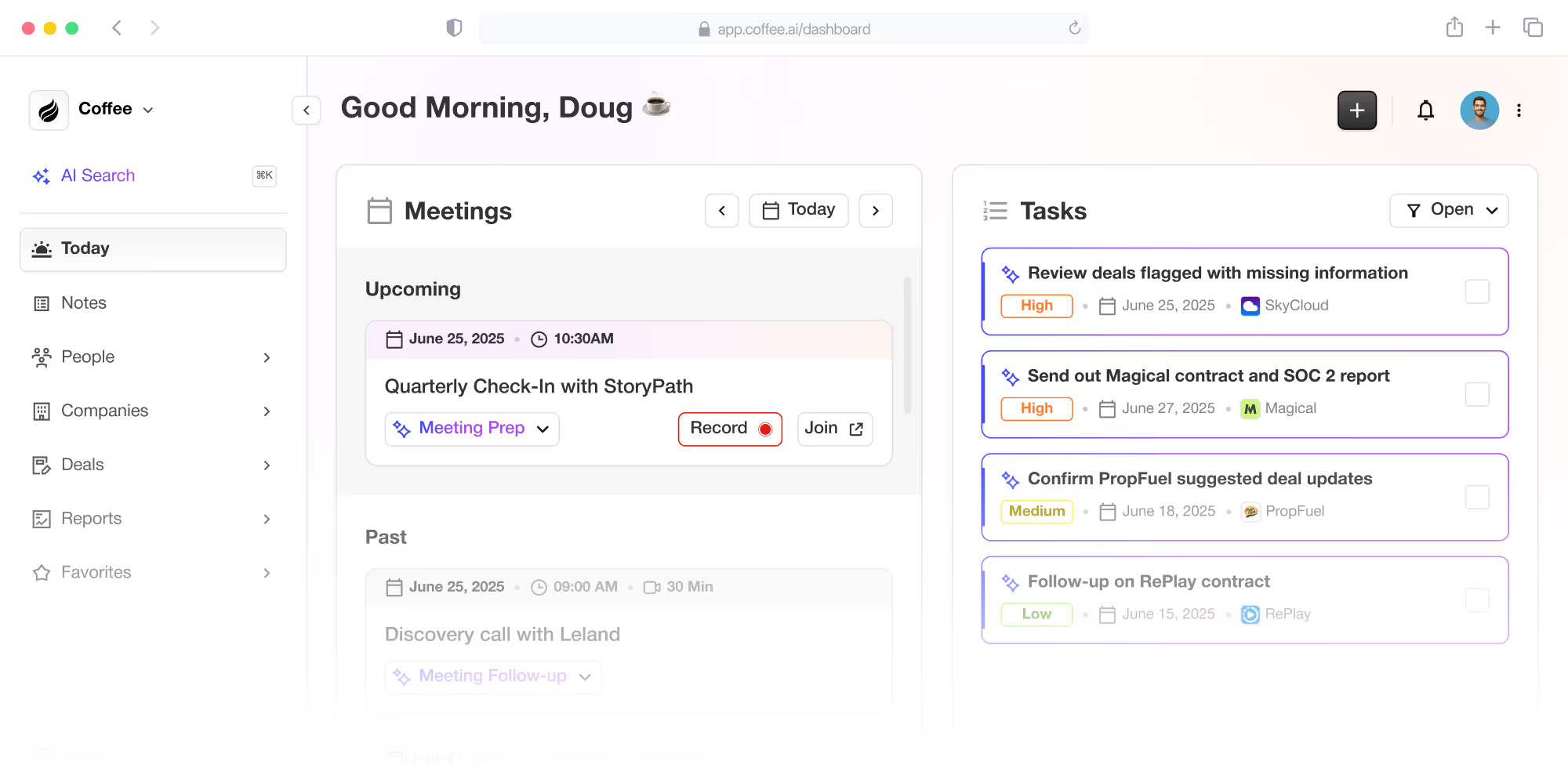
Coffee keeps deals moving by creating tasks based on discussions. This ensures follow-ups don’t slip through the cracks.
Post-meeting, the AI summarizes key points, spots action items, and assigns tasks. Teams often see fewer missed commitments and faster pipeline movement, with progress trackable through Coffee’s analytics.
Tracking Progress with AI CRM Metrics
Using Coffee’s features leads to noticeable gains in sales operations. Its built-in analytics help monitor these changes effectively.
- Adoption rates. Watch daily user engagement and data accuracy. Coffee’s user-friendly design encourages consistent use, and dashboards highlight trends for improvement.
- Pipeline speed. Measure time between stages with tools like ‘Pipeline Compare’ for quick insights into progress.
- Data accuracy. Check contact details and manual edit frequency. Automation reduces errors over time.
- Consistent activity. Track task completion and response speed to ensure uniform follow-up across the team.
Exploring Advanced Options in Coffee
Once familiar with core functions, consider Coffee’s advanced tools for added efficiency, especially for teams seeking a competitive edge.
Through API access, you can integrate Coffee with other systems for custom workflows, enabling detailed briefings or action plans. Pipeline intelligence offers historical data snapshots for week-to-week comparisons, spotting delays or progress easily. Roll out these features gradually, assessing their impact to maintain simplicity and adoption.
Addressing Common Concerns About Coffee’s AI Tools
Impact on Personalization in Sales
Coffee boosts personalization by handling routine tasks, letting reps focus on relationships. Teams often report feeling more prepared, which enhances client interactions rather than diminishing them.
Data Privacy and Security Measures
Coffee adheres to strict standards like SOC 2, Type 2, and GDPR for data protection. Your information isn’t used for AI training, safeguarding confidentiality while delivering intelligent features.
Suitability for Smaller Teams
Coffee’s design prioritizes ease of use, even for small teams with limited tech skills. Basic functions like summaries and automated tasks are straightforward, offering quick benefits after minimal setup.
Comparison to Traditional CRMs
Unlike older systems with fragmented data, Coffee’s unified structure ensures consistent automation across features. This reduces integration struggles, providing smoother operations from summaries to pipeline management.
Adapting to Changing Sales Processes
Coffee’s flexible setup adjusts to evolving needs. You can update configurations as your methodology shifts, maintaining value through business or market changes.
Wrapping Up: Elevate Your Sales with Coffee’s AI Approach
Moving from a conventional CRM to an AI-powered solution like Coffee changes how sales teams function in competitive arenas. By tapping into automation and tailored insights, you can overcome the drawbacks of older tools and build a system that truly fits your workflow.
Teams adopting Coffee often report higher engagement, better data, and faster deal cycles. More notably, the platform grows with your needs, adapting to unique market conditions and customer behaviors. It offers robust capabilities typically reserved for larger enterprises, yet remains accessible for small to mid-sized firms, breaking down barriers to AI use.
Sales success increasingly depends on leveraging AI as a supportive tool rather than wrestling with inefficient systems. Following the steps in this guide can turn your CRM into a vital resource that your team values.
Ready to enhance your sales process with AI? Request access to Coffee now and discover how its features can improve your performance.