
The sales world is undergoing a profound transformation. Artificial intelligence has reshaped how businesses interact with customers, streamline operations, and drive revenue. AI-powered customer relationship management systems, or CRMs, are now central to staying competitive in a crowded market. However, with this technological shift comes a pressing concern: the security of the vast, sensitive data that fuels these systems. For sales leaders, CEOs, and revenue operations professionals, safeguarding data in AI CRM platforms is no longer just a technical issue. It’s a strategic priority that influences compliance, customer trust, and ultimately, the bottom line. Let’s explore the complexities of this evolving landscape, the risks involved, and the solutions that modern enterprises can adopt to thrive securely.
As companies race to adopt AI for sales acceleration, the volume of data—customer interactions, emails, and call transcripts—processed by these systems has grown exponentially. This creates a larger attack surface for cyber threats, while stricter regulations demand tighter controls. Amid this, platforms like Coffee emerge as examples of a broader trend toward AI-first CRMs designed with data protection at their core. This guide unpacks the security challenges of AI in sales and highlights actionable strategies to protect your organization.
Request access to see how Coffee balances AI-driven sales automation with robust data security.
Why Data Security Matters in Today’s AI-Driven Sales Environment
AI adoption in sales is surging, with businesses leveraging it to personalize outreach and optimize workflows. Yet, this reliance on extensive data sets, from structured CRM entries to unstructured meeting notes, heightens the risk of exposure. Unlike traditional CRMs, AI systems process diverse data at scale, introducing unique vulnerabilities that require specialized safeguards.
Regulations like GDPR in Europe and CCPA in California add layers of complexity. Non-compliance can lead to hefty fines and reputational damage. For sales teams, prioritizing data security isn’t just about avoiding risks, it’s about enabling sustainable growth in a regulated world. Understanding these legal frameworks is essential for global operations.
What Are the Specific Threats to Sales Data in AI Systems?
Sales data faces a mix of conventional cyber threats and AI-specific risks. Hackers may target customer information for financial gain, while AI models could inadvertently expose data through improper access or misconfiguration. A breach can disrupt revenue streams and erode client trust, making security a critical factor when choosing a CRM platform.
Vulnerabilities like unsecured APIs or over-permissioned user accounts are common in AI environments. Sales leaders need to address these gaps to protect competitive insights and customer relationships. API risks are a growing concern in connected systems.
Key Concepts for Securing AI CRMs in Sales
Understanding core security principles helps sales leaders navigate AI CRM implementation. Data encryption safeguards information both when stored and during transmission, a necessity for diverse data types in AI systems. Access controls limit visibility to only essential personnel, following the principle of least privilege. Compliance standards, such as SOC 2 Type 2 for service organizations and GDPR for data privacy, provide benchmarks for assessing risk and ensuring protection in cloud-based setups.
Security isn’t just a technical task, it’s a business strategy. Sales, IT, and legal teams must collaborate to build governance models that support AI innovation without compromising safety. This alignment allows companies to adopt advanced tools confidently, knowing their data remains protected.
Request access to explore how Coffee embeds security into its AI-driven sales platform.
What Makes AI CRM Security Different for Sales Teams?
AI in sales CRMs brings unique challenges not fully covered by traditional security measures. Systems can be vulnerable to model exploitation, where attackers manipulate AI outputs. Over-permissioned access might allow unauthorized data exposure, while API integrations risk leaks if not secured. Privacy concerns also arise when handling personal customer information across multiple channels.
Sales leaders must recognize these issues to select platforms and design processes that mitigate risks effectively. Addressing these upfront ensures AI tools enhance performance without creating liabilities.
How to Build a Secure AI CRM Environment for Sales
Creating a secure AI CRM setup requires a multi-layered strategy tailored to sales needs. Consider these practical steps:
- Encrypt all data, whether stored or in transit, to protect against unauthorized access.
- Use granular access controls to restrict data visibility based on user roles.
- Secure API connections to prevent leaks during data exchanges with other tools.
- Vet vendors carefully to ensure their security practices meet your standards.
- Monitor systems continuously for unusual activity that could signal a breach.
- Maintain detailed audit trails to support compliance and track data interactions.
- Train employees on handling data securely to reduce human error.
- Define clear policies for data retention and deletion to manage its lifecycle.
These measures help sales organizations balance AI capabilities with robust protection, fostering trust and operational efficiency.
Coffee: A Leader in AI-First CRM Data Security
As an example of the shift toward AI-first solutions, Coffee stands out by embedding data protection into its platform’s foundation. Following the principle of “Good AI Requires Good Data,” Coffee ensures that its automation features, like contact creation and meeting summaries, operate within strict security boundaries. This approach contrasts with older CRMs retrofitted with AI, which may struggle to address modern threats comprehensively.
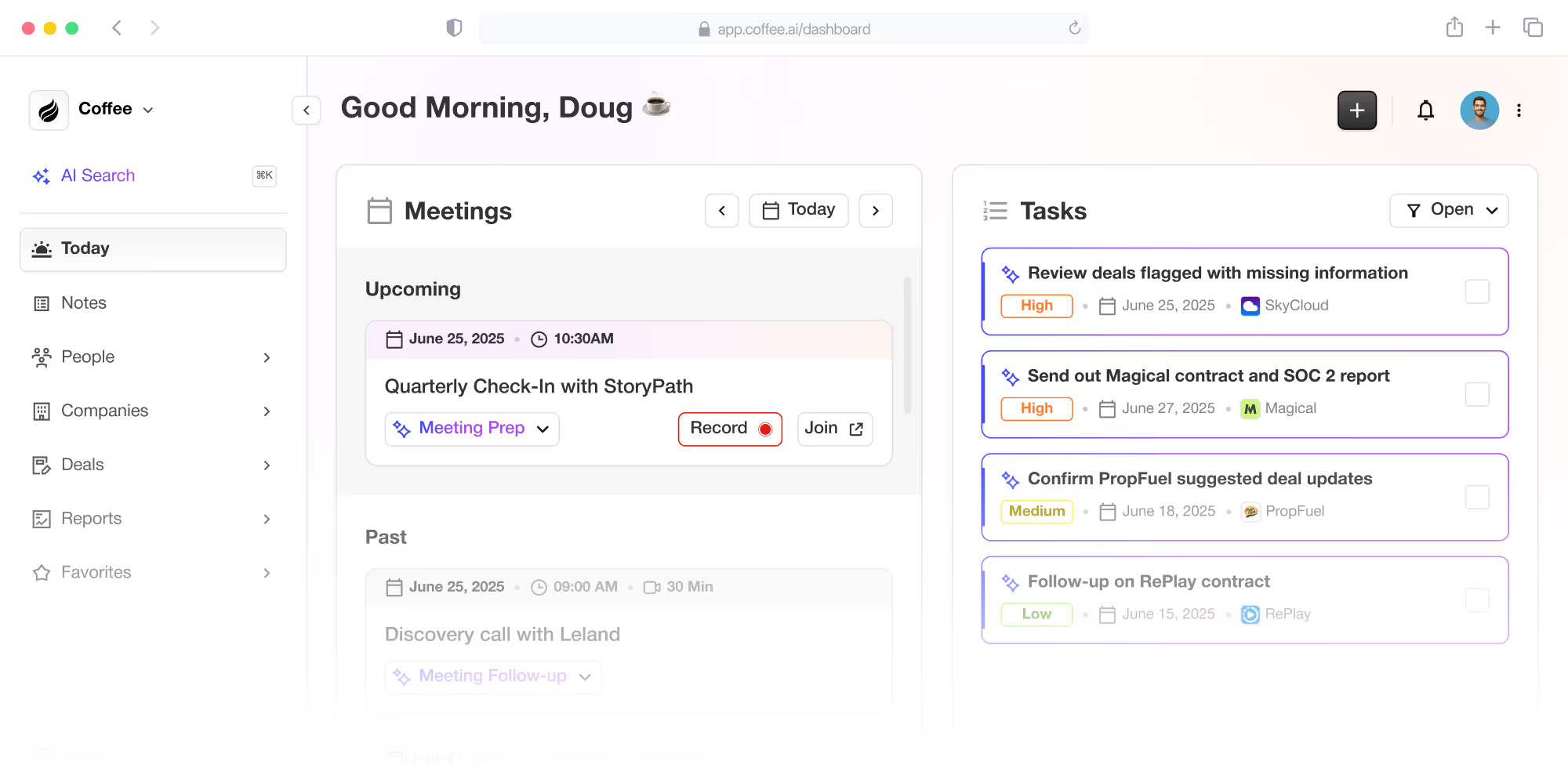
Coffee offers specific tools to enhance secure sales operations. Its automatic data entry pulls information from emails and calendars into contact profiles, using restricted access and licensed data partners to limit exposure. The AI-powered meeting bot records and transcribes calls on platforms like Google Meet or Zoom, with access limited to authorized users only. Additionally, pipeline intelligence features include a data warehouse for historical snapshots, aiding compliance through detailed auditability.
On the compliance front, Coffee holds SOC 2 Type 2 certification, reflecting high standards in security and privacy. It also meets GDPR requirements for handling European customer data, incorporating controls for consent and data rights. Transparent security policies detail how data is managed and how incidents are addressed, aligning with industry expectations. SOC 2 certification is a benchmark for data security.
Request access to learn more about Coffee’s secure AI capabilities for sales teams.
Comparing Coffee to Legacy CRMs: Security in the AI Age
| Aspect | Legacy CRM with Added AI | Coffee AI-First CRM |
|---|---|---|
| System Design | Built for past needs, security often an afterthought | Designed for AI, with security integrated from the start |
| Compliance Support | Struggles to align AI features with standards | Meets SOC 2 Type 2 and GDPR requirements natively |
| Data Tracking | Limited by outdated structures for logging | Includes data warehouse for thorough auditing |
Is Your Organization Ready for AI CRM Security?
Before adopting an AI CRM, evaluate your current setup. Review your technical infrastructure for compatibility with modern security tools. Assess whether your processes align with compliance demands. Engage sales, IT, and legal teams to ensure a unified approach to governance. Key points to consider include whether data access policies are defined, if staff are trained on secure practices, and if activity logs are maintained for transparency.
This self-assessment helps identify gaps and prepares your team for a secure transition to AI-driven sales systems.
Common Mistakes to Avoid in AI CRM Security
Even seasoned organizations can overlook critical security aspects when deploying AI CRMs. Underestimating AI-specific threats can leave systems exposed. Unauthorized third-party integrations often create weak points. Without ongoing monitoring, breaches may go undetected. Failing to vet vendors or embed security across the AI lifecycle can also lead to vulnerabilities. Address these risks with proactive planning, clear guidelines, and regular reviews to keep your data safe.
Answers to Common Questions on AI CRM Data Security
How does Coffee align with regulations like GDPR? Coffee builds GDPR compliance into its system, using encryption, access restrictions, and audit logs to manage customer data responsibly and meet legal obligations.
Is customer data used to train Coffee’s AI, and how is privacy maintained? Coffee upholds strict privacy measures, guided by SOC 2 Type 2 and GDPR standards. Its policies clarify data usage and protection, ensuring customer information remains confidential.
How does security in an AI-first CRM like Coffee differ from legacy systems with AI add-ons? Coffee’s modern design integrates security across all functions, including data auditing and AI access controls. Legacy CRMs, built on older frameworks, often face integration challenges that can compromise protection.
Conclusion: Secure Sales Growth with AI-First Solutions Like Coffee
AI offers immense potential for sales efficiency and customer engagement, but it demands a strong focus on data security. Traditional CRMs retrofitted with AI may not fully address today’s threats, whereas AI-first platforms like Coffee prioritize protection from the ground up. By embedding security into its architecture, Coffee enables enterprises to harness AI confidently for sales growth.
With features supporting automated data entry, meeting summaries, and pipeline analysis, Coffee exemplifies how modern CRMs can deliver value without sacrificing safety or compliance.
Explore how Coffee can strengthen your sales strategy with built-in security. Request access now.