
The market for customer relationship management (CRM) systems has evolved significantly over the past decade, driven by the need for efficiency in sales processes and the integration of artificial intelligence (AI). Small to mid-sized businesses, in particular, face persistent challenges with the rising costs of traditional CRM systems, which often lock users into expensive plans for basic features. At the same time, sales teams lose valuable time on manual tasks, with 71% of sales reps spending excessive time on data entry rather than closing deals. This creates a pressing need for cost-effective, intelligent solutions that prioritize usability and automation. AI-first CRMs have emerged as a response to these challenges, offering a shift toward integrated, affordable tools that can streamline operations. This article outlines eight actionable strategies to help growing businesses select and optimize AI-first CRM systems, focusing on affordability while maximizing return on investment.
1. Opt for Straightforward Seat-Based Pricing to Avoid Cost Surprises
Choosing a CRM with clear per-user pricing is a key step to maintaining budget control. Many traditional systems rely on complicated tiered pricing, leading to unexpected fees for add-ons or additional features. A transparent pricing model lets you predict monthly expenses and plan for growth without financial shocks. Focus on platforms that bundle essential features into a single rate per user.
- Determine the full cost per user, including base fees, integrations, and AI tools.
- Ask for a complete pricing breakdown to uncover potential extra charges.
- Simulate costs for different team sizes, like 5, 10, or 20 users, to gauge scalability.
- Seek discounts for annual commitments during initial negotiations.
Platforms like Coffee stand out here with a simple seat-based pricing structure. You pay a consistent rate per user, with core features included, avoiding the hidden costs common in legacy systems. Request access to learn more about predictable AI-first CRM pricing.
2. Use Free Tiers to Test Functionality Before Committing
Free or freemium plans offered by many CRM providers give you a low-risk way to evaluate a platform. These tiers allow small teams to test real workflows and assess team adoption without upfront costs. Use this period to run actual sales processes with real data, identifying any limitations or friction points.
- Import data from your current tools, like spreadsheets or another CRM.
- Track the time spent on routine tasks, such as adding contacts or updating deals.
- Assess the mobile app for usability, especially for remote sales teams.
- Note any integration needs with your existing software.
- Monitor how often team members log in and engage with the platform.
Be cautious of platforms that restrict critical features to paid plans, limit data exports, or have complex interfaces that demand extensive training. The goal is to confirm that even the free tier supports your basic needs, so upgrades are tied to growth rather than necessity.
3. Evaluate Total Cost of Ownership, Not Just Subscription Fees
Surface-level pricing can be deceptive. True CRM costs include setup, training, integrations, and ongoing support. To avoid budget overruns, calculate a comprehensive cost of ownership by mapping out your sales tech needs, such as email tools, data enrichment, and reporting capabilities.
|
Cost Category |
Legacy CRM Example |
AI-First CRM Example |
|
Base subscription (5 users) |
$500/month |
$300/month |
|
Data enrichment add-on |
$200/month |
Included |
|
AI automation features |
$300/month |
Included |
|
Integration fees |
$150/month |
Minimal via Zapier |
Build a 24-month cost forecast that accounts for:
- Subscription fees as user numbers increase.
- Costs of necessary integrations.
- Setup and training expenses.
- Data migration fees.
- Ongoing support costs.
Ask vendors pointed questions, like how costs change with team growth or which integrations carry extra fees. This upfront clarity helps prevent long-term financial surprises.
4. Select Platforms with Core AI Features to Reduce Extra Expenses
Traditional CRMs often charge separately for AI tools that should be standard. AI-first platforms integrate these capabilities into their base offerings, cutting the need for costly add-ons. Prioritize systems that provide automation as part of the core package.
- Automatic creation of contacts and companies from email or calendar data.
- Transcription and summaries of meetings.
- Drafting of follow-up emails without manual input.
- Insights into pipeline health and deal progress.
Coffee offers a strong example by automatically handling contact enrichment and activity logging from your existing data sources. This eliminates the expense of standalone tools, saving both time and money for smaller teams. Estimate savings by calculating hours saved on manual tasks, typically 8 to 12 per rep weekly, alongside reduced tool subscriptions. Request access to try built-in AI automation without additional costs.
5. Boost Team Adoption to Get Full Value from Each Seat
A CRM only delivers value if your team uses it consistently. Low adoption leads to wasted licenses and reliance on inefficient alternatives like spreadsheets. Choose platforms that emphasize ease of use and direct benefits for sales reps, not just managers.
- Pick systems with strong mobile support for on-the-go teams.
- Focus on tools that auto-capture data from emails, calls, and meetings.
- Ensure the platform offers immediate value to users, like automated insights.
- Roll out gradually, starting with enthusiastic early adopters.
Track metrics like daily active users, time spent in the system, and data completeness. Watch for signs of trouble, such as reps using parallel tools or outdated pipeline info. Adoption improves when reps see tangible benefits, like automated summaries or enriched profiles, making the CRM a tool they want to use.
6. Simplify Your Sales Tools to Cut Overlapping Costs
Many businesses end up with a cluttered mix of sales software, paying for redundant features across CRM, data enrichment, and email automation tools. AI-first platforms often combine these functions, reducing subscription overlap and complexity.
- Inventory all current sales and marketing tools.
- Add up total costs across these subscriptions.
- Spot duplicate features between tools.
- Identify integration pain points.
- Map workflows that rely on multiple systems.
Coffee illustrates this trend well by merging CRM, data enrichment, meeting insights, and pipeline analytics into one platform. This consolidation can lower expenses for growing businesses. Start by replacing the priciest or least-used tool, plan transitions to avoid disruption, and document savings to justify the shift.
7. Secure Annual Contracts with Flexible Growth Terms
Vendors often discount annual subscriptions, but the agreement must support your growth. Aim for contracts with predictable pricing and no penalties for adding users or upgrading features. Avoid terms that lock you into rigid plans or steep price jumps.
- Push for annual discounts, often 15 to 25% off monthly rates.
- Ensure flexibility to add users without extra fees.
- Clarify costs for feature upgrades.
- Confirm data export options and support for transitions.
- Request service level commitments.
Beware of auto-renewals with price increases or high minimum user requirements. Use competitor pricing as leverage, and position your growth plans to show the vendor how their tool supports your success. This partnership approach can yield better terms.
8. Track ROI with Detailed Analytics to Justify Investment
Measuring the return on your CRM investment helps validate costs and uncover areas for improvement. AI-first platforms often provide analytics that connect usage to business results, offering data for informed decisions.
|
Metric |
Baseline (Pre-CRM) |
Target (Post-CRM) |
Measurement Method |
|
Sales cycle length |
45 days |
35 days |
Deal progression tracking |
|
Lead response time |
4 hours |
15 minutes |
Automated activity logging |
|
Rep productivity |
35% selling time |
60% selling time |
Time allocation analysis |
|
Pipeline accuracy |
60% forecast accuracy |
85% forecast accuracy |
AI-powered insights |
Prioritize platforms with robust reporting on pipeline trends, rep performance, conversion rates, and interaction frequency. Coffee excels with features like Pipeline Compare, which automates week-over-week analysis, saving time compared to manual efforts in older systems. Review pipeline data weekly, coach reps monthly, and refine processes quarterly to maximize value. Request access to explore advanced CRM analytics for ROI tracking.
Integrate AI-First CRM Solutions for Streamlined Efficiency
Applying these strategies individually can improve CRM affordability, but the greatest impact comes from platforms that address multiple needs at once. Coffee, as part of the broader trend toward AI-first systems, combines transparent pricing, built-in automation, comprehensive features, and actionable analytics. It serves as a practical example of how modern CRMs can support growing businesses, aligning technology with revenue goals.
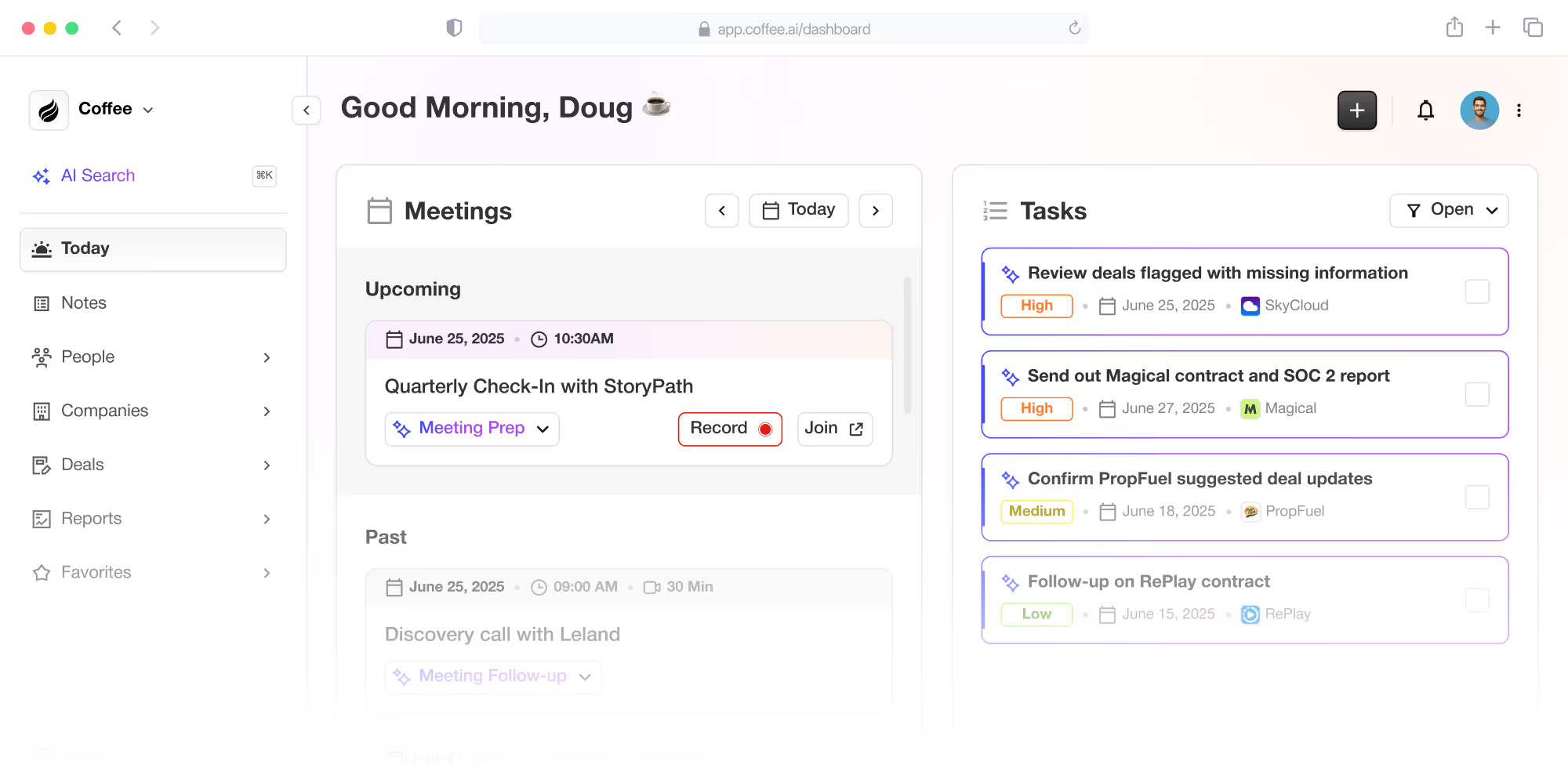
Request access to see how AI-first CRM can enhance your sales operations affordably.
Common Questions About AI-First CRM Affordability
What are typical costs for AI-first CRM among small businesses?
Costs for modern CRM solutions vary depending on features and integrations. AI-first platforms often include automation in their base plans, offering better value than traditional systems. Evaluate total ownership costs, including setup and training, rather than focusing solely on subscription fees.
How can hidden CRM fees be avoided?
Select vendors with clear per-user pricing that covers essential features. Request detailed cost breakdowns for scaling users, storage, API access, and integrations. Ask specific questions about fees for data export, additional users, and feature upgrades during evaluations.
What kind of return can an AI-first CRM provide?
When implemented well, these systems save time and improve sales outcomes through automation. Expect to save 8 to 12 hours per rep weekly on data tasks and streamline pipeline management. Actual returns depend on your team’s size, processes, and chosen platform.
How do AI-first CRMs stack up against traditional ones on cost?
AI-first options often cost less overall by bundling automation and data tools into base plans. This integration reduces the need for separate subscriptions, potentially lowering the total expense while offering broader functionality compared to older platforms.
What should be prioritized in CRM contract discussions?
Aim for annual discounts, flexible user scaling, clear upgrade costs, and data export guarantees. Avoid terms with automatic price hikes or excessive user minimums. Include implementation support and service commitments in negotiations to ensure the contract supports your growth.