
In today’s competitive business landscape, small sales teams face significant challenges in delivering high-quality customer support while managing limited resources. The demand for personalized, efficient service is higher than ever, yet the tools designed for larger enterprises, like HubSpot, often come with steep costs and complex setups that don’t align with smaller budgets or workflows. The market for customer relationship management (CRM) solutions has evolved, with AI-driven platforms emerging as accessible options that prioritize automation and simplicity. These tools aim to level the playing field, enabling smaller teams to meet customer expectations without financial strain. This article explores the broader trends in affordable CRM solutions, outlines seven practical strategies for improving support quality, and highlights specific alternatives, including Coffee, as an example of innovation in this space.
Why Small Sales Teams Face Customer Support Challenges with Tools Like HubSpot
Small sales teams often struggle to provide consistent customer support due to limited staff and budgets. With multiple priorities competing for attention, delivering timely, personalized responses can become difficult.
Key issues include scattered customer data across various tools, manual processes that slow down responses, and the challenge of tracking interaction histories. Sales reps spend about 71% of their time on non-selling tasks, often tied to repetitive data entry or administrative work that could be automated.
HubSpot, while feature-rich, poses hurdles for small teams. Its paid plans can become expensive quickly, and the platform’s complexity may lead to underuse, where teams pay for capabilities they don’t fully adopt. This mismatch results in inefficient workflows and impacts the quality of customer interactions negatively.
Poor support doesn’t just frustrate customers; it raises churn rates, increases costs to acquire new clients, and harms brand reputation over time. For small businesses, where every relationship counts, these effects can stall growth.
7 Practical Strategies and Alternatives to Improve Customer Support
1. Unify Customer Data for Consistent Interactions with AI-Driven CRMs
Having customer data spread across emails, spreadsheets, and notes creates gaps in support quality. Without a complete view, teams struggle to respond accurately, often frustrating customers who must repeat their stories.
A single platform that gathers all customer touchpoints automatically solves this problem. AI-driven CRMs can pull data from emails and calendars to create detailed profiles, ensuring every team member has access to the full history of interactions.
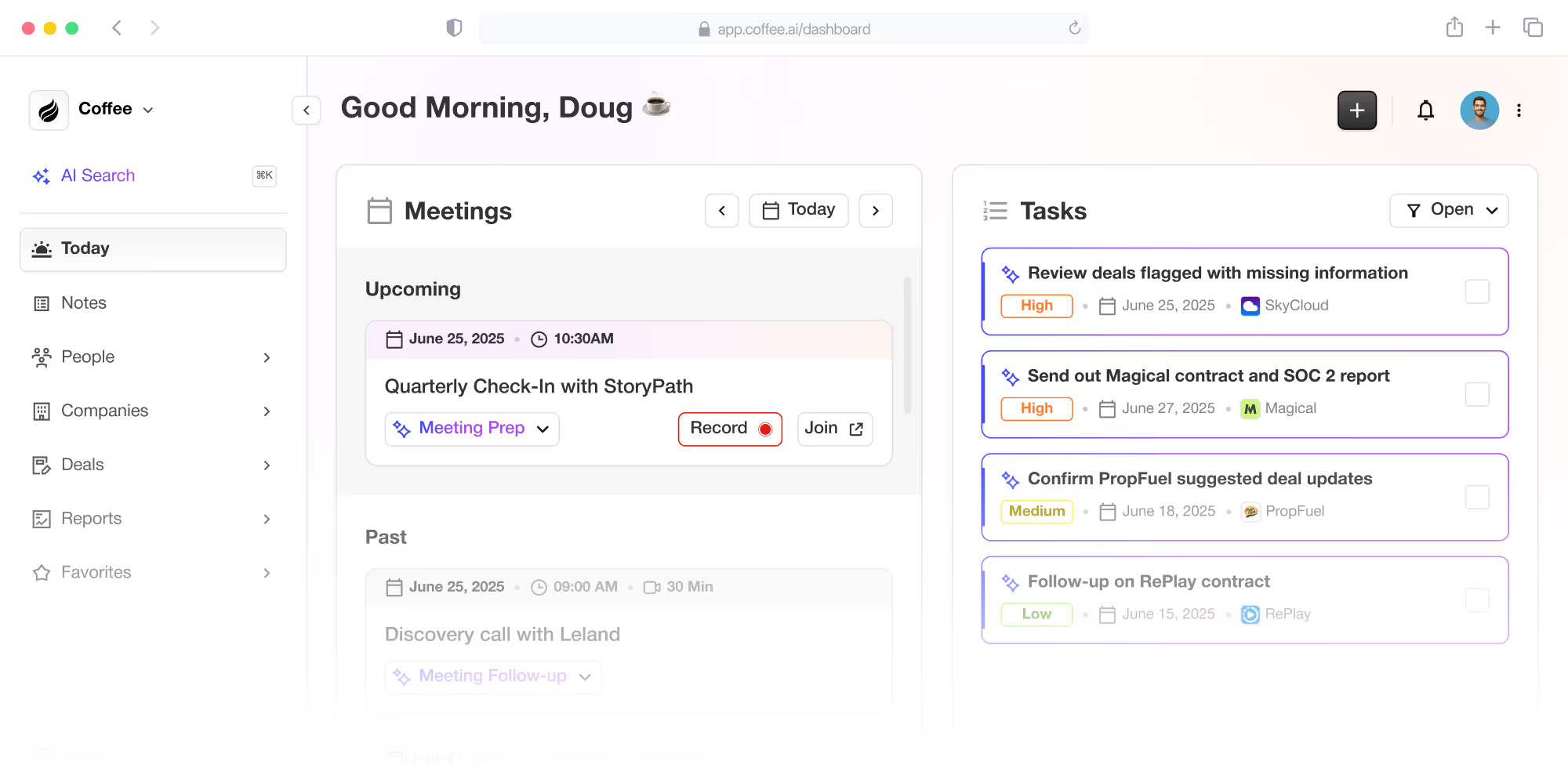
Coffee stands out here by automating contact and activity creation from email and calendar scans. It combines structured data, like contact details, with unstructured content, such as email exchanges, into one hub. This reduces errors and saves time compared to managing multiple tools.
With a unified view, your team can offer tailored support without digging through disconnected systems, making interactions smoother for both staff and customers.
2. Save Time by Automating Routine Tasks and Follow-Ups
Manual tasks like sending follow-up emails or scheduling reminders drain time from small teams, delaying responses and risking missed opportunities. Automating follow-ups and scheduling prevents delays in customer communication, a frequent challenge for teams with limited bandwidth.
Automation enhances efficiency by handling repetitive work, allowing staff to focus on nuanced customer needs. Faster responses and consistent follow-ups improve overall interaction quality.
Coffee offers tools like AI-powered meeting summaries and automated follow-up drafts. After meetings, it identifies action items and prepares emails, ensuring nothing is overlooked while freeing up time for relationship-building.
This shift means less time on notes and more on meaningful conversations, directly boosting support effectiveness and response speed.
3. Anticipate Customer Needs with AI Insights
Waiting for customers to report issues is no longer enough. AI can analyze behavior patterns and flag potential problems, allowing teams to act before dissatisfaction grows. This proactive approach builds trust and reduces complaints.
AI tools can pinpoint ideal outreach moments or stalled deals, making advanced insights accessible to small teams. AI-driven CRMs provide essential features without complex setups or high costs, fitting the needs of smaller operations.
Coffee’s pipeline tracking uses AI to monitor deal progress, alerting teams to delays or opportunities. If a deal stalls, the system highlights it, enabling outreach before issues escalate.
Such foresight helps address concerns early, preventing small hiccups from turning into lost business or formal complaints.
4. Choose Tools with Simple Design for Quick Team Adoption
Complicated software often leads to low usage rates, undermining data quality and support consistency. If team members avoid the system or use it sporadically, customer experiences suffer due to incomplete or outdated information.
Platforms with intuitive designs encourage regular use. Some CRMs offer daily training and tutorials to ease onboarding, while others focus on straightforward interfaces. Tools like Nutshell and Pipedrive provide visual pipelines and drag-and-drop features for simplicity.
Coffee prioritizes ease with an instinctive layout and automated data entry. Teams spend less effort learning the system and more on connecting with clients, ensuring consistent data updates.
A straightforward tool means better adoption, leading to reliable information and stronger customer interactions across the board.
5. Focus on Scalable Solutions with Clear Costs
Small teams need tools that grow alongside them without sudden price jumps or major system changes. Pay-as-you-need models support scaling without overpaying early. Hidden fees or unclear tiers can disrupt budgets unexpectedly.
Predictable pricing helps plan for expansion without financial surprises. Transparent costs avoid the overhead of enterprise-grade platforms, which often burden small budgets.
Coffee uses a seat-based pricing structure without usage caps or tiered limits. This clarity lets teams add users or features as needed, aligning costs with actual growth.
Selecting a CRM with flexible scaling and upfront pricing prevents budget strain, keeping support quality steady during growth phases.
6. Strengthen Team Coordination for Unified Support Delivery
Inconsistent internal communication leads to disjointed customer experiences. If team members can’t share insights or align on responses, customers notice the lack of cohesion, eroding trust.
Effective tools integrate customer data with collaboration features, ensuring shared access to updates and coordinated messaging across touchpoints. This setup keeps everyone on the same page, regardless of who handles an inquiry.
Modern CRMs support this by offering shared views and real-time data updates. Prioritize platforms where team communication flows as easily as customer management does.
Unified internal processes translate to seamless external support, making interactions feel professional and well-organized to customers.
7. Use Customer Feedback to Continuously Refine Support
Improving support quality requires ongoing input from customers to spot trends and gaps. Features like ticketing and feedback collection enable tailored service and adjustments based on real input.
Feedback systems should simplify collection across channels, like email or surveys, and organize data into clear insights. Combining automated tools with regular team reviews helps address recurring issues effectively.
This cycle of collecting input and acting on it ensures support adapts to evolving customer needs, maintaining relevance and satisfaction over time.
Comparing Affordable HubSpot Alternatives for Customer Support
Below is a comparison of key tools to help small teams enhance support quality with budget-friendly options:
|
Feature |
HubSpot (Paid Tier) |
Coffee Standalone CRM |
Freshsales |
|
Automatic Data Entry & Enrichment |
Available in higher tiers with integrations |
Full automation from email/calendar, built-in enrichment |
Basic automation, some manual setup |
|
AI-Powered Meeting Management |
Basic scheduling, advanced in higher plans |
Complete AI for prep, summaries, follow-ups |
Basic scheduling and reminders |
|
Unified Customer View |
Strong structured data, unstructured via integrations |
Seamless structured and unstructured data |
Good structured data focus |
|
Pipeline Intelligence |
Included in Professional tiers and above |
Built-in tracking with historical changes |
Basic tracking and reports |
HubSpot provides extensive features but often at a complexity and cost unsuitable for small teams. Coffee addresses specific pain points with automation and AI, fitting smaller workflows. Freshsales offers a balanced option with core functionalities at a lower barrier to entry.
Common Questions About Customer Support for Small Teams
How Can Small Teams Access Advanced Support Features on a Budget?
Small teams can tap into advanced features by selecting AI-driven CRMs that bundle multiple tools into one platform. Solutions like Coffee combine data enrichment, pipeline tracking, and automation at a lower cost than separate subscriptions. Look for platforms with clear, seat-based pricing and scalable plans to avoid overpaying for unused features.
What Are HubSpot’s Drawbacks for Small Teams in Support Quality?
HubSpot’s pricing can escalate quickly, and its feature set often targets larger organizations, leading to paid-for tools that small teams don’t use. The setup complexity may hinder adoption, reducing efficiency and affecting customer support consistency for smaller groups with limited resources.
Does AI Really Benefit Small Teams in Customer Support?
AI offers significant value to small teams by automating repetitive tasks and providing actionable insights. It handles data organization, meeting notes, and follow-up drafts, enabling personalized support despite limited staff. Platforms tailored for small workflows, like Coffee, deliver these benefits without the complexity of enterprise-focused tools.
How Does Tool Integration Affect Support Quality Compared to Single Platforms?
Using multiple integrated tools can create data silos and inconsistencies, increasing manual work and risking errors in customer interactions. A single AI-driven platform streamlines data flow, reduces training needs, and ensures uniform experiences, ultimately enhancing support quality for small teams.
Which Metrics Track Support Quality Improvements for Small Teams?
Focus on metrics like response times, first-contact resolution rates, customer satisfaction scores, and retention rates to gauge customer experience. Internally, monitor time on administrative tasks, data accuracy, tool adoption, and proactive outreach frequency. These indicators help measure both support impact and team efficiency.
Final Thoughts on Enhancing Support with Cost-Effective Tools
High-quality customer support is within reach for small sales teams and critical for long-term success. By applying these seven strategies and adopting AI-driven, budget-friendly CRMs, your team can match the service levels of larger competitors while keeping costs and operations manageable.
The focus should be on automation over manual effort, unified platforms over fragmented tools, and solutions built for small-scale needs over enterprise complexity. Coffee exemplifies this trend, showing how targeted AI capabilities can empower smaller teams.
Customer support goes beyond solving problems; it’s about fostering connections that turn clients into promoters. The right tools and approaches can shift support from a burden to a driver of loyalty and growth.
Interested in boosting your customer support with an AI-first solution? Request access to explore Coffee’s impact on your team’s performance and see how small teams are achieving big results with streamlined technology.