
In today’s competitive sales landscape, Customer Relationship Management (CRM) tools like HubSpot are essential for driving efficiency and maintaining pipeline visibility. Yet, many sales teams struggle with low adoption rates, often due to usability challenges, manual data burdens, and a lack of immediate value for reps. This issue is not isolated; industry data shows that consistent CRM usage across sectors hovers around just 26%, reflecting a widespread gap between investment and utilization. Poor engagement leads to incomplete data, missed opportunities, and ultimately, weaker sales outcomes.
The market for CRM solutions has evolved rapidly, with platforms like HubSpot, Salesforce, and others expanding their capabilities to meet diverse business needs. However, the complexity of these tools can alienate users if not paired with effective onboarding and support. Balancing functionality with simplicity remains a key challenge for sales leaders and Revenue Operations (RevOps) professionals. As organizations seek to maximize their CRM investments, a growing trend toward intelligent automation offers a path to streamline workflows and enhance user experience.
This guide focuses on actionable strategies to improve HubSpot adoption among sales reps, ensuring better data quality and higher efficiency. Tools like Coffee, an AI-first CRM companion app, exemplify how automation can address friction points, though they are part of a broader movement to make CRMs more user-friendly. By following the steps outlined here, sales leaders can turn HubSpot into a valuable asset rather than a source of frustration for their teams.
Uncovering Why Low HubSpot Adoption Impacts Sales Performance
Many sales reps spend more time updating HubSpot than engaging with prospects, creating a cycle of disengagement. Low adoption directly affects pipeline accuracy, data reliability, and team productivity. When reps avoid using the CRM, critical information gets scattered across emails or personal notes, leading to missed follow-ups and inconsistent processes.
For sales leaders and RevOps professionals using HubSpot, addressing this issue is essential to maximize the platform’s value. This guide assumes you have admin access to your HubSpot instance and a basic grasp of your team’s workflows. Implementing these strategies can significantly enhance HubSpot’s role as a sales enablement tool, positively impacting revenue growth. Plan to dedicate 2-3 hours to assess and apply these recommendations.
To explore how automation can support your efforts, request access to Coffee’s Companion App for streamlined HubSpot integration.
Step 1: Pinpoint Barriers to HubSpot Usability and Adoption
Understanding why your sales team struggles with HubSpot is the first step to improving engagement. A focused audit can reveal specific pain points, helping you address issues that sap time and motivation.
Map Out Daily Workflows to Spot Time-Consuming Tasks
Observe your sales reps for a day or have them track their HubSpot interactions by the hour. Pay attention to repetitive tasks like entering contact details, switching between screens, or dealing with incomplete records. Common delays often occur during post-meeting data entry, transferring email content into deals, or navigating multiple HubSpot sections for customer history.
Tip: Measure the exact time spent on HubSpot tasks compared to active selling. This data provides a baseline to evaluate progress after making changes.
Gather Honest Feedback from Your Sales Team
Use an anonymous survey to collect specific input from reps about their HubSpot challenges. Ask targeted questions like, “Which tasks take up the most time?” or “What information is hardest to access?” Also, identify moments when they skip using HubSpot entirely.
Note: Avoid brushing off feedback as mere reluctance to adapt. If several reps highlight the same issue, it likely points to a structural problem that needs a solution.
Evaluate the Quality and Gaps in HubSpot Data
Generate reports to check the completeness of contact details, accuracy of deal stages, and frequency of activity updates. Look for fields often left blank or deals missing documentation. These gaps show where manual input falls short and where automation could make a difference.
Goal: Target fields with completion rates below 70% as priority areas for improvement. Monitor metrics like unlogged emails, outdated deal statuses, and sparse contact records.
Step 2: Simplify HubSpot Workflows with Targeted Automation
Easing the burden of manual tasks is a proven way to boost HubSpot adoption. Automation can shift the platform’s perception from a tedious chore to a practical tool, encouraging reps to engage more consistently.
Eliminate Manual Data Entry for Contacts and Companies
Creating contact and company records by hand after every interaction eats into selling time. Without automation, reps often spend unnecessary effort on basic data input, detracting from client-focused activities.
Coffee’s Companion App connects with HubSpot to automatically generate and update contact and company information from emails and calendars. This cuts down on repetitive data entry, allowing reps to prioritize building relationships over managing records.
Automatically Record Sales Activities for Accuracy
When sales activities like calls or emails aren’t logged, customer histories become fragmented, reducing the effectiveness of future outreach. Manual tracking often leads to forgotten updates and outdated information.
Coffee ensures HubSpot stays current by auto-logging activities such as the last interaction and upcoming tasks directly from email and calendar data. This reliability makes HubSpot a more trusted resource for reps during client engagements.
Enrich Data Automatically for Deeper Customer Insights
Incomplete records hinder personalized outreach, forcing reps to research details like job titles or company updates outside HubSpot. This extra step wastes time and often results in generic communication.
Coffee enhances HubSpot profiles by pulling in details like job titles, company size, funding updates, and LinkedIn information. With richer data readily available, reps can craft tailored messages without leaving the platform.
Tip: Coffee prioritizes accurate data from primary sources like email content, improving the quality of insights and fostering greater trust in HubSpot among users.
To see how these automation features can save your team time, request access to Coffee’s Companion App and enhance your HubSpot experience.
Step 3:Equip Reps with AI-Driven Tools for Daily Productivity
Beyond reducing manual work, making HubSpot a proactive resource for reps can solidify adoption. AI tools can deliver insights and handle routine tasks, positioning the CRM as a helpful partner in their day-to-day efforts.
Streamline Meeting Prep and Follow-Up Tasks
Preparing for client calls and drafting follow-ups can consume valuable time if reps must dig through scattered records. Delays in capturing meeting outcomes also risk losing critical details.
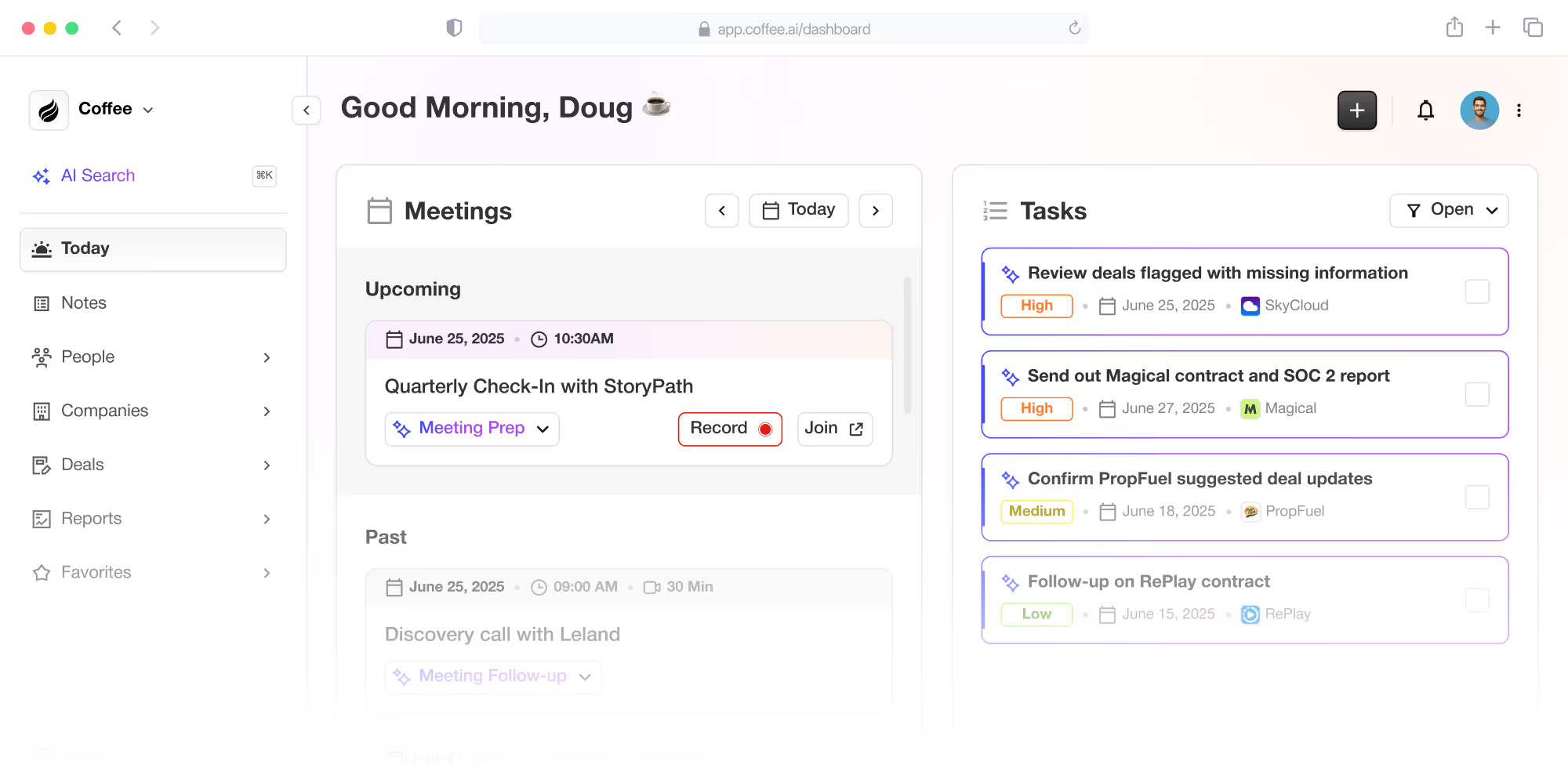
Coffee supports reps by offering a “Today” page with summaries of prior interactions for each call, alongside post-meeting recaps and draft follow-up emails tied to HubSpot. This reduces administrative workload and adds practical value to using the CRM.
Enhance Pipeline Oversight with Timely Data
Reviewing pipeline trends can be labor-intensive if data isn’t organized for quick analysis. Without clear visibility into deal progress, managers may overlook stalled opportunities or emerging patterns.
Coffee’s “Pipeline Compare” feature tracks week-to-week changes in deal status, new opportunities, and delays, syncing with HubSpot for real-time updates. This simplifies pipeline management, freeing managers to focus on strategy over data collection.
Goal: Strive for more efficient pipeline reviews with current insights. Easier analysis supports coaching and decision-making over manual reporting tasks.
Step 4: Build Lasting Adoption with Training and Metrics
Automation alone won’t sustain HubSpot usage without complementary efforts. Pair technology upgrades with focused training, ongoing assistance, and clear metrics to cement long-term behavior shifts among your team.
Offer Practical Training on New Automated Features
Don’t expect reps to figure out new tools independently. Conduct training sessions that show how automation saves time and improves outcomes, using real examples of before-and-after workflows.
Concentrate on areas identified as major hurdles in your audit. If manual contact entry was a frequent complaint, thoroughly explain how automation handles this and what reps should do to benefit from it.
Tip: If usage lags, reinforce the value of tools like Coffee by highlighting direct time savings. Low adoption might reflect a lack of awareness about benefits rather than resistance to change.
Measure Engagement with Meaningful Usage Data
Simple login counts don’t reveal if HubSpot is truly useful to your team. Instead, track indicators of active involvement, such as data field completion, time spent in the platform, feature usage rates, and sales improvements.
Focus on metrics like updated contact details, accurate deal stages, and logged activities. Check if reps use HubSpot for call prep or still turn to external sources. Industry benchmarks note an average sales close rate of 29% and win rate of 21%, offering a comparison point for progress.
Goal: Aim for higher completion rates in critical data fields and fewer manual tasks. Look for faster deal cycles tied to better HubSpot engagement.
Advance with Additional Automation and Features
After mastering basic automation, explore further HubSpot capabilities for added value. Set up custom workflows or lead scoring with improved data, and consider integrations that enhance your setup.
Coffee’s List Builder feature aids targeted prospecting, feeding enriched data into HubSpot for a smooth process from lead identification to deal closure. This ensures consistency across all client interactions.
To apply these adoption strategies effectively, request access to Coffee’s Companion App and leverage AI-driven automation for HubSpot.
Comparing HubSpot Workflows: With and Without Coffee’s Companion App
|
Feature/Benefit |
Standard HubSpot (Without Companion) |
HubSpot with Coffee |
|
Data Entry Workload |
Often manual, requiring significant rep effort if not optimized |
Automatic contact and activity updates from email and calendar |
|
Data Accuracy and Consistency |
Prone to gaps or errors without automated support |
Enhanced and updated from reliable primary sources |
|
Rep Time Management |
Heavy focus on admin tasks if processes aren’t streamlined |
More time for selling with reduced administrative load |
|
Meeting Readiness |
May require manual research across tools and records |
Automated briefings summarizing prior client interactions |
|
Post-Meeting Follow-Ups |
Often involves manual notes and email drafting |
AI-generated summaries and follow-up drafts linked to HubSpot |
|
Pipeline Monitoring |
Can be static, needing manual updates for trend analysis |
Dynamic week-to-week pipeline comparison tool |
|
Tool Stack Complexity |
May require multiple tools for full functionality |
Unified features, reducing the need for additional tools |
|
Rep Perception of CRM |
Often seen as a task-heavy obligation |
Viewed as a supportive tool enhancing daily work |
Common Questions About Improving HubSpot Adoption
What Drives Low HubSpot Adoption Among Sales Teams?
Many reps find HubSpot complex or time-intensive due to manual processes, especially if they don’t see direct benefits to their daily tasks. Without streamlined workflows, tasks like contact entry or activity tracking can discourage consistent use. Coffee’s Companion App tackles these hurdles by automating routine work and providing useful insights, making HubSpot easier to incorporate into daily routines.
How Does Better HubSpot Usability Affect Sales Outcomes?
When HubSpot is user-friendly, data quality improves, and reps gain efficiency, freeing up time for client interactions. Accurate, current information enables more tailored outreach, while automated tracking reduces the risk of missed opportunities, allowing focus on high-priority leads.
Can Tool Integrations with HubSpot Boost Adoption Rates?
Yes, if the integrations simplify rather than complicate workflows. Coffee’s Companion App acts as a supportive layer for HubSpot, automating key tasks and reducing the need for multiple standalone tools, which can improve overall user experience and engagement.
Which Metrics Best Reflect HubSpot Adoption Progress?
Look beyond login counts to assess true engagement. Monitor completion rates for essential data fields like contacts and deal stages, track reliance on HubSpot for call preparation, and evaluate pipeline speed and rep feedback on the platform’s usefulness.
How Soon Can Teams Expect Adoption Improvements with Automation?
Initial improvements often appear within weeks of adopting automation, with deeper changes stabilizing over a couple of months. Factors like team size, workflow complexity, and training quality influence the timeline. Early benefits typically include time saved on routine tasks, while consistent usage develops more gradually.
Conclusion: Make HubSpot a Core Strength for Your Sales Team
Low adoption of HubSpot is a frequent obstacle that reduces team efficiency, but it’s a problem with clear solutions. Strategic workflow improvements and intelligent automation can reshape how reps interact with the platform, turning it into a trusted resource.
As part of the broader trend toward CRM optimization, Coffee’s Companion App integrates with HubSpot to handle data entry, enrich profiles, and deliver actionable insights. By minimizing administrative tasks, Coffee helps improve the day-to-day experience for reps, encouraging consistent use. This reflects a wider industry shift toward tools that prioritize usability alongside functionality.
Changing your team’s relationship with HubSpot starts with practical steps. When the CRM offers real value over obligation, adoption naturally follows. To take the next step, request access to Coffee’s Companion App and discover how AI automation can support your HubSpot adoption goals.